
The best low-light houseplants, and why they can take it
A tropical forest floor and the middle of an ordinary room can receive similar light. The plants below come from that kind of shade and can live with it indoors.
Only about one to two per cent of the light that reaches a tropical forest canopy gets to the ground. Full sun is often around a hundred thousand lux, so a forest floor may receive one to two thousand lux. A spot a couple of metres inside an ordinary room can be in the same range.
That does not mean every dim corner is bright enough for a plant. Many rooms have places darker than a forest floor. Before you choose a plant, check how much light the corner receives.
Measuring the corner takes two minutes
Your eyes are poor light meters. Human vision adapts across a huge range of brightness, so a room at two hundred lux and a pavement at ten thousand lux can both look usable. A plant responds to the difference.
Lay a sheet of white paper where the pot will stand. Hold your hand thirty centimetres above it in the middle of the day and look at the shadow. A sharp shadow with separate fingers means bright light. A soft shadow you can still read as a hand means medium light. No clear shadow means low light, so choose from the first tier below.
For a number, use the ambient light sensor in your phone with a meter app. Phone readings vary, so compare two places rather than trusting one absolute value. Take one reading against the window glass and one where the plant will stand. Use the second reading as a fraction of the first. Against the glass on a clear day you may see five to twenty thousand lux. A metre back can halve that. The middle of a room lit by one window may sit around two to five hundred lux.
The number depends on how much open sky the plant can receive light from. A sill has a wide view of the sky. Three metres back, the window is a much smaller opening. A tree or building opposite blocks more light. A net curtain can reduce light by about a third. A hedge that grows over several years can turn a usable corner into a dark one.
Which window is dark depends on where you live
North of the equator, north-facing windows are usually the dim, even ones. South of the equator, south-facing windows have the same role. In Auckland, Cape Town or Buenos Aires, shade-tolerant plants usually belong in a south-facing room. Near the equator, north and south windows are more even, while east and west windows bring the stronger direct sun.
Latitude changes day length. At around 55 degrees, midwinter has roughly seven hours of daylight and the sun stays low. A sill that works in July can be too dark in January. Near the equator, day length changes much less through the year. Plants respond to total daily light, so twelve hours of moderate light can be better than two bright hours followed by a dark afternoon.
The list
Every plant below has a full care guide on this site, linked from its name.
Tier one, deep shade
These plants tolerate a corner where you would switch on a lamp to read. Expect slow growth.
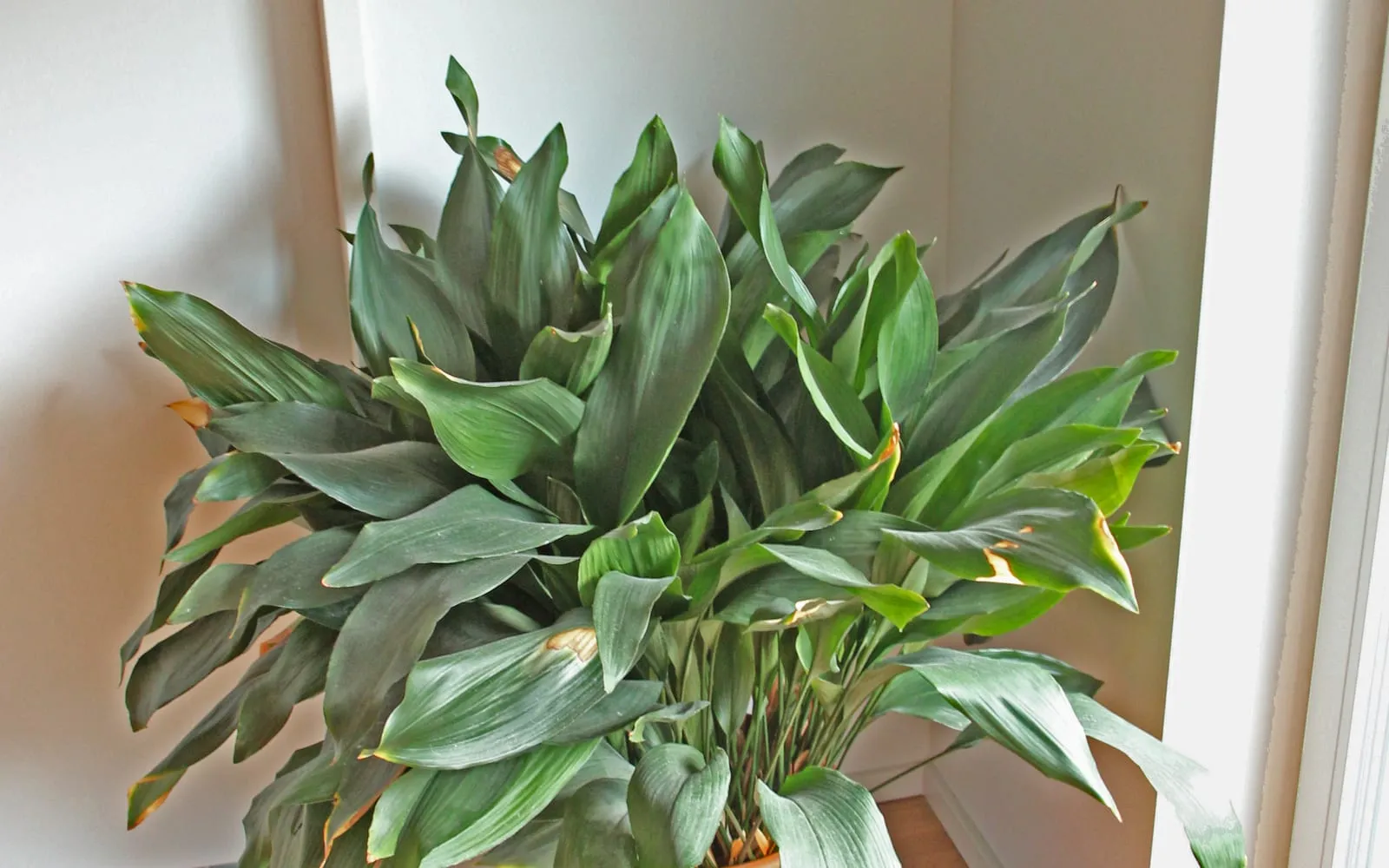
Cast iron plant, Aspidistra elatior. This is the strongest low-light plant here. It earned its common name in Victorian rooms lit by gas and thick with coal smoke. Its leaves are long-lived and its respiration is slow. It is non-toxic, content in dry room air, and usually grows between 10 and 21 deg C. It can survive brief spells near freezing. The trade-off is slow growth, often only two or three leaves a year, so buy it at the size you want.
ZZ plant, Zamioculcas zamiifolia. Thick rhizomes store water and starch, which helps the plant survive dark months and missed watering. It is glossy, upright, mildly toxic and tolerant of dry air. Overwatering kills more ZZ plants than low light does.
Snake plant, Dracaena trifasciata. This has the widest temperature range here, from about 10 to 35 deg C, and it tolerates dry air well. It is mildly toxic. It grows in low light or on a sunny sill. In a cold dark corner, water it only occasionally through winter.
Chinese evergreen, Aglaonema commutatum. Choose this when you want patterned leaves rather than plain green. Dark green and lightly marked cultivars cope best with low light. Pink and heavily variegated forms need brighter conditions. It is moderately toxic, should stay above 12 deg C and often struggles in dry winter air. Aglaonema modestum is the older, plainer and tougher species.
Devil’s ivy, Epipremnum aureum. This is the reliable trailing aroid for a dim shelf. The plain green form is best for low light. Gold and marbled forms need brighter conditions to keep their markings. It is moderately toxic, tolerates missed watering and grows quickly enough to cover a shelf in one season.
Parlour palm, Chamaedorea elegans. This small palm comes from the understorey of Mexican and Guatemalan rainforest. It tolerates deep shade, stays under a metre for years and is non-toxic. Dry air browns the tips. Spider mite is the main pest to watch for.
Lady palm, Rhapis excelsa. This clumping fan palm is slow, long-lived and tolerant of cool rooms. It is one of the most shade-tolerant palms in cultivation. It is also one of the most expensive plants on this list because saleable plants take years to grow.
Satin pothos, Scindapsus pictus. This has thicker leaves and slower growth than devil’s ivy. The silver markings hold in lower light than many variegated epipremnums manage. It tolerates a darker corner than the plant it is often mistaken for.
Tier two, low but not dark
These plants suit a spot a couple of metres from a window, or a brighter place near a dim window.
Heartleaf philodendron, Philodendron hederaceum. This is softer and faster than devil’s ivy and almost as tolerant of shade. It is mildly toxic and prefers 18 to 27 deg C. Leaves grow larger when humidity is above 60 per cent. Labels often use the older name Philodendron scandens or the common name sweetheart plant.
Peace lily, Spathiphyllum wallisii. It keeps its foliage in shade but usually stops flowering. Flowers need more energy than leaves, and low light rarely supplies enough. It is mildly toxic. Its sudden wilt is a useful watering signal, but repeated collapse damages the roots.
Kentia palm, Howea forsteriana. This palm is endemic to Lord Howe Island in the Tasman Sea. It became a classic hotel and parlour palm because it tolerates low indoor light. It is non-toxic, which makes it a good large specimen for a room with a cat. Keep it above 10 deg C. Dry air browns the tips.
Corn plant, Dracaena fragrans. This is an upright plant with a woody stem and arching strap leaves. It tolerates moderate shade and can live for decades indoors. It is moderately toxic. Fluoride and salts in tap water can cause brown tips.
Dragon tree, Dracaena marginata. This gives height in a narrow space, with thin upright leaves and a spare shape. It is moderately toxic and tolerates medium light. In low light, growth is slow.
Lucky bamboo, Dracaena sanderiana. This is a dracaena, not a bamboo. It tolerates low light well, but hard tap water can cause brown tips. Fluoride and chlorine are common causes.
Arrowhead plant, Syngonium auritum. This is another climbing aroid with a juvenile phase adapted to forest-floor shade. It is moderately toxic. It starts as a neat mound and later climbs, so give it a pole or cut it back. Syngonium podophyllum is the species usually sold under the name.
Spider plant, Chlorophytum comosum. This is non-toxic, happy at 10 to 30 deg C and tolerant of dry air. It also produces plantlets on long stems. Variegation dulls in deep shade, and hard water can brown the tips.
Dumb cane, Dieffenbachia seguine. This gives large tropical leaves on a modest light budget. It is severely toxic, and the sap can cause painful swelling because it contains calcium oxalate raphides. Avoid it in a house with a toddler or a pet that chews plants.
Dwarf umbrella tree, Schefflera arboricola. This is a tough shrubby plant for medium light. It keeps its shape well and takes hard pruning. It is useful when you want to fill a dim floor space with a bushy plant.
Japanese aralia, Fatsia japonica. This has large glossy palmate leaves and suits cool, dim rooms. In mild climates it also grows outdoors in dry shade. It can tolerate an unheated hallway or porch better than most tropical houseplants.
Peperomia, Peperomia obtusifolia, with P. caperata and P. argyreia alongside it. These are small, thick-leaved tropical understorey plants. They are non-toxic and suit medium light on a shelf. Their thicker leaves let them tolerate dry air better than many forest plants.
Aluminium plant, Pilea cadierei. The silver-splashed leaves keep their markings in moderate shade. It is a better choice for a dim room than the more fashionable Pilea peperomioides.
Creeping fig, Ficus pumila. This is the ficus for lower light, with small neat leaves and a climbing or trailing habit. It needs steady moisture and suffers quickly if it dries out.
Ivy, Hedera helix. Indoors it tolerates low light and cool rooms, and it benefits from a summer outdoors. Check its legal and invasive status where you live, because it is banned from sale in Oregon and listed on New Zealand’s National Pest Plant Accord.
Spotted laurel, Aucuba japonica. This is mostly an outdoor shrub for dry shade, but it also works as a tub plant for a cool dark basement area or a north-facing doorway in the northern hemisphere.
Tier three, low light and damp air
These plants tolerate shade but need more humidity than an ordinary heated room usually provides. A dim bathroom or a shaded kitchen is a better place for them than a dry hallway.
Bird’s nest fern, Asplenium nidus. This is non-toxic and suits medium indirect light or light shade. Keep it out of direct sun, above 13 deg C and in high humidity. Its undivided fronds collect less dust than many divided fern fronds.
Boston fern, Nephrolepis exaltata. This non-toxic fern tolerates medium and low light, but it needs humidity above 50 per cent and preferably above 60. In a dim living room with a radiator beneath it, dry air is usually the reason the fronds crisp from the tips.
Maidenhair fern, Adiantum raddianum. This is one of the most beautiful ferns here and one of the least forgiving. It wants around 60 per cent humidity and 16 to 24 deg C. One dry afternoon can damage a whole flush of fronds.
Nerve plant, Fittonia albivenis. This non-toxic plant tolerates low to medium indirect light and should stay out of direct sun. It is one of the few low-light plants with strong leaf markings. Very high humidity is the difficult part, so it is often better in a terrarium than on an open shelf.
Prayer plant, Maranta leuconeura. Light shade suits it, and direct sun bleaches the markings. It is non-toxic and wants about 60 per cent humidity. The leaves fold at night as part of a circadian rhythm. Ctenanthe burle-marxii is a tougher relative.
Blue star fern, Phlebodium aureum. This fern has blue-grey lobed fronds on a furry creeping rhizome. It is epiphytic in the wild and more drought-tolerant than most ferns here. It is a good first fern if maidenhair has been too demanding.
Button fern, Pellaea rotundifolia. This New Zealand fern has small round leathery leaflets. It tolerates drier air than many ferns in this tier.
Rabbit’s foot fern, Davallia fejeensis, and hare’s foot fern, Davallia canariensis. Both have furry surface rhizomes that creep over the pot rim, with fine lacy fronds above. They tolerate ordinary room humidity better than many ferns.
Holly fern, Cyrtomium falcatum. This has stiff dark glossy pinnae and does not look like a typical houseplant fern. It is one of the best ferns here for a cold or draughty room.
Cretan brake, Pteris cretica. This variable fern is often variegated and fairly undemanding. It is often the fern that lasts longest in a mixed houseplant bowl.
Hart’s tongue fern, Asplenium scolopendrium. This has undivided strap fronds and is hardy outdoors in deep shade in temperate gardens. Indoors it suits a cool dim room.
Spikemoss, Selaginella kraussiana. This has low creeping fronds and intense green colour. It needs constant humidity and shade, which makes it better for terrariums and bottle gardens than for dry shelves.
Mind your own business, Soleirolia soleirolii. This makes a carpet of tiny leaves for a shaded pot or the surface of a larger container. It can become weedy if it escapes into a mild garden.
Rex begonia, Begonia rex. This is grown for its leaf colour and pattern. It tolerates shade but looks better with humidity above ordinary dry room levels.
African violet, Streptocarpus ionanthus. This is one of the few plants that can flower in a north-facing room north of the equator, or a south-facing one below the equator. Water from below and keep it off cold windowsills in winter.
Why a leaf can live on one per cent of full sun
A leaf uses sugar to stay alive while it makes new sugar from light. The light level where those two processes balance is the light compensation point. Below that point, the plant uses stored reserves faster than it can replace them.
Shade species have a low compensation point. They reach it in several ways, and those differences explain how each plant behaves in a room.
Thin leaves with slow running costs. A shade leaf is thinner and broader than a sun leaf of the same species, so it spreads more area from the same amount of dry matter. It also carries more chlorophyll for its weight and a higher share of chlorophyll b. That helps it use the wavelengths left after canopy leaves have absorbed much of the red and blue light. The leaf also respires slowly, so it costs less to maintain. Cast iron plant, aglaonemas and shade palms follow this pattern.
Storage. A ZZ plant stores water and starch in underground rhizomes and swollen petiole bases. Aspidistra rhizomes also store reserves. Storage helps a plant survive dark periods and missed watering. It does not make the plant grow fast. It also means wet compost can be dangerous, because stored organs rot when they stay wet for too long.
Succulence and CAM photosynthesis. A snake plant uses CAM photosynthesis, opening its stomata at night to conserve water. That adaptation comes from seasonally dry West African bush, and it has an energy cost. In a dark room, the plant is surviving rather than growing strongly. It may put out only a few leaves a year.
A juvenile climbing phase. The trailing aroids are hemiepiphytes. They germinate in deep shade on the forest floor, find a trunk, climb it and then make larger adult leaves. Seedlings of some Monstera species grow towards darkness because, in a forest, a dark shape may be a tree trunk. Devil’s ivy, philodendron, syngonium and satin pothos are all sold in the juvenile phase that tolerates gloom.
Ferns and mosses are different again. Their fronds and cuticles are thin, so they lose water quickly. That is why many of them need damp air as well as low light.
Forest-floor light is not always steady. Sunflecks, the brief shafts of direct sun that move across the ground as the canopy shifts, can supply a large share of a shade plant’s daily carbon. A short stripe of afternoon sun across the floor can help more than it appears to.
Dry corner or damp corner
Light is only the first check. Humidity decides which low-light plants will still look good after a few months.
A dark hallway with central heating is a dry corner. Cast iron plant, ZZ plant, snake plant, devil’s ivy, spider plant, peperomias and the palms tolerate ordinary room air. A dim bathroom or shaded kitchen is a damp corner. Ferns, nerve plant, prayer plant and spikemoss need that extra humidity.
This is why maidenhair fern often fails on a dark landing. The light may be adequate, but the air is too dry.
Feeding should follow growth rather than the calendar alone. A plant growing slowly in low light needs little fertiliser. A quarter-strength balanced feed once a month through the growing season is enough for most plants in a dim corner. Do not feed through winter. Use a pot only slightly larger than the roots, and add grit or bark to the compost. A large pot of dense compost can stay wet for weeks in low light.
Winter, and what passes for dormancy
Most tropical foliage plants in this list do not have true dormancy like a tulip or apple tree. They do not need winter chill. In temperate rooms, they slow down because autumn and winter bring much less light.
The hardy plants behave differently outdoors. Cast iron plant grows outside in shade through USDA zone 7. Hart’s tongue fern, Japanese aralia and spotted laurel are also hardy in suitable temperate gardens. Outdoors, those plants stop for a real winter. Indoors, they slow with the rest of the list.
Change the care when the light drops. From mid-autumn to late winter, water much less, stop feeding, avoid repotting and move plants nearer the window if you can. A snake plant or ZZ plant in a cool dim room may need water only once every six or eight weeks in midwinter. Many houseplants die in January and February because they receive the same watering routine they had in summer.
Moving them into more light
Outdoor shade in summer is much brighter than indoor bright indirect light. A tree-shaded spot outside may still be ten thousand lux, while an indoor room may be only a few hundred. A summer outside can help many shade plants, but direct sun can damage them quickly.
A shade leaf cannot become a sun leaf after it has expanded. Its thin, chlorophyll-rich structure is fixed. If you put an aspidistra into direct sun, the old leaves receive more light than they can process. The photosystems fall behind on repair, excess energy produces reactive oxygen, and white or tan bleached patches appear after a day or two. Those patches are permanent.
Move plants outdoors gradually over two or three weeks. Start in full shade against a wall that gets no direct sun. Move to dappled shade after that, and stop there for every plant on this list. Watch temperature as well as light, because most of these plants are damaged below 10 to 12 deg C. In temperate regions this is a summer move. In the tropics it can be a year-round option. Water more often outdoors, and protect large thin leaves from wind.
Check the plant before it comes back inside. Houseplants can pick up scale insects and spider mite outdoors. A plant moved straight back to a shelf can spread them to the rest of the room.
The reverse move can also cause leaf drop. A plant grown in a bright nursery may shed leaves after it moves into a dim room because it can no longer support the same canopy. Weeping fig is especially prone to this. Give a new plant the brightest suitable place you have for a month before judging how it has settled.
Telltale signs the corner is too dark
New growth is the best evidence. Old leaves can look acceptable for months while the plant uses its reserves.
- Long bare stretches of stem between leaves, with small pale leaves. This is etiolation, and the stretched growth stays stretched even after you improve the light.
- New leaves consistently smaller than the older ones.
- The whole plant leaning towards the window, or becoming lopsided if you never turn the pot.
- Variegated leaves emerging greener than the older ones. The plant is making more chlorophyll to capture more light. That differs from reversion, where a plain green shoot appears and outgrows the variegated growth for genetic reasons.
- A monstera or philodendron making small entire leaves with no splits or holes. The juvenile form persists when light is too low for adult growth.
- Lower leaves yellowing and dropping while no new growth appears at the top.
- A trailing plant bare along most of its stems, with leaves only at the tips.
- A peace lily or African violet that has not flowered in a year despite healthy foliage.
- No new growth across a full growing season.
- Compost staying wet for two or three weeks, green algae on the surface, or liverwort on the compost. These often mean the plant is using little water because light is too low.
What is not a light problem
Brown crisp tips and edges usually come from dry air, hard water or fertiliser salts. Moving the plant nearer the window can make those problems worse. A single lower leaf yellowing on an otherwise healthy plant is ordinary ageing. Sudden collapse with soft brown roots is root rot. A wilting plant in wet compost is waterlogging, not thirst.
Small flies rising from the compost are fungus gnats. They breed in permanently damp compost. In a dark corner, they are often an early sign that watering has not been reduced enough for the light level.
Plants that will not take a dark corner
Fiddle leaf fig, croton, tradescantia, most succulents and nearly every flowering houseplant appear on low-light lists too often. They need brighter conditions. A Monstera wants four to six hours of bright indirect light. The calatheas are a close case: round-leaf calathea comes from the forest floor of Bolivia, but the guide still puts it at medium to bright indirect light. Succulents and cacti stretch into pale weak growth within weeks in low light. Tradescantia keeps its colour only in good light.
Variegated cultivars are the subtler trap. White tissue has no chlorophyll, so a variegated leaf produces less sugar than a plain green leaf of the same size. In a dim room, choose the green form of the plant you like.
Measure the corner first. Choose a plant from the right light tier. Then use humidity to decide between the dry-room plants and the damp-air plants. In a dark hall, a cast iron plant is a much better long-term choice than a fiddle leaf fig.
Sources and further reading
- Comparative photosynthesis of sun and shade plantsN. K. Boardman. Annual Review of Plant Physiology, 1977The leaf-level differences between sun and shade forms that let a shade leaf break even on very little light.
- Shade tolerance, a key plant feature of complex nature and consequencesFernando Valladares and Ulo Niinemets. Annual Review of Ecology, Evolution, and Systematics, 2008A review of the trait suites that sit behind a low light compensation point.
- The importance of sunflecks for forest understory plantsRobin L. Chazdon and Robert W. Pearcy. BioScience, 1991How understorey plants win much of their daily carbon from the brief shafts of light that cross the forest floor.
- Photoinhibition of photosynthesis induced by visible lightS. B. Powles. Annual Review of Plant Physiology, 1984Why a shade leaf moved abruptly into direct sun bleaches, and why the damage does not heal.
- Host tree location behavior of a tropical vine (Monstera gigantea) by skototropismDonald R. Strong and Thomas S. Ray. Science, 1975The experiment showing that some forest-floor climbers grow towards darkness to find a trunk to climb.
- Houseplants for dark and shady roomsRoyal Horticultural SocietyA plain-language shortlist that lines up with the tiers on this page.