
Houseplant
Blue star fern
Phlebodium aureum
Also known as Golden polypody, Hare's foot fern, Cabbage palm fern
How to care for Phlebodium aureum. The blue-grey epiphytic fern that forgives dry air where a maidenhair would not, why the furry rhizome must stay on the surface, and the best first fern to try.
At a glance
- Difficulty
- Easy
- Water
- When the surface of the mix has just dried
- Light
- Medium indirect light or light shade. Never direct sun
- Temperature
- 15-24 deg C, and never below 10 deg C
- Humidity
- Moderate. It tolerates ordinary room air better than most ferns
- Hardiness
- USDA 9-11, RHS H2, hardy to -1 C
- Type
- Evergreen perennial fern, epiphytic and long-lived
- Height
- 50-90 cm
- Native to
- Tropical America
Tropical and subtropical America from Florida to Argentina, growing as an epiphyte on tree trunks and branches, often in the leaf litter that collects in palm boots and forks. It is one of the hardier tropical ferns, with established plants surviving a brief touch of frost outdoors, though it wants a frost-free climate to look well. Growing on bark rather than soil is the fact that governs its care, and it needs an open airy root run rather than compost.
Hardiness zones describe winter cold alone. Summer heat, humidity, rainfall and the length of the growing season decide as much, so treat the range as the outer limit rather than as a recommendation.
Not known to be toxic
Non-toxic. Ferns as a group are among the safest houseplants, and Phlebodium aureum appears on no list of plants harmful to cats, dogs or horses, nor on RHS lists of potentially harmful garden plants. There is no irritant sap and no risk from handling it. The main confusion is cosmetic rather than medical: the brown spore patches on the undersides of mature fronds are a normal part of the plant's reproduction and are regularly mistaken for scale insects, which leads to plants being scrubbed or sprayed for a problem they do not have. The rhizome scales are equally harmless, though they hide real pests well.
Sources: ASPCA (Golden Polypody, Phlebodium aureum), RHS potentially harmful garden plants
About
Most ferns sold as houseplants come from the forest floor, want humidity above 60 per cent, and brown at the edges within a month in a centrally heated room. The blue star fern is the exception. It grows as an epiphyte on branches rather than in leaf litter, and a plant that spends its life exposed on bark has to tolerate drying out in a way a ground-layer fern never does.
That makes it the fern to try after a maidenhair has failed. It survives ordinary room air, tolerates a missed watering and holds a dim position without complaint, though it still wants better humidity than a snake plant does.
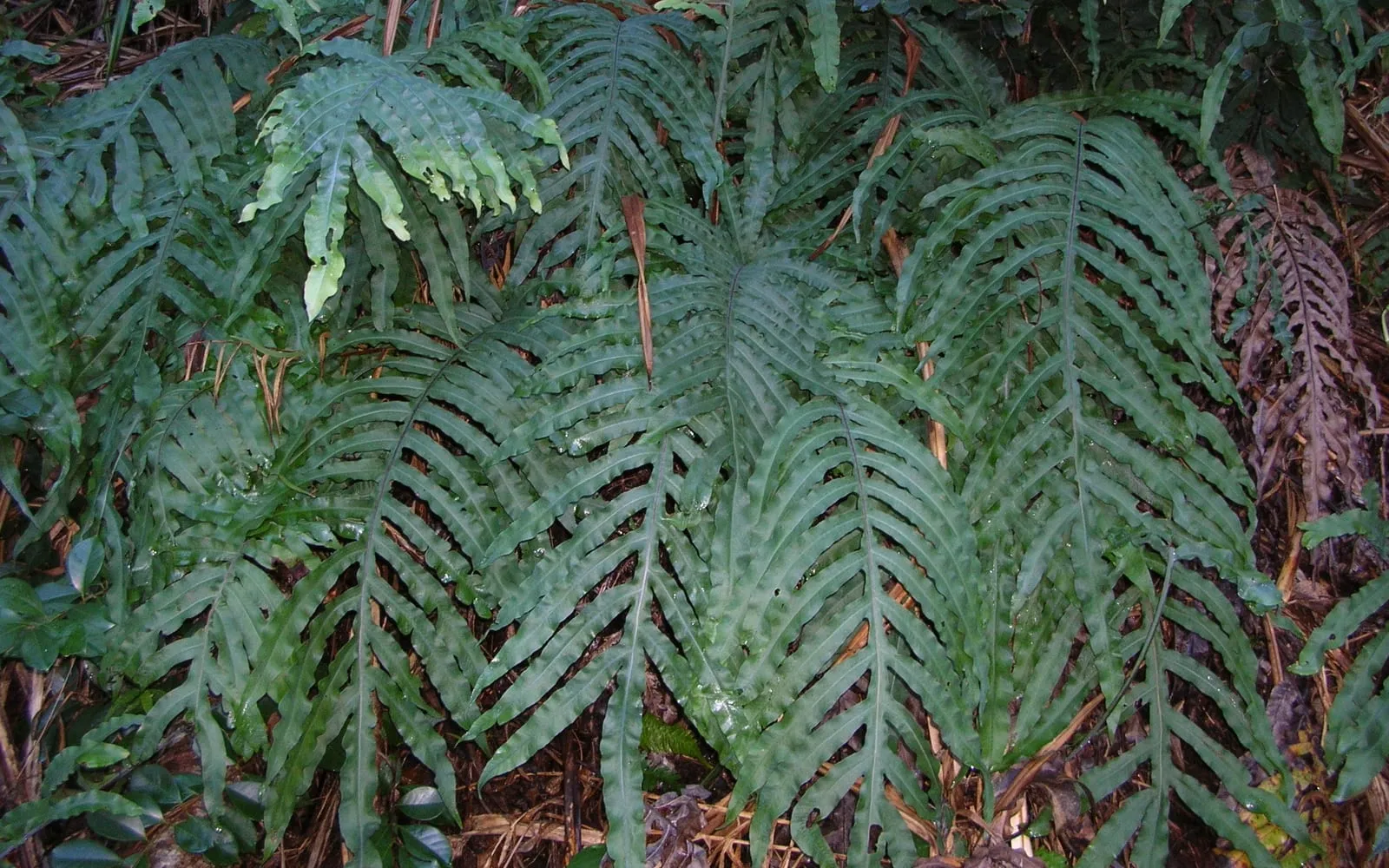
It looks different from the usual ferns too. The fronds are a matt blue-grey rather than green, deeply lobed rather than finely divided, and they rise from a thick rhizome covered in golden-brown furry scales that creeps visibly across the surface of the pot.
Appearance and character
An epiphytic fern with a stout creeping rhizome, 1 to 2 cm thick, densely covered in soft golden-brown scales, running along the surface of the growing medium and over the edge of the pot.
Fronds rise singly from that rhizome on long stalks. Each is deeply lobed, cut almost to the midrib into broad wavy fingers, 30 to 60 cm long, thick-textured and a distinctive blue-grey to sea green. Older plants produce larger and more divided fronds.
The blue-grey colour comes from a waxy bloom on the surface and is one of the easiest ways to recognise the species.
Growth is moderate, and a plant fills a pot and starts creeping over its edge within a couple of years.
Round golden-brown spore patches appear in two neat rows either side of the midrib on the underside of mature fronds. They are reproductive structures and are constantly mistaken for scale insects.
‘Mandaianum’ has strongly wavy, ruffled frond margins and is the cultivar most often sold.
Where it is from
Tropical and subtropical America, from Florida and the Caribbean through Central America to Argentina and Paraguay.
It grows as an epiphyte, rooting into pockets of leaf litter and moss on tree trunks and in the forks of branches, and it is particularly associated with the old leaf bases of palms, where debris collects and holds moisture.
That perch explains the plant. A fern on a branch is exposed to moving air and periodic drying, so it has thicker fronds with a waxy surface and a fleshy rhizome that stores water. Those adaptations are exactly what make it tolerant of a dry room.
The furry scales on the rhizome are a shared feature of several unrelated epiphytic fern genera and give rise to a set of confusingly similar common names, with hare’s foot and rabbit’s foot applied to Davallia species as well as this one.
Its range reaches far enough from the equator that it takes brief cold, which few tropical ferns do.
How it grows
Give it medium indirect light or light shade. It holds a dim corner well.
Keep it out of direct sun, which scorches the fronds and destroys the blue bloom permanently.
Grow it in a very open mix. Orchid bark with some coir or compost, or a bark-based epiphyte mix, is far closer to what the roots want than ordinary potting compost.
Keep the rhizome on the surface. This is the single most important instruction. A buried rhizome rots, and the plant will die from a potting mistake rather than from anything you do later.
Water when the surface of the mix has just dried, thoroughly, and let it drain away completely.
Keep it above 10 deg C and ideally between 15 and 24 deg C. It prefers cooler conditions than most tropical ferns.
Feed every six to eight weeks at quarter strength through the growing season. Ferns are sensitive to fertiliser and burn easily.
Repot every two or three years in spring into a wide shallow pot, laying the rhizome on the surface and pegging it down if it will not stay.
Divide the rhizome in spring to propagate, cutting sections that carry roots and at least one growing tip.
Through the seasons
Spring brings the main flush of new fronds, uncurling from tight croziers along the rhizome. Resume feeding, and repot or divide now.
Summer is steady growth. Water when the surface dries, feed every six to eight weeks, and keep it out of the sun.
Autumn slows it. Reduce watering and stop feeding from October.
Winter is straightforward provided the plant stays above 10 deg C and away from radiators. Water sparingly and expect no growth.
Care difficulty
Easy by fern standards, which is the reason to choose it.
Burying the rhizome is the mistake that kills most plants, and it usually happens at the moment of repotting. The rhizome runs on the surface in nature and it should do so in a pot.
Dense compost has the same effect more slowly, holding water around a structure built to be exposed.
Dry air is tolerated far better than by other ferns, though very dry heated rooms still crisp the frond tips.
Direct sun destroys the blue bloom and scorches the fronds, and the damage does not grow out.
Watering
Water when the surface of the mix has just dried, roughly weekly in summer and every two weeks in winter.
Water thoroughly until it drains from the bottom, then empty the saucer.
Do not let the plant dry out completely for long. It tolerates a missed watering better than other ferns, though repeated drought browns the frond edges.
Use rainwater or filtered water where the tap water is hard, since salts and fluoride brown the tips.
Underwatering shows as browning frond tips and edges, which do not recover on the affected fronds.
Overwatering shows as blackening at the rhizome, collapsing fronds and a sour smell from the mix.
Warning signs, diseases and pests
Neat rows of round golden-brown patches on the frond undersides are spores, not pests. Leave them alone.
A blackening, softening rhizome is rot, from burial or from a mix that holds too much water. Cut away the soft sections, repot into open bark and keep the rhizome on the surface.
Brown crisp frond tips are dry air, drought or hard water. Raise the humidity, water more regularly and switch to rainwater.
Small flat brown discs that scrape off, scattered irregularly rather than in neat rows, are scale insects. The neat double row is spores; anything random is a pest.
White cottony fluff among the rhizome scales is mealybug, which hides very well in the fur.
Fronds losing their blue-grey cast and looking flat green is usually too much light.
Scorched pale patches are sun damage and are permanent.
Whole fronds yellowing one at a time is normal ageing. Cut them off at the base.
Growing environment
Medium indirect light or light shade, and it holds a dim position well.
Never direct sun.
Cool to average, 15 to 24 deg C, with 10 deg C as the floor.
Moderate humidity, and it tolerates ordinary dry room air better than any other fern commonly sold.
A very open bark-based mix in a wide shallow pot with drainage holes, with the rhizome sitting on the surface.
It can also be grown mounted on bark like an orchid, which suits it well if you can keep the humidity up.
Outdoors it grows in shade in USDA 9 and warmer, and an established plant takes a brief touch of frost.
Avoid ordinary potting compost, deep pots, buried rhizomes and direct sun.
Feeding
Feed every six to eight weeks from spring to early autumn with a balanced liquid houseplant fertiliser at quarter strength.
Stop feeding from mid-autumn to early spring.
Feed weakly. Ferns burn readily and show it as brown frond tips that look identical to drought damage.
Repot every two or three years in spring, into a wide shallow pot with an open bark mix, keeping the rhizome above the surface.
Flush the mix occasionally with plain water to clear accumulated salts.
Troubleshooting
There are brown dots in rows under the fronds. Spores, which is how the fern reproduces. They are normal on mature fronds and are constantly mistaken for scale insects. Neat rows means spores; scattered irregular discs means pests.
Can I bury the furry stem? No, and this is the way most plants are killed. The rhizome runs on the surface in nature and rots if covered. Lay it on top of the mix and peg it down if it lifts.
Is this a good first fern? Yes, and it is the one to try if a maidenhair has already defeated you. Growing on branches rather than the forest floor makes it far more tolerant of dry air.
The fronds have brown crisp tips. Dry air, drought or hard water. Raise the humidity, water more regularly and switch to rainwater.
What compost should I use? An open bark-based mix rather than potting compost. Orchid bark with a little coir works well. Ordinary compost holds too much water around a plant built to sit on bark.
Is it safe with pets? Yes. Ferns are among the safest houseplants and this one appears on no list of plants harmful to cats, dogs or horses.
The blue colour has faded. Usually too much light. The blue-grey comes from a waxy bloom on the frond surface, and bright light and direct sun both spoil it.
Why is it called a hare’s foot fern too? Several unrelated epiphytic ferns have furry creeping rhizomes and share those common names. The Davallia species are the other plants called hare’s foot and rabbit’s foot ferns.
Blue star fern problem guides
Not sure what is wrong? See the common houseplant pests guide.