
Houseplant
Round-Leaf Calathea
Goeppertia orbifolia
Also known as Calathea orbifolia, Prayer plant
How to grow Goeppertia orbifolia. Humidity, filtered water, leaf movement at night and the Calathea name change.
At a glance
- Difficulty
- Difficult
- Water
- When the top 2 cm is just dry. Never let it dry through
- Light
- Medium to bright indirect light. Direct sun scorches and fades it
- Temperature
- 18-27 deg C. Avoid cold draughts entirely
- Humidity
- Above 55 per cent. This is the requirement most people underestimate
- Hardiness
- USDA 10-12, RHS H1b, hardy to 15 C
- Type
- Evergreen perennial, clump-forming
- Height
- 40-80 cm
- Native to
- The forest floor of Bolivia
- Best month
- August in the Northern Hemisphere, February in the Southern Hemisphere
Bolivian rainforest floor. It is the most water-sensitive plant on this shelf, marking from fluoride, chlorine and hard water alike, so use filtered or rainwater. Crisping edges are almost always water quality or dry air.
Hardiness zones describe winter cold alone. Summer heat, humidity, rainfall and the length of the growing season decide as much, so treat the range as the outer limit rather than as a recommendation.
Every month named in this guide is for the temperate Northern Hemisphere. If you garden in the Southern Hemisphere, shift each one by six months, so August becomes February. Closer to the equator the wet and dry seasons matter more than the calendar, and the shift stops being a useful guide.
Not known to be toxic
Non-toxic. NC State Extension tags Goeppertia orbifolia as non-toxic to cats and dogs, and the ASPCA lists the prayer plant, Calathea insignis, as non-toxic to dogs, cats and horses. No member of this group appears on the RHS list of potentially harmful garden plants. The whole Marantaceae family has a clean record, which makes calatheas one of the safest choices for a house with animals that chew. A cat that eats a leaf may still be sick, because bulk alone will do that, and it will not be poisoned. Given how demanding this plant is in every other respect, safety is the one box it ticks without effort.
Sources: NC State Extension, Goeppertia orbifolia, ASPCA (Prayer plant, Calathea insignis)
About
This plant moves. Put a hand near it in the evening and nothing happens, but photograph it at nine in the morning and again at ten at night and the leaves will be in different positions. They rise and fold upward after dark and open flat again by morning.
The mechanism is a swollen joint called a pulvinus at the base of each leaf stalk, which pumps water between cells on opposite sides to swing the leaf like a hinge. It runs on a circadian rhythm. The family name for the whole group, prayer plants, comes from the folded night-time posture.
The name has also changed. The genus Calathea was split in 2012 and most of the plants sold as calatheas, including this one, moved to Goeppertia. The trade has entirely ignored it, so you will buy this as Calathea orbifolia and that is fine.
Appearance and character
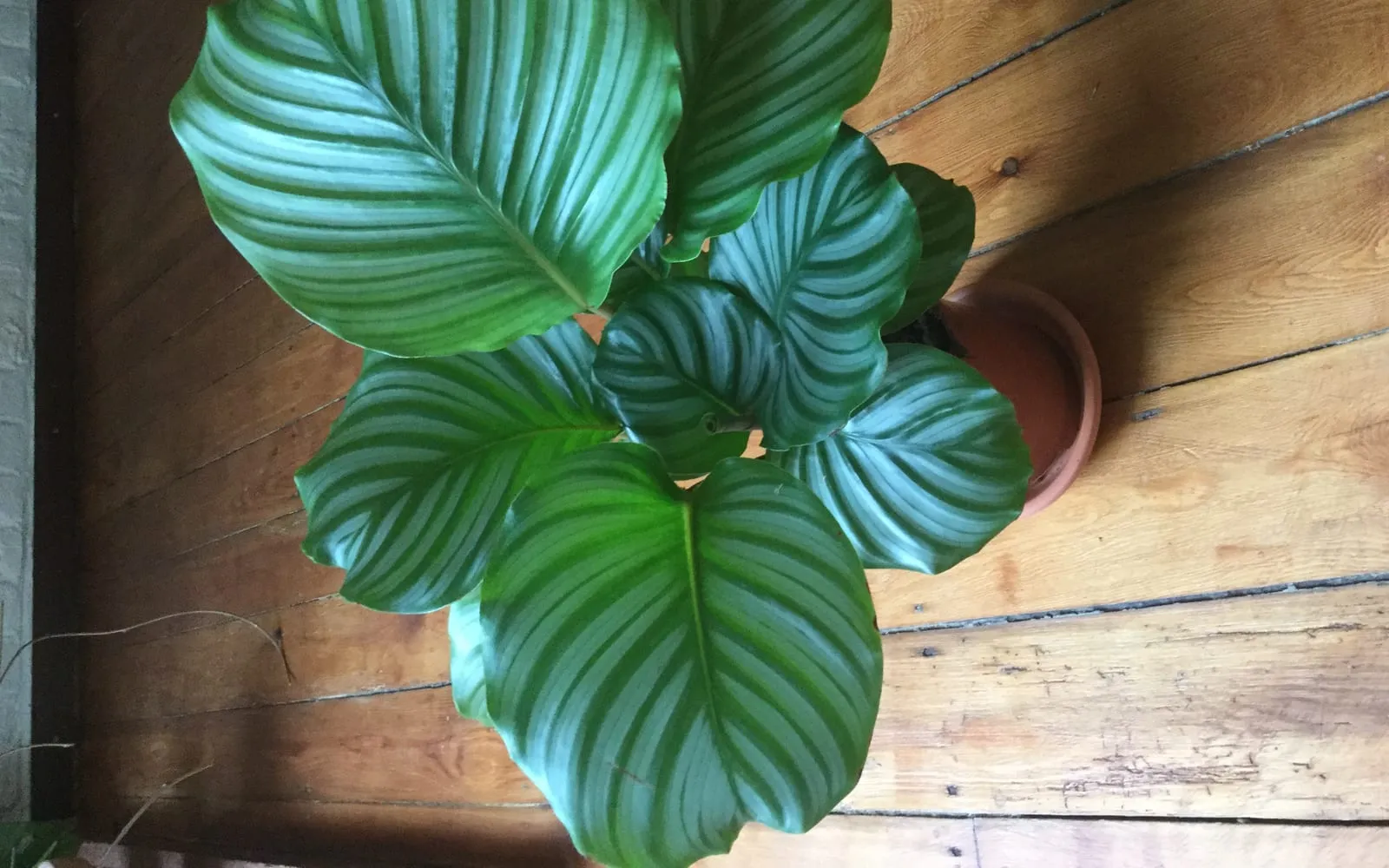
Very large round leaves, 20 to 30 cm across, in pale silvery green with broad darker green stripes running out from the midrib to the edge. Each leaf is held on its own upright stalk directly from the soil.
The undersides are pale green rather than the purple found on many relatives, which is one way to tell this species from the more common Calathea types.
The leaf surface has a faint sheen and the stripes appear slightly raised. New leaves emerge rolled into a tight tube from the centre of the clump and unfurl over about a week.
There are no flowers worth having. The plant is grown entirely for foliage, and indoor specimens rarely bloom.
The size of the leaves is the difficulty as well as the appeal. A large thin leaf loses water fast and shows every mistake at its edges.
Where it is from
The forest floor of lowland Bolivia, in warm humid tropical forest under a closed canopy.
Three things about that environment set the care requirements. The light is dim and completely filtered, which is why direct sun scorches the leaves and bleaches the stripes. The air is humid all year round, typically well above 70 per cent. And the temperature barely varies, with no cold nights and no draughts.
The forest floor is also rich in leaf litter and constantly damp without ever being waterlogged, which describes the compost this plant wants.
Rainwater is what falls on it. Nothing in its evolution prepared it for chlorinated, fluoridated, mineral-rich tap water.
How it grows
An evergreen perennial spreading slowly from rhizomes at the base to form a clump. Growth runs from spring to early autumn and slows through winter.
New leaves appear from the centre of the clump, and a healthy plant produces several over a growing season. Growth is not fast, and a plant that puts out three or four good leaves a year is doing well.
Old outer leaves yellow and die naturally, and removing them at the base keeps the clump tidy.
Division is the propagation method, done in spring when repotting. Separate the clump into sections each carrying several leaves and a good share of root. Cuttings do not work, since there are no stems to cut.
Repot every two years in spring into a pot one size up. The roots are relatively shallow and a wide pot suits it better than a deep one.
Through the seasons
Spring restarts growth. Repot or divide now, and begin feeding in April. This is also when humidity indoors starts recovering as the heating goes off.
Summer is the main growth period. Water more often, keep it out of direct sun, and watch for spider mites in hot dry spells.
Autumn slows down. Stop feeding at the end of September and reduce watering a little.
Winter is the hard season, and central heating is the reason. Room humidity can fall below 30 per cent, which this plant cannot tolerate, so a humidifier does more good in January than anything else you can do for it. Keep it away from radiators and cold windows alike.
Care difficulty
Difficult, and honestly so. This is the most demanding plant in these guides, and people who buy one on looks alone tend to lose it within a year.
Water quality is the first hurdle. Tap water browns the leaf edges within weeks in most hard-water areas, and the damage does not reverse. Use filtered water, rainwater or water that has stood for a day, at room temperature.
Humidity is the second and it is the one people underestimate. Misting raises humidity for about ten minutes and achieves almost nothing. A humidifier, a grouped arrangement of plants, or a bathroom with a window are the real answers.
Consistency is the third. The compost should never dry out completely and never be sodden, which requires checking rather than a schedule.
Watering
Water when the top 2 cm of compost is just dry, and no later. Letting a calathea dry out fully causes crisping that never recovers.
Use filtered water, collected rainwater, or distilled water. Tap water is the single most common cause of the brown edges this plant is notorious for, and it is the fluoride and chlorine rather than hardness that does it. Letting tap water stand overnight helps with chlorine and does nothing about fluoride.
Water at room temperature. Cold water shocks the roots.
Water thoroughly until it drains from the base, then empty the saucer. The compost should be evenly moist rather than wet, and waterlogging rots the roots just as surely as drought kills the leaves.
Reduce slightly in winter, without ever letting it dry through.
Warning signs, diseases and pests
Brown crispy leaf edges are the defining problem and they have three possible causes. Tap water minerals are the commonest, low humidity is second, and underwatering is third. Work through them in that order. Damaged edges never heal, so trim them off with scissors following the leaf shape and judge progress by the new leaves.
Spider mites love the conditions that hurt this plant, namely hot dry air. They stipple the leaves with pale dots and leave fine webbing where the stalk meets the leaf. Raising humidity is both the cure and the prevention. Rinse the plant thoroughly under a tepid shower.
Fungus gnats breed in permanently wet compost. They signal overwatering more than they cause harm.
Root rot follows waterlogging, showing as yellowing leaves and compost that stays wet. Unpot, cut away black roots, and repot into fresh open compost.
Curling leaves usually mean the plant is too dry, either at the root or in the air.
Faded stripes and washed-out colour mean too much light.
Yellowing lower leaves at a rate of one every month or two is normal ageing.
Growing environment
Medium to bright indirect light. A north-facing window is ideal, and an east-facing one works. Direct sun scorches the leaves and fades the silver stripes permanently.
Warmth of 18 to 27 deg C, steady. Cold draughts are a specific hazard, so keep it away from doors, letterboxes and single-glazed windows in winter.
Humidity above 55 per cent, and higher is better. A humidifier is the reliable solution. Pebble trays help marginally. Misting is close to useless on its own, and wet leaves overnight can encourage fungal spotting.
Compost should be an open peat-free houseplant mix with added perlite, holding moisture while draining freely.
A bathroom or kitchen with reasonable light suits it better than a living room, purely on humidity.
Feeding
A balanced liquid houseplant feed at half strength, monthly from April to September.
Stop entirely from October to March.
Calatheas are sensitive to fertiliser salts, and over-feeding shows as brown leaf edges that look exactly like the tap water damage. Water the plant with plain water before feeding, so the roots are never taking concentrated fertiliser into dry compost.
Flush the pot through with plain filtered water every few months to clear accumulated salts.
Troubleshooting
Brown crispy edges on the leaves. Tap water first, low humidity second, underwatering third. Switch to filtered water or rainwater, raise the humidity, and check the compost more often. Existing damage does not heal.
Leaves curling inward. Too dry, at the root or in the air. Water and raise the humidity.
Pale washed-out stripes. Too much light. Move it away from the window.
Yellowing lower leaves with wet compost. Overwatering. Let the top layer dry slightly before watering and check the drainage.
Fine webbing and speckled leaves. Spider mites, brought on by dry air. Rinse the plant and raise the humidity.
Leaves no longer folding up at night. Usually stress, most often from underwatering or poor light. A healthy plant moves noticeably.
It looked perfect in the shop and declined at home. Shops keep stock in high humidity. The plant did not change, its conditions did.
Bought as Calathea, labelled Goeppertia elsewhere. Same plant. The genus was split in 2012 and the trade still uses the old name.
Round-Leaf Calathea problem guides
Not sure what is wrong? See the common houseplant pests guide.