
Houseplant
Fishbone prayer plant
Ctenanthe burle-marxii
Also known as Never never plant, Ctenanthe, Amagris
How to care for Ctenanthe burle-marxii. The toughest of the prayer plant family, why the leaves fold up at night, and how it differs from a calathea in the ways that matter.
At a glance
- Difficulty
- Moderate
- Water
- When the surface has just dried, keeping the compost steadily moist
- Light
- Medium indirect light or light shade. Direct sun bleaches the pattern
- Temperature
- 18-27 deg C, and never below 13 deg C
- Humidity
- High. This is the requirement that decides success
- Hardiness
- USDA 10-12, RHS H1b, hardy to 13 C
- Type
- Evergreen perennial, rhizomatous and clump-forming
- Height
- 20-40 cm
- Native to
- Brazil
Rainforest floor in eastern Brazil, in deep shade with constant warmth, steady moisture and humidity that rarely drops. It has no cold tolerance and is damaged below about 13 deg C, so outdoors it needs a warm humid frost-free climate. Humidity rather than light is the limiting condition indoors, and a plant failing in a bright dry room is short of moisture in the air rather than short of anything else.
Hardiness zones describe winter cold alone. Summer heat, humidity, rainfall and the length of the growing season decide as much, so treat the range as the outer limit rather than as a recommendation.
Not known to be toxic
Non-toxic. The prayer plant family is one of the safest groups in cultivation, and the ASPCA lists the related Maranta and Calathea species as not harmful to cats, dogs or horses, with Ctenanthe treated the same way. There is no irritant sap and no risk from handling the plant or from an animal chewing a leaf. That makes the family the sensible choice for a household with a cat, since almost every other plant that tolerates this little light is an aroid carrying calcium oxalate. The species is named for Roberto Burle Marx, the Brazilian landscape architect who collected and popularised many of the plants now grown from that country.
Sources: ASPCA (Prayer Plant, Maranta leuconeura), RHS potentially harmful garden plants
About
The fishbone prayer plant is the one to start with if the calatheas have already beaten you. It belongs to the same family, carries the same patterned foliage and performs the same nightly folding trick, and it is markedly less temperamental about humidity and water quality than its more fashionable relatives.
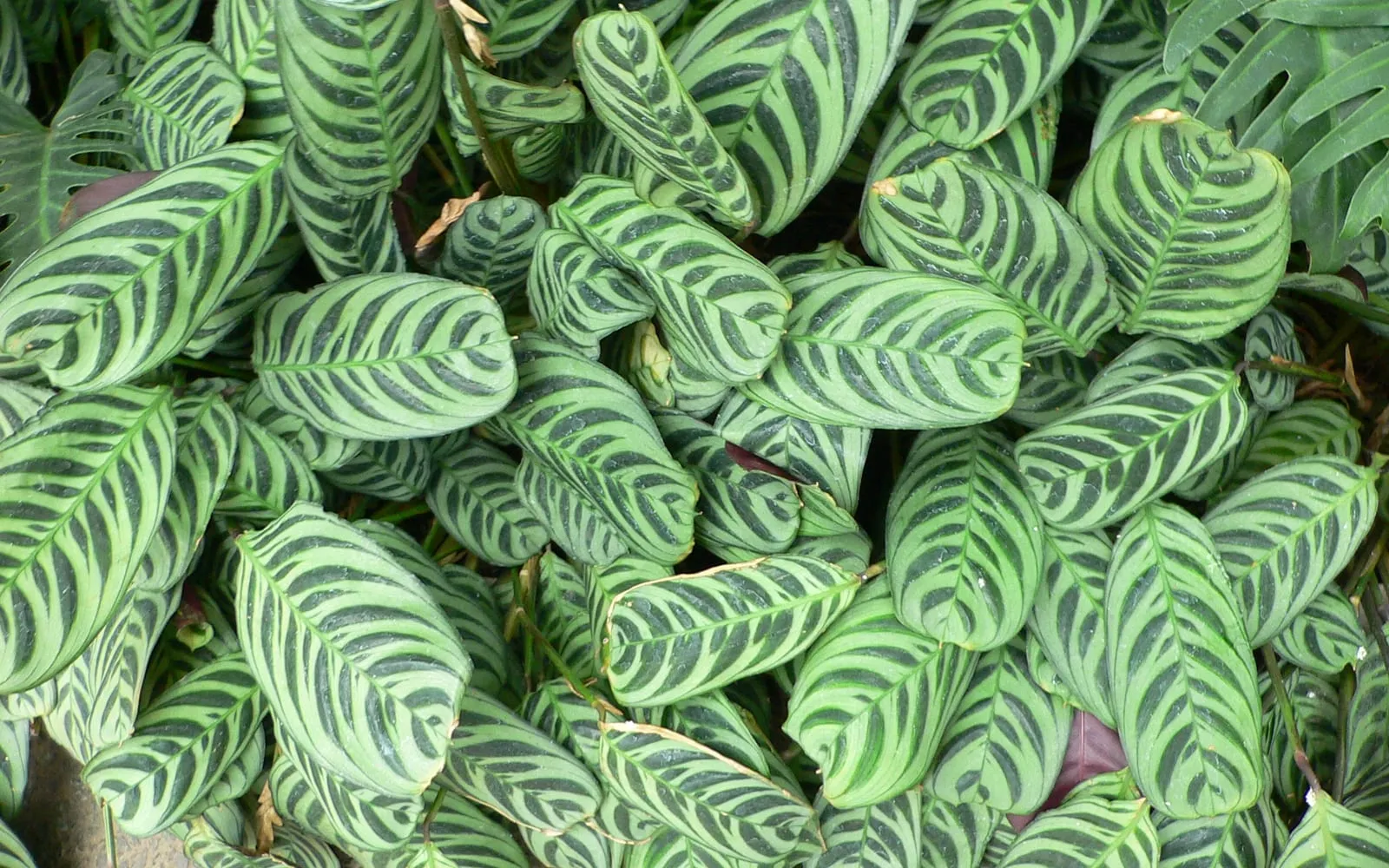
The pattern is the reason to grow it. Each pale green leaf carries dark green bars running out from the midrib at an angle, evenly spaced along the whole length, so that the leaf looks like a fish skeleton laid flat. The undersides are a deep wine purple that shows whenever the leaves lift.
They do lift, every evening. The whole family moves its leaves on a daily cycle, raising them at dusk and lowering them at dawn, driven by a swelling and draining of a joint at the base of each leaf stalk. A plant that folds up at night is behaving normally, and one that stays folded through the day is telling you something is wrong.
Appearance and character
A low spreading perennial growing from a creeping rhizome, forming a dense clump of leaves on short stalks rather than a stem.
Leaves are oblong to lance-shaped, 10 to 20 cm long, pale silvery green above with dark green bars angled outwards from the midrib in a regular herringbone pattern, and deep purple-red beneath.
Each leaf sits on a swollen joint called a pulvinus where the stalk meets the blade. That joint drives the daily movement by pumping water in and out, which is the mechanism behind the whole family’s common name.
Growth is moderate, spreading sideways by rhizome to form a clump 20 to 40 cm tall and wider than that with time.
Flowering indoors is uncommon and unremarkable, producing small white flowers in short spikes among the foliage.
Ctenanthe is often sold as Calathea or Stromanthe, and the whole group is routinely mislabelled in shops. The care is broadly similar, with this genus the most forgiving of the three.
Where it is from
The Atlantic forest of eastern Brazil, growing on the forest floor in deep shade in constantly moist leaf litter.
Every requirement follows from that habitat. Deep shade explains the pattern and the intolerance of direct sun. Constant humidity explains the crisp brown edges that appear in a dry room. Steady moisture in leaf litter explains why the plant dislikes drying out and dislikes sitting wet in equal measure.
The daily leaf movement, called nyctinasty, is found across the family and its purpose is debated. Reducing water loss overnight, shedding rain, and improving light interception during the day are the usual explanations, and none is settled.
The species honours Roberto Burle Marx, whose garden designs in Brazil brought many of these forest floor plants into cultivation from the 1930s onwards.
How it grows
Give it medium indirect light or light shade. It holds a dim position well and suffers in bright light.
Keep it out of direct sun, which bleaches the pattern permanently on affected leaves.
Keep the compost steadily moist, watering when the surface has just dried rather than letting the pot dry out.
Use rainwater or filtered water. The family is sensitive to fluoride, chlorine and dissolved salts, and brown leaf edges follow tap water in hard supply areas.
Raise the humidity. This is the decisive condition, and a bathroom, a humidifier or a gravel tray of damp pebbles all do more than misting.
Keep it above 13 deg C and ideally between 18 and 27 deg C.
Feed monthly at quarter to half strength through the growing season.
Divide the clump in spring if it outgrows its pot, separating rooted sections of rhizome with a clean knife.
Repot every two years in spring into a wide shallow pot, since the plant spreads sideways rather than rooting deep.
Through the seasons
Spring restarts growth. Resume feeding, divide or repot now, and expect new leaves rolled up as tight tubes that unfurl over a few days.
Summer is the growing season. Keep the compost moist, feed monthly, maintain humidity and keep it out of the sun.
Autumn slows it. Reduce feeding from October and watch the watering as the room cools.
Winter is the difficult season, because heating dries the air exactly when the plant is least able to cope. Keep it away from radiators, maintain humidity and water sparingly but never let it dry out.
Care difficulty
Moderate, and easier than any calathea.
Humidity is the whole difficulty. Below about 50 per cent the leaf edges crisp brown and the damage is permanent on those leaves.
Water quality is the second issue. Fluoride and salts in tap water produce the same brown edges by a different route, and switching to rainwater fixes it.
Red spider mite is the pest that follows dry air and is the family’s main affliction, producing a dull stippled plant with fine webbing.
Cold below 13 deg C causes limp, darkened leaves that do not recover.
Watering
Keep the compost steadily moist. Water when the surface has just dried rather than waiting for the pot to feel light.
Use rainwater, filtered or distilled water. Tap water is the commonest cause of brown edges on this family.
Water thoroughly until it drains, then empty the saucer. Steadily moist is not waterlogged.
Reduce watering in winter when growth stops, but never let the plant dry out completely.
Underwatering shows as curled leaves that stay curled and crisp brown edges.
Overwatering shows as yellowing leaves, a soft rhizome and a sour compost smell, most often in a cool room in winter.
Warning signs, diseases and pests
Brown crisp leaf edges are dry air or tap water, in that order. Raise the humidity and switch to rainwater. The affected leaves stay marked, so judge by new growth.
Leaves curled tight and staying curled through the day is the plant conserving water. Check both the compost and the humidity.
Fine pale stippling with faint webbing is red spider mite. Confirm by tapping a leaf over white paper. This pest and dry air arrive together.
Faded washed-out pattern is sun damage and is permanent on those leaves.
Yellowing leaves with a soft base is overwatering, particularly in a cool room.
White cottony fluff among the leaf stalks is mealybug.
Limp darkened leaves after a cold spell are cold damage below 13 deg C.
Leaves not folding at night at all usually means the plant is stressed rather than ill, most often by dryness.
Growing environment
Medium indirect light or light shade, and it holds a dim position well.
Never direct sun.
Warm, 18 to 27 deg C, with 13 deg C as the floor.
High humidity, above 55 per cent and preferably higher. This is the condition that decides whether the plant looks good.
Free-draining peat-free compost kept steadily moist, in a wide shallow pot with drainage holes.
Rainwater or filtered water rather than tap water.
Outdoors only in a warm humid frost-free climate in deep shade.
Avoid radiators, dry heated rooms, direct sun and hard tap water.
Feeding
Feed monthly from spring to early autumn with a balanced liquid houseplant fertiliser at quarter to half strength.
Stop feeding from mid-autumn to early spring.
Feed lightly. This family is sensitive to fertiliser salts and shows excess as brown leaf margins, which look identical to the damage from hard water.
Repot every two years in spring into a wide shallow pot one size up.
Flush the compost with rainwater two or three times a year to clear accumulated salts.
Troubleshooting
The leaf edges are brown and crisp. Dry air or tap water. Raise the humidity and switch to rainwater or filtered water. The affected leaves will stay marked, so judge progress by the new ones.
The leaves fold up at night. Normal, and it is what gives the family its name. A joint at the base of each leaf stalk pumps water in and out on a daily cycle. A plant that stays folded during the day is stressed.
How is this different from a calathea? Same family, similar look, and this genus is markedly more forgiving about humidity and water quality. It is the one to try if calatheas have defeated you.
Fine speckling and webbing. Red spider mite, which arrives with dry air. Raise the humidity and treat promptly, since this family is badly affected.
Is it safe with pets? Yes. The prayer plant family is non-toxic and the ASPCA lists its close relatives as not harmful to cats, dogs or horses.
The pattern has washed out. Sun damage. Move it out of direct light. Those leaves will not recover their markings.
Can I use tap water? Only if it is soft. The family is sensitive to fluoride, chlorine and dissolved salts, and rainwater or filtered water avoids the brown edges that follow.
New leaves are rolled into tight tubes. Normal. They unfurl over several days, and the rolled tube is how a new prayer plant leaf always emerges.
Fishbone prayer plant problem guides
Not sure what is wrong? See the common houseplant pests guide.