
Houseplant
Bird's nest fern
Asplenium nidus
Also known as Nest fern, Crow's nest fern, Crispy wave fern
How to care for Asplenium nidus. Watering around the rosette, humidity, scale insects and protecting new fronds.
At a glance
- Difficulty
- Moderate
- Water
- When the top 2 cm of compost has dried
- Light
- Medium indirect light or light shade. Never direct sun
- Temperature
- 18-24 deg C. Never below 13 deg C
- Humidity
- High. This is the requirement that decides success
- Hardiness
- USDA 11-12, RHS H1b, hardy to 12 C
- Type
- Evergreen epiphytic fern, long-lived and slow-growing
- Height
- 60-90 cm indoors
- Native to
- Tropical Asia, east Africa, Australia and the Pacific islands
- Best month
- December in the Northern Hemisphere, June in the Southern Hemisphere
Tropical Asian and Australasian rainforest, growing in tree forks where leaf litter collects. Water the compost rather than the crown, since the funnel that catches litter in the wild rots in a pot. Outdoors year round only in USDA 11 and 12.
Hardiness zones describe winter cold alone. Summer heat, humidity, rainfall and the length of the growing season decide as much, so treat the range as the outer limit rather than as a recommendation.
Every month named in this guide is for the temperate Northern Hemisphere. If you garden in the Southern Hemisphere, shift each one by six months, so December becomes June. Closer to the equator the wet and dry seasons matter more than the calendar, and the shift stops being a useful guide.
Not known to be toxic
Non-toxic. The ASPCA lists Asplenium nidus among plants that are not harmful to cats, dogs or horses, and the RHS does not include it in its list of potentially harmful garden plants. Ferns as a group are among the safest houseplants to keep around animals, and the bird's nest fern is no exception. A cat that chews a frond may be sick simply because the tissue is fibrous, in the same way it would be after eating grass, and there is no toxic effect. The brown dust that appears in neat lines on the undersides of mature fronds is spores rather than a pest or a disease, and it is harmless to touch. The young fronds of related Asplenium species are eaten as a vegetable in Taiwan and parts of south-east Asia, though not usually this one, and there is nothing in the plant that makes it a concern in a home. The only real caution is a practical one, since the fronds mark permanently when handled and a plant within reach of a cat will end up looking tatty even though the animal is in no danger.
Sources: ASPCA (Bird's Nest Fern, Asplenium nidus), RHS potentially harmful garden plants
About
The bird’s nest fern is shaped the way it is for a reason. In the wild it grows on the branch of a rainforest tree rather than in the ground, and the rosette of upright fronds forms a funnel that catches falling leaves and rainwater. The debris rots down in the centre and feeds the plant, which is a neat solution to living somewhere with no soil.
That same funnel is what kills it indoors. Water poured into the centre of the rosette, as most people instinctively do, sits in the crown where there is no falling debris and no tropical airflow to dry it, and the growing point rots.
Water the compost around the edge instead. Get that right, keep the humidity up, and this is a handsome and long-lived plant that tolerates a dim room.
Appearance and character
An evergreen epiphytic fern forming a rosette of upright arching fronds, reaching 60 to 90 cm indoors and considerably more in the wild.
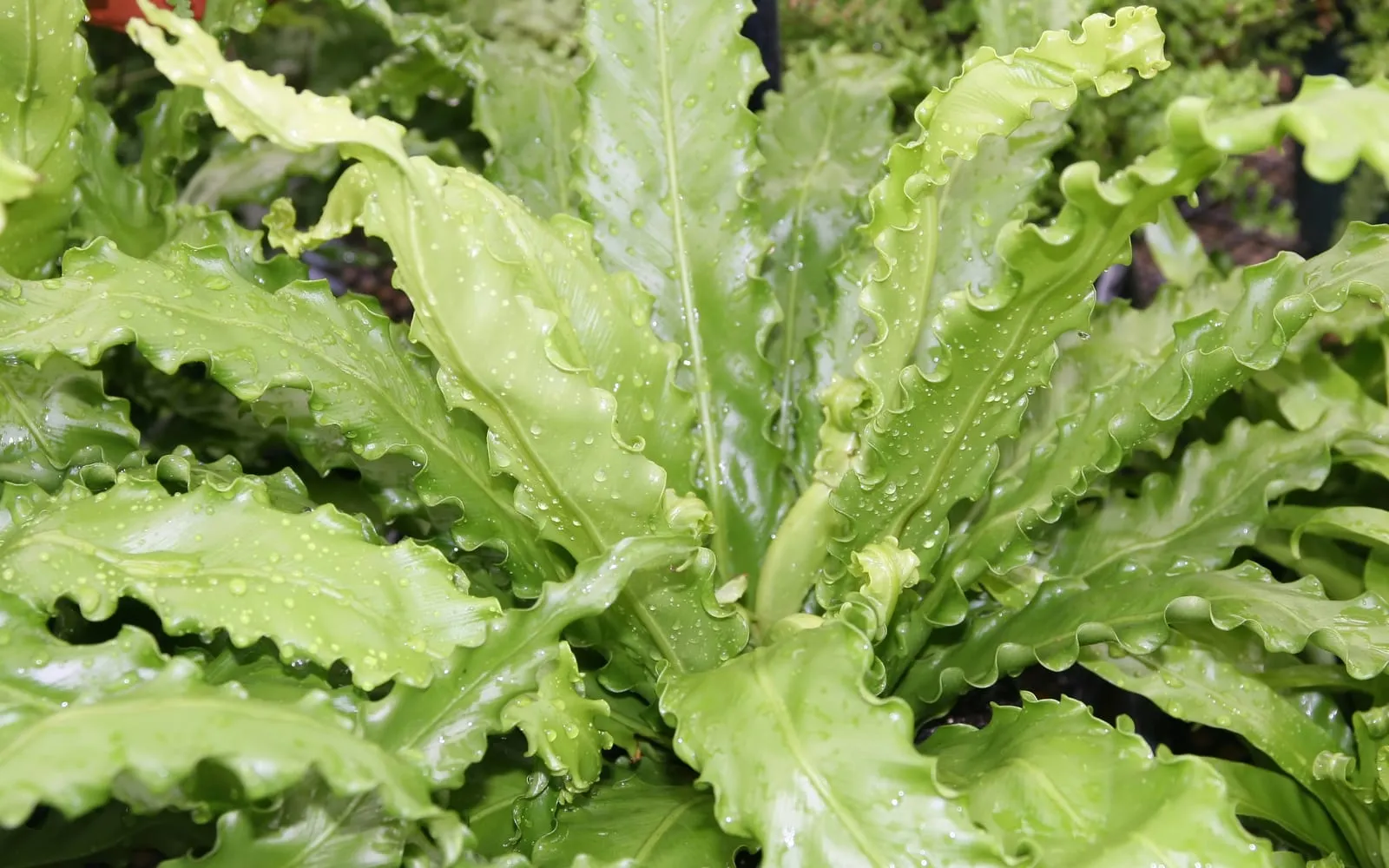
Fronds are simple and undivided, which is unusual among ferns, broad and strap-shaped with a prominent dark midrib, and glossy bright green.
The rosette is the defining shape. Fronds radiate outward from a compact central crown, forming a shuttlecock or nest with a hollow centre.
New fronds emerge from that centre tightly rolled into fiddleheads, unfurling over several weeks. They are extremely delicate at this stage and mark permanently if touched.
Spores appear on mature fronds as neat brown lines running diagonally outward from the midrib on the underside. They are normal and often mistaken for scale insects.
The crown is covered in a mass of dark brown wiry roots and old frond bases, which looks untidy and should be left alone.
Cultivars vary in the frond edge. The species has smooth-margined fronds, while ‘Crispy Wave’, ‘Osaka’ and ‘Crissie’ have strongly waved or ruffled edges and are now the commonest forms sold.
Where it is from
Tropical Asia, east Africa, Australia and the Pacific islands, where it grows as an epiphyte high on the trunks and branches of rainforest trees, and sometimes on rocks.
Living on a branch rather than in soil sets almost every requirement. The roots need air and sharp drainage, ordinary compost suffocates them, and the plant feeds partly on the leaf litter its own rosette collects.
The forest interior gives constant high humidity, warmth without seasonal change, and light filtered through a canopy, which is why direct sun scorches it so quickly.
Large wild specimens hold a considerable weight of accumulated debris, water and invertebrate life in their crowns, and they are important microhabitats in their own right.
The name Asplenium comes from the Greek for spleen, a reference to a supposed medicinal use of related species.
The genus is enormous, with several hundred species worldwide, including the hart’s tongue fern of European hedgerows and walls, which has a similar undivided frond on a much smaller plant.
How it grows
Position it in medium indirect light or light shade. An east or north-facing room suits it, and direct sun scorches the fronds within days.
Keep it warm, 18 to 24 deg C, and never below 13 deg C.
Raise the humidity, which is the requirement that decides whether this plant thrives or merely survives. A bathroom or kitchen is ideal, and elsewhere use a tray of damp pebbles or group it with other plants.
Water when the top 2 cm of compost has dried, pouring around the edge of the pot and never into the central rosette.
Use an open free-draining mix. Peat-free houseplant compost with a third added orchid bark and perlite reproduces the loose material an epiphyte roots into.
Feed monthly through the growing season at quarter to half strength. Ferns are sensitive to fertiliser and burn easily at full strength.
Leave the new fronds alone entirely while they unfurl. Touching a fiddlehead leaves a permanent brown mark on the mature frond.
Do not remove the brown fibrous mass around the crown. It is normal root growth and part of the plant’s structure.
Repot every two or three years in spring, into a pot only slightly larger. This fern grows better slightly restricted.
Cut off old, browned or damaged fronds at the base with clean scissors.
Through the seasons
Winter is the difficult season, since heating dries the air. Raise the humidity, keep the plant away from radiators, water less, and stop feeding.
Spring brings the new fronds, unfurling from the centre. Resume feeding, repot if needed, and increase watering as growth restarts.
Summer is growth. Water when the surface dries, feed monthly at low strength, keep the humidity up, and shade it from any direct sun.
Autumn is the wind-down. Reduce watering and feeding from October and move the plant away from cold windows.
Care difficulty
Moderate, and almost all of it comes down to two habits.
Watering into the crown is the mistake that kills these plants, and it is the natural thing to do given the shape. Water the compost around the edge instead.
Dry air is the other. A centrally heated room in winter is far drier than anything this fern meets in the wild, and brown crispy edges follow.
Light and temperature are straightforward, since it wants shade and ordinary room warmth.
Scale insects are the main pest and they are awkward to treat, since ferns react badly to many insecticides and to oil-based sprays.
Growth is slow, so a damaged plant takes a long time to look well again.
Watering
Water when the top 2 cm of compost has dried, which in a warm room usually means weekly.
Pour the water around the edge of the pot, onto the compost, and never into the central rosette. Water sitting in the crown rots the growing point.
If water does get into the crown, tip the plant gently to drain it and let it dry.
Water thoroughly and let it drain completely. Never leave the pot standing in water.
Reduce watering in winter, though rather less than for most houseplants, since the fern still dislikes drying out completely.
Use tepid rainwater or filtered water where possible. Ferns are sensitive to the salts and chemicals in hard tap water, which show as brown edges.
Keep the compost lightly moist rather than either wet or bone dry.
Warning signs, diseases and pests
A blackening, softening centre with the youngest fronds collapsing is crown rot, caused by water sitting in the rosette. It is usually fatal by the time it is visible. Prevent it by watering the compost around the edge only.
Brown crispy edges and tips are the commonest complaint and mean the air is too dry. They also follow hard tap water and overfeeding. Raise the humidity, switch to rainwater, and feed at a lower strength.
Scale insects appear as small flat brown or pale discs along the undersides of the fronds and on the midribs, with sticky honeydew below. Distinguish them from spores, which sit in neat regular parallel lines and rub off as brown dust. Scale is irregular and sits proud of the surface. Wipe them off with a damp cloth, and avoid oil-based sprays, which damage fern fronds.
Pale bleached or scorched fronds mean direct sun.
Permanent brown marks on an otherwise healthy frond usually mean it was touched while unfurling.
Yellowing fronds throughout the plant point to overwatering or to compost that holds too much water. Use a more open mix.
Very slow growth or no new fronds usually means the plant is too cold, too dark or underfed.
Growing environment
Medium indirect light or light shade. An east-facing or north-facing room suits it well.
Never direct sun, which scorches the fronds quickly.
Warmth of 18 to 24 deg C, and never below 13 deg C.
High humidity, which matters more than anything else. A bathroom with a window is close to ideal, and a pebble tray or a humidifier works elsewhere.
Away from radiators, draughts and cold glass, all of which dry or chill the fronds.
An open free-draining mix with orchid bark and perlite, in a pot with drainage holes only slightly larger than the rootball.
Give it room. The fronds arch outward and a crowded plant gets damaged against walls and other pots.
Out of reach of a cat, less for safety than because the fronds mark so easily.
Feeding
Feed monthly from April to September with a balanced liquid houseplant fertiliser at quarter to half the stated strength. Ferns burn easily at full strength.
Stop feeding from October to March.
Never feed into the crown. Apply the diluted feed to the compost around the edge.
Repot every two or three years into fresh open mix, which supplies more than fertiliser does.
Flush the compost through with plain water occasionally to clear accumulated salts, which cause brown edges.
Troubleshooting
Where do I pour the water? Onto the compost around the edge of the pot, never into the central rosette. Water sitting in the crown rots the growing point and usually kills the plant.
The edges have gone brown and crispy. Dry air, hard tap water, or overfeeding. Raise the humidity, switch to rainwater, and feed at a lower strength.
Brown lines on the undersides of the fronds. Spores, which are normal on a mature frond. They sit in neat regular parallel lines. Scale insects are irregular and raised.
The centre has gone black and soft. Crown rot from water in the rosette. It is usually fatal once visible.
A new frond has a permanent brown mark. It was touched while unfurling. Fiddleheads are extremely delicate and mark for the life of the frond.
Should I clear the brown fibrous mess around the base? No. That is normal root growth and part of the plant’s structure.
Can I put it in a dark bathroom? A bathroom is ideal for the humidity provided it has some daylight. A windowless one will not sustain it long-term.
Is it safe with cats? Yes. Asplenium nidus is listed by the ASPCA as non-toxic, though a curious cat will mark the fronds.
Bird's nest fern problem guides
Not sure what is wrong? See the common houseplant pests guide.