
Pest
Scale insects
Coccoidea
Also called Brown scale, Soft scale, Mussel scale
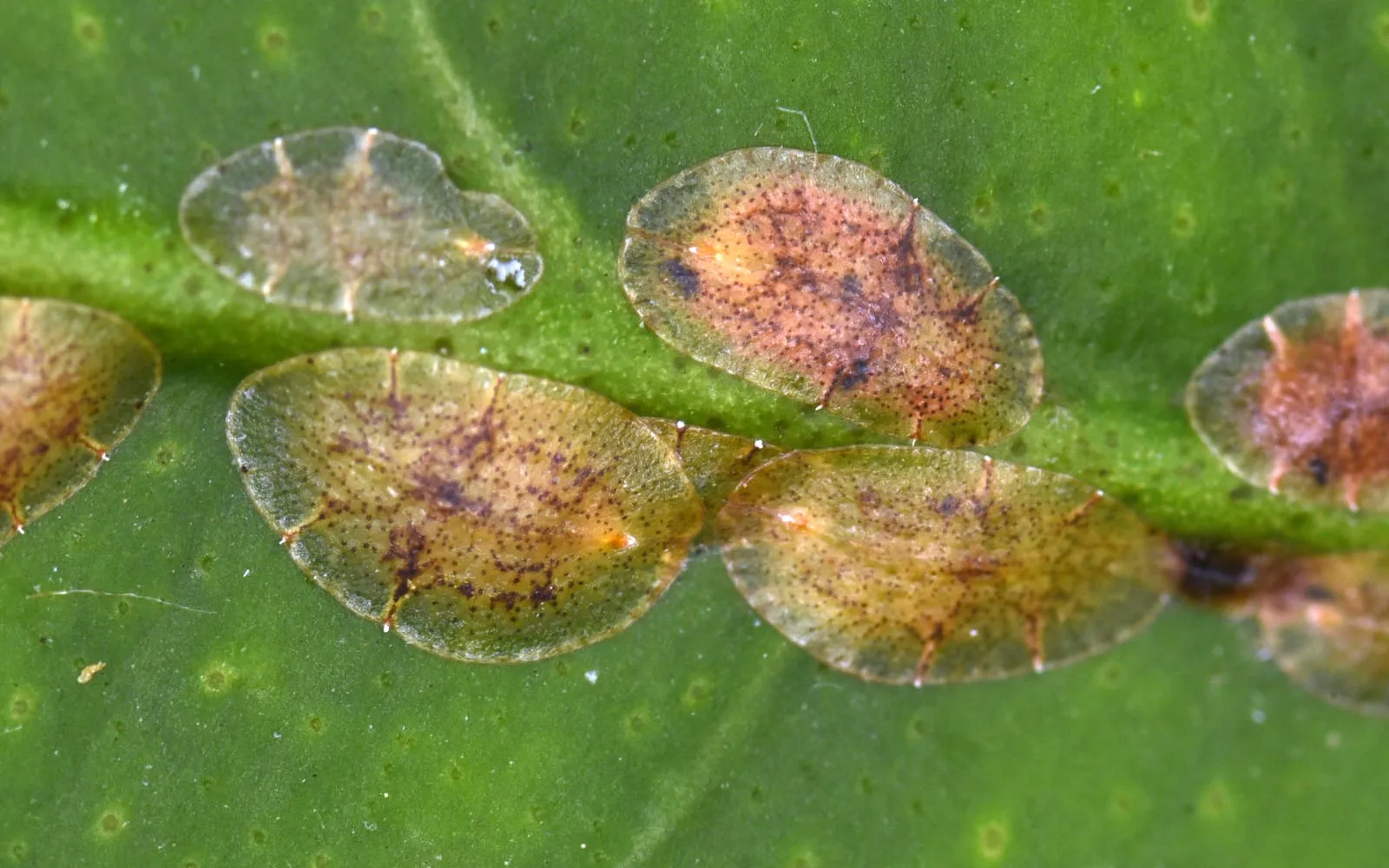
Scale insects look like brown or yellowish domes stuck to stems and leaf veins, often with sticky leaves below. Control works best against the mobile crawler stage in summer.
At a glance
- Type
- Pest
- Cause
- Insect
- Severity
- Weakens the plant
- Affects
- Houseplants, Garden plants, Herbs and edibles
- Active
- All year
- Established in
- Worldwide
What you are seeing
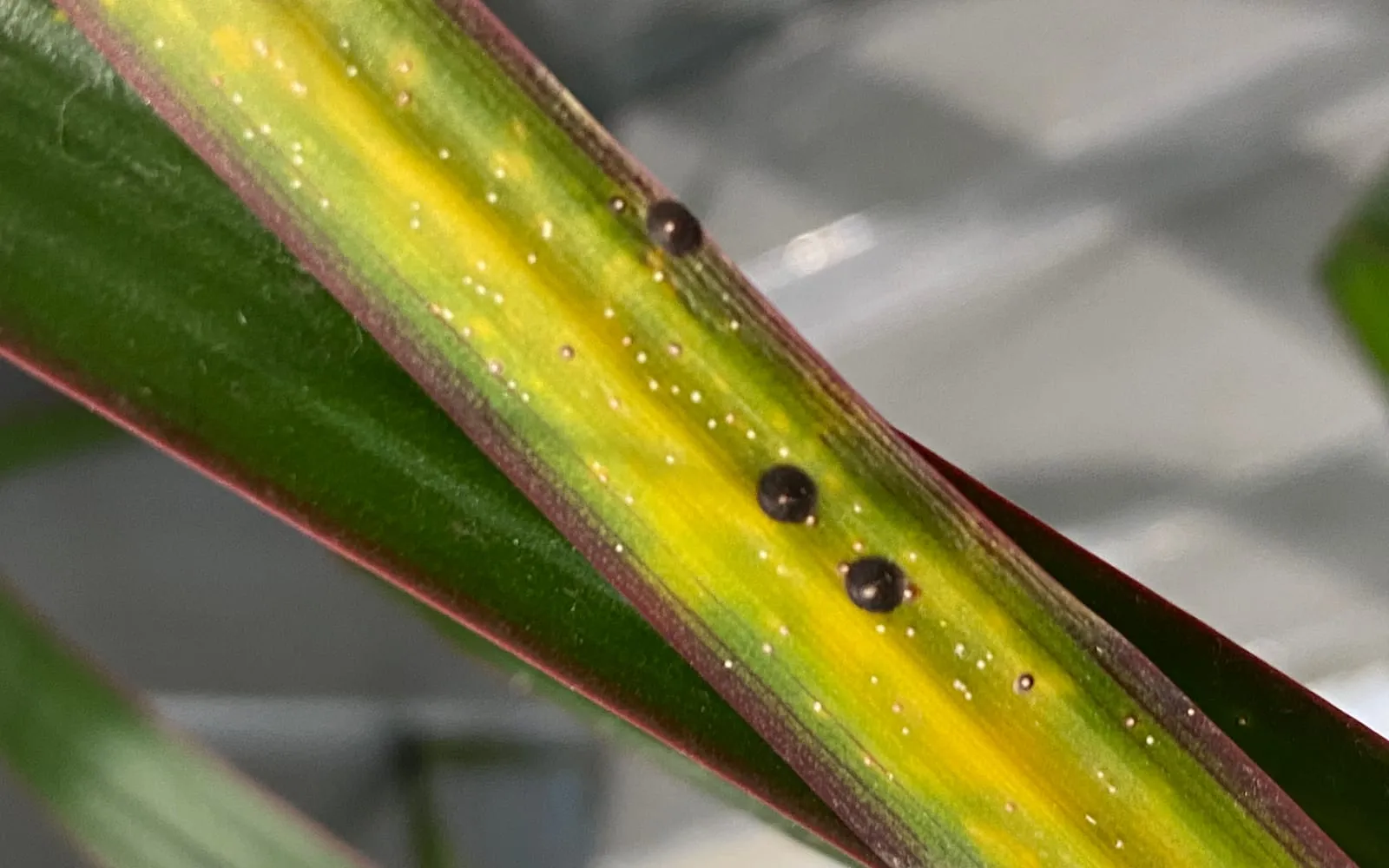
- Oval or round domes two to six millimetres across, brown, yellowish or black, stuck to stems and along the underside of leaf veins
- The domes staying put when pushed with a fingernail, and lifting off whole when scraped
- Yellow blotches on the upper leaf surface directly above where they sit
- Sticky honeydew on the leaves below and on the surface under the plant
- Black sooty mould growing on the honeydew
- Neat round holes in some of the old scales, which are exit holes rather than damage
- The plant thinning and losing leaves over a year or two with no other cause
Before you treat anything
Surgical spirit is flammable and irritant. Use it in a ventilated room, away from any flame, and test a single leaf a day ahead, because it browns fern fronds and marks the bloom on succulents.
What you are looking at
Small domes stuck to a stem or lined up along the underside of a leaf vein. Brown, yellowish, grey or black, two to six millimetres, flattish or shaped like a limpet, and completely still. Most people take them for part of the plant, a scab, a bud scale or a fungal growth, and the sticky leaves get blamed on something else entirely.
Push one with a fingernail. It will not move. Slide the nail under the edge and it lifts off in one piece, leaving a pale mark on the bark and, if it is a live one, a soft yellowish insect underneath.
The dome is the animal. An adult female scale has no legs, no wings and barely any body plan left. She settled once as a nymph, pushed her mouthparts into the plant and stayed there for the rest of her life under a cover she secreted over herself.
The two kinds, and the difference it makes
Soft scales include the brown scale on bay and currants, the soft scale on citrus and ficus, and the hemispherical scale on ferns and orchids. Their cover is part of the body, they feed on phloem sap, and they excrete honeydew. Sticky leaves mean a soft scale.
Armoured scales, including mussel scale on apple and the oleander scale, build a separate hard shield that is not attached to them and can be flicked off with a pin. They feed differently and produce no honeydew, so the plant declines with nothing sticky to explain it.
Both respond to the same handling. The distinction is worth making because the absence of honeydew leads people to rule scale out on a plant covered in it.
The one week they can be reached
Everything about controlling this comes down to the crawler. Eggs hatch under the mother’s cover into tiny flat mobile nymphs, and those walk out, spread over the plant, and settle wherever the sap suits them. Once settled, each secretes its own cover and stops moving for good.
While they are crawling they have no armour and nothing waxy over them. That is the only stage anything applied to the plant reaches easily, and it lasts days. Outdoors on brown scale it falls in late June and July, and under glass it can be any month.
An adult under a cover is a different proposition. Whatever you spray sits on the outside of a waterproof shield with the insect sealed beneath it, which is why sprays disappoint against scale and why a thumbnail does not.
What the damage amounts to
They take phloem sap, and slowly. A mature bay tree can carry scale for years and look no worse for it. What accumulates is a general thinning, yellow blotches on the leaves directly above the feeding points, early leaf fall and a plant that never quite grows.
The honeydew is what most people notice first. It drips onto the leaves below, a windowsill or a patio, black sooty mould grows on it within weeks, and the mould shades the leaves without infecting them.
Under glass and indoors, with no natural enemies and no season off, numbers keep climbing until an orchid or a ficus is carrying hundreds. Outdoors, parasitoid wasps and predatory beetles usually hold it somewhere tolerable unless the garden has been sprayed.
What to do about them
Scrape them off. A thumbnail on a stem, an old toothbrush and soapy water on bark, a cotton bud dipped in surgical spirit for the ones tucked along a vein. An evening spent on a potted bay clears it, and nothing sold in a bottle performs better.
Go back a fortnight later and again a fortnight after that, because eggs under the covers you removed will have hatched in the meantime and settled somewhere you did not check. Wash the leaves down with plain water at the same time to take off the honeydew and the sooty mould.
Prune out any stem that is encrusted along its length. It will not come clean and it is manufacturing crawlers while you work on the rest of the plant.
Before you scrape everything, look for neat round holes in the older scales. Those are exit holes made by parasitoid wasps that developed inside, and a plant showing a good number of them has help already. Take the intact scales and leave the drilled ones.
Why no spray is listed here
The cover is waterproof and it is there to keep things out. A contact spray reaches settled adults poorly and eggs not at all, so anyone spraying a scaly bay is treating the ten per cent of the population that happens to be crawling that week and killing whatever predators are on the plant at the same time.
Fatty acid and plant oil products smother, which needs total coverage of every stem and leaf underside to achieve what a thumbnail achieves in one pass. In a garden they also remove the parasitoid wasps that keep outdoor scale from ever becoming a problem, which is why sprayed gardens have the worst scale.
What it gets mistaken for
Mealybugs are the same family of insects, but they keep their legs, they move when prodded, and they sit under white waxy fluff in leaf joints rather than under a smooth hard dome on a vein.
Whitefly rise in a cloud when the plant is disturbed. Their immature stages sit still on the leaf underside and do look like small pale scales, so check for adults before deciding.
Buds, lenticels and leaf galls are part of the plant and will not come away without tearing tissue. A scale lifts off cleanly and leaves a mark rather than a wound.
Honeydew and sooty mould with nothing visible on the plant usually means aphids higher up, or a lime, sycamore or maple overhead. Look above the sticky surface before searching the plant beneath it.
What to do, in order
Start here
Prevention, and the changes that stop the problem returning. Most of these pages should end at this tier.
- Look along the underside of the veins on anything new
- Scale arrives on bought plants and stays undetected for months because nobody turns the leaves over. Run a thumb along the midrib on the underside of half a dozen leaves before a new bay, ficus or citrus joins the others.
- Open up a congested plant
- Still air and deep shade inside a clipped bay or an overgrown camellia suit them, and the same conditions hide them from anything that would eat them. Thinning the growth makes the plant easier to inspect as well as less comfortable.
- Keep the plant out of drought stress
- A plant repeatedly allowed to dry out supports larger populations and recovers from them more slowly. Steady watering and a balanced feed do more here than they appear to.
- Watch bay, citrus and ficus in particular
- A few plants attract this out of all proportion. Bay in a pot, indoor citrus, weeping fig, rubber plant and orchids account for most cases in British homes, and a monthly look at those is worth more than a general vigilance across everything.
Then reach for a barrier
Netting, hand removal and water. Nothing here harms anything except the target.
- Scrape them off
- A thumbnail, a blunt knife or an old toothbrush with soapy water removes them, and the insect underneath dies with the cover. On a bay or a citrus this is a job for an evening rather than a season, and it is the most reliable thing on this page.
- Use a cotton bud and surgical spirit on the ones you cannot scrape
- Along a leaf vein or in a stem fork, alcohol on a bud lifts the cover and kills the insect without damaging the leaf. Test one leaf first, and keep it off ferns.
- Time a second pass for the crawler stage
- The young are mobile for a few days after hatching, and they have no cover while they are. Outdoors on brown scale that falls in late June and July, and a firm wash of the stems and leaf undersides then removes a generation before it settles.
- Prune out the worst stems
- A branch encrusted along its length will not be cleaned by any treatment and is producing crawlers continuously. Take it out and bag it.
- Wash the honeydew off afterwards
- Sooty mould does not infect the plant and comes off with plain water and a cloth once the insects above it have gone. Leaving it blocks light from leaves that have already lost enough.
Then bring in the predators
Encourage what already lives in the garden, and buy predators in where the problem is under glass and nothing will arrive on its own.
- Leave the parasitised scales alone
- A neat round hole in the top of an old scale is where a parasitoid wasp emerged, and a plant showing plenty of them has a control population working on it. Scraping every scale off removes the wasps along with the pests.
- Introduce Metaphycus helvolus under glass
- A parasitoid wasp that works on soft scales at around 22 degrees C and above, which suits a conservatory or a heated greenhouse with citrus in it. It needs the scales to be young, so use it early.
- Encourage the beetles that eat them outdoors
- Small black ladybirds of the genus Chilocorus, along with lacewings and several parasitoid wasps, keep outdoor scale in check where nothing has been sprayed. Gardens with a broad-spectrum spray history are the ones where scale runs away.
Biological controls are live organisms and their sale and release are regulated country by country. An agent sold freely in one place may be unapproved in another, so buy from a licensed supplier where you live and never import or move one yourself.
In pictures
Plants affected
Guides that name it among the problems to watch for. The list is the plants it is characteristic of rather than everything it will feed on.
A common houseplant pest
This is one of the pests and problems that houseplant owners meet most often. See it alongside the others, with a quick table for telling them apart, on the houseplant pests guide.
Common houseplant pestsA common rose problem
This is one of the pests, diseases and disorders that rose growers meet most often. See it alongside the others on the common rose problems guide.
Common rose problems