
Houseplant
Green aglaonema
Aglaonema modestum
Also known as Chinese evergreen, Aglaonema modestum, Chinese water plant
How to care for Aglaonema modestum. The plain green original of the Chinese evergreens, tougher in shade and cold than the coloured cultivars that replaced it, and why the plain leaf is the point.
At a glance
- Difficulty
- Easy
- Water
- When the top half of the compost has dried
- Light
- Low to medium indirect light. It takes deeper shade than any coloured aglaonema
- Temperature
- 18-24 deg C, and never below 12 deg C
- Humidity
- Moderate to high. Dry winter air browns the leaf edges
- Hardiness
- USDA 10-12, RHS H1b, hardy to 12 C
- Type
- Evergreen perennial, long-lived and slowly suckering
- Height
- 60-80 cm
- Native to
- Southern China, Southeast Asia
Subtropical to tropical forest floor from southern China through Indochina, in deep shade with warm wet summers and a cooler but frost-free winter. That cooler winter is why this species tolerates a room several degrees below what the tropical coloured hybrids want, though it still suffers below about 12 deg C. Outdoors it needs a frost-free climate and full shade, and it is the aglaonema most likely to survive an unheated but sheltered room.
Hardiness zones describe winter cold alone. Summer heat, humidity, rainfall and the length of the growing season decide as much, so treat the range as the outer limit rather than as a recommendation.
Toxic if eaten
- Do not eat
- Every part, and the sap most of all
- Harm from
- Eating it and handling it
- Affects
- People, cats and dogs
Aglaonema modestum carries needle-shaped calcium oxalate crystals called raphides through its tissues, as most of the arum family does. Chewing any part drives them into the lining of the mouth and throat, and the result is immediate burning, drooling, swelling of the lips and tongue and difficulty swallowing. The ASPCA lists Chinese evergreen as toxic to cats and dogs on that basis. Severe cases are uncommon because the pain begins on the first bite, but swelling that reaches the airway is an emergency in a small animal. The sap irritates skin as well, so wear gloves when dividing or taking cuttings. Keep the plant off the floor in a household with a cat that chews foliage, since a plant at ankle height in a dark corner is exactly where an aglaonema tends to be placed.
Sources: ASPCA (Chinese Evergreen, Aglaonema modestum), RHS potentially harmful garden plants
About
The green aglaonema is the plant the whole genus was built on and the one you can no longer easily buy. Every pink, red, silver and cream aglaonema in a garden centre descends from breeding work that started with plain green species like this one, and the coloured hybrids sold now need substantially more light than their ancestor did.
That is the trade the genus has made. A leaf patterned in cream or pink carries less chlorophyll per square centimetre and has to earn the same living from less pigment, so it wants a brighter position. The plain green modestum keeps all of its chlorophyll and holds a corner that would leave a ‘Pink Dalmatian’ pale and stretched within a season.
It is also the toughest of them about temperature, which follows from a native range that reaches well out of the true tropics into subtropical southern China. Where a coloured hybrid sulks below 15 deg C, this one keeps going a few degrees lower.
Appearance and character
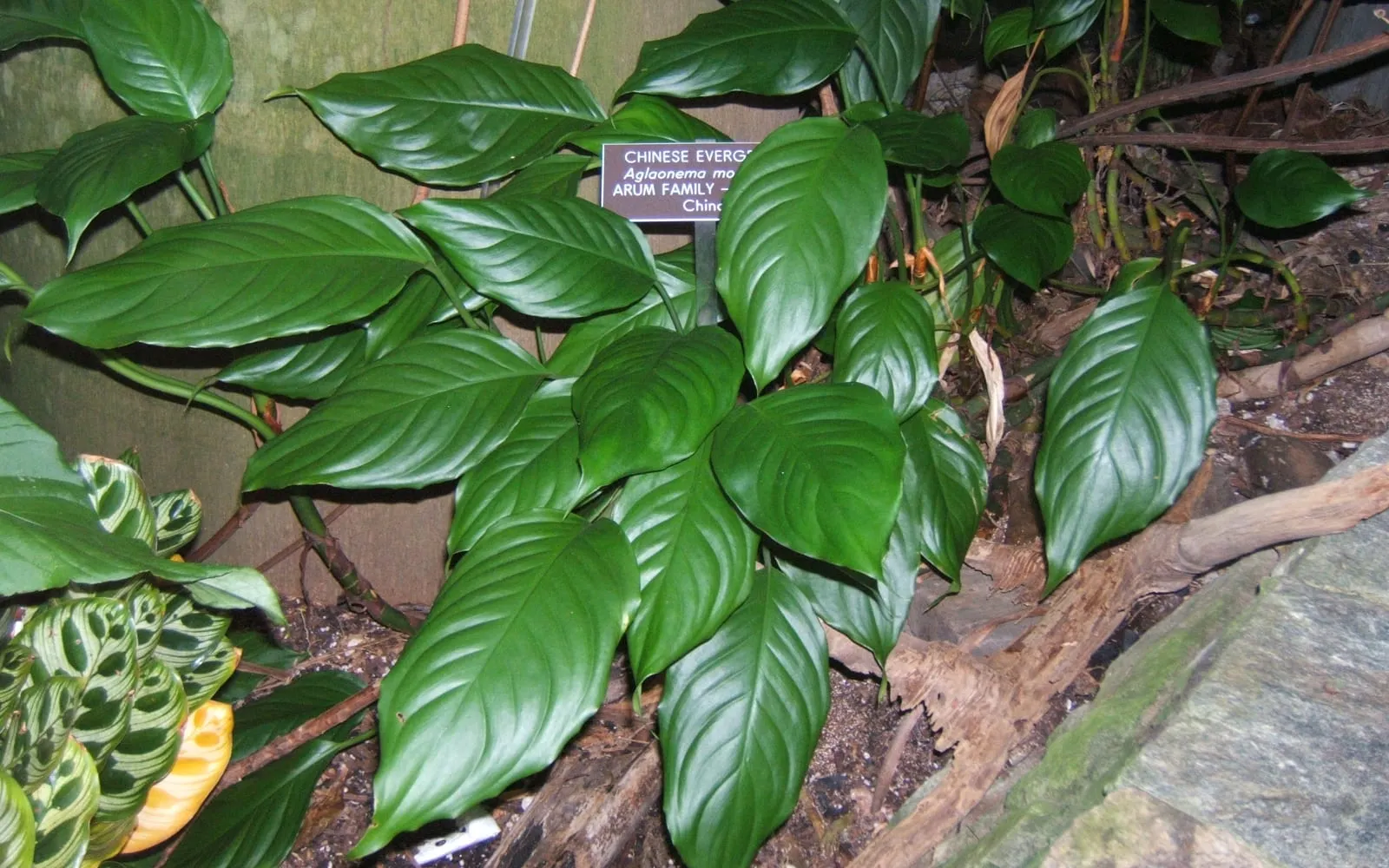
An upright clump-forming perennial with thick, slightly fleshy green stems and broad, glossy, plain deep green leaves. Each leaf is oval to lance-shaped, 15 to 25 cm long, held on a sheathing stalk, with a paler midrib and a smooth wavy margin.
There is no pattern, no silver dusting and no coloured edge. The uniform dark green is the diagnostic feature against every other aglaonema in cultivation.
Growth is slow and steady, producing a handful of new leaves a year and suckering gently at the base to widen the clump. Height settles around 60 to 80 cm.
Older plants lose their lower leaves and lean, exposing a bare stem marked with the rings of old leaf scars. That is normal ageing rather than a problem, and the remedy is to cut the stem back hard in spring or to air-layer the top.
Flowering happens occasionally indoors, producing a small greenish white spathe and spadix of the classic arum shape at the top of a stem. It is unremarkable and takes energy the plant would otherwise put into leaves, so most people cut it off.
Where it is from
Southern China, Vietnam, Laos, Cambodia and Thailand, on shaded forest floors and along stream banks in humid lowland and hill forest.
Its range reaches further from the equator than most of the genus, which is the source of its cool tolerance. A plant from subtropical southern China experiences a distinctly cooler dry season than one from equatorial Borneo, and that shows up indoors as a plant that copes with a room in the mid-teens.
Growing on a shaded forest floor under closed canopy explains the rest. Deep shade tolerance is the ordinary condition the species evolved for rather than a horticultural achievement.
It has a long history in Chinese cultivation as a plant grown in water, which is where the name Chinese water plant comes from. Stems root readily and will live for years in a jar, which is also how it is often propagated.
The genus contains around twenty-five species from tropical Asia and New Guinea. Breeding since the 1980s, much of it in Thailand and Florida, produced the hundreds of coloured cultivars now sold.
How it grows
Give it low to medium indirect light. It holds a dim corner and will also take a brighter spot away from direct sun.
Keep it out of direct sunlight, which bleaches the leaves to a yellowish green and burns pale patches into them.
Water when the top half of the compost has dried, thoroughly, letting the excess drain away completely.
Keep it above 12 deg C at all times, and between 18 and 24 deg C for active growth. Cold damage on this plant is distinctive, appearing as dark greasy patches rather than as browning.
Raise the humidity where the room is dry. Grouping plants, a gravel tray or a kitchen position all help, and dry winter air is the usual cause of brown leaf edges.
Feed monthly at half strength through spring and summer, and not at all in winter.
Repot every two or three years in spring, moving up one pot size. This is a plant that grows better slightly pot-bound.
Cut a leggy stem back to 10 or 15 cm in spring. It will resprout from the remaining nodes, and the cut top roots readily in water or damp compost.
Divide a wide clump in spring by separating rooted suckers from the parent with a clean knife.
Through the seasons
Spring is when growth restarts. Resume feeding, repot or divide if the pot is full, and cut back any leggy stems now so the plant has the season to recover.
Summer is the main growing period. Water when the top half dries, feed monthly and keep it out of direct sun.
Autumn slows everything. Reduce watering, stop feeding from October and move the plant nearer the window as the light drops.
Winter is when to be careful. Keep it above 12 deg C, water sparingly, and keep it well away from cold glass and draughty doors. Almost all losses happen now.
Care difficulty
Easy, and among the most tolerant foliage plants for a dim room.
Cold is the real limit. Below 12 deg C the leaves develop dark, water-soaked looking patches that turn brown and never recover, and a plant left against a freezing window overnight can be ruined.
Overwatering is the other. In a cool dim position the compost stays wet for weeks, and the fleshy stem bases rot from the bottom.
Dry air is a nuisance rather than a danger, producing brown edges and tips that spoil the look without threatening the plant.
Legginess in old plants is inevitable and easily fixed. A stem cut back hard in spring resprouts, and the removed top makes a new plant.
Watering
Water when the top half of the compost has dried, which in a shaded room usually means every ten to fourteen days in summer and every three weeks or more in winter.
Water thoroughly until it drains from the bottom, then empty the saucer.
Cut watering hard in winter. A plant that is not growing, in a cool room, needs a fraction of what it takes in July, and this is where most of them are lost.
Use rainwater or filtered water where the tap water is hard, since accumulated salts contribute to the brown leaf edges.
Underwatering causes drooping leaves and dry edges, and the plant recovers when watered.
Overwatering causes yellowing lower leaves, soft stem bases and a sour smell from the compost. Take a cutting from the healthy top growth if you find that, because the base may be beyond saving.
Warning signs, diseases and pests
Dark greasy-looking patches appearing after a cold spell are cold damage and are permanent. Move the plant somewhere warmer and remove the worst leaves.
Yellowing lower leaves, several at once, are overwatering. Check that the pot drains and let the compost dry further between waterings.
Brown crisp edges and tips are dry air or fertiliser salts. Raise the humidity and flush the compost through with plain water.
White cottony fluff in the leaf joints is mealybug, which favours the sheathing leaf bases on this plant. Wipe it off and check weekly for a month.
Small flat brown discs on the leaf undersides are scale insects.
Fine pale stippling with faint webbing is red spider mite, which follows warm dry air rather than cool.
Bleached yellow-green leaves in a bright spot are sun damage. Move the plant back from the window.
A bare leaning stem with leaves only at the top is age. Cut it back hard in spring and root the top as a new plant.
Growing environment
Low to medium indirect light, including corners well back from a window.
Never direct sun.
Warm, between 18 and 24 deg C, with 12 deg C as a hard floor.
Moderate to high humidity. A kitchen or bathroom suits it better than a heated living room in winter.
Free-draining peat-free houseplant compost in a pot with drainage holes.
It also grows in plain water indefinitely, which is a long-standing way of keeping it, though a plant in compost grows larger.
Outdoors it needs full shade and a frost-free climate, USDA 10 and warmer.
Avoid cold glass, draughty entrance halls in winter and any pot without drainage.
Feeding
Feed monthly from spring to early autumn with a balanced liquid houseplant fertiliser at half the strength on the label.
Stop feeding entirely from mid-autumn to early spring.
Feed lightly in a dim position. A plant making little growth cannot use the fertiliser, and the surplus builds up as salts that brown the leaf margins.
Repot every two or three years in spring, one pot size up.
Flush the compost with plain water two or three times a year to clear salts.
Troubleshooting
How is this different from the pink and silver ones? It is the plain green species those were bred from. It has all its chlorophyll, so it holds a much darker corner than any coloured cultivar, and it tolerates a cooler room.
Dark, wet-looking patches appeared overnight. Cold damage, below about 12 deg C. The marks are permanent. Move the plant somewhere warmer and remove the worst leaves.
The lower leaves keep yellowing. One at a time is normal ageing. Several at once is overwatering, so let the top half of the compost dry between waterings.
Brown edges on every leaf. Dry air or fertiliser salts. Raise the humidity and flush the compost.
Is it safe around a cat? No. It carries calcium oxalate raphides and the ASPCA lists Chinese evergreen as toxic to cats and dogs. Chewing burns the mouth and can swell the airway.
The stem is bare and leaning. Age rather than illness. Cut it back to 10 or 15 cm in spring, and root the top as a separate plant.
Can I grow it in water? Yes, and it has been grown that way in China for a long time. A stem in a jar of water will live for years, though it stays smaller than one in compost.
Will it flower? Sometimes, producing a small greenish white arum spathe. It costs the plant energy it would otherwise put into leaves, so cut it off unless you want to see it.
Green aglaonema problem guides
Not sure what is wrong? See the common houseplant pests guide.