
Houseplant
Button fern
Pellaea rotundifolia
Also known as Round-leaved fern, Tarawera, New Zealand cliff brake
How to care for Pellaea rotundifolia. The New Zealand fern with round leathery buttons instead of lace, why it takes drier air than other ferns, and the one thing it will not forgive.
At a glance
- Difficulty
- Moderate
- Water
- When the top third of the compost has dried
- Light
- Medium indirect light or light shade. Never direct sun
- Temperature
- 15-24 deg C, and never below 7 deg C
- Humidity
- Moderate. It takes drier air than most ferns and still wants some
- Hardiness
- USDA 9-11, RHS H2, hardy to -1 C
- Type
- Evergreen perennial fern, slow and long-lived
- Height
- 15-30 cm
- Native to
- New Zealand
Lowland and hill forest across New Zealand, growing on shaded banks, rock crevices and dry ground under canopy in a mild oceanic climate with cool winters and no extreme heat. That cool maritime origin is why it dislikes hot rooms and tolerates a chilly one, taking brief dips near freezing on an established plant. It grows in sharply drained ground rather than in wet litter, which is why the compost must never stay soggy.
Hardiness zones describe winter cold alone. Summer heat, humidity, rainfall and the length of the growing season decide as much, so treat the range as the outer limit rather than as a recommendation.
Not known to be toxic
Non-toxic. The ASPCA lists Pellaea rotundifolia among plants that are not harmful to cats, dogs or horses, and it appears on no RHS list of potentially harmful garden plants. There is no irritant sap and no risk from handling it or from an animal chewing a frond. Ferns as a group are among the safest houseplants available, which is one of the reasons they are worth persevering with in a household with animals, since so many of the shade plants that would otherwise suit a dim room are aroids carrying calcium oxalate. The dark spore patches along the underside of mature pinnae are reproductive structures and are harmless.
Sources: ASPCA (Button Fern, Pellaea rotundifolia), RHS potentially harmful garden plants
About
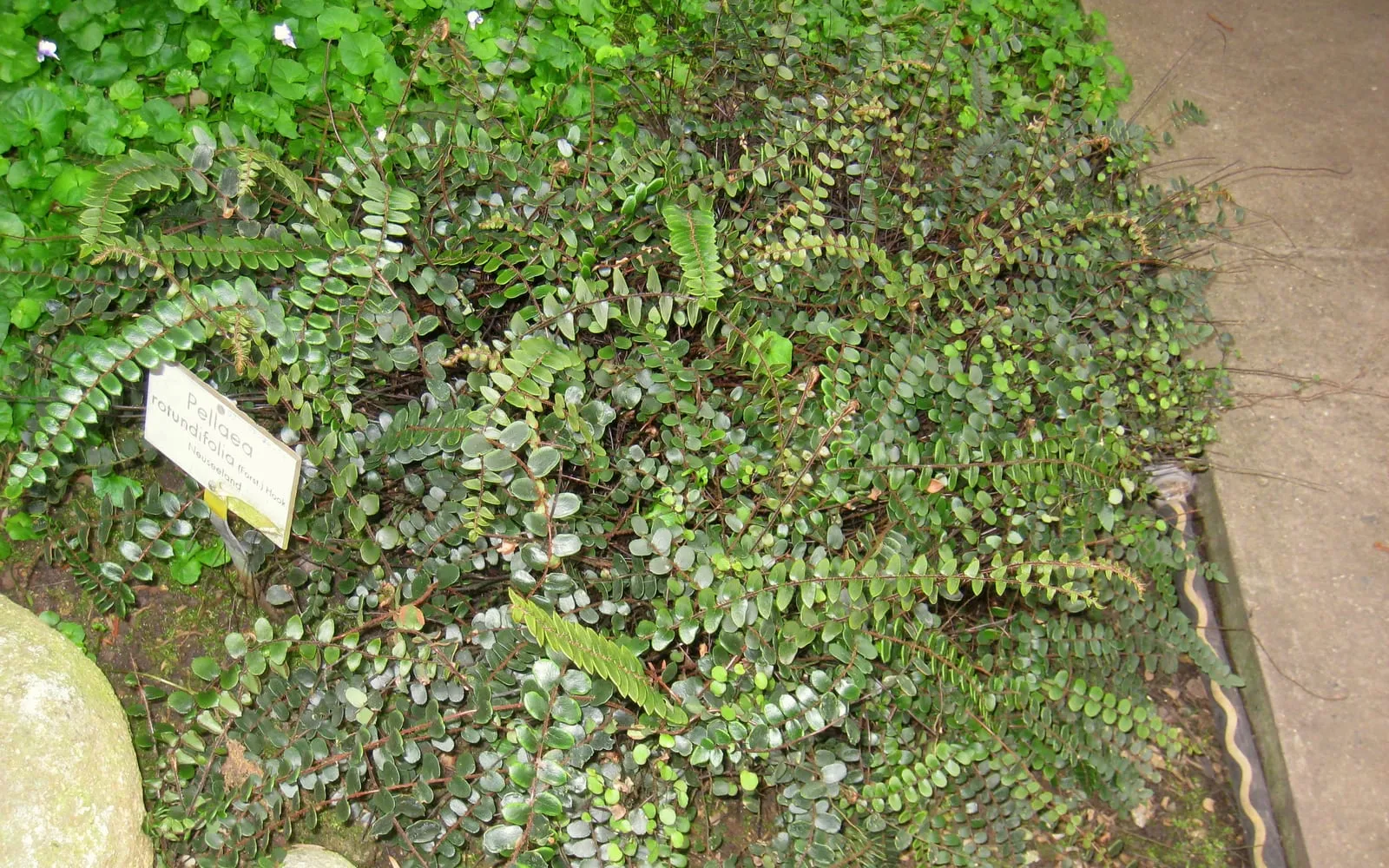
The button fern does not look like a fern to most people. Instead of a lacy divided frond it carries neat round leathery leaflets, dark green and glossy, spaced in two rows along a wiry near-black stalk. The effect is closer to a string of coins than to anything in a hanging basket.
That leathery texture is the reason to grow it. A thick-surfaced leaflet loses water far more slowly than the thin tissue of a maidenhair, so this fern tolerates a normal room in a way most ferns do not, and it will hold a dim position at the same time.
It has one uncompromising requirement, which is that it must never dry out completely. A button fern that has been left a week too long loses whole fronds, and because it is slow to replace them the plant looks poor for months afterwards. This is a fern that punishes forgetfulness rather than dry air.
Appearance and character
A low spreading fern growing from a thin creeping rhizome, forming a dense clump of arching fronds.
Each frond is 15 to 30 cm long, once-divided, with fifteen to thirty rounded to oval leaflets set in pairs along a dark, wiry, almost black stalk. The leaflets are 1 to 2 cm across, thick, leathery and a deep glossy green.
Young fronds carry rounder, smaller leaflets and the shape lengthens slightly with age.
Growth is slow. A plant adds a handful of fronds a season and takes years to fill a pot, which is why an established specimen is worth looking after.
Spore patches form as a continuous dark band along the rolled-under margin of the leaflets on mature fronds, rather than as separate dots.
Fronds arch outwards and the plant spreads sideways along its rhizome rather than building upwards, reaching 15 to 30 cm tall and rather wider.
Where it is from
New Zealand, throughout the North and South Islands, growing in lowland and hill forest on shaded banks, in rock crevices and on drier ground beneath canopy.
Two things about that habitat matter indoors. The climate is mild and oceanic with cool winters and no great heat, which is why the plant tolerates a cool room and dislikes a hot one. And it grows in sharply drained positions on banks and rock rather than in wet forest litter, which is why the compost has to drain freely and why a soggy pot rots the rhizome.
Its Maori name is tarawera. It is common and widespread in its native range and is one of the few New Zealand ferns to have become a standard houseplant worldwide.
The genus Pellaea contains around forty species, mostly from dry and rocky habitats, and several are called cliff brakes. That dry-country ancestry across the genus is the source of the drought tolerance that makes this one useful indoors.
How it grows
Give it medium indirect light or light shade. It holds a dim position well.
Keep it out of direct sun, which scorches the leaflets.
Water when the top third of the compost has dried, thoroughly, and drain completely. Never let it dry out fully.
Use a free-draining gritty compost. Houseplant compost with added bark and grit suits it better than anything water-retentive.
Keep it above 7 deg C and ideally between 15 and 24 deg C. It prefers cool conditions and suffers in a hot room.
Raise the humidity modestly. It needs less than other ferns, though very dry heated air still browns the leaflets.
Feed every six to eight weeks at quarter strength through the growing season.
Remove dead fronds at the base with scissors, since the plant does not shed them cleanly.
Repot every two or three years in spring into a wide shallow pot, since the rhizome spreads sideways.
Divide in spring to propagate, separating rooted sections of rhizome each with several fronds.
Through the seasons
Spring brings the main flush of new fronds, uncurling as tight croziers. Resume feeding, and repot or divide now.
Summer is steady slow growth. Water when the top third dries, feed every six to eight weeks, and keep it cool and out of the sun.
Autumn slows it further. Reduce watering and stop feeding from October.
Winter is easy provided the plant stays above 7 deg C and away from radiators. Water sparingly but never let it dry out.
Care difficulty
Moderate, and the difficulty is a narrow one.
Drying out completely is what kills it. Whole fronds brown and die, and the plant is too slow to replace them quickly, so one lapse spoils the look for months.
Overwatering rots the thin rhizome, which is the opposite failure and just as final.
The gap between those two is wider than for most ferns, which is what makes this a reasonable plant for a normal room, but it still needs checking weekly.
Heat is the third issue. A hot dry room browns the leaflets and stresses a plant adapted to a cool oceanic climate.
Watering
Water when the top third of the compost has dried, roughly weekly in summer and every ten to fourteen days in winter.
Water thoroughly until it drains from the bottom, then empty the saucer.
Check it weekly without fail. This plant gives little warning before losing fronds.
Use rainwater or filtered water where the supply is hard, since salts brown the leaflet margins.
Underwatering shows as whole fronds browning and crisping from the tip back. The affected fronds do not recover and must be cut out.
Overwatering shows as blackening at the base of the fronds, a soft rhizome and a sour compost smell.
Warning signs, diseases and pests
Whole fronds browning and dying is drought. Cut them off at the base, water more regularly, and expect the plant to look thin for several months while it replaces them.
Brown crisp leaflet margins are dry heated air or hard water. Raise the humidity and switch to rainwater.
Blackening frond bases with a soft rhizome is rot from overwatering.
A continuous dark band along the rolled-under edge of the leaflets is spores, not a pest. It appears on mature fronds and is normal.
Small brown discs on the wiry stalks are scale insects, which are easy to miss against the dark stems.
White cottony fluff at the base of the fronds is mealybug.
Pale scorched leaflets are sun damage.
A plant that has stopped producing new fronds entirely is usually cold, dry at the root, or recovering from one of those.
Growing environment
Medium indirect light or light shade.
Never direct sun.
Cool to average, 15 to 24 deg C, with 7 deg C as the floor. It tolerates cool rooms better than warm ones.
Moderate humidity, and it manages ordinary room air better than most ferns.
Free-draining gritty compost with added bark, in a wide shallow pot with drainage holes.
Outdoors in shade in USDA 9 and warmer, where established plants take a brief touch of frost.
Avoid hot dry rooms, radiators, direct sun and compost that either dries out completely or stays soggy.
Feeding
Feed every six to eight weeks from spring to early autumn with a balanced liquid houseplant fertiliser at quarter strength.
Stop feeding from mid-autumn to early spring.
Feed weakly. Ferns burn easily and the damage shows as brown leaflet margins that look like drought.
Repot every two or three years in spring into a wide shallow pot one size up.
Flush the compost occasionally with plain water to clear salts.
Troubleshooting
Whole fronds have gone brown. It dried out. The affected fronds will not recover, so cut them at the base. This fern is slow to replace them, so keep the compost from ever drying fully in future.
Is it really a fern? Yes. The round leathery leaflets look nothing like a typical fern frond, but the plant unfurls its new growth as croziers and reproduces by spores like any other.
There is a dark band along the leaflet edges. Spores, on mature fronds. It is normal and is not a pest.
Can it take a dry room? Better than most ferns, because the leaflets are thick and leathery. It still wants moderate humidity, and it will not forgive the compost drying out completely.
Is it safe with pets? Yes. The ASPCA lists it as non-toxic to cats, dogs and horses.
Why has it not grown all year? This is a slow fern and a season with only a few new fronds is normal, particularly in a dim position or after a setback.
What compost should it have? A gritty free-draining mix. It grows on banks and in rock crevices rather than in wet forest litter, so water-retentive compost rots the rhizome.
Can I divide it? Yes, in spring. Separate rooted sections of the creeping rhizome, each with several fronds, and expect them to sulk for a season.
Button fern problem guides
Not sure what is wrong? See the common houseplant pests guide.