
Houseplant
Baby rubber plant
Peperomia obtusifolia
Also known as Pepper face, American rubber plant, Blunt-leaved peperomia
How to care for Peperomia obtusifolia. Light, watering, dry rooms, propagation and avoiding root rot.
At a glance
- Difficulty
- Easy
- Water
- When the top half of the compost has dried
- Light
- Medium to bright indirect light, and it tolerates lower levels
- Temperature
- 18-26 deg C, and never below 12 deg C
- Humidity
- Undemanding. Thick leaves make it tolerant of dry air
- Hardiness
- USDA 10-12, RHS H1b, hardy to 12 C
- Type
- Evergreen perennial, semi-succulent and long-lived
- Height
- 25-30 cm
- Native to
- The Caribbean, Tropical America
Tropical American rainforest, where it grows as a small epiphyte on branches and rotting logs rather than in the ground, in warm shaded humid conditions with no cold season. Growing on bark rather than soil is what produced the thick water-storing leaves and the small fine root system, and it is why the plant needs an open, fast-draining compost indoors. It is damaged below about 12 deg C and needs a frost-free climate outdoors.
Hardiness zones describe winter cold alone. Summer heat, humidity, rainfall and the length of the growing season decide as much, so treat the range as the outer limit rather than as a recommendation.
Not known to be toxic
Non-toxic. The ASPCA lists Peperomia obtusifolia among plants that are not harmful to cats, dogs or horses, and the genus does not appear on RHS lists of potentially harmful garden plants. This is one of the more useful facts about the genus, because peperomias are small, sit on low shelves and desks where animals reach them, and are among the few completely safe options for a household with a cat that chews foliage. The plant is in the pepper family alongside black pepper and kava, and some peperomias are eaten as leaf vegetables in South America, though this species is grown for ornament rather than for food and there is no reason to eat it.
Sources: ASPCA (Baby Rubber Plant, Peperomia obtusifolia), RHS potentially harmful garden plants
About
The baby rubber plant is not a rubber plant and is not related to one. It is a peperomia, in the pepper family, and the name comes from the thick glossy leaves looking vaguely like a small Ficus elastica. Knowing that matters, because a real rubber plant wants regular watering and this one does not.
What it is, functionally, is a succulent that tolerates shade. The leaves store water, the root system is small and fine, and the plant is built for a life perched on a branch in a rainforest where the moisture arrives and drains away within the hour. Indoors that translates into a plant that copes with dry air, handles a dim corner, forgives a fortnight of neglect, and rots if the compost stays wet.
Almost every dead peperomia was watered on a schedule. The plant gives very little warning, because thick leaves stay looking fine while the stem bases turn to mush.
Appearance and character
A compact upright perennial with thick fleshy stems and glossy, rounded, spoon-shaped leaves, forming a bushy clump that sprawls outwards as it ages.
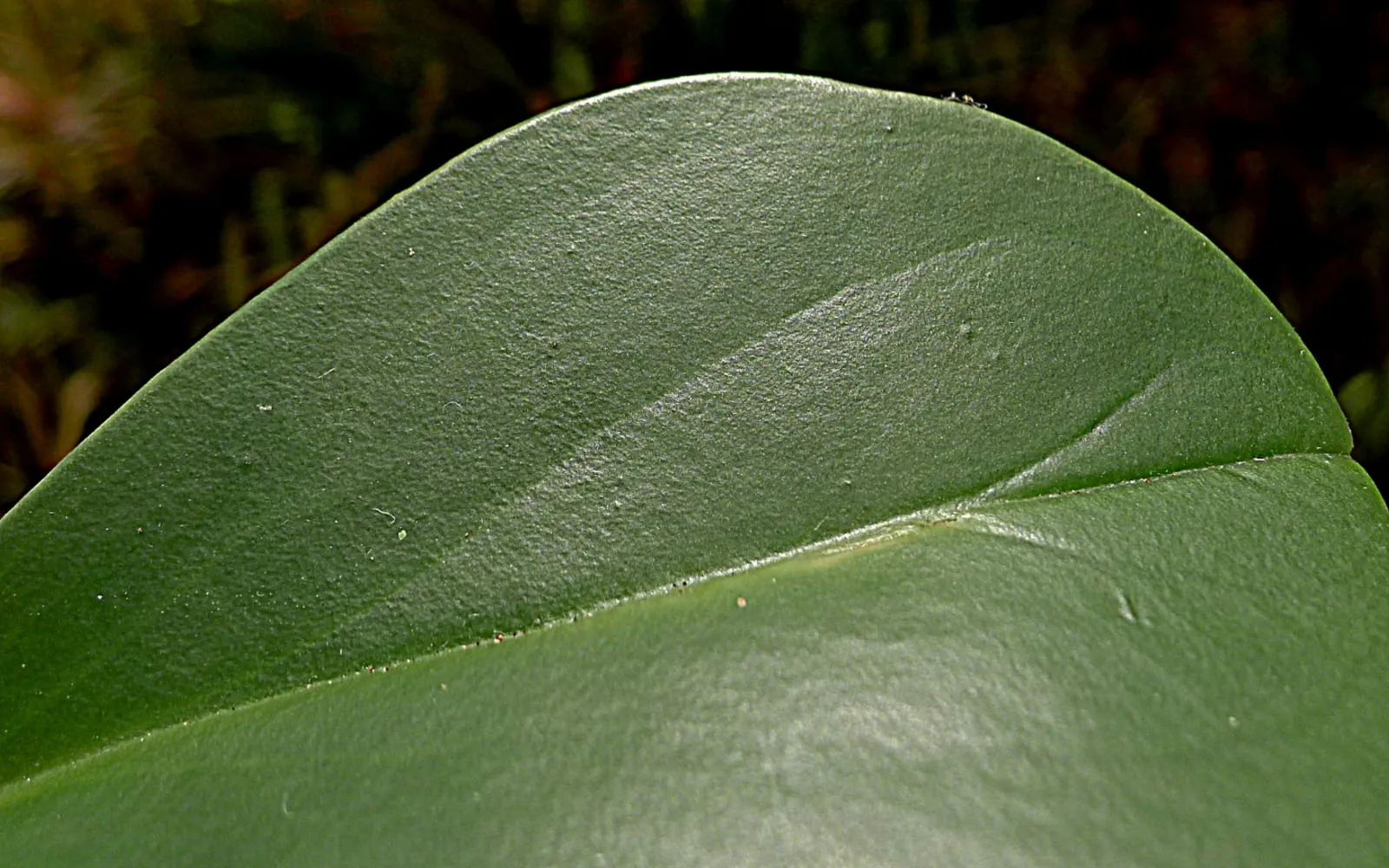
Each leaf is 5 to 10 cm long, cupped, blunt-tipped, very thick, and a deep glossy green in the plain form. The stems are equally succulent and often flushed red.
Growth is moderate and the plant stays small, at 25 to 30 cm tall, which is why it is sold as a desk plant.
Flowers appear readily even in poor light, as narrow greenish white spikes held above the foliage on thin stalks. They look like rat tails and are the family signature. They carry no scent and cost the plant little, so leaving them on does no harm.
Variegated cultivars are common. ‘Variegata’ has broad creamy margins, ‘Golden Gate’ is marbled in cream and grey-green, and all of them need more light than the plain form to hold the pattern.
Stems become long and sprawling with age, which is normal rather than a fault, and cuttings root very readily.
Where it is from
Florida, Mexico, the Caribbean and northern South America, growing as a small epiphyte on branches, tree bases and rotting logs in tropical forest.
Growing on bark rather than in the ground explains the whole plant. An epiphyte in a rainforest gets soaked and then dries within an hour, so it stores water in its leaves and stems and keeps a small root system that would rot in constant moisture. Reproducing that with garden compost in a pot is what most owners get wrong.
The shade tolerance is the ordinary condition of the understorey it grows in.
The genus Peperomia is enormous, with well over a thousand species across the tropics, and dozens are in cultivation. It sits in the Piperaceae with black pepper and kava.
How it grows
Give it medium to bright indirect light. It tolerates lower levels at the cost of speed, and variegated forms want the brighter end.
Keep it out of direct sun, which bleaches and scorches the leaves.
Water when the top half of the compost has dried, thoroughly, and let it drain completely. Then leave it alone.
Use a very open compost. Houseplant compost cut with a third perlite, or an orchid or cactus mix, is closer to what the roots want than ordinary compost.
Choose a small pot. A peperomia in an oversized pot sits in wet compost the roots cannot reach, which is the standard route to rot.
Keep it above 12 deg C and ideally between 18 and 26 deg C.
Feed every six to eight weeks at quarter to half strength through the growing season, and not at all in winter.
Pinch the growing tips to keep it bushy, since an unpinched plant sprawls.
Take cuttings whenever you prune. A leaf with its stalk, or a short stem section, roots in damp compost within a few weeks.
Through the seasons
Spring restarts growth. Resume light feeding, repot if the plant has outgrown its pot, and take cuttings.
Summer is the growing season. Water when the top half dries, feed every six to eight weeks, and pinch tips to keep the shape.
Autumn slows it. Reduce watering, stop feeding from October.
Winter is when most losses happen. Water very sparingly, keep it above 12 deg C and away from cold glass. A cool wet root ball is fatal.
Care difficulty
Easy, with one hard rule about water.
Overwatering is the way it dies and the only common cause. The base of a stem turns brown and soft, the plant collapses, and by then it is usually too late for the parent though cuttings from the top will save the plant.
Cold combined with wet compost accelerates it, which is why winter is the dangerous season.
Legginess is cosmetic. Stems sprawl with age and the fix is pinching and cutting back, with the trimmings rooted to fill the pot.
Ring spot virus turns up occasionally, showing as brown concentric rings on the leaves. There is no cure and the plant should be discarded rather than propagated.
Watering
Water when the top half of the compost has dried, which in a medium-lit room often means every ten to fourteen days in summer and every three to four weeks in winter.
Water thoroughly until it drains from the bottom, then empty the saucer.
Lift the pot to judge it. The weight difference between wet and dry is the most reliable guide with a plant whose thick leaves hide thirst.
Cut watering back hard in winter, when the plant is not growing and the compost stays wet for weeks.
Underwatering shows as slightly soft, dull, wrinkled leaves, and the plant plumps back up within a day of watering.
Overwatering shows as yellowing leaves that fall while still firm, soft brown stem bases and a sour compost smell. Take cuttings from healthy top growth immediately.
Warning signs, diseases and pests
Leaves falling while still firm and plump is overwatering. Check the stem bases, which will be soft and brown, and take cuttings if the base has gone.
Wrinkled, slightly limp leaves are underwatering, which is easily corrected.
Brown concentric rings on the leaves are ring spot virus. There is no treatment, and the plant should be destroyed rather than propagated, since cuttings carry it.
White cottony fluff in the crown and among the leaf stalks is mealybug, which this plant’s crowded centre hides well.
Small flies rising from the compost are fungus gnats, which indicate the compost is being kept too wet.
Bleached or scorched patches are sun damage.
Loss of variegation is insufficient light on a variegated cultivar.
Long bare sprawling stems are age and low light. Pinch the tips, cut back, and root the trimmings into the same pot.
Growing environment
Medium to bright indirect light, and it tolerates lower levels at the cost of speed. Variegated forms need more.
Never direct sun.
Warm, 18 to 26 deg C, with 12 deg C as the floor.
Dry air is fine. Thick leaves make this one of the more drought-tolerant plants on the shelf, and no humidity provision is needed.
Very free-draining compost with a third perlite or bark, in a small pot with drainage holes.
A small pot rather than a generous one, since excess wet compost is the main danger.
Outdoors only in a frost-free climate in shade, USDA 10 and warmer.
Avoid deep pots, water-retentive compost and saucers left full.
Feeding
Feed every six to eight weeks from spring to early autumn with a balanced liquid houseplant fertiliser at quarter to half strength.
Stop feeding entirely from mid-autumn to early spring.
Feed lightly. This is a small plant with a small root system and it burns easily, showing as brown leaf margins and a crust on the compost.
Repot every two or three years in spring, and only into a pot one size up. A peperomia does better slightly cramped.
Flush the compost occasionally with plain water to clear accumulated salts.
Troubleshooting
Leaves are dropping off while still firm. Overwatering. Check the base of the stems, which will be soft and brown. Let the top half of the compost dry between waterings, and take cuttings from healthy growth if the base has rotted.
Is it related to a rubber plant? No. It is a peperomia in the pepper family. The name comes from the thick glossy leaves resembling a small ficus, and the care is completely different.
The leaves are wrinkled. Underwatering. Water it and they will plump up within a day. This is the easy problem to have.
Brown rings on the leaves. Ring spot virus. There is no cure. Destroy the plant rather than propagating it, since cuttings carry the virus.
Is it safe with a cat? Yes. The ASPCA lists it as non-toxic to cats, dogs and horses, which makes it one of the safest plants for a low shelf.
What are the odd green spikes? Flowers. Peperomia flower spikes look like narrow rat tails and are perfectly normal, even on a young plant in modest light.
It has gone sprawling and leggy. Age plus low light. Pinch the tips regularly, cut it back in spring, and root the cuttings into the same pot to thicken it up.
How often should I water it in winter? Far less than in summer, perhaps every three to four weeks. A cool room plus wet compost is what kills peperomias.
Baby rubber plant problem guides
Not sure what is wrong? See the common houseplant pests guide.