
Houseplant
Lady palm
Rhapis excelsa
Also known as Bamboo palm, Broadleaf lady palm, Rhapis
How to care for Rhapis excelsa. The most shade-tolerant palm in cultivation, why it costs what it does, and why a plant that suits cool dim rooms is still sold as difficult.
At a glance
- Difficulty
- Easy
- Water
- When the top third of the compost has dried
- Light
- Low to medium indirect light. It holds deep shade better than any other palm
- Temperature
- 16-24 deg C, tolerating brief spells near 5 deg C
- Humidity
- Moderate. More forgiving of dry air than most palms
- Hardiness
- USDA 9-11, RHS H2, hardy to -2 C
- Type
- Evergreen perennial palm, clump-forming and very long-lived
- Height
- 2-3 m indoors after many years
- Native to
- Southern China, Taiwan
Subtropical understorey from southern China and Taiwan, growing in shade on forest slopes with cool winters and no frost to speak of. That cool-winter ancestry is what separates it from the tropical palms, and it takes brief dips to around -2 deg C on an established plant without lasting damage. It wants a climate with no hard frost and enough summer humidity to avoid scorched tips, and it will not take a dry continental winter outdoors.
Hardiness zones describe winter cold alone. Summer heat, humidity, rainfall and the length of the growing season decide as much, so treat the range as the outer limit rather than as a recommendation.
Not known to be toxic
Non-toxic. The ASPCA lists Rhapis excelsa among plants that are not harmful to cats, dogs or horses, and it appears on no RHS list of potentially harmful garden plants. It is one of a very small group of plants that combine deep shade tolerance with complete safety, the others being the cast iron plant, the parlour palm and the kentia. The stiff fan-shaped leaflets are unappealing to a chewing animal in practice as well as being harmless in principle. The brown fibre wrapping the canes is old leaf sheath rather than anything applied to the plant, and it presents no hazard either, though it is worth pulling away where it hides scale insects.
Sources: ASPCA (Lady Palm, Rhapis excelsa), RHS potentially harmful garden plants
About
The lady palm is the plant interior landscapers reach for when a job needs something living in a dark lobby that will still be there in fifteen years. It tolerates less light than any other palm in cultivation, takes cool rooms, shrugs off dry air better than its relatives, and grows so slowly that a specimen keeps its shape for a decade.
The price follows directly from the slowness. A lady palm sold at a metre tall has spent five or six years in a nursery, and no amount of feeding shortens that. What you are paying for is time already spent, which is also why a mature plant holds its value and why they are so often inherited rather than bought.
It has a reputation for being difficult that it does not deserve. Almost every lady palm that fails does so from compost that never dries, and a palm this slow in a room this dim uses far less water than the person watering it expects.
Appearance and character
A clumping palm producing multiple slender upright canes from a spreading underground rhizome, each cane about the thickness of a finger and wrapped in a coarse dark brown fibre that is the remains of old leaf sheaths.
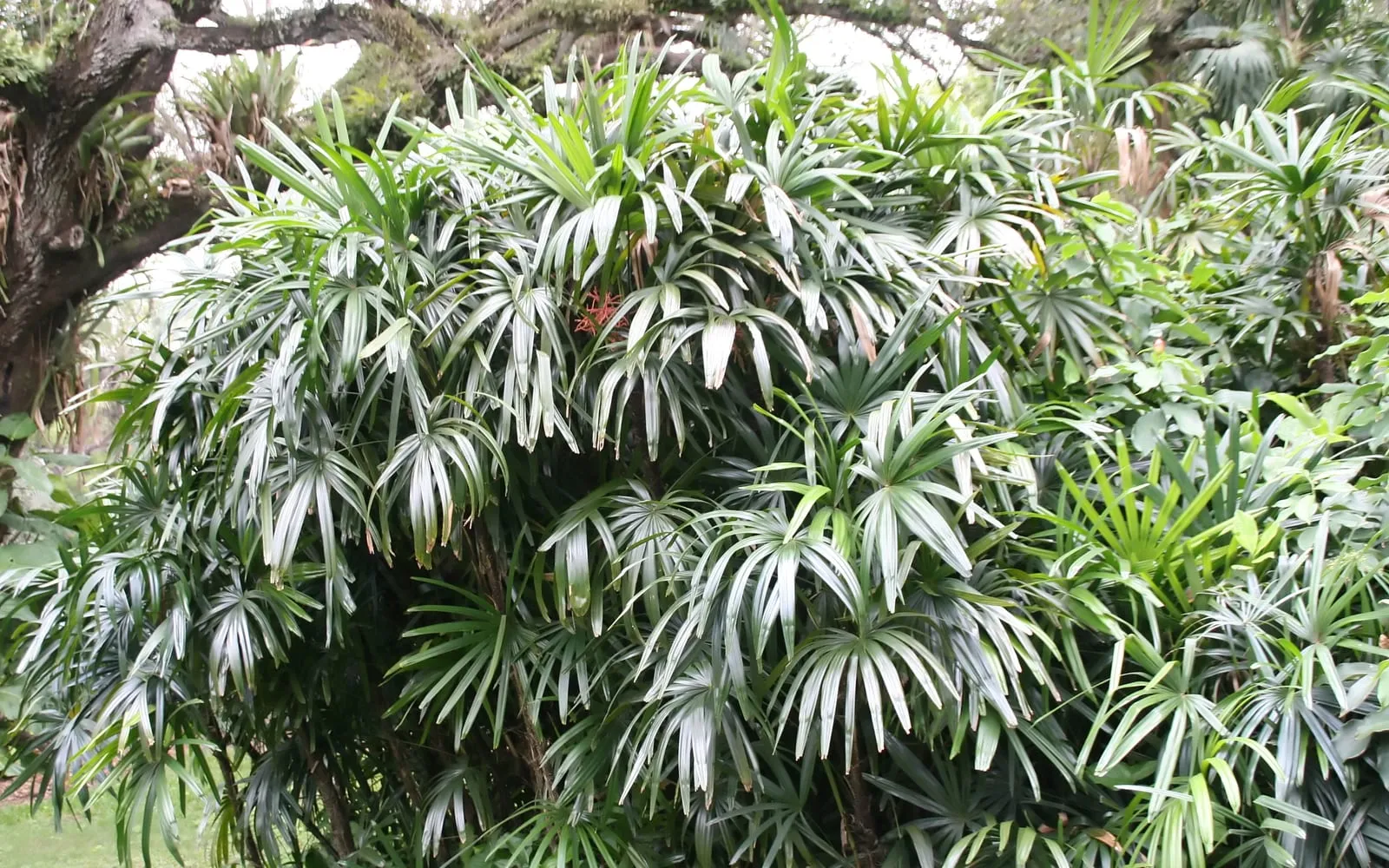
The leaves are palmate rather than feathered, which is unusual among indoor palms. Each is a fan of three to ten stiff, glossy, deep green leaflets with blunt, squared-off tips that look as though they have been trimmed with scissors. That squared tip is the quickest way to recognise the species.
Growth is very slow, at perhaps two or three new leaves per cane per year, and new canes appear from the rhizome at a similar rate. A clump thickens rather than shooting up, and two metres is a great age indoors.
Named cultivars exist in some quantity, most of them Japanese and several variegated with white or yellow striping. Those cost several times what the plain green form does and want more light to hold the pattern.
Plants are male or female, and flowering indoors is uncommon and unremarkable when it happens, producing small fleshy branched sprays among the leaf bases.
Where it is from
Southern China and Taiwan, on shaded forest slopes, though the species has been in cultivation so long that wild populations are hard to identify.
It reached Japan by the seventeenth century and became a plant of the Tokugawa court, where collectors bred and named variegated forms and traded them at prices that would look familiar to anyone who watched the houseplant market in recent years. Japanese cultivar names still attach to most of the variegated forms sold.
The subtropical origin is what gives it the cool tolerance. A palm from a forest slope with cool winters copes with an unheated hallway in a way that a lowland tropical palm does not, and an established plant takes a brief touch of frost outdoors without lasting harm.
The genus Rhapis contains around a dozen species, and Rhapis humilis, the slender lady palm, is the other one occasionally sold. It is taller, finer in the leaf and slightly less shade-tolerant.
How it grows
Give it low to medium indirect light. It holds a corner darker than any other palm will accept, and it also takes a brighter position provided the sun is not direct.
Keep it out of direct sun, which yellows the leaves and scorches the leaflet tips.
Water when the top third of the compost has dried. In a cool dim room this can mean every two to three weeks, and in winter less often still.
Keep it between 16 and 24 deg C. It tolerates cooler conditions than most houseplants and does not want to sit above a radiator.
Feed every six to eight weeks through spring and summer at half strength, and not at all in winter.
Repot every three or four years at most, in spring, moving up one pot size. A clump growing from a rhizome fills a pot slowly and does better slightly restricted.
Divide a large clump in spring if you want more plants, cutting through the rhizome with a clean knife so each division carries several canes and its own roots. Expect the divisions to sulk for a season.
Pull the brown fibre away from the cane bases occasionally and look underneath. Scale insects shelter there and go unnoticed for months otherwise.
Remove whole leaves at the cane where they have browned, and cut out an entire cane at soil level if it dies. Unlike a single-stemmed palm, the clump carries on regardless.
Through the seasons
Spring is when new leaves and new canes appear. Resume feeding, and divide or repot now if the clump has filled its pot.
Summer is steady slow growth. Water when the top third dries and feed every six to eight weeks. Keep it out of the sun and watch for spider mite.
Autumn slows it down. Reduce watering, stop feeding from October, and move the plant nearer the glass as the daylight shortens.
Winter demands almost nothing except restraint. Water sparingly, keep it cool rather than warm, and accept that nothing will happen until spring.
Care difficulty
Easy, with one hard requirement, which is that the compost must dry between waterings.
Overwatering is what kills it, and it kills slowly enough to be misdiagnosed. The rhizome rots, the canes yellow one at a time over months, and the plant is usually treated for something else before anyone looks at the roots.
Hard water is the second difficulty. Lady palms are sensitive to fluoride and to accumulated fertiliser salts, and both produce the brown leaflet tips that are the commonest complaint about the species.
Slowness is the third, and it is a fact rather than a fault. A lady palm will not fill a corner in a season, and buying the size you want is the only way to have it.
Beyond those it takes shade, cool rooms, draughts and long gaps between waterings without complaint.
Watering
Water when the top third of the compost has dried, thoroughly, until it runs from the drainage holes.
Empty the saucer within twenty minutes. A palm standing in water is the standard route to a rotted rhizome.
In a cool shaded room this often means every two to three weeks in summer and monthly in winter. Judge it by the compost rather than by the calendar, and lift the pot to learn its weight wet and dry.
Use rainwater or filtered water where the supply is hard. Fluoride is the specific problem, and it accumulates until the leaflet tips brown.
Flush the compost through with plain water two or three times a year to clear salts, letting several potfuls drain away.
Underwatering shows as dull leaves and dry tips and is easily corrected. Overwatering shows as yellowing canes and a sour smell and is not.
Warning signs, diseases and pests
Brown, dry leaflet tips are the signature complaint and usually mean hard water or fertiliser salts rather than dry air. Flush the pot, switch to rainwater and feed at half strength.
Yellowing of a whole cane from the base upwards is either old age, if it is one cane among many, or root rot if it spreads. Tip the plant out and look at the rhizome, which should be firm and pale.
Small flat brown discs on the leaf undersides, the stalks and under the cane fibre are scale insects. This plant hides them better than most, so pull the fibre back and check when anything looks sticky.
Fine pale stippling across the leaflets is red spider mite, which arrives in warm dry air and troubles this palm less than a parlour palm.
White fluff among the cane bases is mealybug.
Pale, washed-out leaves in a bright position are sun damage rather than a nutrient problem. Move the plant back from the window.
No new growth for a whole year on an otherwise healthy plant is often normal. This palm is slow enough that a season with nothing visible is unremarkable.
Variegated cultivars losing their pattern are usually short of light. Move them brighter, though still out of direct sun.
Growing environment
Low to medium indirect light, including positions well back from a window that no other palm would accept.
Never direct sun.
Cool to average warmth between 16 and 24 deg C. An unheated hallway suits it better than a hot living room.
Moderate humidity. It is more tolerant of dry air than the parlour palm, though tips brown faster in a very dry room.
Free-draining peat-free houseplant compost in a pot with drainage holes, and a pot heavy enough to balance a tall clump.
Outdoors it grows in shade in frost-free and near-frost-free climates, roughly USDA 9 and warmer, and an established clump takes a brief -2 deg C.
Avoid radiators, hot dry airflow and any pot that holds standing water.
Feeding
Feed every six to eight weeks from spring to early autumn with a balanced liquid houseplant fertiliser at half the strength on the label.
Stop feeding entirely from mid-autumn to early spring.
Feed variegated cultivars more sparingly still, since rich feeding pushes green growth at the expense of the pattern.
Repot every three or four years in spring. The plant does better slightly pot-bound, and disturbing the rhizome sets it back a season.
Flush the compost occasionally with plain water to clear accumulated salts, which are the usual cause of brown tips on a well-cared-for plant.
Troubleshooting
The leaf tips are brown and dry. Hard water or fertiliser salts in most cases rather than dry air. Flush the compost through, switch to rainwater and halve the feed.
A whole cane has gone yellow. One cane among several is normal ageing. Cut it out at the base. Several at once means the rhizome is rotting, so check the roots and reduce watering hard.
Why is it so expensive? Because it grows slowly. A metre-tall plant represents five or six years of nursery time and there is no way to speed that up.
Sticky leaves and small brown discs. Scale insects, and this plant hides them under the fibre on the canes. Pull the fibre back to look.
Is it safe with pets? Yes. The ASPCA lists it as non-toxic to cats, dogs and horses.
How dark a corner will it take? Darker than any other palm sold. It holds positions where a kentia would decline, though it grows more slowly there.
It has not grown at all this year. That may be normal. Two or three leaves per cane in a year is a good rate for this species.
Can it go outside? In shade, in a climate without hard frost. It takes a brief -2 deg C when established, and in colder places it can spend the summer outdoors in full shade and come in before autumn.
Lady palm problem guides
Not sure what is wrong? See the common houseplant pests guide.