
Houseplant
Dwarf umbrella tree
Schefflera arboricola
Also known as Umbrella plant, Hawaiian schefflera, Heptapleurum arboricola
How to care for Schefflera arboricola. The tough bushy shrub that takes hard pruning and medium light, why the leaflets drop, and how to stop it becoming a bare stick.
At a glance
- Difficulty
- Easy
- Water
- When the top third of the compost has dried
- Light
- Bright indirect light, and it holds medium light without stretching much
- Temperature
- 15-24 deg C, and never below 10 deg C
- Humidity
- Moderate. It tolerates ordinary dry room air well
- Hardiness
- USDA 9b-11, RHS H1c, hardy to 2 C
- Type
- Evergreen perennial shrub, long-lived
- Height
- 2-3 m indoors
- Native to
- Taiwan, Southern China
Subtropical Taiwan and southern China, growing as an understorey and forest edge shrub in warm humid conditions with a mild frost-free winter. That subtropical rather than equatorial origin gives it more cold tolerance than most large-leaved houseplants, and an established plant outdoors survives brief spells near 2 deg C. It wants warmth and light shade and will not take frost. It has naturalised and become invasive in Hawaii and parts of Florida, so check local status before planting it outside.
Hardiness zones describe winter cold alone. Summer heat, humidity, rainfall and the length of the growing season decide as much, so treat the range as the outer limit rather than as a recommendation.
Toxic if eaten
- Do not eat
- Every part, and the sap
- Harm from
- Eating it and handling it
- Affects
- People, cats and dogs
Schefflera contains needle-shaped calcium oxalate crystals, and the ASPCA lists it as toxic to cats and dogs. An animal that chews the foliage experiences immediate oral burning, drooling, vomiting and swelling of the mouth and tongue, and difficulty swallowing follows in worse cases. The plant is a common cause of calls to animal poison lines, partly because it is grown as a large floor specimen with leaves at exactly the height a dog investigates. The sap can also cause contact dermatitis in sensitive people, so wear gloves when pruning, which this plant needs regularly. Effects are painful rather than usually dangerous, but swelling that reaches the airway in a small animal needs immediate veterinary attention.
Sources: ASPCA (Schefflera), RHS potentially harmful garden plants
About
The dwarf umbrella tree is what to buy when a room needs a metre or two of bushy green and the light is average. It is not a deep-shade plant in the way an aspidistra is, but it holds a medium position without stretching badly, tolerates dry air, takes hard pruning and regrows from old wood, which very few houseplants do.
That tolerance of pruning is the property that matters most. A schefflera that has gone leggy can be cut back to bare stumps in spring and will resprout, which means a plant that has been neglected for years is recoverable rather than disposable.
Its defining fault is leaflet drop. It sheds in response to almost any change, whether a move across the room, a cold draught, a missed watering or a soaking, and owners who react to the shedding by watering more usually make it worse.
Appearance and character
An upright evergreen shrub with slender woody stems, often sold with several plants braided or grouped in one pot to look full.
The leaves are palmately compound, meaning seven to eleven glossy oval leaflets radiate from the top of a single long stalk like the spokes of an umbrella. Each leaflet is 7 to 15 cm long, deep glossy green, with a blunt or slightly notched tip.
Variegated cultivars carry yellow or cream marbling and need noticeably more light than the plain green form to hold it.
Growth is moderate and upright. A plant reaches two to three metres indoors over many years and becomes bare at the base if it is never pruned.
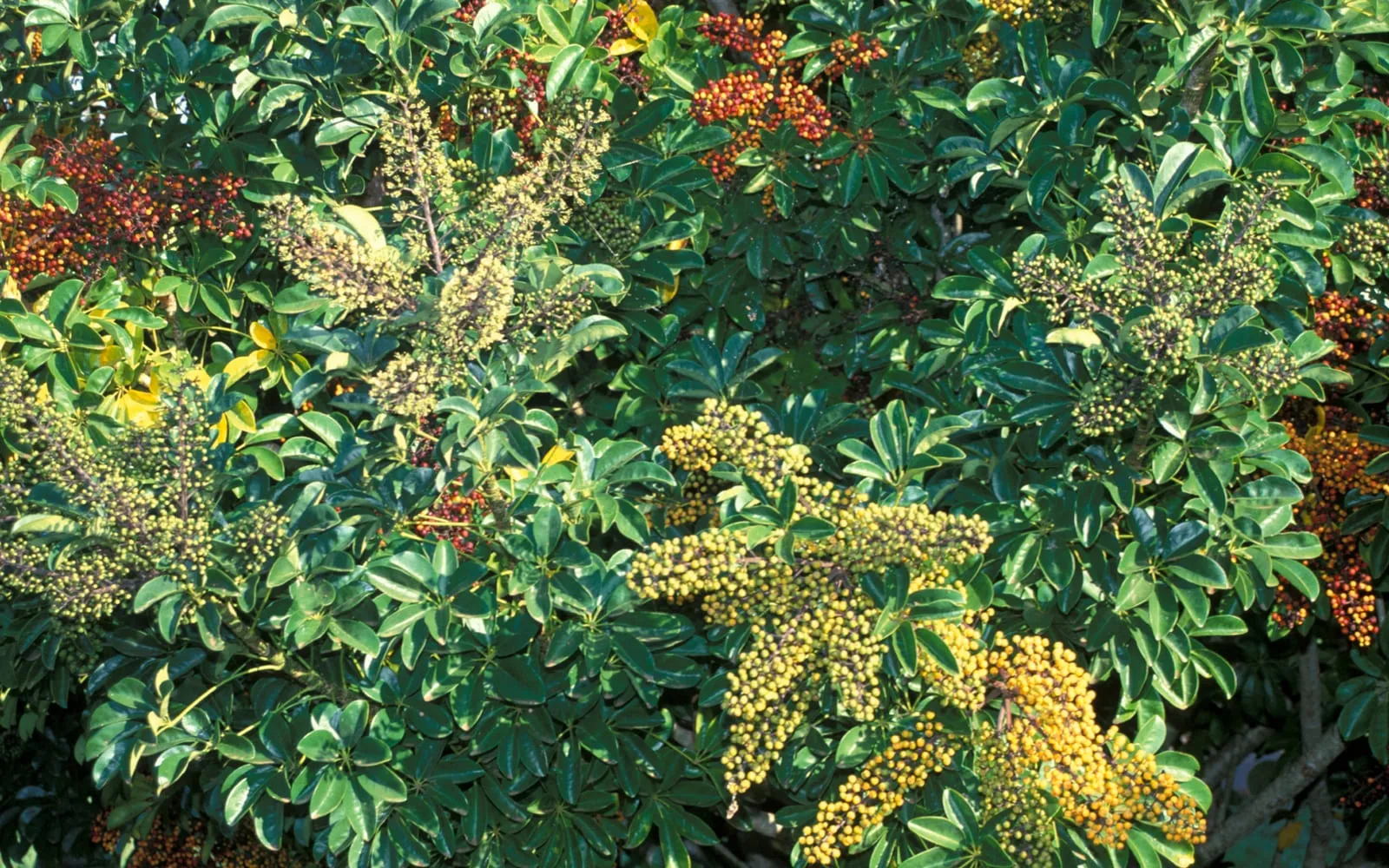
Flowering is rare indoors. Outdoors in warm climates it produces sprays of small red flowers followed by orange fruits, which are attractive to birds and are part of why it spreads where it has escaped.
The genus name is in flux. Botanical work has moved this species to Heptapleurum arboricola, and both names appear on labels.
Where it is from
Taiwan and Hainan in southern China, growing as a shrub in the understorey and at the edges of subtropical forest.
Its origin explains its usefulness indoors. Forest edge species tolerate a wide range of light, and a subtropical range with cool winters gives it more cold tolerance than the equatorial plants it sits beside in a garden centre.
It has escaped cultivation and become an environmental weed in Hawaii and parts of Florida, where birds spread the seed and the plant establishes on other trees and in disturbed forest. Do not plant it out in those climates.
The related Schefflera actinophylla, the Queensland umbrella tree, is a much larger species with bigger leaflets, sold as a houseplant when young and invasive across a similar range.
How it grows
Give it bright indirect light for the best growth, and expect it to hold a medium position with only modest stretching. Variegated forms need the brighter end.
Keep it out of harsh direct sun, which scorches the leaflets, though a little gentle morning sun does no harm.
Water when the top third of the compost has dried, thoroughly, and drain completely.
Keep it between 15 and 24 deg C, with 10 deg C as the floor. It prefers cooler conditions than most tropical foliage plants.
Avoid moving it about. Sudden changes of position, temperature or watering routine all provoke leaflet drop.
Feed monthly at half strength through the growing season.
Prune in spring, cutting stems back to the height you want. It resprouts from old wood readily, which is unusual and makes it easy to keep at a chosen size.
Pinch the growing tips of a young plant to encourage branching, since an unpinched schefflera runs upward on a single stem.
Repot every two or three years in spring, one pot size up, and use a heavy pot for a tall plant.
Through the seasons
Spring is the time for pruning and repotting. Cut back leggy growth now so the plant has the season to fill out, and resume feeding.
Summer is steady growth. Water when the top third dries, feed monthly, and watch for red spider mite in warm dry rooms.
Autumn slows it. Reduce watering, stop feeding from October, and move it nearer the light.
Winter is when leaflet drop is worst. Keep it away from radiators and cold draughts alike, water sparingly, and accept some shedding.
Care difficulty
Easy, with one recurring nuisance.
Leaflet drop is that nuisance. A plant sheds after being moved, after a cold night, after drying out and after being overwatered, and the shedding looks the same in each case. Work out which happened rather than reaching for the watering can.
Red spider mite is the pest that ruins schefflera indoors, thriving in warm dry air and producing a dull stippled plant with fine webbing before most people notice.
Overwatering rots the roots and drops leaflets in quantity, and it is the most common serious mistake.
Legginess is easily fixed on this species because it resprouts from old wood, so a bare plant is worth cutting back rather than discarding.
Watering
Water when the top third of the compost has dried, roughly weekly in summer and every two to three weeks in winter.
Water thoroughly until it drains, then empty the saucer promptly.
Keep the routine steady. This plant reacts to change more than to any particular regime.
Reduce watering substantially in winter, when growth stops and the compost stays wet far longer.
Underwatering causes wilting and then leaflet drop from the lower stems. Recovery is good if it is caught early.
Overwatering causes yellowing leaflets, blackened stem bases and heavy shedding. Check the roots before concluding the plant is thirsty.
Warning signs, diseases and pests
Leaflets dropping in quantity is the plant’s response to change. Consider what altered recently, whether position, temperature, draught or watering, and correct that rather than adding water.
Fine pale stippling across the leaflets with faint webbing between them is red spider mite. Confirm by tapping a leaf over white paper. Raise the humidity and treat promptly.
Small flat brown discs along the stems and leaf undersides are scale insects, with sticky honeydew and sooty mould below them.
White cottony fluff where leaflets meet the stalk is mealybug.
Yellowing lower leaflets with soft stems is overwatering.
Long bare stems with foliage only at the top is low light and no pruning. Cut back hard in spring.
Loss of variegation on a variegated cultivar means insufficient light.
Brown scorched patches on the leaflets are sun damage from harsh direct light.
Growing environment
Bright indirect light for the best growth, and it holds a medium position reasonably well.
Gentle morning sun is acceptable. Harsh midday sun is not.
Cool to average, 15 to 24 deg C, with 10 deg C as the floor.
Moderate humidity, and it copes with dry room air better than most large-leaved houseplants.
Free-draining peat-free houseplant compost in a heavy pot with drainage holes.
A stable position out of draughts and away from radiators, since it dislikes change more than it dislikes any particular condition.
Outdoors in a frost-free or near-frost-free climate, USDA 9b and warmer, but not in Hawaii or Florida where it is an environmental weed.
Feeding
Feed monthly from spring to early autumn with a balanced liquid houseplant fertiliser at half the strength on the label.
Stop feeding from mid-autumn to early spring.
Feed variegated cultivars at the same rate. Excess nitrogen pushes green growth at the expense of the pattern.
Repot every two or three years in spring, one pot size up.
Flush the compost occasionally with plain water to clear accumulated salts.
Troubleshooting
It is dropping leaflets everywhere. Something changed. Look at position, draughts, temperature and watering rather than assuming it is thirsty, since overwatering causes the same symptom.
It has become a bare stick with leaves on top. Low light and no pruning. Cut the stems back hard in spring. This species resprouts from old wood, so even a badly neglected plant recovers.
Fine speckling and webbing. Red spider mite, which is the plant’s main pest indoors. Raise the humidity and treat early.
Is it safe with a dog? No. The ASPCA lists Schefflera as toxic to cats and dogs, and it causes oral burning and vomiting. It is a common cause of calls to animal poison lines because it sits at floor level.
Why is it called Heptapleurum now? Botanical revision moved the species out of Schefflera. Both names refer to the same plant and labels vary.
The variegation is fading. Not enough light. Move it to a brighter position out of harsh sun.
Can I cut it back hard? Yes, harder than almost any other houseplant. Cut to the height you want in spring and it will resprout from bare wood.
Can I plant it in the garden? Only in a frost-free climate, and not in Hawaii or Florida, where it has escaped and become an environmental weed.
Dwarf umbrella tree problem guides
Not sure what is wrong? See the common houseplant pests guide.