
Houseplant
Aluminium plant
Pilea cadierei
Also known as Watermelon pilea, Aluminum plant, Pilea cadierei
How to care for Pilea cadierei. Light, watering, pruning leggy stems, keeping the silver markings clear and replacing old plants.
At a glance
- Difficulty
- Easy
- Water
- When the top third of the compost has dried
- Light
- Medium indirect light, and it keeps its markings in lower light
- Temperature
- 18-26 deg C, and never below 12 deg C
- Humidity
- Moderate to high. Dry air browns the leaf edges
- Hardiness
- USDA 10-12, RHS H1b, hardy to 12 C
- Type
- Evergreen perennial, short-lived and best renewed from cuttings
- Height
- 25-30 cm
- Native to
- Vietnam, Southern China
Humid tropical forest floor in Vietnam and southern China, growing in deep shade in constantly moist leaf litter with no cold season. It has thin leaves rather than succulent ones, which is why it needs steadier moisture than a peperomia and suffers in dry air. Damaged below about 12 deg C, it needs a warm humid frost-free climate outdoors and is grown almost exclusively indoors.
Hardiness zones describe winter cold alone. Summer heat, humidity, rainfall and the length of the growing season decide as much, so treat the range as the outer limit rather than as a recommendation.
Not known to be toxic
Non-toxic. The ASPCA lists Pilea cadierei among plants that are not harmful to cats, dogs or horses, and the genus does not appear on RHS lists of potentially harmful garden plants. The nettle family it belongs to contains some notorious stinging genera, but *Pilea* has no stinging hairs and no irritant sap, so there is no risk from handling the plant or from an animal chewing it. This is a small plant that lives on shelves and windowsills at the height a cat investigates, which makes the safety more useful than it would be on a large specimen. Its relative *Pilea peperomioides*, the Chinese money plant, is equally harmless.
Sources: ASPCA (Aluminum Plant, Pilea cadierei), RHS potentially harmful garden plants
About
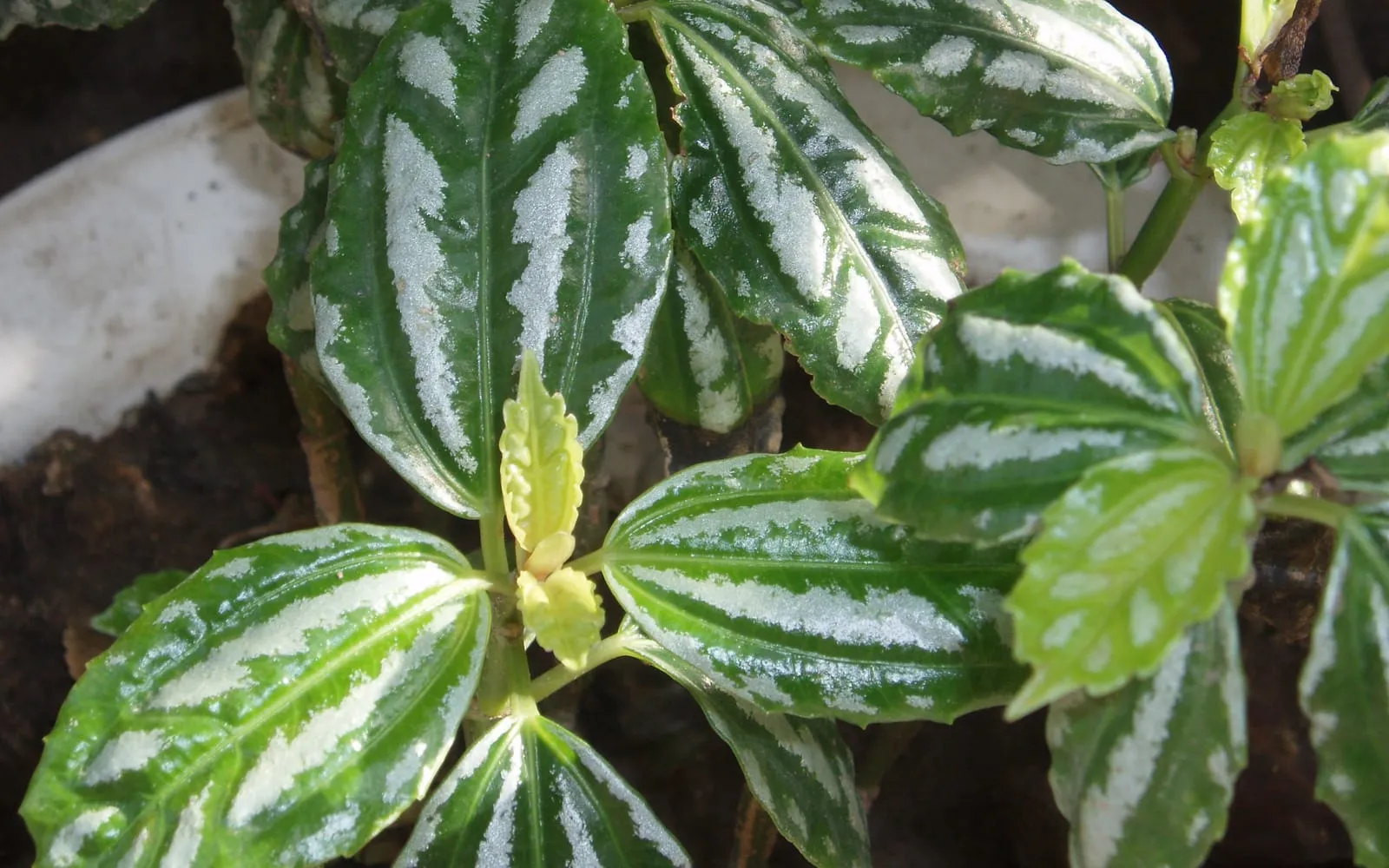
The aluminium plant looks as though somebody has flicked silver paint across it, which is exactly how it got its name. Raised silver patches sit between the veins on a dark green leaf, arranged in four neat rows, and the effect is metallic enough to be striking on a plant this small.
Like the silver in a satin pothos or a watermelon peperomia, those patches are structural rather than pigmented. The leaf surface is lifted away from the chlorophyll layer beneath, leaving an air gap that reflects light. Since no chlorophyll has been given up, the plant keeps the markings in a dim position where a variegated plant would go green.
The thing to accept about it is the life cycle. An aluminium plant goes leggy and bare-stemmed within two or three years however well it is grown, and the answer is not better care. It is cuttings, taken every couple of years, rooted in a few weeks, and used to replace the parent.
Appearance and character
An upright bushy perennial with soft, slightly fleshy green stems that become woody and bare at the base as the plant ages.
Leaves are oval, 5 to 8 cm long, with a quilted texture, a toothed margin and four rows of raised silver patches between the sunken veins on a deep green ground. The undersides are paler and the veins are prominent.
Growth is fast for the first year or two and then the plant sprawls, losing its lower leaves and lying over.
‘Minima’ is a compact half-sized cultivar with the same markings and a tidier habit.
Flowers are tiny, greenish and clustered in the leaf axils, and they are insignificant enough that many owners never notice them.
The plant is in the nettle family, which is easier to believe when you look at the toothed leaf and the way the stems root at the nodes wherever they touch compost.
Where it is from
Vietnam and southern China, on the floor of humid tropical forest, growing in constantly moist leaf litter in deep shade.
Its thin leaves, rather than the succulent ones of a peperomia, are the key difference in care. A plant from continuously moist litter has no water reserve to draw on, so it needs steadier moisture and suffers in dry air where a peperomia would shrug.
Deep shade under closed canopy is the ordinary condition, which is why the plant holds a dim room without stretching as badly as most.
It was introduced to European cultivation in the 1930s and named for the French botanist who collected it in what was then Indochina.
The genus Pilea is large, at around six hundred species, and contains the Chinese money plant, the artillery plant and the creeping Pilea species used in terrariums.
How it grows
Give it medium indirect light. It keeps its silver markings in a dimmer position than most patterned plants, though it stretches if the room is very dark.
Keep it out of direct sun, which bleaches the silver and scorches the leaves.
Water when the top third of the compost has dried, thoroughly, and drain completely. Do not let it dry out fully, since the thin leaves have no reserve.
Raise the humidity where the room is dry. Brown leaf edges are the standard consequence of dry heated air and they do not recover on the affected leaves.
Keep it above 12 deg C and ideally between 18 and 26 deg C.
Feed monthly at half strength through the growing season.
Pinch the growing tips regularly. This is the single thing that keeps the plant bushy, and an unpinched aluminium plant sprawls within a season.
Take cuttings every year or two. A 5 cm stem tip roots in water or damp compost within two or three weeks, and three or four rooted into one pot make a full plant.
Repot annually in spring while the plant is young, since it grows fast.
Through the seasons
Spring is the main growing period and the time to take cuttings, repot and cut back a leggy plant.
Summer is fast growth. Water when the top third dries, feed monthly, and pinch the tips every few weeks.
Autumn slows it. Reduce watering, stop feeding from October, and move it nearer the light.
Winter is the difficult season, mostly because of dry heated air. Keep it away from radiators, maintain humidity, water sparingly and keep it above 12 deg C.
Care difficulty
Easy to grow and hard to keep looking good for long.
Legginess is the defining issue and it is a property of the plant rather than a fault in the care. Regular pinching delays it and cuttings replace it, and no watering or feeding regime prevents it.
Dry air is the second problem, producing brown crisp leaf edges through winter.
Overwatering rots the soft stems, particularly in a cool room.
Red spider mite follows dry heated air and is the main pest, producing a dull speckled plant with fine webbing.
Watering
Water when the top third of the compost has dried, roughly weekly in summer and every ten to fourteen days in winter.
Water thoroughly until it drains, then empty the saucer.
Do not let the plant dry out fully. Thin leaves wilt quickly and repeated wilting leaves permanent brown margins.
Reduce watering in winter, when growth stops and the compost stays wet longer.
Underwatering shows as sudden wilting of the whole plant, which recovers on watering but leaves damaged edges.
Overwatering shows as yellowing lower leaves, soft blackened stem bases and a sour compost smell.
Warning signs, diseases and pests
Brown crisp leaf edges are dry air, and they are permanent on the affected leaves. Raise the humidity and the new growth will be clean.
Long bare stems with leaves only at the tips is the normal ageing of this plant. Pinch tips regularly, cut back hard in spring, and take cuttings to replace it.
Sudden wilting of the whole plant is underwatering. Water it and it will lift within hours.
Yellow lower leaves with soft stems is overwatering.
Fine pale stippling with webbing is red spider mite, which follows dry heated air and is the plant’s main pest.
White cottony fluff in the leaf joints is mealybug.
Small flies from the compost are fungus gnats and indicate it is being kept too wet.
Faded silver and scorched patches are sun damage. Move it out of direct light.
Stems stretching with long gaps between leaves means the position is too dark.
Growing environment
Medium indirect light, and it holds the markings in lower light better than most patterned plants.
Never direct sun.
Warm, 18 to 26 deg C, with 12 deg C as the floor.
Moderate to high humidity. A bathroom or kitchen suits it far better than a heated living room in winter.
Free-draining peat-free houseplant compost in a small pot with drainage holes.
A terrarium or a closed case suits it very well, since the humidity is constant and the plant stays compact.
Outdoors only in a warm humid frost-free climate in shade.
Avoid radiators, dry heated rooms in winter and compost that dries out completely.
Feeding
Feed monthly from spring to early autumn with a balanced liquid houseplant fertiliser at half the strength on the label.
Stop feeding from mid-autumn to early spring.
Feed lightly rather than generously. Rich feeding produces soft growth that sprawls sooner.
Repot annually in spring while the plant is young and growing fast.
Flush the compost occasionally with plain water to clear salts, which contribute to brown leaf margins.
Troubleshooting
It has gone leggy and bare at the bottom. Normal. This plant sprawls within two or three years however it is grown. Pinch the tips regularly to delay it, then take cuttings and replace the parent.
The leaf edges are brown and crisp. Dry air. The affected leaves will not recover, so raise the humidity and judge by the new growth.
Will it lose its silver in a dark room? No. The silver is an air layer beneath the leaf surface rather than a lack of chlorophyll, so the plant gives up nothing by keeping it in shade. What suffers in very low light is the habit.
How do I propagate it? Take a 5 cm stem tip and root it in water or damp compost. It will root in two or three weeks. Put three or four in a pot together.
Is it safe with pets? Yes. The ASPCA lists it as non-toxic to cats, dogs and horses, and although it is in the nettle family it has no stinging hairs.
Fine speckling and webbing on the leaves. Red spider mite, which thrives in the dry heated air this plant already dislikes. Raise the humidity and treat early.
The whole plant wilted suddenly. It dried out. Water it and it will recover within hours, though any leaves that browned at the edge will stay marked.
Is it related to the Chinese money plant? Yes, both are Pilea. The money plant has round leaves on long stalks and is more succulent; this one has quilted silver-marked oval leaves and needs more humidity.
Aluminium plant problem guides
Not sure what is wrong? See the common houseplant pests guide.