
Houseplant
Kentia palm
Howea forsteriana
Also known as Thatch palm, Paradise palm, Sentry palm
How to care for Howea forsteriana. Watering a palm that hates wet feet, why the brown tips appear, never cutting the growing point, and the one island it comes from.
At a glance
- Difficulty
- Easy
- Water
- When the top 3-5 cm of compost has dried
- Light
- Medium to bright indirect light. It tolerates lower levels
- Temperature
- 18-24 deg C. Never below 10 deg C
- Humidity
- Moderate to high, and dry air brings brown tips
- Hardiness
- USDA 9-11, RHS H1c, hardy to 5 C
- Type
- Evergreen palm, very slow-growing and very long-lived
- Height
- 2-3 m indoors over many years
- Native to
- Lord Howe Island, in the Tasman Sea
- Best month
- January in the Northern Hemisphere, July in the Southern Hemisphere
Endemic to one island in the Tasman Sea, which still supplies most of the world seed. That subtropical rather than tropical origin is why it takes cooler rooms, lower light and more neglect than any other indoor palm, and why it lives outdoors through USDA 9.
Hardiness zones describe winter cold alone. Summer heat, humidity, rainfall and the length of the growing season decide as much, so treat the range as the outer limit rather than as a recommendation.
Every month named in this guide is for the temperate Northern Hemisphere. If you garden in the Southern Hemisphere, shift each one by six months, so January becomes July. Closer to the equator the wet and dry seasons matter more than the calendar, and the shift stops being a useful guide.
Not known to be toxic
Non-toxic. The ASPCA lists Howea forsteriana among plants that are not harmful to cats, dogs or horses, and the RHS does not include it in its list of potentially harmful garden plants. Kentia palm is one of the safest large houseplants available and a sound choice for a home with animals or small children, which is part of why it has stayed popular for well over a century. A cat that chews a frond may be sick from the fibre alone, in the same way it would be after eating grass, and there is no poisoning involved. Confusion with genuinely toxic plants is worth clearing up, since several unrelated plants are sold under names containing the word palm. Sago palm, Cycas revoluta, is not a palm at all and causes fatal liver failure in dogs. Cardboard palm, Zamia furfuracea, is another cycad and is equally dangerous. Both look quite different from a kentia, which has long feathered fronds on slender green stems, and anyone buying a plant on the strength of the word palm alone should check the botanical name on the label.
Sources: ASPCA (Kentia Palm, Howea forsteriana), RHS potentially harmful garden plants
About
Every kentia palm in the world comes from one island. Howea forsteriana grows naturally on Lord Howe Island in the Tasman Sea, an area of about fifteen square kilometres, and nowhere else at all. The seed trade has been the island’s main industry for over a century and is carefully regulated.
It has been the indoor palm of choice since the Victorian period for good reasons. It tolerates lower light than most palms, it stands the dry air of a heated room better than its rivals, it grows slowly enough to stay in scale, and it lives for decades.
The one thing that kills them is water. Kentia palms are sold in pots that hold more compost than the root system needs, they are watered on a schedule rather than by checking, and the roots rot quietly over a winter.
Appearance and character
An evergreen palm with slender upright stems, reaching 2 to 3 m indoors over many years and up to 15 m in the wild.
Fronds are pinnate, meaning feathered, 1 to 2 m long on a mature plant, with many narrow dark green leaflets arranged along each side of the central rib.
The arch is what distinguishes it. Fronds rise then curve gracefully outward and down, and the leaflets droop slightly, giving the plant its characteristic soft outline.
Stems are green and slender when young, becoming ringed and cane-like with age as old frond bases fall away.
Growth is very slow. A healthy indoor plant produces perhaps two or three new fronds a year, which is why large specimens are expensive.
Each stem has a single growing point at the tip. Cutting it off kills that stem permanently, since a palm cannot branch or reshoot.
Plants are almost always sold as several seedlings in one pot to give a fuller look, since a single kentia is sparse for its first decade.
Where it is from
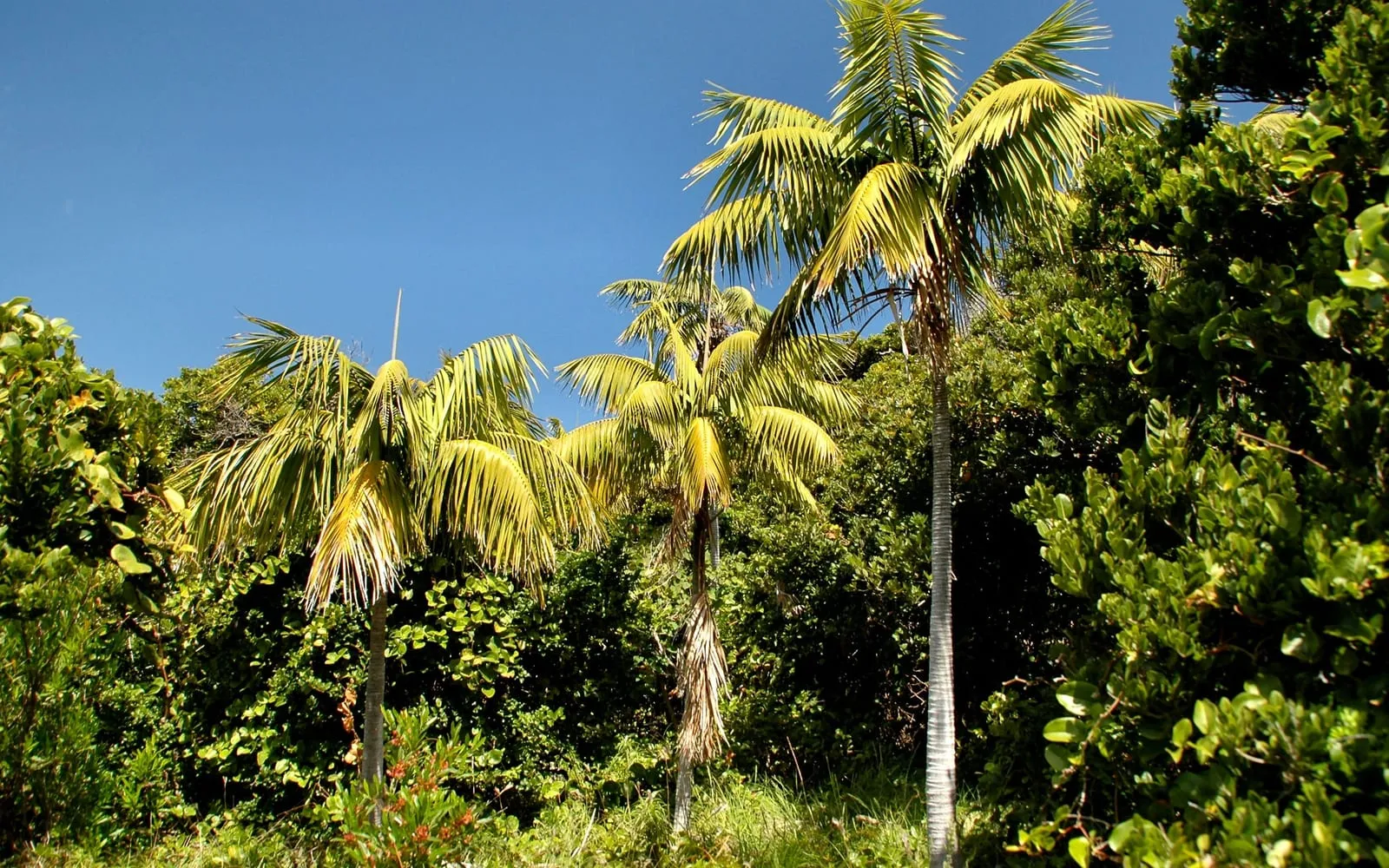
Lord Howe Island, a small volcanic island in the Tasman Sea about 600 km east of Australia, where it grows in lowland forest and on exposed slopes, often in sandy calcareous soil.
Its entire natural range covers roughly fifteen square kilometres, which makes it one of the most geographically restricted plants in widespread cultivation.
Growing under and among taller trees on the island explains the tolerance of moderate light, and the exposed coastal conditions explain the tolerance of wind and moving air.
Seed collection began in the 1870s and became the island’s principal export. Commercial harvesting is licensed and managed, and seed from the island still supplies growers worldwide.
The palm became a fixture of Victorian and Edwardian interiors, and the palm court of a grand hotel was usually planted with kentias. Queen Victoria is said to have kept them at Osborne House and asked for them around her coffin.
The species honours Johann Reinhold Forster, a naturalist on Cook’s second voyage. The common name comes from Kentia, an old genus name, which in turn came from the island’s main settlement.
How it grows
Position it in medium to bright indirect light. Kentia tolerates lower light than most palms and grows faster in brighter conditions, and direct sun scorches the fronds.
Keep it warm, 18 to 24 deg C, and never below 10 deg C.
Water when the top 3 to 5 cm of compost has dried, watering thoroughly and letting it drain completely. Check by pushing a finger well into the compost rather than judging by the surface.
Use a free-draining loam-based compost with added grit. Palms dislike sitting in water-retentive peat-free mixes.
Raise the humidity where you can. A pebble tray or a group of plants reduces the brown tips considerably.
Feed monthly through the growing season at half strength.
Repot only every three or four years, and only when roots are clearly filling the pot. Kentias resent disturbance and do better slightly restricted.
Never cut the growing point at the top of a stem. Trim only fully browned fronds, cutting the stalk close to the main stem.
Wipe or shower the fronds occasionally, which removes dust and is the best defence against red spider mite.
Turn the pot every few weeks so the growth stays even.
Through the seasons
Winter is the risky season. Reduce watering considerably, stop feeding, keep the plant away from radiators and cold glass, and raise the humidity if you can.
Spring is when growth restarts. Resume feeding, increase watering, and repot if the roots have filled the pot.
Summer is the growing season, and the one or two new fronds a year usually appear now. Water when the top few centimetres dry, feed monthly, and watch for red spider mite.
Autumn is the wind-down. Reduce watering and feeding from October.
Care difficulty
Easy, and among the most forgiving of all indoor palms.
Overwatering is the failure that accounts for most losses. The root system is smaller than the pot suggests and the compost below it stays wet.
Dry air produces brown tips, which are cosmetic and permanent.
Red spider mite is the pest to watch for, and it thrives in exactly the hot dry conditions that stress the plant.
Slow growth means patience is required, and buying the size you want is more practical than growing into it.
The plant lives for decades in the same position with very little attention.
Watering
Water when the top 3 to 5 cm of compost has dried out, which in a warm room usually means every week to ten days in summer.
Check with a finger pushed well down rather than looking at the surface, since the top dries long before the base.
Water thoroughly until it runs from the drainage holes, then drain fully and empty the saucer. A palm standing in water will rot.
Reduce watering considerably in winter, perhaps to every two or three weeks.
Use rainwater or filtered water where the tap water is hard, since palms are sensitive to the fluoride and salts in tap water and show it as brown tips.
Drooping fronds with dry compost mean thirst. Yellowing fronds with wet compost mean the opposite and are more serious.
Warning signs, diseases and pests
Brown tips on the fronds are almost universal on indoor palms and have several causes. Dry air is the commonest, followed by hard tap water, accumulated fertiliser salts, and letting the plant dry out. Raise the humidity, switch to rainwater, flush the compost occasionally, and trim the brown portion with scissors following the natural shape of the leaflet.
Yellowing fronds throughout the plant usually mean overwatering. Check that the pot drains and let the compost dry further between waterings.
Red spider mite produces fine pale stippling on the fronds, a dull grey cast, and fine webbing between the leaflets. It multiplies quickly in hot dry air. Shower the plant, raise the humidity, and treat promptly, since a bad infestation on a palm is hard to clear.
Scale insects sit as small brown discs along the leaflet undersides and the frond stalks, with sticky honeydew beneath.
Scorched pale patches mean direct sun, particularly on a plant moved suddenly into a brighter position.
The oldest lower fronds yellowing and dying one at a time is normal ageing. Cut them off at the base.
A stem that has had its top cut off will not regrow. Palms have one growing point per stem and cannot reshoot from lower down.
Growing environment
Medium to bright indirect light. Kentia copes with lower light than most palms, which is why it suits cool dim rooms in winter.
Never direct sun, which scorches the fronds.
Warmth of 18 to 24 deg C, and never below 10 deg C.
Moderate to high humidity. A pebble tray, a group of plants or an occasional shower all reduce the brown tips.
Free-draining loam-based compost with added grit, in a heavy pot with drainage holes. A tall palm in a light plastic pot topples.
Away from radiators, draughts and cold glass.
Give it room for the fronds to arch without touching walls or furniture, since damaged leaflets do not repair.
Feeding
Feed monthly from April to September with a balanced liquid houseplant fertiliser at half the stated strength. Palms burn easily at full strength.
Stop feeding from October to March.
Repot every three or four years only. A kentia does better slightly pot-bound and resents root disturbance.
Top-dress with fresh compost each spring instead of repotting, removing the top few centimetres first.
Flush the compost through with plain water occasionally to clear fertiliser salts, which contribute to brown tips.
Troubleshooting
The fronds have brown tips. Dry air, hard tap water or fertiliser salts. Raise the humidity, use rainwater, and flush the compost. Trim the brown part with scissors following the shape of the leaflet.
Whole fronds are turning yellow. Usually overwatering. Let the top few centimetres dry between waterings and make sure the pot drains freely.
Fine grey speckling and webbing between the leaflets. Red spider mite, which thrives in hot dry rooms. Shower the plant, raise the humidity, and treat quickly.
Can I cut the top off to keep it short? No. Each palm stem has a single growing point and cutting it kills that stem for good. Trim only browned fronds at the base.
It has hardly grown in two years. Kentia palms are very slow, producing perhaps two or three fronds a year. That is normal.
Why are there several stems in one pot? They are separate seedlings planted together to give a fuller plant. Kentia does not clump or sucker.
Will it survive in a north-facing room? Yes, better than most palms, though it will grow more slowly than in brighter light.
Is it safe with a dog? Yes. Kentia palm is non-toxic. Do not confuse it with sago palm, which is a cycad rather than a palm and causes fatal liver failure in dogs.
Kentia palm problem guides
Not sure what is wrong? See the common houseplant pests guide.