
Houseplant
Boston Fern
Nephrolepis exaltata
Also known as Sword fern, Ladder fern
How to grow a Boston fern, Nephrolepis exaltata. The humidity it demands, why fronds shed in winter, propagating from runners, and the Victorian craze that made it famous.
At a glance
- Difficulty
- Moderate
- Water
- Keep evenly moist at all times. Never let it dry out
- Light
- Bright indirect light. Tolerates medium and low. No direct sun
- Temperature
- 15-24 deg C. Dislikes both radiators and cold draughts
- Humidity
- Above 50 per cent, ideally 60. This is the whole difficulty
- Hardiness
- USDA 9-11, RHS H1c, hardy to 10 C
- Type
- Evergreen fern, spreading by runners
- Height
- 60-90 cm, and as wide
- Native to
- Humid tropical and subtropical regions worldwide
- Best month
- October in the Northern Hemisphere, April in the Southern Hemisphere
Tropical America, and hardier than most ferns sold as houseplants. It survives outdoors through USDA 9 and has naturalised widely in the subtropics, weedily so in parts of Australia and the Pacific. Indoors the constant leaflet drop is dry air rather than disease.
Hardiness zones describe winter cold alone. Summer heat, humidity, rainfall and the length of the growing season decide as much, so treat the range as the outer limit rather than as a recommendation.
Every month named in this guide is for the temperate Northern Hemisphere. If you garden in the Southern Hemisphere, shift each one by six months, so October becomes April. Closer to the equator the wet and dry seasons matter more than the calendar, and the shift stops being a useful guide.
Not known to be toxic
Non-toxic. The ASPCA lists Nephrolepis exaltata as non-toxic to dogs and cats, and Boston fern does not appear on the RHS list of potentially harmful garden plants. It is one of the safest houseplants available and a standard recommendation for homes with cats, which is fortunate given that a cat will almost certainly chew a plant shaped like this. A cat that eats a quantity of frond may be sick from the bulk alone, and there is no toxin involved. Worth distinguishing from unrelated plants that share the fern name: asparagus fern is Asparagus setaceus, is not a fern at all, and is toxic to cats and dogs. If you are choosing a fern for a house with animals, check the botanical name rather than the label.
Sources: ASPCA (Boston fern, Nephrolepis exaltata), RHS potentially harmful garden plants
About
The Boston fern is a mutation somebody noticed. In 1894 a shipment of sword ferns arrived in Boston, and one plant in the consignment had fronds that arched gracefully instead of standing stiffly upright. It was propagated, sold as ‘Bostoniensis’, and became the defining houseplant of its era.
Its era was already primed for it. Victorian Britain had gone through a fern mania serious enough to have its own name, pteridomania, which stripped wild populations and filled parlours with glass fern cases.
The plant demands one thing above all, and it is the thing a modern centrally heated house is worst at supplying. Humidity.
Appearance and character
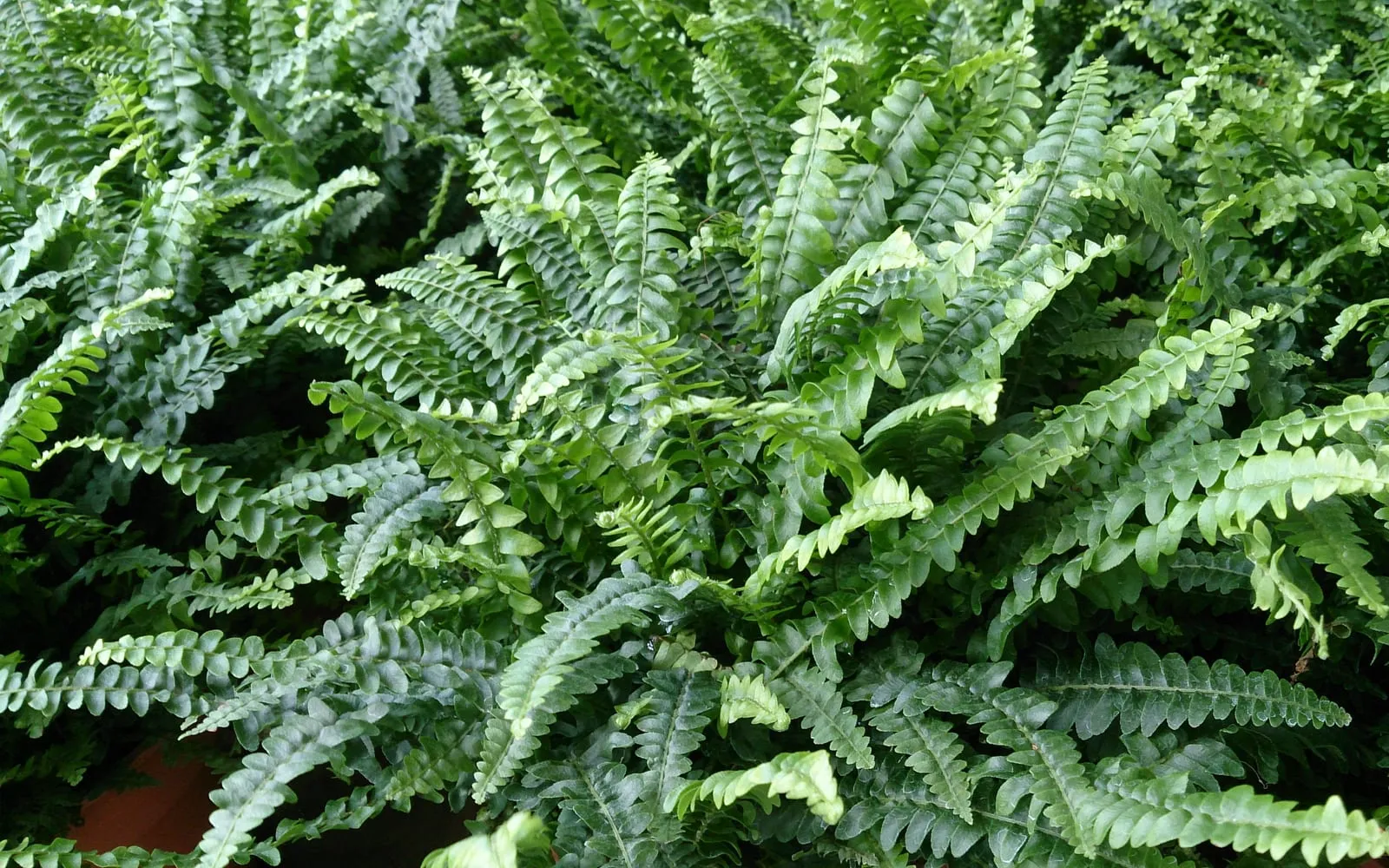
Long fronds, 60 to 90 cm, arching outward and downward from a central crown to form a fountain shape. Each frond is divided into dozens of small leaflets in a ladder arrangement along the midrib.
New fronds emerge as tightly coiled fiddleheads from the crown and unroll over about a week, which is worth watching.
Wiry runners, properly called stolons, snake out from the crown and over the edge of the pot. They look like bare string and they are the plant’s method of spreading.
The undersides of mature fronds carry rows of small brown dots along the edges. These are sori, the spore-bearing structures, and they are a sign of maturity rather than pests or disease.
Ferns have no flowers and reproduce by spores, which puts them in a different part of the plant kingdom altogether from everything else in these guides.
Where it is from
Humid tropical and subtropical regions across the world, including Florida, Central and South America, the West Indies, Africa and Polynesia. It grows in swamps, damp forest and on tree trunks in constantly moist air.
Constant moisture is the requirement, in the soil and in the air alike. There is no dry season in the habitat and no adaptation for one.
Light in those places is filtered through canopy, so direct sun scorches the fronds rapidly.
The plant is naturalised widely and is an invasive weed in some regions, which indicates just how vigorously it grows when the humidity is right.
How it grows
An evergreen fern growing from a central crown and spreading by stolons. Growth is fastest in spring and summer and slows in winter.
Fronds have a finite life. Older fronds yellow and die naturally while new ones emerge from the centre, so a steady low level of shedding is normal rather than a problem. Mass shedding is a different matter and always points at dry air.
Propagation is easy and free. Pin a runner into a pot of moist compost beside the parent, leave it attached until a plantlet forms and roots, then sever it. This takes a few weeks in the growing season.
Division works too. Lift the plant in spring, cut the crown into sections each with plenty of roots and fronds, and pot them separately.
Repot every year or two in spring. The plant is a hungry rooter and fills a pot quickly.
Spores can be raised, though it is slow, fiddly work and rarely worth it when runners are this easy.
Through the seasons
Spring restarts growth. Repot or divide now, trim off any fronds that browned over winter, and start feeding in April.
Summer is the main growing season. Water frequently, feed fortnightly, and keep it out of direct sun. This is the easy half of the year, since summer air indoors is more humid than winter air.
Autumn slows down. Stop feeding at the end of September.
Winter is the hard season and the heating is why. Room humidity can drop below 30 per cent, and the fern responds by shedding fronds and browning at the tips. A humidifier is the single most effective intervention. Keep the plant away from radiators and cold draughts alike, and keep watering, since a warm dry room dries the compost fast even though the plant is barely growing.
Care difficulty
Moderate, and it comes down to one factor.
Humidity above 50 per cent is what this plant needs, and most heated homes in January sit well below that. Misting raises humidity for a few minutes and does almost nothing measurable. A humidifier works. A steamy bathroom with a window works. Grouping plants together helps a little, and a pebble tray helps slightly.
The second issue follows from the first. The compost must never dry out completely, and a Boston fern in a hanging basket dries out faster than anything else in the house.
Given moisture in both forms, the plant is vigorous and easy.
Watering
Keep the compost evenly moist at all times. This is one of the few plants in these guides where letting it dry out is worse than overwatering.
Water thoroughly and let the excess drain. Check every few days rather than following a fixed schedule.
Hanging baskets dry out fastest and are hardest to water properly from above. Taking the basket down and immersing the whole pot in tepid water for fifteen minutes once a week is the reliable method.
Use tepid water. Cold water shocks the roots.
Even brief drying causes fronds to brown and shed, and that damage does not reverse, so consistency matters more than volume.
Do not let the pot stand in water permanently, since waterlogged compost rots the crown.
Warning signs, diseases and pests
Mass frond browning and shedding is the defining problem and it means dry air, dry compost, or both. This is what a Boston fern does when a house is heated. Raise the humidity, keep the compost moist, and trim off the dead fronds. New growth from the crown is the sign of recovery.
Brown crispy tips on otherwise healthy fronds mean low humidity specifically.
Occasional yellowing of older fronds while new ones emerge is normal ageing.
Scale insects appear as small brown bumps along the frond midribs and stalks, with sticky honeydew below. They are awkward to treat on a plant with this much surface area, so wipe them off with a cloth and soapy water and repeat weekly.
Mealybugs hide in the crown as white cottony fluff.
Spider mites arrive in hot dry conditions, which are exactly the conditions that already stress this plant. Fine webbing between fronds is the sign. Rinse thoroughly and raise the humidity.
Runners growing out of the pot are a sign of vigour rather than a problem. Pin them down to make new plants, or trim them.
Growing environment
Bright indirect light is ideal, and the plant tolerates medium and even fairly low light. Direct sun scorches the fronds within days, so no south-facing windowsill.
Warmth of 15 to 24 deg C. Avoid the extremes on both sides, meaning no radiators beneath it and no cold draughts from a door or a single-glazed window.
Humidity above 50 per cent, and 60 is better. A humidifier is the reliable solution. A bathroom with reasonable natural light is the best room in most houses for this plant.
Compost should hold moisture while still draining. A peat-free houseplant compost with added perlite works, and a slightly larger proportion of organic matter than you would use for a succulent is right.
Hanging baskets show the plant off and make watering harder. A pot on a plant stand is easier to keep alive.
Feeding
A balanced liquid feed at half strength, fortnightly from April to September.
Feed onto damp compost rather than dry, since fertiliser applied to a dry rootball burns the fine roots.
Reduce to monthly in autumn and stop entirely through winter.
Boston ferns are moderate feeders when growing actively and are sensitive to fertiliser salts, so half strength is the right concentration. Small pale new fronds indicate underfeeding, and brown frond margins can indicate the opposite.
Flush the pot through with plain water every few months to clear accumulated salts.
Troubleshooting
Dropping fronds everywhere. Low humidity, and it is the classic winter complaint. Get a humidifier, move it to a bathroom, and keep the compost moist. Misting is not enough on its own.
Brown crispy tips. Dry air. Same answer.
Whole fronds yellowing one at a time while new ones grow. Normal ageing. Trim them off at the base.
Grey-green washed-out fronds. Too much light. Move it somewhere shadier.
Fronds dry and brittle with dry compost. It dried out. Immerse the pot, and check it every few days from now on.
Small pale new fronds. Underfed. Feed fortnightly at half strength through the growing season.
Brown bumps along the frond stalks with sticky residue. Scale insects. Wipe them off with soapy water and repeat weekly.
Bare wiry runners hanging out of the pot. Stolons, and a sign the plant is thriving. Pin one into compost to make a new plant.
Boston Fern problem guides
Not sure what is wrong? See the common houseplant pests guide.