
Pest
Fungus gnats
Sciaridae
Also called Sciarid flies, Compost flies, Soil gnats
Fungus gnats are small dark flies that rise from damp compost when you water. Their larvae feed mostly on fungi and dead matter, and letting the compost surface dry breaks the cycle.
At a glance
- Type
- Pest
- Cause
- Insect
- Severity
- Cosmetic
- Affects
- Houseplants, Herbs and edibles
- Active
- All year
- Established in
- Worldwide
What you are seeing
- Small dark flies two to four millimetres long drifting up from the compost when the pot is moved or watered
- The same flies walking over the compost surface and up the inside of the pot
- A weak, fluttery flight rather than the quick darting of a fruit fly
- Translucent white larvae with a shiny black head in the top two centimetres of compost
- Fine glistening trails on the compost surface where larvae have moved
- Seedlings and soft cuttings collapsing at compost level in a propagator
Before you treat anything
Fungus gnats do not bite and carry nothing that affects people or pets. If small flies in the house are biting, they are something else.
What you are looking at
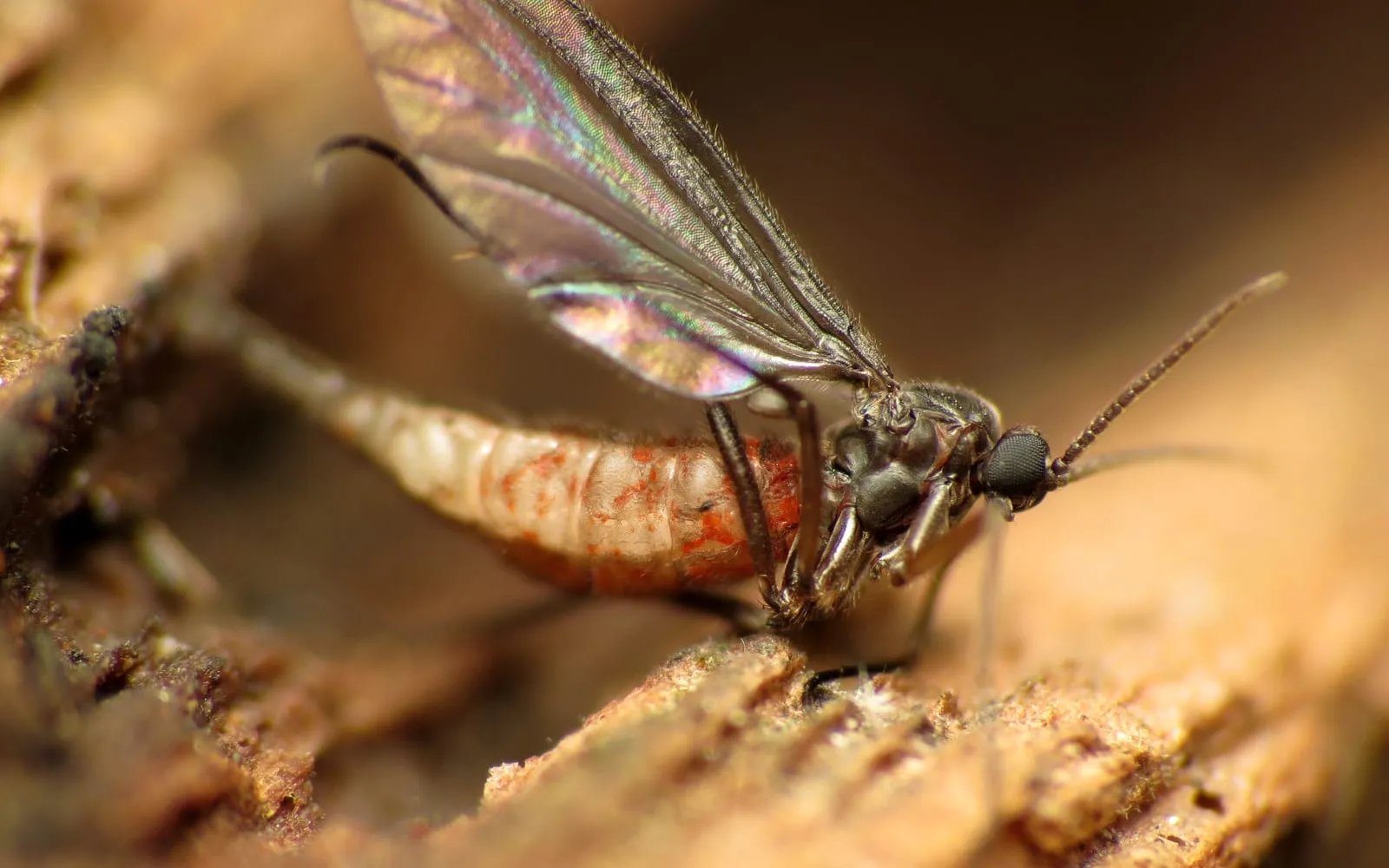
Small dark flies, two to four millimetres long, that drift up out of the compost when you move a pot and settle again a foot away. They have long legs, long beaded antennae and a single pair of clear wings, and they fly badly, wandering rather than darting.
Most of them are on the compost surface or walking up the inside of the pot rather than on the plant. That is the clue that separates them from anything that matters. A pest of leaves is found on leaves.
The stage doing anything at all is underground. Scrape back the top two centimetres of compost and look for translucent white legless larvae up to about six millimetres long, each with a hard shiny black head. They are unmistakable once seen and invisible until looked for.
What they are eating
The clue is in the name. These larvae are fungus eaters, living on the fungi, algae and decaying organic matter in permanently damp compost. A pot that stays wet at the surface, with a layer of fallen leaves on it and compost that has begun to break down, is what they came for.
They also graze root hairs and fine roots while they are there. On an established houseplant that costs the plant almost nothing, which is why this page rates the problem as cosmetic when so much written about it does not.
The exception is worth taking seriously. In a propagator, a seed tray or a pot of soft cuttings, the roots are the whole plant, and a heavy population will kill seedlings outright and open wounds that let Pythium in behind them. If you are sowing, deal with fungus gnats. If you have a mature monstera, deal with the watering.
Why they keep appearing
At room temperature an egg becomes an adult in three to four weeks, and a female lays a hundred or more eggs in the top layer of compost. Indoors there is no winter, so generations run continuously and overlap.
That is why killing the adults changes nothing. Every fly you swat has already laid, and the pot holds the next fortnight’s worth. Anything that only addresses the flying stage is a sedative rather than a treatment.
Their arrival is generally traceable. They come in on a new plant, in a bag of compost left open in a shed, or from a pot that has been overwatered all winter and is now the source for the whole windowsill.
What to do about them
Stop watering so often. Let the top two centimetres of compost dry properly between waterings, and the eggs and young larvae in that layer die without anything being applied to them. For most houseplants this is what they wanted anyway, and the population collapses within a few weeks.
Where a plant cannot be allowed to dry at the surface, cover it instead. A centimetre or two of horticultural grit or perlite over the compost dries within hours of watering, gives the female nowhere to lay and stops the adults getting out. It works on ferns and calatheas, which are the plants where drying out is not on offer.
Take the dead leaves off the surface while you are there, and repot anything sitting in dense broken-down compost.
For a serious population, or any seed tray, water in Steinernema feltiae nematodes. They hunt the larvae in the compost, they are sold for exactly this, and they do not touch the plant. Keep the compost moist for a fortnight afterwards so they can move, then let the surface dry again.
Yellow sticky traps are worth putting up not because they control anything but because they measure. A trap filling more slowly each week tells you the watering change has worked.
What it gets mistaken for
Whitefly are white, they sit on the undersides of leaves rather than on the compost, and disturbing the plant sends up a cloud that resettles on the foliage. Fungus gnats are dark and stay near the pot.
Fruit flies are tan or yellowish with red eyes, they hover around fruit, wine and the kitchen bin, and they fly quickly and precisely. Fungus gnats are blackish and drift.
Drain flies are furry, moth-like and triangular at rest, and they come out of sink and shower drains rather than from compost.
Thrips are the ones worth ruling out properly, because they are also small, dark and associated with plants. They are on the leaves, they are slender rather than fly-shaped, and they leave silvered patches with tiny black specks on the foliage. No leaf damage means no thrips.
What to do, in order
Start here
Prevention, and the changes that stop the problem returning. Most of these pages should end at this tier.
- Let the top two centimetres dry out between waterings
- Eggs and young larvae need a moist surface and die within a day or two without it. Nothing else on this page comes close to the effect of letting the surface go properly dry, and for most houseplants it is better for the roots as well.
- Water from below
- Stand the pot in a saucer of water for half an hour, then tip away what is left. The root zone gets what it needs and the surface stays dry, so there is nowhere to lay.
- Clear dead leaves and debris off the compost
- The larvae eat fungi, algae and decaying plant material, so a surface littered with fallen leaves is a food supply. Keeping it bare removes most of what the larvae are living on.
- Expect more of them in peat-free compost
- Wood fibre and green compost break down as the plant grows, which supports more of the fungi these larvae feed on than old peat mixes did. This is a consequence of a change worth making rather than a reason to go back, and it means the watering habit matters more than it used to.
- Keep bags of compost closed
- An open bag in a shed or a greenhouse is a breeding site, and the flies arrive in the house with the next repotting. Roll the top down and store it somewhere dry.
Then reach for a barrier
Netting, hand removal and water. Nothing here harms anything except the target.
- Top the pot with a layer of grit
- One to two centimetres of horticultural grit, coarse sand or perlite over the compost dries out fast, gives the female nowhere to lay, and blocks the emerging adults. On a plant that has to stay damp, such as a fern or a calathea, this is the answer.
- Put up yellow sticky traps
- These catch adults and, more usefully, tell you whether the population is rising or falling. A trap that filled in three days and takes a fortnight to fill next time means the changes are working.
- Vacuum the ones in the air
- Fungus gnats fly badly and slowly. Running a vacuum nozzle over a pot and through the air above it removes most of the adults in a room in a few seconds, which buys peace while the larvae are dealt with.
- Repot if the compost has broken down
- Old, exhausted compost that has turned dark and dense holds water at the surface and feeds the larvae. Repotting into fresh open mix removes the habitat and the population in it at the same time.
Then bring in the predators
Encourage what already lives in the garden, and buy predators in where the problem is under glass and nothing will arrive on its own.
- Water in Steinernema feltiae nematodes
- A parasitic nematode that hunts the larvae in the compost, sold for this specific job and effective. Water it on to moist compost, keep the pot moist for a fortnight afterwards so the nematodes can move, and repeat once.Widely sold across Europe and North America. Australia and New Zealand permit far fewer species, because releasing an entomopathogenic nematode that is not already approved is prohibited there. Check what is registered locally rather than ordering from overseas.
- Introduce the predatory mite Hypoaspis
- Stratiolaelaps scimitus, still widely sold as Hypoaspis miles, lives in the top few centimetres of compost and eats gnat larvae and eggs. It establishes in a pot and keeps working, which suits a large collection better than repeated treatments.Sold by licensed biocontrol suppliers across Europe, North America, Australia and New Zealand, where it is already approved for release. Buy from a supplier in your own country: importing a live agent yourself is an offence in most of them.
- Stand a butterwort next to the worst pot
- Pinguicula catches adult fungus gnats on its sticky leaves and lives happily on a windowsill. It will not clear an infestation on its own, and it does reduce the flying population while being a plant rather than a treatment.
Biological controls are live organisms and their sale and release are regulated country by country. An agent sold freely in one place may be unapproved in another, so buy from a licensed supplier where you live and never import or move one yourself.
Plants affected
Guides that name it among the problems to watch for. The list is the plants it is characteristic of rather than everything it will feed on.
A common houseplant pest
This is one of the pests and problems that houseplant owners meet most often. See it alongside the others, with a quick table for telling them apart, on the houseplant pests guide.
Common houseplant pests