
Houseplant
Mind your own business
Soleirolia soleirolii
Also known as Baby's tears, Angel's tears, Helxine
How to care for Soleirolia soleirolii. The tiny-leaved carpet that fills a shaded pot in a season, why it is a nettle without a sting, and why it is hard to remove once loose in a garden.
At a glance
- Difficulty
- Easy
- Water
- When the surface has just dried, keeping the compost steadily moist
- Light
- Medium indirect light or light shade. Never direct sun
- Temperature
- 10-21 deg C, and it takes brief spells near freezing
- Humidity
- Moderate to high. It collapses in dry heated air
- Hardiness
- USDA 9-11, RHS H4, hardy to -10 C
- Type
- Evergreen perennial, creeping and mat-forming
- Height
- 5-10 cm
- Native to
- The western Mediterranean
Damp shaded rocks, walls and stream banks on Corsica, Sardinia and the nearby mainland, in a Mediterranean climate moderated by constant moisture from shade and seepage. It is hardier than its delicate appearance suggests, with established mats surviving around -10 deg C and regrowing from the roots after being cut back by frost. Shade and steady moisture matter far more than warmth, and it will not take a dry sunny position anywhere.
Hardiness zones describe winter cold alone. Summer heat, humidity, rainfall and the length of the growing season decide as much, so treat the range as the outer limit rather than as a recommendation.
Not known to be toxic
Non-toxic. Soleirolia soleirolii appears on no list of plants harmful to cats, dogs or horses, and it is absent from RHS lists of potentially harmful garden plants. It sits in the nettle family, which contains the stinging nettles, but this species has no stinging hairs at all and no irritant sap, so there is nothing to be careful of in handling it. The leaves are tiny and the plant grows flat, which puts it within reach of animals in a way a taller plant would not be, and the complete absence of hazard is one reason it is used as a groundcover in mixed planted bowls and terrariums.
Sources: RHS potentially harmful garden plants, NC State Extension, Soleirolia soleirolii
About
Mind your own business is a nettle with no sting. It belongs to the same family as the stinging nettle and shares the family’s tiny green flowers and creeping habit, and it has none of the hairs that make its relatives unpleasant.
What it does have is speed. Threadlike stems root wherever they touch damp compost, and a small plug covers the surface of a pot in a single season, running over the rim and down the sides into a soft green cushion. That makes it the standard groundcover for planted bowls, terrariums and the bare soil under a larger specimen.
The same speed is why it should never be tipped into a garden in a mild damp climate. Every fragment of stem roots, and a mat that has established between paving or in a lawn is close to impossible to remove without lifting everything it has grown through.
Appearance and character
A low creeping perennial forming a dense cushion of fine, brittle, threadlike stems that root at the nodes as they spread.
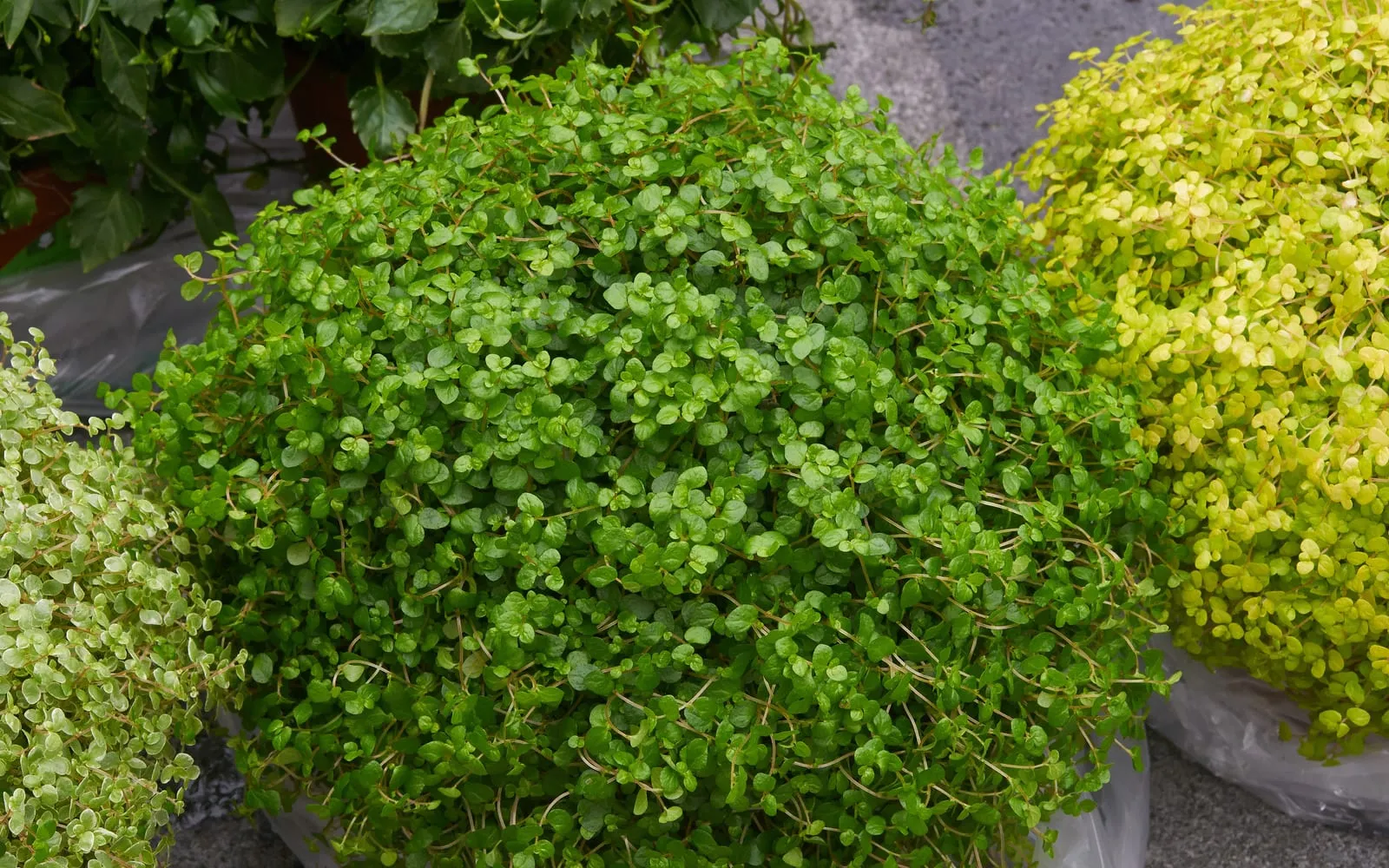
The leaves are the smallest of any plant commonly grown indoors, round to kidney shaped and only 2 to 6 mm across, bright fresh green, and packed close enough that the mat reads as a solid surface.
Height is 5 to 10 cm at most, and the plant spreads sideways indefinitely wherever the surface stays damp.
Flowers are minute, greenish white and hidden among the foliage, and most owners never notice them.
‘Aurea’ is a golden-leaved form and ‘Variegata’ is silver-flecked. Both are slower and slightly less vigorous than the plain green species.
Old cushions go bare and woody in the centre while continuing to spread at the edges, which is normal and is fixed by dividing and replanting.
The stems are brittle and break easily, which is both how it propagates and why it spreads where it is not wanted.
Where it is from
Corsica, Sardinia and the adjacent mainland of Italy and France, growing on damp shaded rocks, old walls, stream banks and seepage lines.
Those places are wetter than the Mediterranean climate around them, which is the key to the plant. It comes from permanently moist shaded microhabitats within a region that is otherwise hot and dry, so it has no drought tolerance and considerable shade tolerance.
Its hardiness is greater than the delicate look suggests. Established mats survive around -10 deg C and regrow from the rootstock after frost cuts the top growth back.
It has naturalised widely in mild damp climates, including western Europe, New Zealand and parts of North America, where it grows in lawns, between paving and on shaded walls. In several of those places it is regarded as a persistent weed, though it is not generally listed as a regulated pest.
The genus contains this single species, and the plant is still sold under its old name Helxine soleirolii.
How it grows
Give it medium indirect light or light shade. It holds a dim position well and the golden form wants a little more.
Keep it out of direct sun, which scorches the mat brown within a day.
Keep the compost steadily moist. Water when the surface has just dried, and never let a pot dry out completely.
Stand the pot in a shallow tray of water in warm weather, or grow it in a container without drainage in a terrarium, where the moisture stays constant.
Keep it above freezing indoors and ideally between 10 and 21 deg C. It prefers cool conditions to warm ones and suffers in a heated room.
Raise the humidity where the room is dry, since the fine leaves have no reserve and collapse quickly.
Feed every six to eight weeks at quarter strength through the growing season.
Trim the mat with scissors whenever it outgrows its container or starts smothering a neighbour.
Divide and replant every two or three years, when the centre of the cushion goes bare.
Propagate by pressing any small piece of rooted stem onto damp compost, which establishes within a fortnight.
Through the seasons
Spring brings vigorous growth. Resume feeding, divide and replant tired cushions now.
Summer is the risk period for drying. Check daily in warm weather, keep the plant out of sun and stand the pot in a tray if needed.
Autumn slows it. Reduce feeding from October.
Winter is easier in a cool room and harder in a heated one. Keep the plant away from radiators and maintain moisture.
Care difficulty
Easy, provided it never dries out.
Drying is the only common cause of death, and it happens fast. A pot left a day too long in a warm room collapses into brown straw, and although the roots often survive to regrow, the mat has to rebuild.
Heat is the second issue. This is a cool-climate plant from shaded seepage and it suffers in a warm dry room.
Vigour is a problem in mixed plantings, since it smothers anything smaller than itself within a season.
Escape into a garden is the serious consideration. Do not tip a pot onto a compost heap or into a border in a mild damp climate.
Watering
Keep the compost steadily moist, watering when the surface has just dried.
Water little and often rather than heavily and rarely.
Stand the pot in a shallow tray of water during warm weather, which suits this plant better than most and removes the risk of a missed day.
Use rainwater or filtered water where the supply is hard.
Underwatering shows as a sudden collapse of the whole mat into brown straw. Cut the dead growth away, water thoroughly and the roots will usually regrow.
Overwatering, meaning standing water at the root over a long period, causes blackening and rot at the base of the mat.
Warning signs, diseases and pests
The whole mat collapsing brown is drought. Cut it back, water thoroughly and keep it moist. The roots often survive and regrow within a few weeks.
Scorched brown patches on the exposed side are sun damage.
Grey fuzzy mould in a dense wet mat with no air movement is botrytis. Thin the mat and improve ventilation.
Small flies rising from the compost are fungus gnats, which are common in the permanently damp compost this plant requires.
A bare woody centre with growth only at the edges is normal ageing. Divide and replant.
Yellowing and thinning in a warm room is heat stress rather than a feeding problem.
Neighbouring plants disappearing under it is the plant doing what it does. Trim it back regularly in mixed plantings.
Growth rooting into the pot beside it is how it spreads, and it will keep doing so.
Growing environment
Medium indirect light or light shade.
Never direct sun.
Cool, 10 to 21 deg C, and it takes brief spells near freezing. A cool hallway suits it better than a warm living room.
Moderate to high humidity, and it collapses in dry heated air.
Peat-free compost kept steadily moist, in a shallow pot, a bowl or a terrarium.
A shallow tray of water beneath the pot in warm weather.
Outdoors in damp shade in USDA 9 and warmer, where established mats take around -10 deg C. Think carefully before planting it out in any mild damp climate, because removing it afterwards is very difficult.
Avoid direct sun, radiators, heated dry rooms and compost that dries out.
Feeding
Feed every six to eight weeks from spring to early autumn with a balanced liquid houseplant fertiliser at quarter strength.
Stop feeding from mid-autumn to early spring.
Feed sparingly. Rich feeding produces soft growth that rots in the centre of a dense mat.
Divide and replant into fresh compost every two or three years rather than repotting, since an old cushion goes bare in the middle.
Flush the compost occasionally with plain water to clear salts.
Troubleshooting
The whole thing went brown in a day. It dried out. Cut the dead growth away and water thoroughly. The roots usually survive and the mat regrows within a few weeks, so do not throw it out immediately.
Is it a moss? No. It is a flowering plant in the nettle family, with proper stems, leaves and tiny flowers. Only the scale of the leaf suggests otherwise.
Does it sting? No. It is in the same family as the stinging nettle and has no stinging hairs and no irritant sap at all.
It is smothering the other plants in the bowl. That is what it does. Trim it back with scissors every few weeks in a mixed planting, or grow it on its own.
Is it safe with pets? Yes. It appears on no list of plants harmful to cats, dogs or horses.
Can I plant it in the garden? Only with care. Every fragment of stem roots, and an established mat between paving or in a lawn is very hard to remove. Do not put trimmings on a compost heap in a mild damp climate.
The middle has gone bare and woody. Normal ageing. Lift it, divide the healthy outer growth and replant into fresh compost.
How do I propagate it? Press any small piece of rooted stem onto damp compost. It will establish within a fortnight, which is also why it spreads so readily.
Mind your own business problem guides
Not sure what is wrong? See the common houseplant pests guide.