
Houseplant
African violet
Streptocarpus ionanthus
Also known as Saintpaulia, Usambara violet, Saintpaulia ionantha
How to care for Streptocarpus ionanthus. Light for flowering, watering from below, avoiding leaf spots and understanding the name change.
At a glance
- Difficulty
- Moderate
- Water
- When the surface has just dried, keeping the compost lightly moist
- Light
- Medium indirect light. It flowers in light too low for most flowering plants
- Temperature
- 18-24 deg C, and never below 15 deg C
- Humidity
- Moderate to high, and it dislikes cold draughts
- Hardiness
- USDA 11-12, RHS H1b, hardy to 15 C
- Type
- Evergreen perennial, compact and long-lived
- Height
- 10-15 cm
- Native to
- Eastern Africa
Cloud forest on the Usambara and Uluguru mountains of Tanzania and Kenya, growing in shade on damp shaded rock faces at altitude, where temperatures are steady and mild rather than hot and the air stays humid year round. The steadiness is what it needs indoors. It is damaged below about 15 deg C, dislikes both heat and cold draughts, and has no frost tolerance whatever, so it is an indoor plant everywhere outside the tropics.
Hardiness zones describe winter cold alone. Summer heat, humidity, rainfall and the length of the growing season decide as much, so treat the range as the outer limit rather than as a recommendation.
Not known to be toxic
Non-toxic. The ASPCA lists the African violet among plants that are not harmful to cats, dogs or horses, and it appears on no RHS list of potentially harmful garden plants. There is no irritant sap and no risk from handling the plant or from an animal chewing a leaf. That makes it one of the very few flowering houseplants that is both safe and content in modest light, which is a useful combination for a household with animals. Its relatives in the genus, the cape primroses, are equally harmless. Nothing about the plant is related to a true violet; the name refers only to the flower colour and shape.
Sources: ASPCA (African Violet, Saintpaulia species), RHS potentially harmful garden plants
About
The African violet is one of a very short list of plants that will flower in a room facing away from the sun. Almost everything else grown for flowers wants several hours of bright light and sulks below that, which is why a dim room usually ends up filled with foliage plants only.
It manages it because it comes from shaded rock faces in mountain cloud forest, where the light is filtered, the temperature barely moves and the air stays wet. Reproduce the steadiness and it flowers more or less continuously.
Two habits kill more of them than anything else. Watering into the crown rots the short central stem, and splashing cold water on the hairy leaves leaves permanent pale rings. Both are avoided by watering from below with tepid water, which is the best way to avoid both problems.
Appearance and character
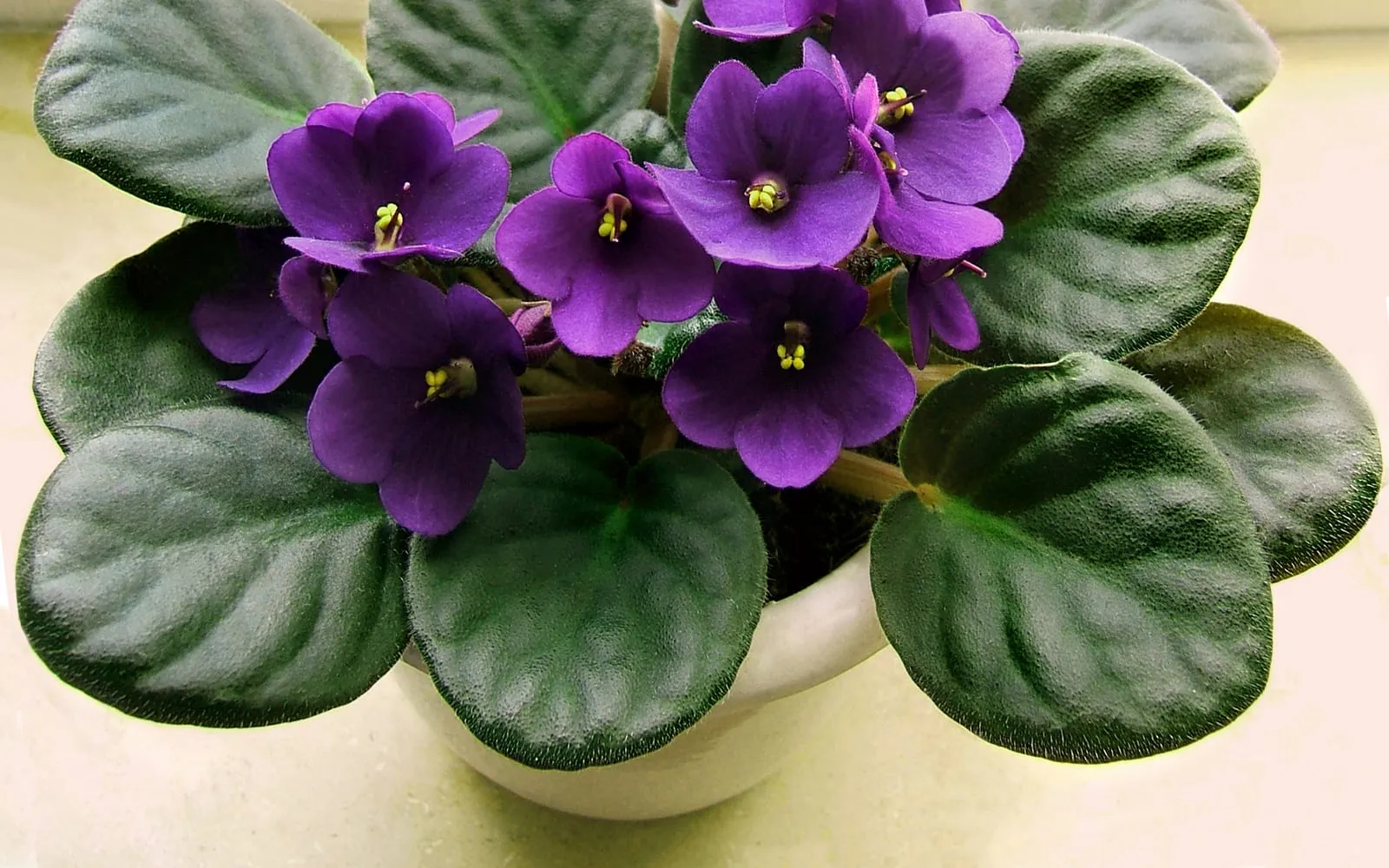
A compact perennial forming a flat rosette of leaves pressed close to the compost, with flower stalks rising just above them.
Leaves are oval to almost round, 5 to 8 cm long, thick, slightly brittle and densely covered in fine hairs that give a velvety texture. They are held on short fleshy stalks and arranged in a neat symmetrical spiral.
Flowers are five-petalled, 2 to 4 cm across, carried in small clusters on short stalks. The wild species is violet-blue with a yellow eye. Cultivars run through purple, pink, white, red and bicolours, and doubles, frilled edges and variegated foliage are all common.
A well-grown plant flowers for most of the year, pausing only briefly.
Growth is slow and the plant stays small, at 10 to 15 cm tall and up to 20 cm across for a standard cultivar. Miniature and trailing forms are also grown.
Old plants develop a bare stem below the rosette, called a neck, as the lowest leaves are shed.
Where it is from
The Usambara and Uluguru mountains of Tanzania, with a few populations in southeastern Kenya, growing on shaded damp rock faces and steep forest slopes at altitude.
Everything about the plant follows from that. Filtered light under forest canopy explains the flowering in modest light. Constant mild temperatures at altitude explain the dislike of both heat and cold. Permanent humidity from cloud cover explains the need for moist air, and growing in thin material on rock explains the shallow roots and the need for an open compost.
The wild populations are small, fragmented and threatened by forest clearance, and several of the species in the group are on the IUCN red list, which is a striking contrast with a plant sold by the million.
The name changed recently. Genetic work showed that Saintpaulia sat inside Streptocarpus, and the genus was folded into it in 2012. Labels and literature still use both, and the plant is unchanged.
How it grows
Give it medium indirect light. A position facing away from the sun, or a metre back from a brighter window, suits it. Twelve hours a day of moderate light produces the most flowers.
Keep it out of direct sun, which scorches the hairy leaves quickly.
Water from below with tepid water. Stand the pot in a saucer of water for twenty minutes, then pour away what is left. Never water into the crown.
Keep water off the leaves. Cold water on a hairy leaf causes pale ring-shaped marks that are permanent, caused by cells collapsing under the sudden temperature drop.
Keep it above 15 deg C and ideally between 18 and 24 deg C, away from draughts and from cold glass.
Use a small shallow pot. A rosette this size wants a pot about a third the diameter of the plant, and an oversized pot holds wet compost the roots cannot reach.
Feed every two to four weeks in the growing season with a high-potassium or African violet feed at quarter to half strength.
Remove dead flowers and any leaf that yellows, snapping them off cleanly at the base so no stub is left to rot.
Turn the pot a quarter each week so the rosette stays symmetrical.
Through the seasons
Spring brings the strongest flush of flowers. Resume regular feeding and repot if the plant has developed a long neck.
Summer needs shade from strong sun and attention to watering. Feed every two to four weeks and keep the plant away from open windows on hot days.
Autumn slows flowering as the light drops. Reduce feeding and move the plant nearer the glass.
Winter is when plants are lost to cold and wet. Keep it above 15 deg C, well away from cold windowsills and draughts, and water sparingly. A grow light extends the flowering through the dark months.
Care difficulty
Moderate, and the difficulties are all about water and steadiness.
Crown rot is the commonest killer, caused by water sitting in the middle of the rosette. Watering from below removes the risk entirely.
Leaf spotting from cold water is disfiguring rather than dangerous and is permanent on the affected leaves.
Failure to flower is the other frequent complaint and is almost always insufficient light. This plant needs modest light for a long day rather than bright light for a short one.
Cold draughts and cold windowsills damage it quickly, and a plant behind a curtain on a winter night can be lost.
Watering
Water from below. Stand the pot in tepid water for twenty minutes and then drain it completely.
Use tepid water rather than cold. Water below room temperature marks the leaves and shocks the roots.
Water when the surface has just dried, keeping the compost lightly moist rather than wet or dry.
Reduce watering in winter, when growth slows and cool compost stays wet.
Underwatering shows as limp drooping leaves that recover when watered.
Overwatering shows as a soft brown crown, yellowing outer leaves and collapse. This is the most common cause of death and it is very hard to reverse.
Warning signs, diseases and pests
The whole plant collapsing with a soft brown centre is crown rot, from water in the rosette. Take leaf cuttings from healthy outer leaves and start again.
Pale ring-shaped or irregular spots on the leaves are cold water damage. They are permanent, so water from below with tepid water in future.
No flowers on a healthy plant means not enough light. Move it brighter or add a lamp on a timer for twelve hours a day.
Tight, distorted, stunted growth at the centre with greyish hairy leaves is cyclamen mite, which is too small to see. It is difficult to treat and infested plants are usually destroyed.
White cottony fluff among the leaf stalks is mealybug.
Long thin leaf stalks with leaves reaching upward means the plant is stretching for light.
A bare stem below the rosette is a neck, which is normal ageing. Repot the plant deeper so the neck is buried, or cut the rosette off and re-root it.
Brown scorched patches are direct sun damage.
Growing environment
Medium indirect light for around twelve hours a day. A room facing away from the sun suits it, and a grow light on a timer works well in winter.
Never direct sun.
Steady warmth, 18 to 24 deg C, with 15 deg C as the floor. It dislikes heat as much as cold.
Moderate to high humidity, with a gravel tray or a group of plants rather than misting, since wet leaves mark.
Open free-draining African violet compost or houseplant compost with added perlite, in a small shallow pot with drainage holes.
A stable position out of draughts, away from cold glass and away from radiators.
Outdoors only in the tropics in deep shade, and it is otherwise an indoor plant everywhere.
Feeding
Feed every two to four weeks from spring to early autumn with a high-potassium or purpose-made African violet feed at quarter to half strength.
Reduce or stop feeding in winter unless the plant is under a grow light and still flowering.
Feed weakly and often rather than strongly and rarely. This plant has a fine root system that burns easily.
Repot annually in spring into fresh compost, using the same size pot unless the roots have filled it.
Bury the neck when repotting an older plant, setting the rosette lower so the bare stem is covered and can root.
Troubleshooting
Pale rings have appeared on the leaves. Cold water splashed on the foliage. The marks are permanent. Water from below with tepid water in future.
Why will it not flower? Almost always not enough light. It needs about twelve hours a day of medium light, which is a long day at modest brightness rather than a short burst of sun. A lamp on a timer solves it in winter.
The middle has gone soft and brown. Crown rot, from water sitting in the rosette. The plant will not recover. Take leaf cuttings from healthy outer leaves and start again.
Why is it called Streptocarpus now? Genetic work showed that Saintpaulia sat within Streptocarpus, and the two were merged in 2012. Both names appear on labels and it is the same plant.
Is it safe with a cat? Yes. The ASPCA lists it as non-toxic to cats, dogs and horses, which is unusual for a flowering houseplant.
There is a bare stem under the leaves. That is a neck, and it forms as old leaves are shed. Repot the plant deeper so the neck is buried, or cut the rosette off and re-root it.
How do I propagate it? Take a healthy leaf with 3 cm of stalk, push the stalk into damp compost at a shallow angle and keep it warm and humid. Plantlets appear at the base in two or three months.
Is it related to a violet? No. It is in the Gesneriaceae with gloxinias and cape primroses. The name refers only to the colour and shape of the flower.
African violet problem guides
Not sure what is wrong? See the common houseplant pests guide.