
Houseplant
Prayer Plant
Maranta leuconeura
Also known as Maranta, Herringbone plant, Rabbit's foot plant
How to care for Maranta leuconeura. Why the leaves fold up at night, what causes the crispy edges everyone gets, and one of the few striking houseplants that is safe with cats.
At a glance
- Difficulty
- Moderate
- Water
- When the top 1-2 cm dries, roughly twice weekly in summer
- Light
- Bright indirect light or light shade. Direct sun bleaches the markings
- Temperature
- 18-27 deg C. Below 12 deg C causes damage
- Humidity
- 60% or higher. Dry air is the usual cause of failure
- Hardiness
- USDA 11-12, RHS H1b, hardy to 15 C
- Type
- Evergreen perennial
- Height
- 20-30 cm tall, spreading to 40 cm
- Native to
- The shaded forest floor of tropical Brazil
- Best month
- October in the Northern Hemisphere, April in the Southern Hemisphere
Brazilian rainforest floor. The leaves fold upright at night on a hinge at the leaf base, which is what the name records. It wants humidity, warmth and soft water, and it browns at the edges in hard water.
Hardiness zones describe winter cold alone. Summer heat, humidity, rainfall and the length of the growing season decide as much, so treat the range as the outer limit rather than as a recommendation.
Every month named in this guide is for the temperate Northern Hemisphere. If you garden in the Southern Hemisphere, shift each one by six months, so October becomes April. Closer to the equator the wet and dry seasons matter more than the calendar, and the shift stops being a useful guide.
Not known to be toxic
Non-toxic. The ASPCA lists the prayer plant among species that are not toxic to cats, dogs or horses, and Maranta does not appear on the RHS list of potentially harmful garden plants. NC State Extension carries no toxicity section for the genus. That makes this one of the few boldly marked houseplants you can grow at cat height without a second thought. It is worth saying plainly, because the plants competing for the same shady shelf are mostly arums, and peace lily, philodendron and anthurium all carry calcium oxalate. A cat that chews the leaves may still be sick from the roughage, in the way any plant material can cause vomiting, and there is no poison involved.
Sources: ASPCA (Prayer Plant, Maranta leuconeura), NC State Extension, Maranta leuconeura
About
At dusk the leaves rise and fold together like closing hands, and by morning they have flattened out again. The movement is slow enough that you never catch it happening and fast enough that a plant looks different at bedtime from how it looked at tea.
Botanists call it nyctinasty. A swollen hinge of tissue at the base of each leaf stalk, the pulvinus, pumps water from one side to the other, and the change in pressure swings the leaf. It runs on an internal clock, so a plant kept in constant light carries on folding for days.
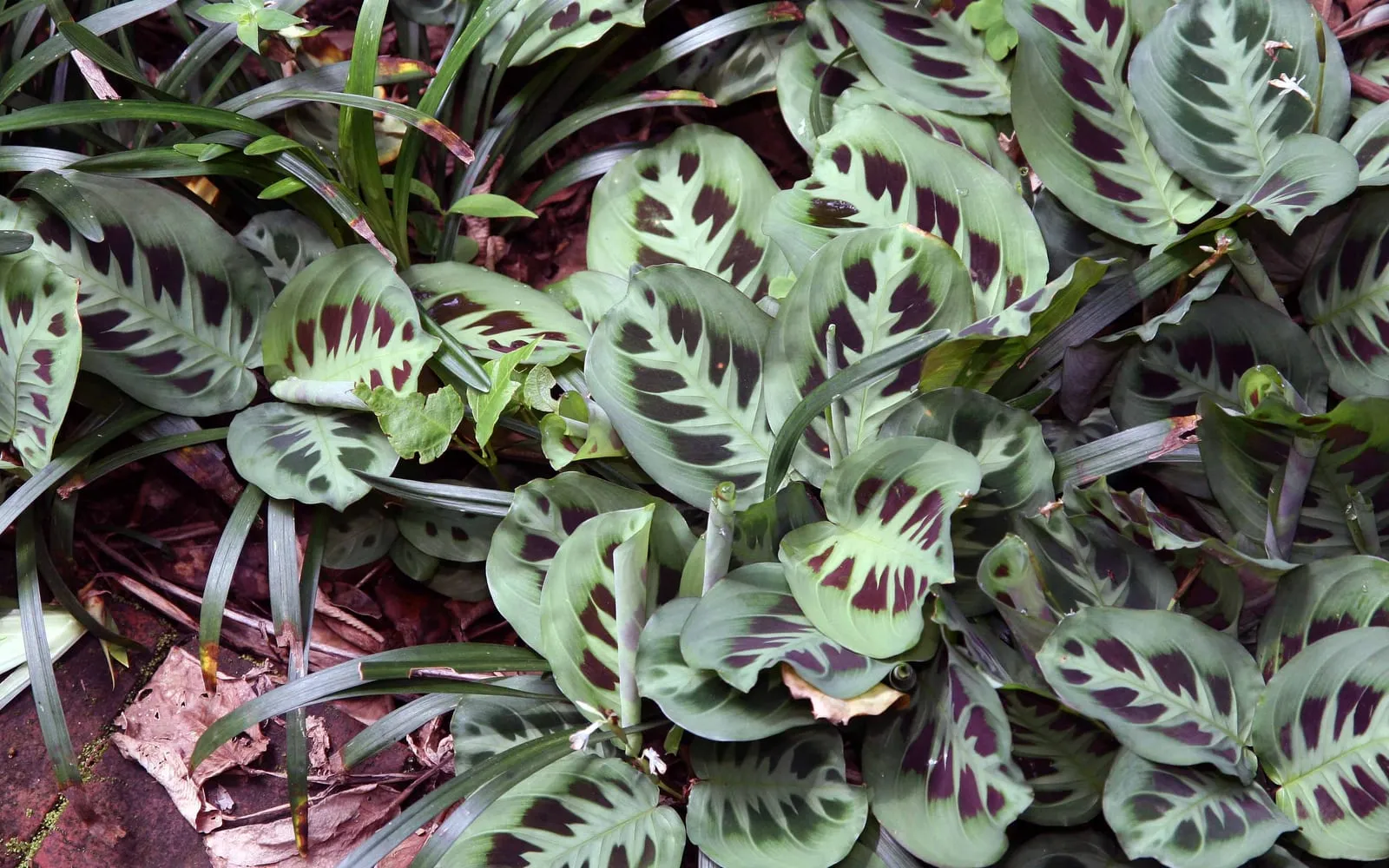
The markings are the other draw. Dark maroon blotches sit either side of a pale midrib on a mid-green ground, with veins picked out in pink on the best forms, and the pattern is strong enough to read from across a room.
Appearance and character
Oval leaves, 10 to 15 cm long, held nearly flat by day on short stalks from a low spreading clump. The plant stays around 20 to 30 cm tall and creeps outward to about 40 cm.
Leaf undersides are a soft purple-grey, which is what you see when the leaves fold at night.
Three forms account for almost everything sold. Maranta leuconeura var. erythroneura, the herringbone plant, has scarlet veins branching from a lime midrib. Var. kerchoveana, sometimes called rabbit’s tracks, carries paired dark blotches on plain green. Var. leuconeura itself has white veining.
Stems lengthen and trail as the plant matures, so an older specimen works well in a hanging pot or on a shelf edge.
Small white or pale lilac flowers appear on thin spikes now and then. They are slight and short-lived, and nobody grows this plant for them.
Where it is from
The floor of tropical rainforest in Brazil, in deep shade under a closed canopy, in leaf litter that never dries out.
Deep shade is the key fact. This plant evolved to catch what little light filters through several layers of canopy, so its leaves are thin and its pigments are easily bleached. A sunny windowsill washes the markings out within weeks.
The forest floor stays damp and the air stays saturated. Neither condition is reproduced in a centrally heated room, and the gap between the two explains almost every prayer plant problem.
Temperatures there are warm and steady all year, so the plant has no dormancy and no cold tolerance.
How it grows
An evergreen perennial spreading by short surface rhizomes, sending up leaves along creeping stems.
Growth is quick in warmth and light and stops altogether below about 15 deg C. A plant that has done nothing since October is cold rather than ill.
New leaves emerge rolled into a tight tube and open over two or three days, often showing their strongest colour when young.
Propagation is straightforward. Cut a stem just below a node where roots are already forming, and stand it in water or push it into damp compost. Roots come within two or three weeks. Dividing the clump in spring works equally well, and each piece needs its own roots and several leaves.
Older plants go bare in the middle as the stems run outward. Cut them back hard in spring and the plant reshoots from the base.
Through the seasons
Spring restarts growth. Cut back leggy stems, divide or repot if the pot is full, and begin feeding once new leaves appear.
Summer brings fast growth and the highest water demand. Check the compost every few days and never let it dry out completely. Keep it out of direct sun.
Autumn slows things down. Stop feeding by the end of September and water a little less.
Winter is when most prayer plants deteriorate, and dry air is why. Central heating drops the humidity, the leaf edges crisp, and spider mites move in. Keep the plant off cold windowsills, away from radiators, and work at the humidity.
Care difficulty
Moderate. The plant is not fussy about much, and it is unforgiving about two things.
Humidity is the first. Below about 50% the leaf edges turn brown and papery, and no amount of watering fixes it because the problem is in the air rather than the soil. This is the single most common complaint about the species.
Water quality is the second. Marantas are sensitive to fluoride and chlorine, which accumulate at the leaf margins and produce the same brown edges. Rainwater solves it.
Beyond those two, keep it out of direct sun, keep the compost damp without being sodden, and keep it warm.
Watering
Water when the top 1 to 2 cm of compost feels dry, which in summer usually means twice a week. This plant should stay evenly damp, unlike most houseplants that prefer to dry out between drinks.
Never let it dry out completely. A prayer plant that dries to the point of wilting loses leaves and does not always recover the ones it drops.
Never leave it standing in water either. Cold sodden compost rots the shallow roots.
Use rainwater, filtered water, or tap water left standing overnight. Hard tap water is a leading cause of the crispy edges people blame on humidity.
Water at room temperature. Cold water on warm roots checks growth.
Reduce watering through winter, to roughly weekly, while keeping the compost from drying out entirely.
Warning signs, diseases and pests
Brown crispy leaf edges are the signature problem. Dry air causes most cases and hard tap water causes most of the rest, with compost allowed to dry out a distant third. Address the air and the water together.
Faded washed-out markings mean too much light. Move the plant out of direct sun and the colour returns on new growth.
Yellowing lower leaves with wet compost mean root rot, usually combined with cold. Check the roots and repot into fresh compost.
Leaves that stay folded upright through the day are a stress signal, most often thirst or cold.
Curling leaves with the edges rolling inward point to underwatering or low humidity.
Spider mites are the main pest and thrive in exactly the dry air that damages the plant. Look for fine webbing between the stalks and a stippled, dusty surface. Rinse the foliage thoroughly and raise the humidity.
Mealybugs appear as white fluff in the leaf joints and come off with a cotton bud dipped in surgical spirit.
Dark spots with yellow haloes are leaf spot, caused by water sitting on the leaves in still air. Water the compost rather than the foliage and improve airflow.
Growing environment
Bright indirect light or light shade. An east or north-facing window suits it, and a spot well back from a south-facing window works. Direct sun is the one exposure to avoid.
The plant tolerates lower light than most patterned houseplants, which makes it useful for rooms where a calathea would sulk.
Keep it between 18 and 27 deg C. Growth stops below 15 deg C and cold damage starts around 12 deg C.
Humidity above 60% is the target. Stand the pot on a tray of damp gravel, group plants together, or keep it in a bathroom with a window. Misting raises humidity for a few minutes and leaves water on leaves overnight, which invites leaf spot.
Use peat-free houseplant compost with a couple of handfuls of perlite. The roots are shallow, so a wide shallow pot suits the plant better than a deep one.
Keep it away from radiators and from draughts through external doors.
Feeding
A balanced liquid houseplant feed at a quarter to half strength, fortnightly from April to September.
Marantas are sensitive to fertiliser salts, so err on the weak side. Brown leaf tips on a plant with good humidity and rainwater usually mean too much feed.
Stop feeding from October to March.
Flush the pot with clean water every couple of months through the growing season to clear accumulated salts.
Repot every year or two in spring, into fresh compost and a pot one size up. Refreshing the compost matters more here than for most houseplants, because the roots sit near the surface where compost breaks down fastest.
Troubleshooting
Brown crispy edges on most leaves. Dry air and hard water together. Move the plant onto a wet gravel tray away from radiators, and switch to rainwater. New leaves will come in clean; the damaged ones stay damaged.
The leaves stay folded up all day. Stress. Check whether the compost has dried out and whether the plant is sitting somewhere cold.
The markings have faded. Too much light. Move it out of direct sun.
Leaves curling inward at the edges. Underwatering or low humidity. Water more consistently and raise the humidity.
Bare stems with leaves only at the tips. Normal in an older plant. Cut the stems back hard in spring and it will reshoot from the base.
Fine webbing between the leaf stalks. Spider mites. Rinse the whole plant under a tepid shower, raise the humidity, and check weekly.
Do the leaves move? Yes. Look at it last thing at night and first thing in the morning. The leaves fold upright at dusk and flatten at dawn, driven by water pressure in a hinge at the base of each stalk.
Is it safe with pets? Yes. The ASPCA lists it as non-toxic to cats and dogs, which makes it a good choice for a low shelf where a philodendron or peace lily would be a poor one.
Prayer Plant problem guides
Not sure what is wrong? See the common houseplant pests guide.