
Houseplant
Dumb cane
Dieffenbachia seguine
Also known as Dieffenbachia, Leopard lily
How to care for Dieffenbachia seguine. Handling it safely, keeping it from going leggy, air-layering a bare stem, and where the name comes from.
At a glance
- Difficulty
- Moderate
- Water
- When the top 2-3 cm of compost has dried
- Light
- Bright indirect light, and never direct sun
- Temperature
- 18-24 deg C. Never below 15 deg C
- Humidity
- High. It suffers badly in dry centrally heated air
- Hardiness
- USDA 11-12, RHS H1b, hardy to 15 C
- Type
- Evergreen perennial, fast-growing and becoming cane-like with age
- Height
- 1-1.5 m indoors
- Native to
- The Caribbean and tropical South America
- Best month
- October in the Northern Hemisphere, April in the Southern Hemisphere
Tropical American rainforest. It wants steady warmth and humidity and marks badly from cold draughts. Outdoors year round only in USDA 11 and 12.
Hardiness zones describe winter cold alone. Summer heat, humidity, rainfall and the length of the growing season decide as much, so treat the range as the outer limit rather than as a recommendation.
Every month named in this guide is for the temperate Northern Hemisphere. If you garden in the Southern Hemisphere, shift each one by six months, so October becomes April. Closer to the equator the wet and dry seasons matter more than the calendar, and the shift stops being a useful guide.
Poisonous if eaten
- Do not eat
- Every part, and the sap in the stems most of all
- Harm from
- Eating it, handling it and sap in the eyes
- Affects
- People, cats and dogs
The common name is a description of what the plant does. Chewing a piece of stem fires microscopic needle-shaped calcium oxalate crystals, called raphides, into the soft tissue of the mouth and throat, and a proteolytic enzyme in the sap deepens the reaction. The result is immediate severe burning, profuse drooling, swelling of the tongue and throat, and temporary loss of speech, which is where the name comes from. The plant was used to punish enslaved people in the Caribbean, which is the origin of the name in English. Treat that as part of the plant's history rather than as a curiosity. Swelling severe enough to obstruct breathing is rare and possible, and any difficulty breathing or swallowing after contact is an emergency. Symptoms typically last several days. The ASPCA lists Dieffenbachia as toxic to cats and dogs, and it is among the plants most often reported to poison centres because it is so widely sold and the leaves are within a child's reach. Sap in the eye causes intense pain, swelling and, with a large exposure, corneal damage. Flush the eye with water for at least fifteen minutes and seek medical attention. Wear gloves whenever you prune, take cuttings, repot or air-layer it, avoid touching your face, and wash your hands and tools afterwards. None of this makes it unreasonable to own. It makes it a plant to put on a high shelf rather than a low table if there are children or animals in the house.
Sources: ASPCA (Dumb Cane, Dieffenbachia seguine), RHS potentially harmful garden plants
About
Dumb cane grows faster than almost any other large-leaved houseplant and gives a tropical effect within a season. A well-grown plant carries leaves 40 cm long splashed with cream, on a thick upright stem, and it will do that in a room that gets no direct sun.
It also has the bluntest common name in horticulture, and the name is accurate. The sap contains calcium oxalate needles under pressure along with an enzyme that makes them worse, and a mouthful causes severe burning and temporary loss of speech.
Neither fact should decide the question on its own. Grown out of reach and handled with gloves, it is a straightforward and rewarding plant. On a low table in a house with a toddler, it is the wrong choice.
Appearance and character
An evergreen perennial with thick fleshy stems, reaching 1 to 1.5 m indoors and growing quickly in warm conditions.
Leaves are large, 20 to 45 cm long, oblong with a pointed tip, held on sheathing stalks that clasp the stem.
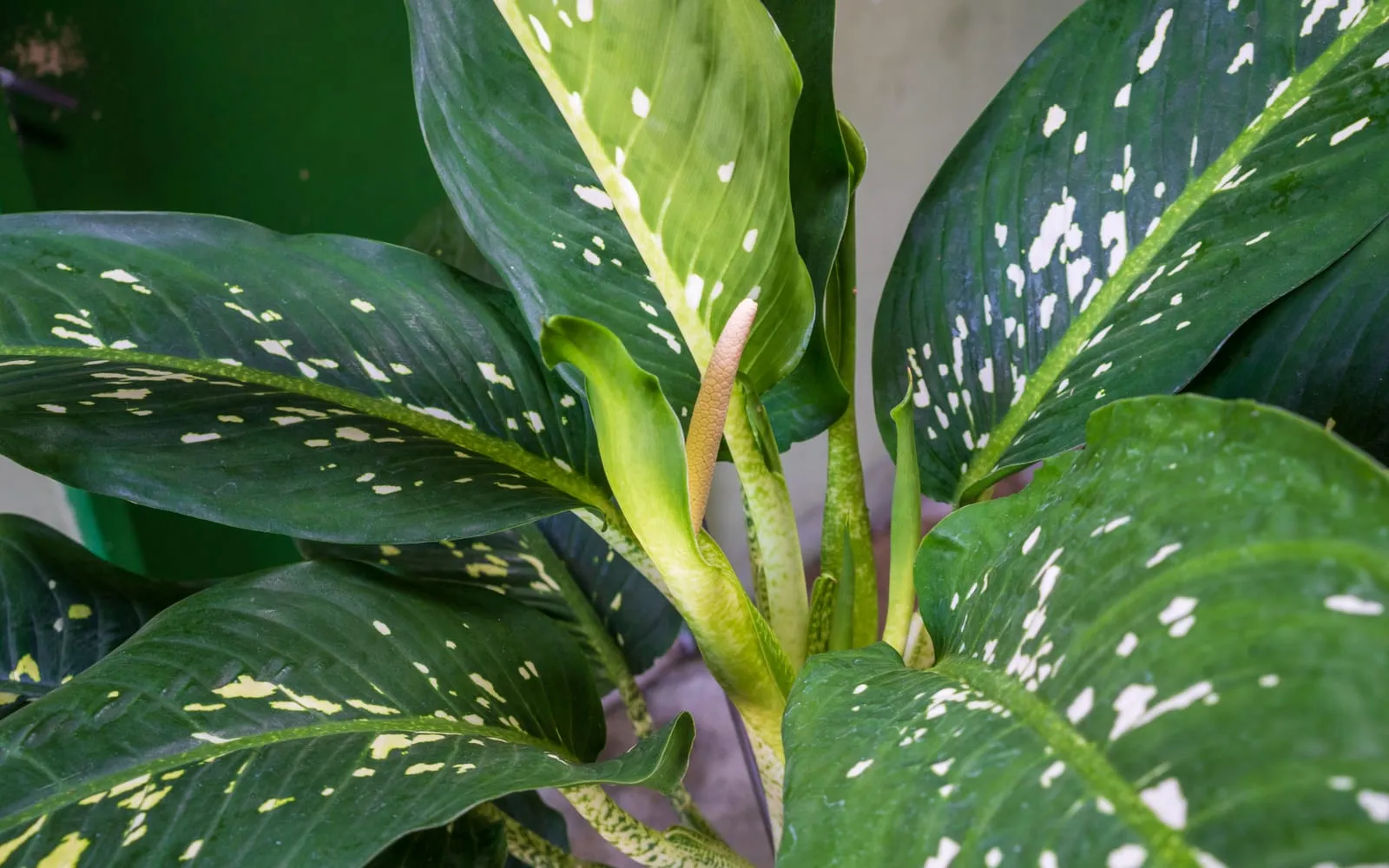
The variegation is what people buy it for. Most varieties carry irregular splashes, speckles and streaks of cream, white or pale yellow over a dark green ground, and the pattern varies from fine flecking to leaves that are almost entirely cream with a green margin.
Stems are thick, green, and marked with the scars of fallen leaves. They become cane-like with age, which is where the second half of the name comes from.
Flowers appear occasionally on mature plants as a pale green spathe wrapped around a narrow spadix, in the manner of a peace lily. They are unremarkable and best removed, since they take energy from the leaves.
Sap is watery and clear rather than milky, and it is present throughout the plant.
Varieties differ mainly in the pattern. ‘Camille’ is pale cream with a green edge, ‘Tropic Snow’ is large and boldly marked, and ‘Reflector’ is dark with heavy speckling.
Where it is from
The Caribbean and tropical South America, where it grows on the floor of humid lowland rainforest in warm shade with high year-round humidity.
That habitat sets every requirement. Filtered light under a canopy gives the dislike of direct sun, constant warmth gives the intolerance of cold, and high humidity gives the brown tips it develops in a centrally heated room.
The genus was named for Joseph Dieffenbach, head gardener at the Schoenbrunn Palace gardens in Vienna in the nineteenth century.
Its use as an instrument of punishment on Caribbean plantations is documented in colonial records and gave the plant its English name. Growing it now carries none of that, and the history is part of why the name sounds so strange.
It became a mainstream houseplant in the mid-twentieth century, and it is now among the most widely sold foliage plants in the world.
How it grows
Position it in bright indirect light. Direct sun scorches the leaves and deep shade produces weak leggy growth with poor variegation.
Keep it warm, between 18 and 24 deg C, and never let it drop below 15 deg C. Cold is a common cause of collapse.
Water when the top 2 to 3 cm of compost has dried, watering thoroughly and letting it drain completely.
Raise the humidity. A tray of damp pebbles, grouping plants together or a humidifier all help, and misting does very little.
Feed fortnightly through spring and summer with a balanced houseplant fertiliser at half strength.
Rotate the pot a quarter turn every week or two. Dumb cane leans hard towards the light and becomes lopsided otherwise.
Repot every year or two in spring while the plant is growing quickly.
Cut a leggy plant back hard in spring, to 15 cm from the compost if necessary. It reshoots from dormant buds on the stem, often producing several new heads.
Wear gloves for all of the above that involves cutting. The sap runs freely from a cut stem.
Propagate from the cut sections. Stem pieces 10 cm long laid horizontally on damp compost will root and shoot, and the top can be rooted as a cutting. Air-layering works well on a tall bare stem.
Through the seasons
Winter is the difficult season. Keep it well away from cold glass and draughts, water sparingly, stop feeding, and expect brown tips from dry heated air.
Spring is the time for the work. Repot, cut back a leggy plant, take cuttings, and resume feeding as growth restarts.
Summer is fast growth. Water when the surface dries, feed fortnightly, keep the humidity up, and rotate the pot regularly.
Autumn is the wind-down. Reduce watering and feeding from October and move the plant away from windows that get cold at night.
Care difficulty
Moderate. The growing itself is straightforward and the handling requires attention.
Legginess is the characteristic problem. A dumb cane naturally sheds its lower leaves and ends up as a bare stem with a tuft on top, and cutting it back hard in spring is the routine answer rather than a rescue.
Cold and dry air are the two conditions it dislikes most, and heated houses in winter supply both.
The safety precautions are the part that needs remembering. Gloves for any cutting, and a position out of reach.
Beyond that it grows fast, roots easily and recovers well from being cut back.
Watering
Water when the top 2 to 3 cm of compost has dried, which in summer usually means weekly.
Water thoroughly until it drains from the bottom, then empty the saucer. Standing water rots the roots.
Reduce watering considerably in winter, perhaps to every two or three weeks, depending on the temperature.
Use tepid water. Cold water on the roots of a tropical plant checks its growth.
Rainwater or filtered water reduces the brown leaf tips that hard water causes.
Drooping leaves with dry compost mean thirst, and the plant recovers within hours. Drooping with wet compost means root rot and is far more serious.
Warning signs, diseases and pests
A bare stem with leaves only at the top is normal ageing rather than a problem. Cut the plant back hard in spring, to 15 cm if needed, and it reshoots from dormant buds. Use the cut sections as cuttings, wearing gloves.
Brown crispy leaf tips and margins come from dry air, and they are almost universal in a centrally heated room in winter. Raise the humidity.
Yellowing lower leaves in quantity mean overwatering or cold roots. Check the drainage and the temperature.
Red spider mite produces fine pale stippling and webbing in hot dry conditions, and it is the commonest pest on this plant. Raise the humidity and treat promptly.
Mealybug gathers in the leaf axils as white cottony masses.
Leaves losing their variegation and turning plain green means too little light. Leaves scorched with bleached patches means too much direct sun.
Sudden collapse with soft blackened stem bases is root or stem rot, usually from cold wet compost. Cut back to firm tissue and root the healthy top as a cutting.
Growing environment
Bright indirect light. An east-facing window, or a couple of metres back from a south-facing one, suits it well.
Never direct summer sun, which scorches the large leaves quickly.
Warmth between 18 and 24 deg C, and never below 15 deg C.
High humidity. A bathroom or kitchen is ideal, and a tray of damp pebbles helps elsewhere.
Away from radiators, draughts, external doors and cold windowsills.
Free-draining peat-free houseplant compost with added perlite, in a pot with drainage holes.
Position it out of reach. A high shelf, a plant stand or a room that children and pets do not use are all better than a low table.
Feeding
Feed fortnightly from April to September with a balanced liquid houseplant fertiliser at half the stated strength.
Stop feeding from October to March.
Repot annually or every second year in spring, which matters more than feeding for a fast-growing plant.
Flush the compost with plain water occasionally to clear accumulated fertiliser salts, which contribute to brown leaf tips.
A plant cut back hard in spring benefits from feeding as soon as new shoots appear.
Troubleshooting
Why is it called dumb cane? Chewing the stem fires calcium oxalate crystals into the mouth and throat, causing severe burning, swelling and temporary loss of speech. The name comes from its historical use as a punishment.
It is a bare stem with a few leaves on top. Normal ageing. Cut it back hard in spring, to 15 cm if necessary, and it reshoots. Root the cut pieces as new plants.
Brown crispy leaf tips. Dry air, which is standard in a heated room in winter. Raise the humidity with a pebble tray or by grouping plants.
The leaves have gone plain green. Not enough light. Move it somewhere brighter, but out of direct sun.
It leans over to one side. It grows towards the light. Rotate the pot a quarter turn every week or two.
Yellow lower leaves and a soft stem base. Overwatering, often combined with cold. Cut back to firm tissue, root the healthy top, and water less.
Do I need gloves to prune it? Yes. The sap runs freely from cut stems and causes skin irritation and severe eye pain. Wash hands and tools afterwards.
Is it safe to own with a cat? Only out of reach. It causes severe mouth pain and swelling in cats and dogs, and it is one of the most frequently reported houseplants to poison centres.
Dumb cane problem guides
Not sure what is wrong? See the common houseplant pests guide.