
Houseplant
Parlour palm
Chamaedorea elegans
Also known as Neanthe bella palm, Good luck palm, Chamaedorea
How to care for Chamaedorea elegans. The Victorian drawing-room palm that still tolerates a dim corner better than almost anything, why it stays small, and the two things that brown the tips.
At a glance
- Difficulty
- Easy
- Water
- When the top third of the compost has dried
- Light
- Low to medium indirect light. Deep shade slows it rather than harming it
- Temperature
- 18-24 deg C, and never below 10 deg C
- Humidity
- Moderate. Dry air is the usual cause of brown tips
- Hardiness
- USDA 10-12, RHS H1b, hardy to 10 C
- Type
- Evergreen perennial palm, slow and long-lived
- Height
- 1-2 m indoors over many years
- Native to
- Mexico, Central America
Understorey palm from the rainforests of southern Mexico and Guatemala, where it grows in deep shade under a closed canopy with warm nights and year-round humidity. It has no cold tolerance to speak of and is damaged below about 10 deg C, so outdoors it needs a frost-free climate with no dry season. What it does not need is light, which is the reverse of most palms and the whole reason it became a houseplant.
Hardiness zones describe winter cold alone. Summer heat, humidity, rainfall and the length of the growing season decide as much, so treat the range as the outer limit rather than as a recommendation.
Not known to be toxic
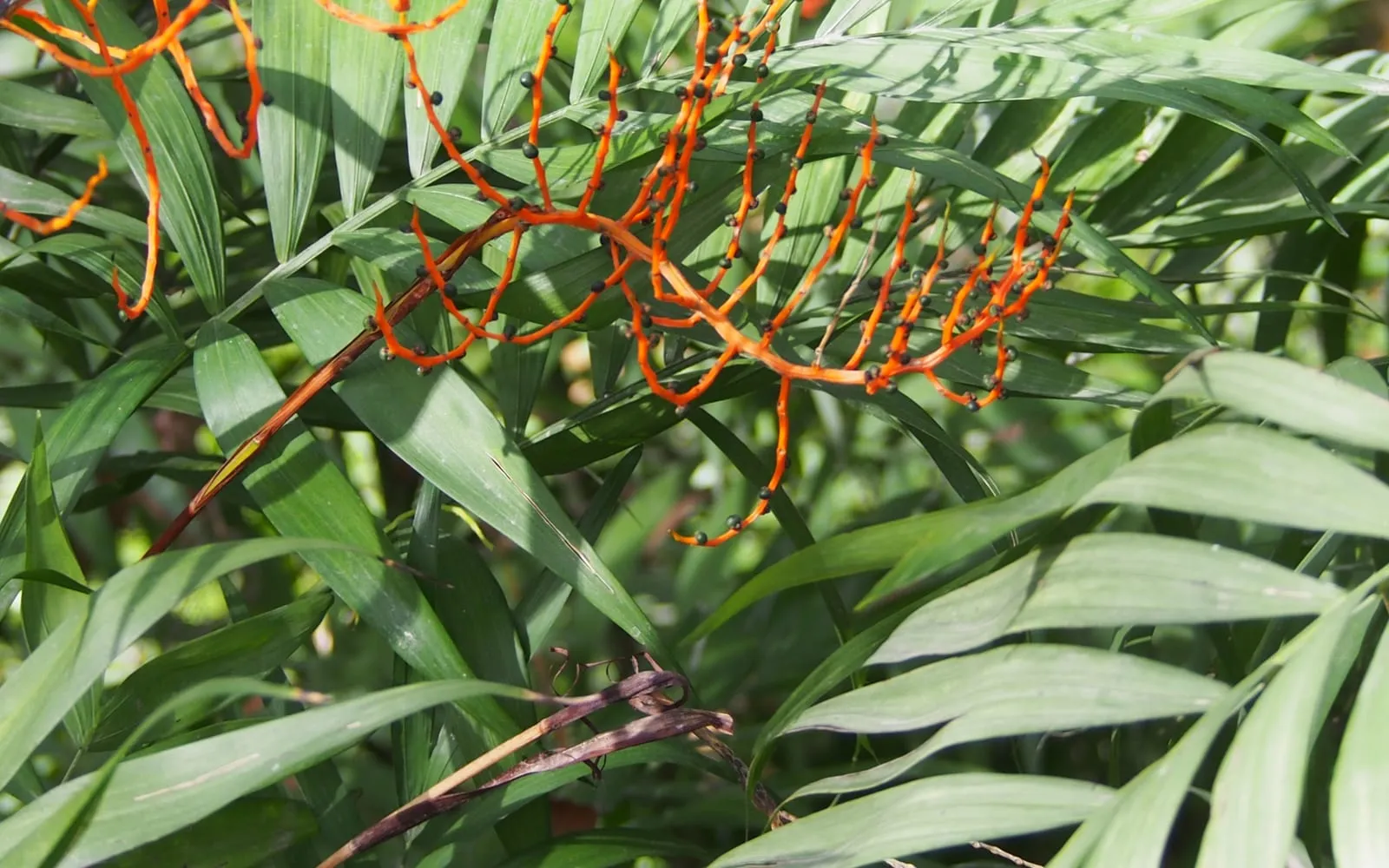
Non-toxic. The ASPCA lists Chamaedorea elegans among plants that are not harmful to cats, dogs or horses, and it appears on no RHS list of potentially harmful garden plants. That combination of deep shade tolerance and complete safety is rare enough to matter, because most of the plants that will hold a dark corner are aroids carrying calcium oxalate. A cat that chews the fronds will do the palm more harm than the palm does the cat, though repeated chewing leaves permanently severed leaflets that never grow back. The small orange fruits that follow flowering on a mature female plant are not toxic either, but they are not food and there is nothing in them worth eating.
Sources: ASPCA (Parlor Palm, Chamaedorea elegans), RHS potentially harmful garden plants
About
The parlour palm arrived in European drawing rooms at the same time as the aspidistra and for the same reason. It survived them. Gas lighting, coal smoke and rooms that were dark by any modern standard suited a palm that had spent its evolutionary history under a rainforest canopy, and it became the palm of the Victorian interior almost by default.
It has kept the position since without much competition. Most palms sold as houseplants want the brightest spot in the room and sulk anywhere else. This one holds a corner that no other palm will, stays small enough for a side table for years, and asks for very little beyond water and a room that does not go cold.
Two things spoil it, and both show up as brown leaflet tips. Dry air is the common one. Hard water and accumulated fertiliser salts are the other, and they work slowly enough that most people blame the air when the water is doing it.
Appearance and character
A slender single-stemmed palm with a green, faintly ringed stem carrying arching pinnate fronds. Each frond has perhaps twenty to forty narrow leaflets set along a central rachis, soft rather than stiff, and a deep matt green.
Nurseries almost always sow several seeds to a pot, so what looks like a multi-stemmed clump is a handful of separate plants growing together. That matters when one of them dies, because the gap does not fill in.
Growth is slow. A plant puts out two or three new fronds in a good year and takes a decade or more to reach a metre. Two metres is the practical ceiling indoors and most never approach it.
Mature plants flower readily, even in poor light, sending up branched sprays of tiny bead-like yellow flowers from among the fronds. Plants are either male or female, and a pollinated female carries small black or orange fruits afterwards. The flower sprays take energy the plant could spend on fronds, so cutting them off is reasonable if you want growth rather than novelty.
A palm has one growing point per stem, at the top. Cut it out and that stem is finished, because there is no dormant bud further down to take over. This is the single most common way a healthy parlour palm gets killed.
Where it is from
The rainforests of southern Mexico, Guatemala and Belize, where it grows on the forest floor beneath a closed canopy.
That habitat explains the plant completely. A palm growing in the understorey of a lowland tropical forest receives a small fraction of the light hitting the canopy, sits in air that rarely dries out, and never experiences cold. Give it those three conditions indoors and it is content.
It was collected commercially through the nineteenth and twentieth centuries on a scale that damaged wild populations, and seed collection in Mexico and Guatemala was for a long time a significant rural income. Most plants sold now come from cultivated seed rather than wild stands.
The genus Chamaedorea runs to over a hundred species, nearly all of them understorey palms of Central and South America, and several others are grown as houseplants. Chamaedorea seifrizii, the bamboo palm, is the clumping one often sold alongside it and wants noticeably more light.
How it grows
Give it low to medium indirect light. A north-facing room north of the equator, or a south-facing one below it, suits it exactly, and so does a position two or three metres back from a brighter window.
Keep it out of direct sun, which bleaches the fronds to a yellowish green and scorches them at the edges.
Water when the top third of the compost has dried, watering thoroughly until it runs from the bottom, then emptying the saucer. A palm standing in water rots from the roots up.
Keep it warm and steady. Between 18 and 24 deg C is ideal, and anything below 10 deg C causes damage that shows as blackened leaflets a fortnight later.
Raise the humidity if you can. Grouping plants together, standing the pot on a tray of damp gravel, or keeping it in a bathroom all help more than misting, which raises humidity for about ten minutes.
Feed every six weeks through spring and summer at half the strength on the bottle, and not at all from mid-autumn to early spring.
Repot every two or three years at most, in spring. Palms grow better slightly pot-bound and dislike root disturbance, so move it up one pot size and no more.
Never cut the top out of a stem. Remove whole fronds at the base once they have browned, and trim brown tips with scissors following the shape of the leaflet if the look bothers you.
Through the seasons
Spring brings the year’s new fronds, pushing up from the centre as tight spears. Resume feeding, and repot now if the roots have filled the pot.
Summer is steady growth. Water when the top third dries, feed every six weeks, and watch for red spider mite in a warm dry room.
Autumn is the wind-down. Reduce watering, stop feeding from October, and move the plant closer to the glass as the light drops.
Winter is the risky season. Water sparingly, keep it away from cold glass and from radiators, and expect no growth. Most losses happen now, from compost that stays wet in a cool room.
Care difficulty
Easy, and among the most forgiving palms in cultivation.
Dry air is the main difficulty rather than a fault of the plant. Central heating takes room humidity well below what a rainforest understorey provides, and the leaflet tips brown in response.
Overwatering is the way it dies. A slow-growing palm in a dim corner uses very little water, and the compost stays wet for far longer than the label suggests.
Red spider mite follows dry air and is the pest that ruins the look of a good plant, producing fine pale stippling and eventually webbing at the frond tips.
Cold damage is sudden rather than gradual. A plant left behind a curtain against a freezing window can be blackened by morning.
Watering
Water when the top third of the compost has dried, which in a shaded room usually means every seven to ten days in summer and every two to three weeks in winter.
Water thoroughly until it drains from the bottom, then empty the saucer within twenty minutes.
Use rainwater or filtered water where your tap water is hard. Fluoride and dissolved salts accumulate in the compost and show as browning tips, and palms are among the more sensitive houseplants to both.
Flush the compost through with plain water two or three times a year to clear those salts, letting several potfuls run out of the bottom.
Underwatering causes the lower fronds to yellow and dry from the tips inwards. The plant recovers, but the damaged fronds do not.
Overwatering causes a general yellowing, a sour smell from the compost and, at the end, blackened bases. Check the roots before assuming anything else.
Warning signs, diseases and pests
Brown crisp tips on otherwise healthy fronds are dry air, hard water or salts, in that order of likelihood. Raise the humidity, switch to rainwater and flush the pot.
Fine pale speckling across the leaflets, worst near the tips, is red spider mite. Hold a sheet of white paper under a frond and tap it to confirm. Raise the humidity and treat early, because a bad infestation on a slow-growing palm takes a year to grow out.
Small flat brown discs along the leaflet undersides and the stems are scale insects. Wipe them off with a damp cloth and check the plant weekly for a month.
White fluff in the leaf axils is mealybug. Deal with it the same way.
Whole fronds yellowing from the bottom of the plant upwards is normal ageing if it happens to one at a time, and overwatering if it happens to several at once.
A stem that has stopped producing new fronds entirely has usually lost its growing point, whether cut off, rotted or damaged by cold. That stem will not recover, and the correct move is to cut it out at the base and let the others carry on.
Blackened leaflets appearing suddenly after a cold night are cold damage. Remove the worst fronds and move the plant somewhere warmer.
Growing environment
Low to medium indirect light, and it will hold a position most plants will not.
Never direct sun.
Warm and steady between 18 and 24 deg C, with 10 deg C as the floor.
Moderate to high humidity. A bathroom or kitchen suits it better than a living room with the heating on.
Free-draining peat-free houseplant compost in a pot with drainage holes. A slightly heavy pot steadies a tall plant.
Outdoors it needs a frost-free climate and shade, which puts it in USDA 10 and warmer. In cooler climates it can spend the summer in full shade outside and must come in well before the first cold nights.
Avoid cold glass, draughty doorways and the airflow directly above a radiator.
Feeding
Feed every six weeks from spring to early autumn with a balanced liquid houseplant fertiliser at half the recommended strength.
Stop feeding entirely through late autumn and winter, when the plant is not growing and unused fertiliser accumulates as salts.
Underfeeding shows as pale new fronds and very slow growth. Overfeeding shows as brown tips and a white crust on the compost surface.
Repot every two or three years in spring, moving up one pot size. Palms resent disturbance, so tease the roots as little as possible.
Top-dress instead of repotting where the plant is large, scraping off the top few centimetres of compost and replacing it with fresh.
Troubleshooting
The tips of all the leaflets are brown. Dry air first, hard water second. Raise the humidity around the plant and switch to rainwater or filtered water, then flush the compost to clear accumulated salts.
Fine pale speckling and a little webbing. Red spider mite, which arrives in warm dry air. Raise the humidity and treat promptly, since a slow palm takes a long time to grow out the damage.
A whole stem has stopped growing. Palms have one growing point per stem. If it was cut, rotted or frosted, that stem is finished. Cut it out at the base.
Several fronds yellowed at once. Overwatering. Check that the pot drains, let the top third dry between waterings, and look at the roots.
Is it safe with a cat? Yes. The ASPCA lists it as non-toxic to cats, dogs and horses, which is unusual among plants that tolerate this little light.
It has sent up strange yellow beads on a stalk. Flowers, and they are normal even on a young plant in poor light. Cut them off if you would rather it put the energy into fronds.
How much light does it need to survive? Less than any other palm sold. It holds a corner where you would want a lamp on to read, though it grows more slowly there than it would nearer a window.
Can I make it bushier? No. Each stem grows from a single point and will not branch, and the fullness of a shop plant comes from several seedlings sharing one pot. Plant more stems rather than pruning the ones you have.
Parlour palm problem guides
Not sure what is wrong? See the common houseplant pests guide.