
Outdoor plant
English Ivy
Hedera helix
Also known as Common ivy, Ivy, Hedera
How to grow Hedera helix. Whether it damages walls, the two completely different forms one plant takes, why it feeds bees in November, and where it is a banned weed.
At a glance
- Difficulty
- Easy
- Water
- Through the first year only, then never
- Light
- Full shade to full sun. Variegated forms need more light
- Temperature
- Fully hardy, to about -20 deg C
- Hardiness
- USDA 5-10, RHS H6, hardy to -25 C
- Type
- Evergreen perennial climber, long-lived
- Height
- 20-30 m given a tall enough support
- Native to
- Woodland and hedgerow across Europe and western Asia, including Britain
- Best month
- March in the Northern Hemisphere, September in the Southern Hemisphere
Where you are decides whether to plant this at all. It is native across Europe and western Asia, where it feeds late bees and shelters nesting birds and does not harm a sound tree. In North America it is a listed noxious weed, banned from sale in Oregon, and it smothers forest floors and kills trees through the Pacific north-west, the mid-Atlantic and coastal California. It is also a declared weed in parts of Australia and New Zealand.
Hardiness zones describe winter cold alone. Summer heat, humidity, rainfall and the length of the growing season decide as much, so treat the range as the outer limit rather than as a recommendation.
Every month named in this guide is for the temperate Northern Hemisphere. If you garden in the Southern Hemisphere, shift each one by six months, so March becomes September. Closer to the equator the wet and dry seasons matter more than the calendar, and the shift stops being a useful guide.
Toxic if eaten
- Do not eat
- The leaves and the black berries, and the sap on skin
- Harm from
- Eating it and handling it
- Affects
- People, cats and dogs
Ivy causes trouble two different ways, and the skin reaction is the one most people meet. The sap contains falcarinol, a compound that produces an allergic contact dermatitis with blistering and itching. It is a recognised occupational problem among gardeners and hedge cutters, and sensitivity builds with repeated exposure, so someone who has handled ivy for years without trouble can develop a reaction. Wear gloves and long sleeves when cutting it back, and wash afterwards. The RHS lists Hedera helix as a skin irritant and as harmful if eaten. The berries and leaves contain saponins, chiefly hederasaponins, and eating them causes burning of the throat, vomiting, abdominal pain and diarrhoea. The ASPCA lists English ivy as toxic to cats and dogs, with the foliage more toxic than the berries. Serious poisonings are uncommon because the taste is acrid and the black berries ripen high on mature growth out of easy reach. Birds eat those berries without harm and depend on them in late winter.
Sources: ASPCA (English Ivy, Hedera helix), RHS potentially harmful garden plants
About
An ivy plant lives two lives. The familiar climbing form has lobed arrow-shaped leaves, grips with short adhesive roots, and never flowers. Once a stem reaches good light at the top of its support it changes into something that looks like a different species altogether, with plain oval leaves, no clinging roots, stiff woody shrubby growth, and flowers followed by black berries.
Botanists call the second the arborescent or adult phase. A cutting taken from adult growth roots into a free-standing shrub that never climbs, which is how the bushy ivies sold as Hedera helix ‘Arborescens’ are produced.
The phase change explains the wildlife value. Ivy flowers in September, October and November, when almost nothing else in a temperate garden offers nectar, and the berries ripen in late winter when birds are hungriest.
Appearance and character
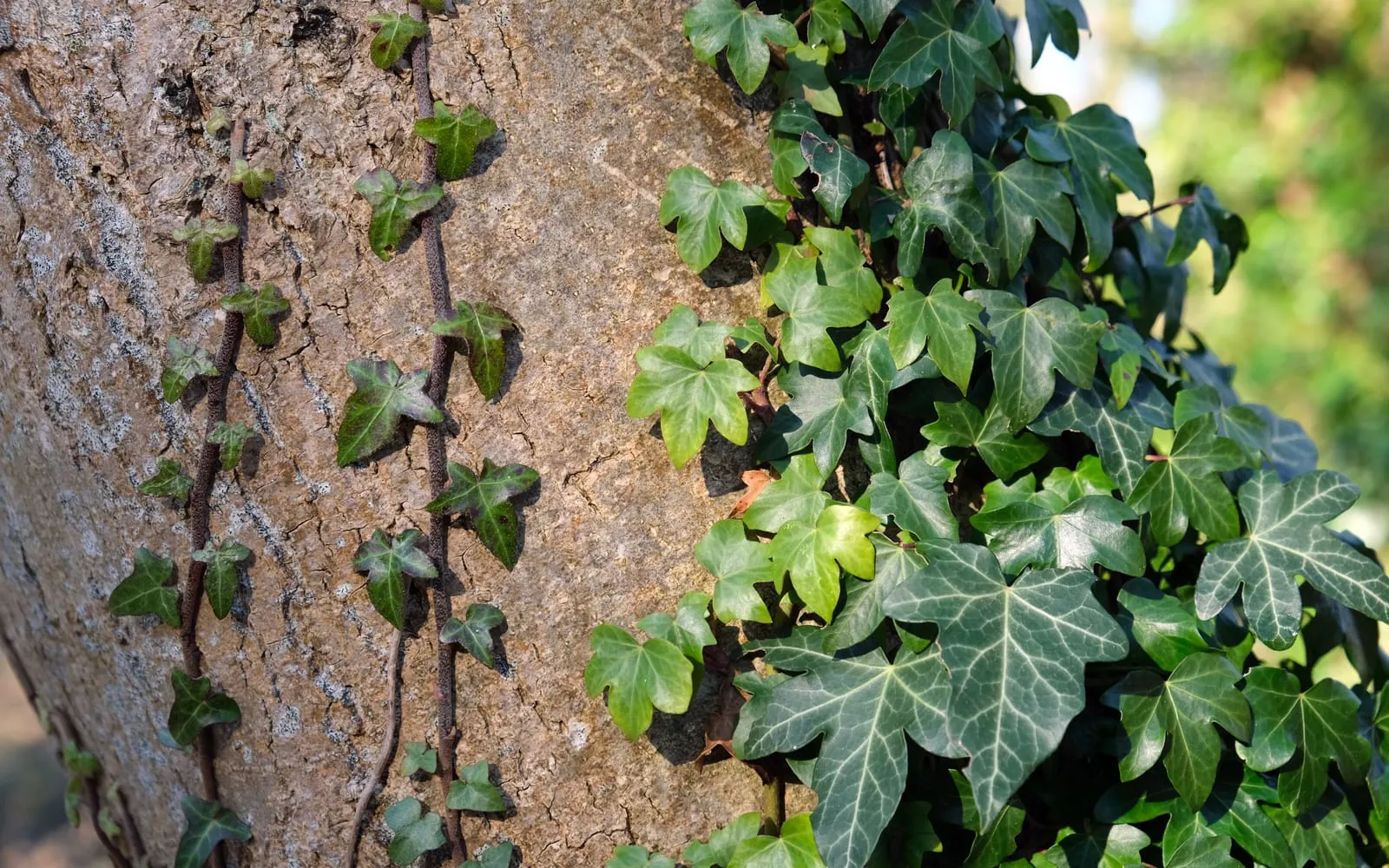
Juvenile climbing growth carries dark green leaves with three to five lobes, 5 to 10 cm across, often with pale veins, on thin flexible stems studded with brown adhesive rootlets.
Adult growth carries unlobed oval to diamond-shaped leaves on stout stems with no rootlets. The two forms sit on the same plant, juvenile below and adult above.
Flowers are small, greenish-yellow and clustered in rounded umbels, unremarkable to look at and heavily worked by insects.
Berries are matte black, ripening from February to April, in tight clusters.
The species has produced hundreds of cultivars. ‘Glacier’ is silver-grey and cream, ‘Goldheart’ has a bold yellow central splash, and ‘Buttercup’ turns yellow-green in sun. Hedera colchica and Hedera hibernica are separate species with much larger leaves, often sold loosely as ivy.
Where it is from
Woodland, hedgerows, cliffs and old walls across Europe and western Asia, and native throughout Britain.
Its natural place is the woodland floor and the trunks of trees, in shade, on moist soil rich in leaf litter. Shade tolerance is its defining trait among climbers, and it will cover ground and walls where nothing else grows.
It favours slightly alkaline soil and grows strongly on chalk and limestone, which is why ivy dominates old lime-mortared walls.
Britain and Ireland are within its native range, and it belongs in the ecosystem here. In other places it behaves very differently. Ivy has become a serious invasive weed in the Pacific Northwest of the United States, smothering native forest understorey, and it is listed as a noxious weed in Oregon and restricted in Washington. Readers in those states should plant something else.
How it grows
An evergreen perennial climber that ascends by short adhesive roots along the stem. Those roots secrete a glue and grip surfaces; they do not penetrate living tissue and take no water or nutrients from the support.
Growth is slow for the first year or two while roots establish, then rapid. An established plant adds a metre or more a year.
The switch to adult growth happens when a stem reaches light at the top of its support, usually after several years. A plant kept clipped as ground cover or a low wall covering may never make the switch and so never flowers.
Ground-running stems root where they touch soil, which is how ivy spreads laterally and how it becomes hard to remove.
Propagation is trivial. Any length of juvenile stem with a node roots in water or compost within a few weeks. Cuttings from adult growth give the shrubby form.
Through the seasons
Spring brings the main flush of new growth. Cut back and shape now, before birds nest in it. Check for nests from March onward and leave the plant alone if you find one.
Summer is steady growth. Trim wall-grown ivy back from gutters, windows and roof tiles.
Autumn is the flowering season, from September into November, and the plant becomes loud with wasps, hoverflies and the ivy bee.
Winter holds its leaves and shelters a great deal of wildlife. Berries ripen from February. Avoid heavy cutting in hard frost.
Care difficulty
Easy to the point of being difficult to stop. The skill with ivy is restraint rather than encouragement.
Left unchecked it climbs into gutters, lifts roof tiles, blocks windows and swamps shrubs. An annual cut keeps all of that in hand and takes half an hour.
The one genuine question is whether it damages walls, and the answer has been studied. Ivy does not damage sound masonry. English Heritage commissioned research at Oxford finding that an ivy cover moderates temperature swings and reduces frost damage and pollution on the wall behind it. Where the mortar is already soft, cracked or lime-perished, the rootlets exploit the gaps and make things worse. Ivy on a modern wall in good repair is protective, and ivy on a crumbling Victorian garden wall accelerates its decline.
On trees the picture is similar. Ivy is not a parasite and takes nothing from the tree, and a heavy growth adds weight and windage to a tree already in decline.
Watering
Water through the first growing season after planting while the roots establish.
After that ivy needs no watering in a temperate climate, including through drought. The root system is deep and efficient.
Plants in containers need regular watering, and ivy in a pot is the one situation where it can dry out and die.
Ivy grown against a house wall sits in a rain shadow and stays much drier than open ground, so give it a soak in the first couple of summers.
Water at the base rather than over the foliage, since wet leaves in still air encourage leaf spot.
Warning signs, diseases and pests
Ivy leaf spot shows as brown or grey blotches with dark margins, sometimes with tiny black dots. It is worse in damp crowded growth. Cut out affected shoots and improve airflow.
Scale insects appear as brown or white bumps along the stems, often with sooty mould on the leaves below. Established plants tolerate them.
Spider mites attack ivy grown under glass or indoors, leaving a stippled dusty leaf surface.
Vine weevil grubs eat the roots of container-grown ivy, causing sudden wilting.
Yellowing leaves on variegated forms usually mean too much shade. Reversion to plain green means the same, and reverted shoots should be cut out.
Leaves dropping from the base of an old plant while the top thrives is normal ageing. Cut the whole thing back hard in spring and it regrows from the base.
A tree carrying heavy ivy that is also thinning in the crown needs the tree assessed, since ivy tends to increase where a tree is already failing.
Growing environment
Anything from deep shade to full sun. Deep shade is where ivy beats every alternative. Variegated cultivars need reasonable light to hold their markings and lose them in gloom.
Almost any soil, and it does particularly well on chalk. Moist humus-rich ground gives the fastest growth.
Fully hardy to about -20 deg C, and tolerant of wind, salt and urban pollution.
Give it something to climb. A wall, a fence, a tree, a pergola or a stump all work, and it needs no tying in since it attaches itself.
As ground cover it is excellent under trees where grass will not grow, and it will run over anything low unless you edge it.
Keep it off thatch and away from gutters, and cut it back from window frames and under roof tiles annually.
Consider what it will reach in ten years rather than in one.
Feeding
Ivy needs no feeding in open ground. It grows too well already.
A mulch of garden compost in spring helps a newly planted specimen establish.
Container-grown ivy benefits from a balanced liquid feed monthly through summer, since a pot exhausts quickly.
Feeding an established wall-grown plant produces more growth to cut back, which is rarely what anyone wants.
Variegated forms fed heavily with nitrogen tend to revert to plain green.
Troubleshooting
Will it destroy my wall? Not if the wall is sound. Research commissioned by English Heritage found ivy protects masonry from frost and pollution damage. On walls where the mortar has already perished, the rootlets get into the gaps and make it worse. Check the pointing before you decide.
Is it killing my tree? Ivy takes nothing from the tree, since it roots in the ground and only uses the trunk for support. Very heavy growth adds weight and catches wind, which matters on a tree already in poor condition. Sever the stems at the base if you want it off, and leave the dead growth to fall away rather than pulling it and stripping bark.
My ivy has never flowered. It is still in its juvenile climbing phase, or you clip it every year. Flowering only happens on adult growth that has reached the top of its support and been left alone.
The leaves have changed shape near the top. That is the adult phase. Plain oval leaves, woody stems and no clinging roots. Cuttings from that growth make a free-standing shrub.
My variegated ivy has gone green. Too little light, or too much nitrogen. Cut out the plain green shoots and move it somewhere brighter.
I got a rash after cutting it back. Falcarinol in the sap causes an allergic contact dermatitis, and sensitivity builds over time. Wear gloves and long sleeves and wash afterwards.
How do I get rid of it? Cut every stem through at the base, wait for the top growth to die and fall, and dig out the roots. Repeat, because it regrows from fragments.
Should I plant it at all? Anywhere in Europe, yes. It is native, and the autumn nectar and late-winter berries are valuable. Across much of North America it is a listed noxious weed, banned from sale in Oregon, and there you should plant a native climber instead.