
Houseplant
Cast iron plant
Aspidistra elatior
Also known as Aspidistra, Bar room plant, Parlour palm
How to care for Aspidistra elatior. The Victorian parlour plant that survives dark corners and cold hallways, why it grows so slowly, and the two things that kill it.
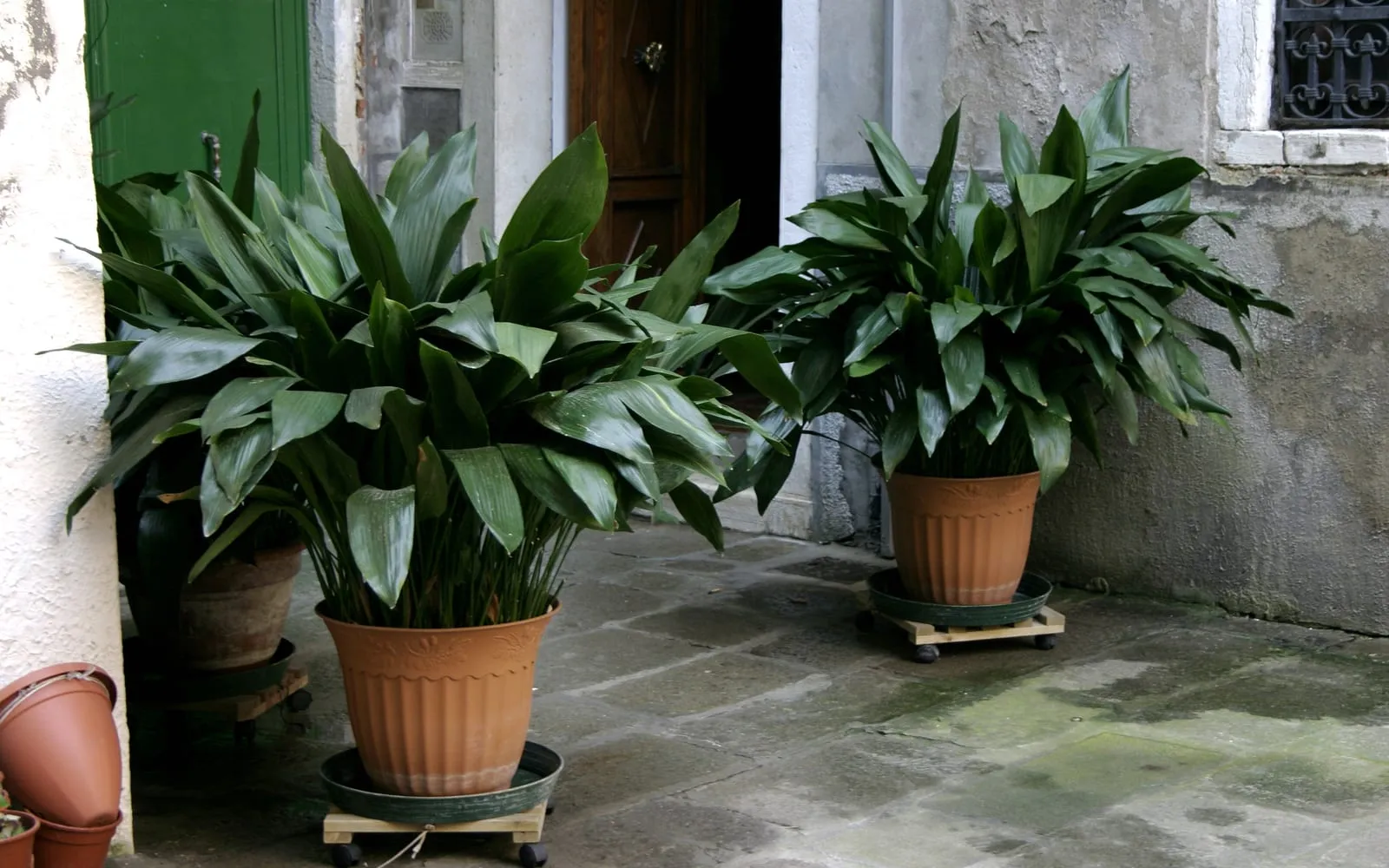
At a glance
- Difficulty
- Easy
- Water
- When the top half of the compost has dried
- Light
- Low to medium indirect light. It tolerates deep shade
- Temperature
- 10-21 deg C, and it survives brief spells near freezing
- Humidity
- Ordinary room air is fine
- Hardiness
- USDA 7-11, RHS H4, hardy to -10 C
- Type
- Evergreen rhizomatous perennial, extremely long-lived
- Height
- 60-90 cm
- Native to
- Japan and Taiwan
- Best month
- January in the Northern Hemisphere, July in the Southern Hemisphere
Woodland in southern Japan and Taiwan, and far hardier than its reputation as a parlour plant suggests. It survives outdoors through USDA 7, taking around -10 deg C, and makes excellent evergreen ground cover in dry shade where little else grows. Indoors it tolerates darkness, draughts and neglect.
Hardiness zones describe winter cold alone. Summer heat, humidity, rainfall and the length of the growing season decide as much, so treat the range as the outer limit rather than as a recommendation.
Every month named in this guide is for the temperate Northern Hemisphere. If you garden in the Southern Hemisphere, shift each one by six months, so January becomes July. Closer to the equator the wet and dry seasons matter more than the calendar, and the shift stops being a useful guide.
Not known to be toxic
Non-toxic. The ASPCA lists Aspidistra elatior among plants that are not harmful to cats, dogs or horses, and the RHS does not include it in its list of potentially harmful garden plants. Neither the leaves nor the rhizomes present a poisoning risk, which makes this one of the safest houseplants available for a home with animals or small children. The tough leathery leaves are also unattractive to a chewing cat, so it tends to be left alone in practice as well as in principle. The plant flowers at soil level rather than above the foliage, producing small dull purple blooms that sit half buried in the compost and are frequently missed entirely. Those are harmless too. Aspidistra leaves have long been used in Japanese cooking as a decorative divider in bento boxes, which is where the plastic green dividers in supermarket sushi originated, and while the leaves are not eaten they are handled around food without concern.
Sources: ASPCA (Cast Iron Plant, Aspidistra elatior), RHS potentially harmful garden plants
About
The cast iron plant earned its name in the worst conditions any houseplant has ever faced. Victorian parlours were lit by coal gas, heated by coal fires, and thick with soot and tobacco smoke, and the aspidistra was the one plant that survived them. It became so completely the emblem of respectable middle-class domestic life that Orwell used it as the title of a novel about failing to escape that life.
Nothing has changed about the plant since. It will grow in a north-facing hallway, in an unheated porch, in the dark corner of a stairwell, and it will keep going for decades with almost no attention. It is among the surest houseplants for a low-light room, holding on where almost nothing else will.
Two things kill it. Overwatering rots the rhizome, and direct sun bleaches and scorches the leaves. Avoid both and there is very little else to get wrong.
Appearance and character
An evergreen perennial growing from a creeping underground rhizome, forming a slow clump 60 to 90 cm tall.
Leaves rise individually straight from the compost on stiff stalks rather than from a central stem, each one broad, lance-shaped, 30 to 60 cm long, thick, leathery and very deep glossy green.
Growth is remarkably slow. A healthy plant produces perhaps four to six new leaves in a year, which is why a large specimen costs what it does and why they are so often passed down.
Flowers appear at soil level, hidden among the leaf bases, small fleshy dull purple cups about 2 cm across sitting half buried in the compost. Most owners never notice them.
The pollination is odd and was argued over for a century. Fungus gnats are now thought to be the main pollinators, having earlier been credited variously to slugs and to amphipods.
Variegated forms are grown. ‘Variegata’ is striped in cream, and ‘Milky Way’ is speckled with white dots.
Where it is from
Japan and Taiwan, where it grows on shaded forest floors and rocky slopes beneath dense evergreen canopy.
Growing under a closed canopy is the whole explanation for the shade tolerance. A plant that receives almost no direct light in the wild will cope with a dim room.
Its native range also has cool winters, which is why it survives an unheated hall and a porch that drops close to freezing. It is hardy enough to grow outdoors in sheltered gardens through USDA 7 and warmer.
It reached Britain in the early nineteenth century and was ubiquitous by the 1880s. The Victorian home suited it exactly, and its association with that period made it deeply unfashionable for most of the twentieth century.
Aspidistra leaves are used in Japan as bento dividers, laid between foods to keep flavours separate, and the disposable plastic green strips in supermarket sushi imitate them.
The genus was once thought to contain a handful of species and now runs to well over a hundred, most of them described from southern China and Vietnam in the last thirty years.
How it grows
Position it in low to medium indirect light. A north-facing room, a hallway, a stairwell or a shaded corner all suit it.
Keep it out of direct sun, which bleaches and scorches the leaves permanently.
Water when the top half of the compost has dried, watering thoroughly and letting it drain completely.
Keep it cool. Anywhere between 10 and 21 deg C is fine, and it tolerates brief spells near freezing without damage.
Feed sparingly, every six to eight weeks in the growing season, and not at all in winter.
Wipe the leaves with a damp cloth every few weeks. Dust matters more on a plant in poor light, since it blocks what little it gets.
Repot only every four or five years, in spring. Aspidistra dislikes disturbance and grows better when left in the same pot for years.
Divide a congested clump in spring, separating the rhizome into sections each with several leaves and roots.
Remove old, marked or damaged leaves at the base with secateurs, which is the only pruning it needs.
Expect very little. A plant that produces five new leaves in a year is doing well.
Through the seasons
Winter is undemanding. Reduce watering considerably, stop feeding, and expect no growth at all. Cold does not trouble it.
Spring is when the new leaves come, appearing as tightly rolled spears pushing up from the compost. Resume feeding, and repot or divide if the clump has filled the pot.
Summer is slow steady growth. Water when the top half of the compost dries, feed every six to eight weeks, and keep it out of sun.
Autumn is the wind-down. Reduce watering and stop feeding from October.
Care difficulty
Easy, and it has a strong claim to being the most tolerant houseplant sold.
Overwatering is one of the two genuine risks. The rhizome rots in compost that stays wet, particularly in a cool room in winter.
Direct sunlight is the other, and it leaves permanent pale scorched patches.
Slow growth is the thing people find hardest. A cast iron plant will not fill a corner in a season, and buying a large plant is the only way to get a large plant quickly.
Beyond those it withstands cold, draughts, dust, neglect, dim light and long gaps between waterings.
Watering
Water when the top half of the compost has dried out, which in a cool shaded position often means every two to three weeks.
Water thoroughly until it drains from the bottom, then empty the saucer.
Reduce watering in winter, perhaps to monthly, particularly in an unheated room.
Underwatering causes very little harm. The plant tolerates drying out and recovers without fuss.
Overwatering causes yellowing leaves and a soft rotting rhizome, which is considerably harder to reverse.
Rainwater or filtered water reduces the brown leaf tips that hard tap water produces over time.
Warning signs, diseases and pests
Yellowing leaves, particularly several at once, almost always mean overwatering. Let the compost dry out further between waterings and check that the pot drains.
Pale bleached patches on the leaves are sun scorch and are permanent. Move the plant out of direct light and remove the worst leaves at the base.
Brown crispy tips and margins usually come from hard tap water and accumulated fertiliser salts. Flush the compost through occasionally and switch to rainwater.
Scale insects appear as small flat brown discs along the leaf undersides and the midribs, producing sticky honeydew. Wipe them off with a damp cloth.
Red spider mite causes fine pale stippling in a warm dry room, which is less common on this plant than on most because it is usually grown somewhere cool.
Dull dusty leaves in a dark corner reduce what little light the plant receives. Wipe them.
No new growth at all over a whole season usually means the plant is cold and underfed rather than ill, and it may be behaving normally.
Variegated forms reverting to plain green are usually being fed too richly, since variegation holds better in poorer conditions.
Growing environment
Low to medium indirect light. This plant will grow where almost nothing else will, including north-facing rooms, hallways and stairwells.
Never direct sun, which scorches the leaves permanently.
Cool conditions between 10 and 21 deg C. An unheated hall or porch suits it better than a warm living room.
Ordinary room humidity, with no special provision needed.
Free-draining peat-free houseplant compost in a pot with drainage holes. A heavy pot suits a tall plant.
It grows outdoors in sheltered shaded gardens through USDA 7 and warmer, and it makes good ground cover in dry shade.
Avoid a sunny windowsill, a spot above a radiator and any pot that holds water.
Feeding
Feed every six to eight weeks from April to September with a balanced liquid houseplant fertiliser at half strength.
Stop feeding entirely from October to March.
Feed variegated forms less, since rich feeding encourages them to revert to plain green.
Repot only every four or five years. The plant resents disturbance and does better slightly pot-bound.
Flush the compost with plain water occasionally to clear fertiliser salts, which contribute to brown leaf tips.
Troubleshooting
Several leaves have gone yellow. Overwatering, which is the commonest problem. Let the top half of the compost dry between waterings and make sure the pot drains.
Pale bleached patches on the leaves. Sun scorch, and it is permanent. Move the plant out of direct light and cut off the worst leaves at the base.
It has not grown at all this year. Cast iron plants are extremely slow, producing perhaps four to six leaves a year. That may be normal rather than a problem.
Brown crispy tips. Hard tap water and fertiliser salts building up. Flush the compost through and use rainwater or filtered water.
Will it survive in a dark hallway? Yes. This is the plant for exactly that position, and it will also tolerate an unheated porch.
Small purple things at soil level. Flowers. They are produced at the base among the leaf stalks and are easy to miss entirely.
My variegated one is turning plain green. Too much feeding. Variegation holds better in poorer conditions, so feed it less.
Can I grow it outside? In a sheltered shaded spot in USDA 7 and warmer, yes. It makes good ground cover in dry shade.
Cast iron plant problem guides
Not sure what is wrong? See the common houseplant pests guide.