
Houseplant
Arrowhead vine
Syngonium podophyllum
Also known as Goosefoot plant, Nephthytis, Syngonium
How to care for Syngonium podophyllum. The plant that changes leaf shape as it climbs, why the arrowhead you bought turns into something else, and how to keep it compact.
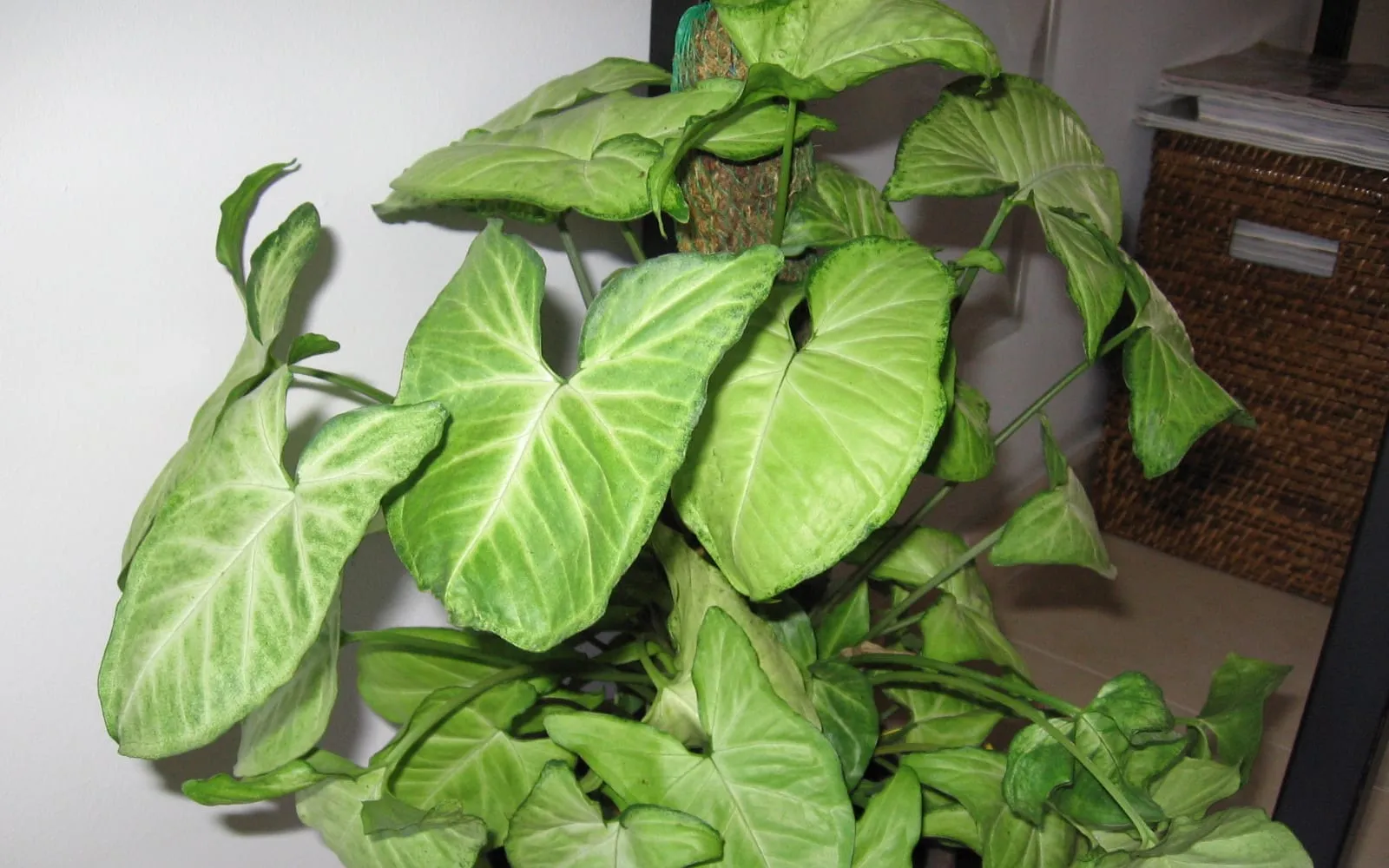
At a glance
- Difficulty
- Easy
- Water
- When the top third of the compost has dried
- Light
- Bright indirect light for coloured forms, moderate shade for green ones
- Temperature
- 18-27 deg C, and never below 12 deg C
- Humidity
- Moderate to high. Leaf size follows humidity
- Hardiness
- USDA 10-12, RHS H1b, hardy to 12 C
- Type
- Evergreen perennial climber, long-lived
- Height
- 2-3 m indoors on a pole
- Native to
- Mexico, Central America
Lowland tropical forest from Mexico through Central America into northern South America, climbing trunks in warm, wet, shaded conditions with no cold season. It has no frost tolerance and is damaged below about 12 deg C, so outdoors it needs a warm humid frost-free climate. It is invasive in several of those climates, having escaped cultivation in Florida, Hawaii, Singapore and parts of Australia, so check local status before planting it out.
Hardiness zones describe winter cold alone. Summer heat, humidity, rainfall and the length of the growing season decide as much, so treat the range as the outer limit rather than as a recommendation.
Toxic if eaten
- Do not eat
- Every part, and the sap most of all
- Harm from
- Eating it and handling it
- Affects
- People, cats and dogs
Syngonium carries needle-shaped calcium oxalate raphides throughout its tissues, as most of the arum family does. Chewing any part of it drives those crystals into the lining of the mouth and throat, and the result is immediate burning, drooling, swelling of the lips and tongue and difficulty swallowing. The ASPCA lists arrowhead vine as toxic to cats and dogs on that basis and the same applies to people. Serious cases are uncommon because the pain begins on the first bite, though swelling that reaches the airway is an emergency in a small animal. The sap irritates skin on contact and this plant is pruned often, so wear gloves and wash afterwards. A trailing plant on a shelf puts leaves within reach of a jumping cat, which is worth considering when placing it.
Sources: ASPCA (Arrowhead Plant, Syngonium podophyllum), RHS potentially harmful garden plants
About
The arrowhead vine is sold as a neat little mound of simple arrow-shaped leaves and does not stay that way. Given a few years it becomes a climber, and as it climbs the leaves change shape entirely, splitting into three, five and eventually eleven separate lobes that look nothing like the plant on the label.
This catches people out constantly. A plant that appears to have been replaced by something else has done nothing more than grow up. Aroids that climb produce juvenile leaves near the ground and adult leaves higher up, and Syngonium makes the transition more dramatically than most.
Which form you get is your decision. Pinch the growing tips out and it stays a compact juvenile mound indefinitely. Give it a pole and let it run and you get the divided adult foliage on a vine two or three metres long.
Appearance and character
A climbing perennial with slender green stems, aerial roots at the nodes and leaves held on long sheathing petioles.
Juvenile leaves are simple arrowheads, 8 to 15 cm long, with two backward-pointing basal lobes. Adult leaves on a climbing stem divide into three, five, seven or more separate leaflets arranged like a foot, which is where the name goosefoot comes from.
Colour runs from plain green through cream and white variegation to the pink and red cultivars bred in the last two decades. ‘White Butterfly’ is the common cream-centred form, ‘Neon Robusta’ and ‘Pink Splash’ carry the pink pigment, and plain green forms are the most shade-tolerant of the lot.
Growth is fast in warmth, and a plant left alone lengthens quickly and goes bare at the base while carrying leaves at the tips.
Flowering indoors is uncommon and produces a small greenish or cream arum spathe that is easy to miss.
The stem exudes a milky sap when cut, which stains fabric and irritates skin.
Where it is from
Tropical forests from southern Mexico through Central America into Bolivia and Brazil, climbing tree trunks in warm, humid, shaded conditions.
It is a hemiepiphyte in the same pattern as the pothos and the philodendrons. It germinates in low light on the forest floor, finds a trunk and climbs, and the leaf shape changes as it rises. The juvenile phase is the shade-adapted one, which is why the plant sold in a pot copes with a dim room.
It has become a serious weed outside its range. Escaped plants smother native vegetation in Florida, Hawaii, parts of Australia and much of tropical Asia, where discarded cuttings root readily in warm damp ground. Nothing thrown out of a pot in those climates should go on a compost heap.
The genus contains around forty species from tropical America, and the horticultural trade has concentrated almost entirely on this one.
How it grows
Give plain green forms moderate shade to bright indirect light, and give variegated and pink cultivars the brighter end of that, since pale tissue carries less chlorophyll and needs more light to break even.
Keep it out of direct sun, which scorches and bleaches the leaves.
Decide early whether you want a mound or a vine. Pinching out the growing tips every few weeks keeps the juvenile arrowhead form and a compact shape. A moss pole lets it climb and produces the divided adult leaves.
Water when the top third of the compost has dried, thoroughly, and drain completely.
Keep it above 12 deg C and ideally between 18 and 27 deg C.
Raise the humidity where the room is dry, which improves leaf size and reduces brown edges.
Feed monthly at half strength through spring and summer.
Repot annually or every other year in spring into a free-draining mix, since this plant grows faster than most aroids and fills a pot quickly.
Cut it back hard whenever it goes leggy. It responds well, resprouting from the nodes below the cut, and the trimmings root easily in water or compost.
Through the seasons
Spring starts vigorous growth. Resume feeding, repot, and take cuttings now to thicken the plant or start new ones.
Summer is fast growth in warmth. Water when the top third dries, feed monthly, and pinch tips regularly if you want to keep it compact.
Autumn slows it. Reduce watering, stop feeding from October, and move the plant nearer the light.
Winter is when to be careful. Keep it above 12 deg C, water sparingly and keep it away from cold glass. Growth stops until spring.
Care difficulty
Easy, and among the fastest and most forgiving of the climbing aroids.
Legginess is the main complaint and is a consequence of the plant doing what it evolved to do. Use regular pinching or a pole rather than changing in feeding.
Overwatering rots the stem bases, particularly in winter in a cool room.
Loss of variegation follows insufficient light on the coloured cultivars, and new leaves come in progressively greener.
Cold damage below 12 deg C shows as dark patches and leaf drop.
Watering
Water when the top third of the compost has dried, which in a warm room means roughly weekly in summer and every two weeks in winter.
Water thoroughly until it runs from the drainage holes, then empty the saucer.
This plant wilts visibly and dramatically when dry and recovers within an hour of watering, which makes it easy to read but is not a routine to rely on, since repeated wilting damages roots.
Use rainwater or filtered water where the supply is hard, since salts brown the leaf margins.
Underwatering causes a general collapse that reverses on watering.
Overwatering causes yellowing lower leaves, soft blackened stem bases and a sour smell.
Warning signs, diseases and pests
Long bare stems with leaves only at the tips are normal climbing behaviour in low light. Cut back hard in spring and pinch the tips regularly afterwards.
Leaves changing shape and dividing into lobes is the plant maturing, not a problem. Pinch the tips to hold the juvenile arrowhead form.
Variegated leaves coming in greener means not enough light. Move it brighter, out of direct sun.
Yellow lower leaves, several at once, are overwatering.
Brown crisp edges are dry air or accumulated salts. Raise the humidity and flush the compost.
White cottony fluff in the leaf sheaths is mealybug.
Fine pale stippling with webbing is red spider mite, which follows dry heated air.
Dark, water-soaked patches after a cold night are cold damage and do not recover.
Growing environment
Bright indirect light for coloured cultivars, moderate shade for plain green forms.
Never direct sun.
Warm, 18 to 27 deg C, with 12 deg C as the floor.
Moderate to high humidity, and leaf size responds to it.
Free-draining peat-free compost with bark or perlite through it, in a pot with drainage holes.
A moss pole if you want the adult divided foliage, or nothing at all if you want a compact mound.
Outdoors only in a warm humid frost-free climate, and check local invasive status first, since it is a listed weed in Florida, Hawaii, Singapore and parts of Australia.
Avoid cold glass, dry heated air in winter and pots without drainage.
Feeding
Feed monthly from spring to early autumn with a balanced liquid houseplant fertiliser at half the strength on the label.
Stop feeding from mid-autumn to early spring.
Feed variegated forms at the same rate rather than more, since extra nitrogen pushes green growth at the expense of the pattern.
Repot every year or two in spring, one pot size up. This plant grows faster than most aroids and becomes pot-bound quickly.
Flush the compost through with plain water occasionally to clear salts.
Troubleshooting
The leaves have changed shape completely. The plant is maturing. Juvenile leaves are simple arrowheads and adult leaves divide into several lobes. Pinch out the growing tips to keep the juvenile form.
It has gone leggy and bare at the bottom. Normal for a climber in low light. Cut it back hard in spring, root the cuttings into the same pot, and pinch the tips regularly afterwards.
The pink is fading. Not enough light. Move it to a brighter position out of direct sun. Pink and cream tissue carries no chlorophyll and needs more light to pay its way.
It wilted completely and then recovered. This plant collapses dramatically when dry and lifts within an hour of watering. Try not to rely on it, since repeated wilting damages the roots.
Is it safe with a cat? No. It carries calcium oxalate raphides and the ASPCA lists it as toxic to cats and dogs. Chewing burns the mouth.
Can I put it outside? Only in a warm frost-free climate, and check first. It is invasive in Florida, Hawaii, Singapore and parts of Australia, and cuttings root wherever they land.
How do I keep it small? Pinch out every growing tip every few weeks through the growing season, and cut the whole plant back hard each spring.
The sap has stained my hands. It is milky and irritant. Wear gloves when pruning and wash the sap off promptly.
Arrowhead vine problem guides
Not sure what is wrong? See the common houseplant pests guide.