
Houseplant
Devil's Ivy
Epipremnum aureum
Also known as Pothos, Golden pothos, Money plant
How to grow pothos, Epipremnum aureum. Keeping the variegation, propagating in water, why a climbing plant grows different leaves, and the calcium oxalate that makes it toxic.
At a glance
- Difficulty
- Easy
- Water
- When the top 2-3 cm dries. Less in winter
- Light
- Bright indirect light for variegation. Survives low light
- Temperature
- 15-30 deg C. Avoid anything below 10
- Humidity
- Ordinary room air is fine
- Hardiness
- USDA 10-12, RHS H1b, hardy to 12 C
- Type
- Evergreen perennial vine
- Height
- 2-3 m indoors, far more if allowed to climb
- Native to
- The Society Islands of French Polynesia
- Best month
- September in the Northern Hemisphere, March in the Southern Hemisphere
South-east Asia and the western Pacific. It is the most forgiving houseplant sold and a serious environmental weed where it escapes, smothering forest in Sri Lanka, Hawaii, northern Australia and the Caribbean. In USDA 10 and warmer, keep it in a pot and never tip cuttings into green waste.
Hardiness zones describe winter cold alone. Summer heat, humidity, rainfall and the length of the growing season decide as much, so treat the range as the outer limit rather than as a recommendation.
Every month named in this guide is for the temperate Northern Hemisphere. If you garden in the Southern Hemisphere, shift each one by six months, so September becomes March. Closer to the equator the wet and dry seasons matter more than the calendar, and the shift stops being a useful guide.
Toxic if eaten
- Do not eat
- Every part
- Harm from
- Eating it, handling it and sap in the eyes
- Affects
- People, cats and dogs
The ASPCA lists Epipremnum aureum as toxic to dogs and cats through insoluble calcium oxalates, with oral irritation, intense burning of the mouth, tongue and lips, heavy drooling, vomiting and difficulty swallowing. The RHS places Epipremnum in category C, harmful if eaten and a skin and eye irritant. Calcium oxalate works mechanically rather than chemically: the plant carries bundles of needle-sharp crystals that fire into soft tissue when the leaf is chewed, which is why the reaction is immediate and painful. That pain usually stops an animal from eating much, so severe cases are uncommon, though swelling of the mouth and throat is possible. The sap irritates skin and eyes, so wash your hands after taking cuttings and keep it away from your face. This is a trailing plant often hung where a cat can bat at it, and placement is the practical control.
Sources: ASPCA (Golden pothos, Epipremnum aureum), RHS potentially harmful garden plants
About
Pothos is the plant that survives the office. It tolerates low light, erratic watering and being forgotten for a month, which is why it turns up in waiting rooms and stairwells more than almost anything else.
It also has a curious history of being misunderstood. For decades it was thought never to flower, and plants in cultivation are effectively all stuck in a juvenile state, propagated as cuttings from cuttings. Flowering in the wild was only documented relatively recently.
The trailing plant with small heart-shaped leaves that most people know is only half of what it is. Given something to climb, the same plant produces leaves several times larger, deeply cut and holed, and looks like a completely different species.
Appearance and character
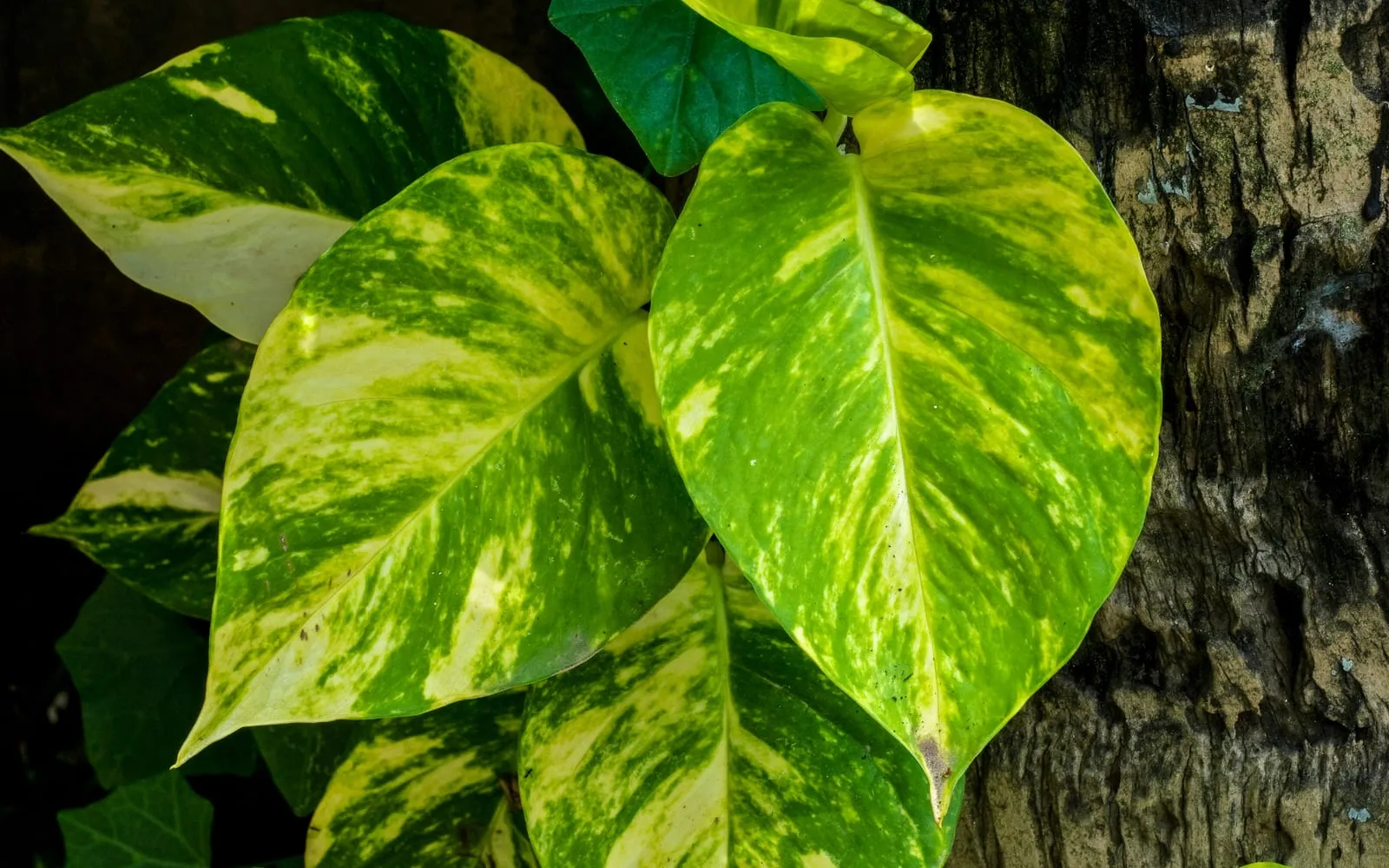
Heart-shaped, glossy, slightly waxy leaves in mid green, marbled or streaked with gold, cream or white depending on the cultivar. Leaves on a hanging plant reach 10 to 20 cm.
Stems trail or climb, producing short aerial roots at each node. Those roots grip bark in the wild and will grip a moss pole indoors.
Climbing changes the plant. As it ascends, leaves get progressively larger and develop deep splits along the edges, sometimes reaching 60 cm or more. This is the mature form, and it needs a support and years to appear.
Named forms vary widely. ‘Golden’ is the standard gold-marbled type, ‘Marble Queen’ is heavily white-variegated and slower, ‘Neon’ is a uniform chartreuse, and ‘Cebu Blue’ has narrow silvery-blue leaves that look unrelated until it matures.
Where it is from
The Society Islands of French Polynesia, principally Mo’orea, growing in humid tropical forest and climbing tree trunks towards the light.
It has since naturalised across the tropics and become a serious invasive weed in Sri Lanka, Hawaii and parts of Australia, smothering native vegetation. That vigour is the same quality that makes it forgiving indoors.
Forest floor light is dim and dappled, which is why the plant survives a dark corner. Light higher up the trunk is much stronger, which is why variegation and mature leaves both need brightness.
How it grows
An evergreen vine growing from spring to autumn and slowing in winter. Growth is fast in good conditions, and a stem can add a metre in a season.
Each node carries a leaf, a bud and an aerial root, and a cutting containing one node will make a whole new plant. This is why propagation is close to foolproof.
Cut a stem into sections with at least one node and one leaf each, put them in a glass of water, and roots appear within two weeks. Pot them up once the roots are 3 to 5 cm long. Cuttings can also go straight into compost.
Variegation depends on light. In dim conditions the plant produces more chlorophyll to compensate, and new leaves come out plain green. Those leaves never regain their pattern, so recovery means brighter light and waiting for new growth.
Pruning makes it bushy. Cutting a trailing stem back encourages branching from the nodes behind the cut, and the prunings become new plants.
Through the seasons
Spring restarts growth. Repot if the roots fill the pot, take cuttings, prune back any bare leggy stems, and begin feeding in April.
Summer is the main growing season. Water when the top few centimetres dry, feed monthly, and rotate the pot so growth stays even.
Autumn slows down. Stop feeding at the end of September and reduce watering.
Winter is a rest. Growth is minimal, so water considerably less and check before watering rather than following a routine. Keep it away from cold glass and draughts. Low light is more of a problem now, and a plant that was fine in July may need moving nearer a window in January.
Care difficulty
Easy, and the most forgiving plant in these guides.
The one way to kill it is persistent overwatering, which rots the roots and turns the stems soft and black at the base. Pothos tolerates drought far better than wet compost.
The one way to disappoint yourself with it is low light, which costs the variegation. The plant survives a dark corner and it does not stay gold-marbled in one.
Everything else is optional.
Watering
Water when the top 2 to 3 cm of compost is dry. In a warm room in summer that is roughly weekly, and in winter it may be every two or three weeks.
Drench thoroughly until water runs from the base, then let it drain completely. Never leave the pot standing in water.
Pothos gives clear signals. Slight drooping with dry compost means it wants water and it recovers within hours. Yellowing leaves with wet compost means the opposite. Those two signals are the whole of telling overwatering from underwatering.
Repeated severe wilting damages the leaf edges permanently even though the plant recovers, so a rough schedule beats total neglect.
Tap water is fine. This species has no fluoride sensitivity.
Warning signs, diseases and pests
Root rot from overwatering is the main killer. Leaves yellow, black patches appear, stems go soft at the base, and the compost stays wet. Unpot the plant, cut away black mushy roots, and repot into fresh free-draining compost. Take cuttings from healthy stems as insurance.
Loss of variegation means too little light. Move the plant nearer a window, prune out the sections that have gone plain green, and judge by the new growth.
Mealybugs appear as white cottony patches in leaf joints and along stems. Dab with a cotton bud dipped in alcohol.
Spider mites turn up in hot dry rooms, stippling the leaves and leaving fine webbing. Rinse the plant thoroughly.
Scale insects show as small brown bumps on stems with sticky honeydew below.
Brown crisp leaf tips usually mean the plant dried out completely at some point, or the air is very dry.
Long bare stems with leaves only at the ends means low light plus no pruning.
Growing environment
Bright indirect light for the best variegation and growth. An east-facing window, or a position a couple of metres back from a south-facing one, suits it well. Direct midday sun scorches the leaves.
It survives genuine low light better than almost any other houseplant, at the cost of variegation and speed. Plain green cultivars cope with dim conditions best.
Warmth of 15 to 30 deg C. Below 10 deg C causes damage, so keep it off a cold windowsill in winter and away from draughty doors.
Ordinary room humidity is fine. Higher humidity gives slightly larger leaves and nothing is lost without it.
Compost should be free-draining. A peat-free houseplant compost with added perlite works well.
Give it a moss pole if you want the large fenestrated mature leaves. Without something to climb it stays in its juvenile form indefinitely.
Feeding
A balanced liquid houseplant feed at half strength, monthly from April to September.
Stop from October to March.
Yellowing leaves can indicate over-feeding as well as overwatering. If the compost has a white crust, flush the pot through with plain water and cut back the feeding.
Fresh compost carries enough nutrients for the first couple of months after repotting, so hold off feeding during that period.
Troubleshooting
New leaves coming out plain green. Not enough light. Move it brighter. Those leaves will not regain their pattern, so prune them out and watch the new growth.
Yellow leaves with wet compost. Overwatering. Let it dry out properly and check the drainage.
Long bare stems with a tuft of leaves at the end. Low light plus no pruning. Cut the stems back hard in spring and root the cuttings into the same pot to fill it out.
Brown crispy tips. The plant dried out completely at some point, or the air is very dry. Water more consistently.
Black soft stems at compost level. Root rot. Take cuttings from healthy growth immediately.
Leaves never get any bigger. It is in juvenile form. Give it a moss pole to climb and the leaves enlarge and split over several years.
White cottony patches in the leaf joints. Mealybugs. Dab with alcohol on a cotton bud and repeat weekly.
Cutting rotted in water. Change the water weekly and make sure at least one node is submerged while the leaf stays out of it.
Devil's Ivy problem guides
Not sure what is wrong? See the common houseplant pests guide.