
Houseplant
Spider Plant
Chlorophytum comosum
Also known as Spider ivy, Ribbon plant, Hen and chickens
How to grow a spider plant, Chlorophytum comosum. Fixing brown tips, rooting the babies, and whether it is safe for cats.
At a glance
- Difficulty
- Easy
- Water
- Every 7-10 days, when the top 2-3 cm is dry
- Light
- Bright indirect light. Tolerates low light and some morning sun
- Temperature
- 10-30 deg C
- Humidity
- Ordinary room humidity is fine
- Hardiness
- USDA 9-11, RHS H1c, hardy to 7 C
- Type
- Evergreen perennial
- Height
- 30-60 cm, with runners far longer
- Native to
- Coastal southern Africa
- Best month
- January in the Northern Hemisphere, July in the Southern Hemisphere
Among the hardiest houseplants sold, surviving outdoors through USDA 9, where it also naturalises freely and is a recognised weed in parts of eastern Australia and the Pacific islands. Brown tips indoors are fluoride in tap water rather than dry air.
Hardiness zones describe winter cold alone. Summer heat, humidity, rainfall and the length of the growing season decide as much, so treat the range as the outer limit rather than as a recommendation.
Every month named in this guide is for the temperate Northern Hemisphere. If you garden in the Southern Hemisphere, shift each one by six months, so January becomes July. Closer to the equator the wet and dry seasons matter more than the calendar, and the shift stops being a useful guide.
Not known to be toxic
The ASPCA lists spider plant as non-toxic to dogs and cats, which is the main reason it turns up on every list of pet-safe houseplants, and it does not appear on the RHS list of potentially harmful garden plants. The persistent claim that it is mildly hallucinogenic to cats has no evidence behind it. What is true is that cats are drawn to the dangling leaves and will chew them, and a cat that eats a lot of any plant will be sick from the bulk of it. Hang it out of reach if your cat is stripping it, for the plant's sake.
Source: ASPCA
About
The spider plant has been a parlour standard since the Victorians and it earns its place. It grows in poor light, forgives a missed fortnight, hangs well, and gives away free plants on the end of every runner.
It is also non-toxic to cats and dogs, which puts it in a small group with the Christmas cactus and not much else on this list.
Two things account for nearly all the complaints about it. The tips go brown, and people cannot get it to make babies. Both have straightforward causes.
Appearance and character
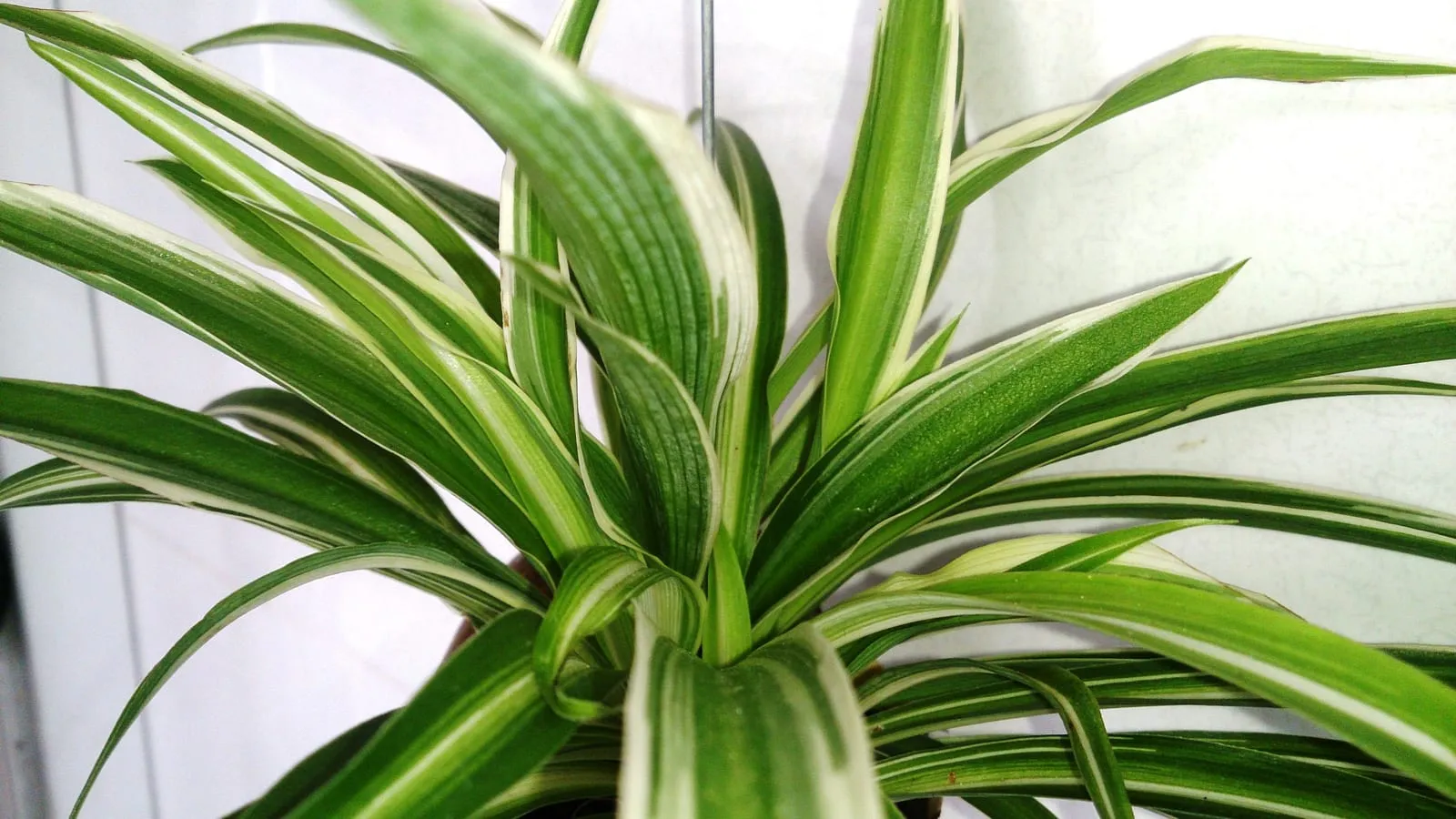
Arching, grass-like leaves growing from a central crown, most often striped cream or white. Thick white roots swell into water-storing tubers that you can see through the sides of a pot, and which are why the plant survives being forgotten.
Mature plants send out long wiry runners carrying small white flowers, and each flower cluster then develops into a plantlet, a miniature spider plant complete with its own aerial roots, dangling in mid-air.
The striping tells you which variety you have and the two common names are easily swapped. ‘Vittatum’ has a white or cream stripe down the middle of a green leaf. ‘Variegatum’ has the reverse, a green leaf with white margins. There is a plain green wild form too, which is more vigorous than either.
Where it is from
Coastal southern Africa, in the eastern Cape and up through KwaZulu-Natal, growing as ground cover in the shade of forest edges and rock outcrops.
It grew up in shade and has not changed, which is why it does so well in a north-facing room where most houseplants struggle. The tuberous roots are an adaptation to a climate with a dry season, and they are what makes it drought-tolerant indoors.
How it grows
An evergreen perennial forming a clump that widens each year and pushes hard against the pot. Roots fill a container fast, and a plant that has been in the same pot for two years will often lift its own compost into a dome.
Runners are a response to maturity and to lengthening nights, so most plants produce them in late summer and autumn rather than in spring. A slightly pot-bound plant produces more of them than a recently repotted one, which is useful if you want plantlets.
Propagation could not be simpler. Sit a pot of damp compost next to the parent, lay a plantlet on the surface with its roots touching, and hold it down with a paperclip or a hairpin while it is still attached to the runner. Cut the runner once it has rooted, usually in two or three weeks.
Through the seasons
Spring is when growth restarts and the time to repot, though only if the plant is bursting out. Go up one pot size.
Summer is the main growing season. Water regularly and feed monthly.
Autumn is when the runners and plantlets usually appear, in response to the nights drawing out. Peg the babies down now and they root before winter.
Winter is a rest. Growth slows, water less, and stop feeding altogether. Brown tips are at their worst now, because the heating is on.
Care difficulty
Easy, and hard to kill outright. It tolerates low light, dry air, missed watering and general neglect, and it bounces back from all of them.
The reason people still get frustrated with it is cosmetic. Brown leaf tips are almost universal on spider plants indoors, and they have more to do with your tap water than with anything you are doing wrong.
Watering
Water when the top 2-3 cm of compost feels dry, roughly every seven to ten days in summer and considerably less in winter. Soak it thoroughly, let it drain, and empty the saucer.
Use rainwater, or filtered water, if brown tips bother you. Spider plants are unusually sensitive to the fluoride and chlorine in mains water, and the salts accumulate at the leaf tips, which is precisely where the damage shows. Letting tap water stand overnight helps with chlorine but does nothing about fluoride.
Every couple of months, flush the pot through with plain water until it runs freely from the base. That washes out accumulated salts from both the water and the feed.
The fleshy roots tolerate a missed watering better than a waterlogged pot, so when in doubt, wait.
Warning signs, diseases and pests
Brown tips are the complaint, and there are four causes worth separating. Fluoride and chlorine in tap water is the most common. Over-feeding is next, and it looks identical. Dry air from radiators contributes in winter. Erratic watering, letting the plant go bone dry and then soaking it, does the rest.
Trim the brown off with scissors following the natural taper of the leaf, and fix the cause rather than expecting the damaged tissue to recover.
Spider mites turn up in hot dry rooms, showing as fine pale speckling and webbing between the leaves. Aphids cluster on flower stems and runners. Mealybugs hide down in the crown.
Rot at the crown, with leaves collapsing from the centre, means the compost has been kept too wet.
Growing environment
Bright indirect light is where it looks best, but it copes with a dim corner. Variegated forms fade towards plain green in poor light, so if your ‘Vittatum’ is losing its stripe, move it nearer a window. Direct summer sun through glass scorches pale bleached patches into the leaves.
It takes anything from 10 to 30 deg C. Keep it above 10 deg C in winter and away from a cold windowsill at night.
Ordinary household humidity is fine. Higher humidity reduces brown tips a little, so a bathroom or kitchen suits it, but it does not need misting.
Any decent peat-free multipurpose compost with a handful of perlite works.
Feeding
A balanced liquid feed at half strength, monthly, from spring to the end of summer. Stop completely in autumn and winter.
Spider plants are more easily over-fed than under-fed, and the symptom is the brown tips you were probably trying to cure. If tips start appearing a week or two after you feed, that is your answer: halve the frequency and flush the pot.
Troubleshooting
Brown leaf tips. Fluoride and chlorine in tap water, over-feeding, dry air, or erratic watering, in roughly that order. Switch to rainwater, feed less, and flush the pot.
No plantlets. The plant is too young, too recently repotted, or in too large a pot. Spider plants make runners when mature and slightly pot-bound, mostly in autumn. Leave it in its pot for another year.
Pale, washed-out stripes. Not enough light. Move it closer to a window.
Leaves collapsing from the middle. Crown rot from overwatering. Let it dry, and repot into fresh compost if it is soft at the base.
Roots pushing the compost up out of the pot. Normal, and a sign it is ready for repotting. Go up one size only, since a plant swimming in compost stops making runners.
My cat keeps eating it. It is non-toxic, so the cat is fine, but it will be sick if it eats enough. Hang the plant higher.
Spider Plant problem guides
Not sure what is wrong? See the common houseplant pests guide.