
Houseplant
Heartleaf Philodendron
Philodendron hederaceum
Also known as Philodendron scandens, Sweetheart plant, Philodendron oxycardium
How to care for Philodendron hederaceum. How to tell it apart from pothos for certain, why climbing gives bigger leaves than trailing, and how it behaves around pets.
At a glance
- Difficulty
- Easy
- Water
- When the top 3 cm dries, roughly weekly in summer
- Light
- Bright indirect light. Tolerates moderate shade, dislikes direct sun
- Temperature
- 18-27 deg C. Below 12 deg C causes damage
- Humidity
- Fine from 40%, larger leaves above 60%
- Hardiness
- USDA 10-12, RHS H1b, hardy to 12 C
- Type
- Evergreen perennial climber
- Height
- 3-6 m of stem indoors, more on a support
- Native to
- Rainforest from southern Mexico through Central America to Brazil and the Caribbean
- Best month
- May in the Northern Hemisphere, November in the Southern Hemisphere
Caribbean and Central American rainforest. It takes lower light than almost anything else with a leaf this size, which is why it survives offices. Outdoors year round in USDA 10 and warmer.
Hardiness zones describe winter cold alone. Summer heat, humidity, rainfall and the length of the growing season decide as much, so treat the range as the outer limit rather than as a recommendation.
Every month named in this guide is for the temperate Northern Hemisphere. If you garden in the Southern Hemisphere, shift each one by six months, so May becomes November. Closer to the equator the wet and dry seasons matter more than the calendar, and the shift stops being a useful guide.
Harmful if eaten
- Do not eat
- Every part, leaves and stems most of all
- Harm from
- Eating it and handling it
- Affects
- People, cats and dogs
Every part carries insoluble calcium oxalate raphides, needle-shaped crystals that embed in soft tissue when chewed. The ASPCA lists Philodendron as toxic to cats and dogs, causing oral irritation, burning of the mouth and tongue, drooling, vomiting and difficulty swallowing. People react the same way, and the RHS places Philodendron in its harmful-if-eaten category and also notes skin irritation from the sap. The pain is immediate, which is what keeps most incidents to a single bite and a distressed animal rather than a serious poisoning. Rinse the mouth and offer something cold, and ring a vet or doctor if breathing or swallowing is affected. This plant trails within easy reach of a curious cat, so hang it high or grow it up a pole rather than letting it dangle at floor level.
Sources: ASPCA (Heartleaf Philodendron, Philodendron scandens), RHS potentially harmful garden plants
About
Half the plants sold as heartleaf philodendron are pothos, and half the plants sold as pothos are this. The two look alike at a glance, come from different genera, and want slightly different things.
Telling them apart takes ten seconds once you know where to look, and the section below sets out the four checks that settle it.
Beyond the identification muddle this is among the most forgiving houseplants available. It grows in poor light, roots from any cutting, and forgives missed waterings. A stem trailing off a bookshelf will reach two or three metres within a couple of years.
Appearance and character
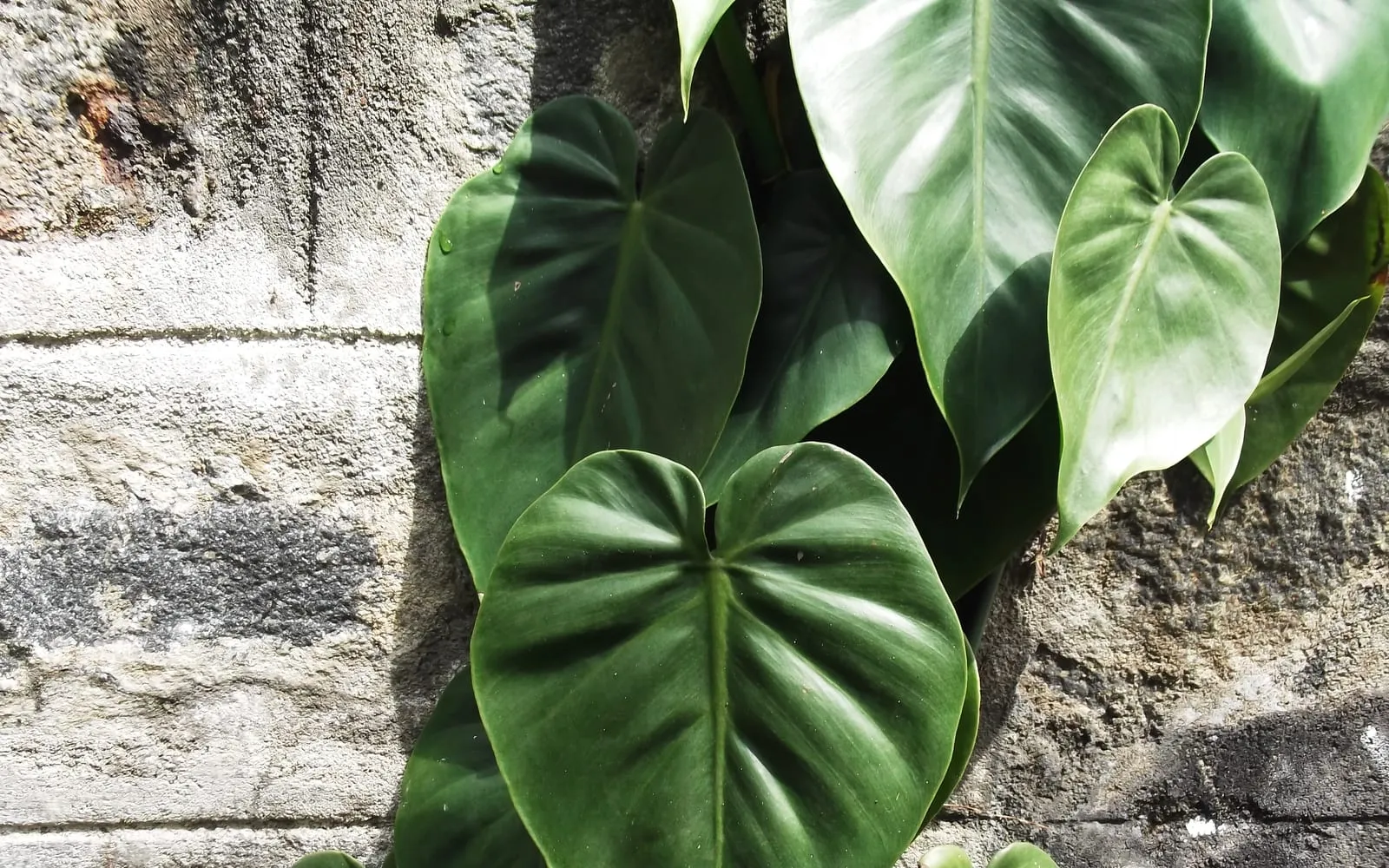
Heart-shaped leaves, 7 to 12 cm long on a trailing plant, matte to softly glossy, in a green that leans dark and slightly bronze on new growth.
The stems are slender and flexible, with a node every few centimetres and a short aerial root at each one. Those roots are how the plant grips bark in the wild, and how it grips a moss pole in a living room.
Four checks separate it from pothos for certain.
New philodendron leaves emerge from a cataphyll, a thin papery sheath that dries and drops away. Pothos leaves unfurl straight out of the previous leaf, with no sheath.
The philodendron petiole is round in cross-section. The pothos petiole has a groove running along its upper side.
Philodendron leaves are thinner and more flexible, with a pronounced notch where the stalk meets the blade. Pothos leaves are thicker, waxier and more asymmetric.
Each philodendron node carries several fine aerial roots. Pothos produces one thick stubby nub per node.
‘Brasil’ carries a central splash of chartreuse and ‘Lemon Lime’ is uniformly acid yellow-green. Both are the same species and want the same care, though the variegated forms need more light to hold their colour.
Where it is from
Rainforest from southern Mexico through Central America to Brazil and across the Caribbean, growing as a hemiepiphyte. It germinates on the forest floor, finds a tree, and climbs.
That climbing habit matters more than any other fact about the plant. As it ascends it reaches better light and firmer support, and the leaves it produces get progressively larger. A plant kept trailing stays in juvenile mode with small leaves indefinitely.
The forest floor is shaded, humid and covered in loose leaf litter, which is why the plant tolerates a dim room and why it resents dense, water-retentive compost around its roots.
Temperatures stay even year-round, so it has no dormancy and takes cold badly.
How it grows
An evergreen perennial climber that grows from the tip of each stem, adding a node and a leaf at a time.
Give it a moss pole or a plank and the aerial roots grip, the internodes shorten, and the leaves double or triple in size. Let it trail and it stays small-leaved and stringy at the top as the older growth ages out.
Pinching the growing tip forces side shoots from the nodes below, which is the only way to get a bushy plant rather than three long bare strands.
Propagation is close to trivial. Cut a length of stem with three or four nodes, strip the lowest leaf, and stand it in water or push it into damp compost. Roots appear from the node within a fortnight. Putting three cuttings back into the parent pot is how you thicken a leggy plant.
Through the seasons
Spring restarts growth. Repot if roots are circling the pot, take cuttings to fill gaps, and begin feeding once new leaves appear.
Summer is the fast season, and a well-lit plant will add a leaf a week. Water roughly weekly and feed monthly. Pinch the tips to keep it dense.
Autumn slows things. Stop feeding at the end of September and let the compost dry a little further between waterings.
Winter demands very little. Water every two to three weeks, keep the plant off cold windowsills, and expect no new leaves. Dry heated air brings spider mites, so check the undersides now and then.
Care difficulty
Easy. The plant survives most things, and two habits separate a handsome specimen from a straggly one.
The first is light. Deep shade keeps it alive and produces small leaves on long bare stems, with variegated forms reverting to plain green. Bright indirect light fixes both.
The second is pinching. Left alone, every stem grows from its tip and never branches, so the plant becomes a few long strands trailing from a bald crown. Pinching out the tips a few times a year is the whole solution.
Overwatering is the main way people kill it. The roots want air, and compost kept permanently sodden rots them.
Watering
Water when the top 3 cm of compost feels dry, which means roughly weekly in summer and every two to three weeks in winter.
Soak the pot through until water runs from the base, then tip away whatever collects underneath. This plant should never stand in water.
Yellow leaves appearing in numbers are the classic overwatering sign. A single yellow leaf on old growth is ordinary ageing.
Drooping, limp stems with dry compost mean genuine thirst, and the plant recovers within hours of a soak.
Room temperature water. Rainwater is preferable if your tap water is very hard, though this species is far less fussy about it than a peace lily.
Warning signs, diseases and pests
Long bare stems with widely spaced small leaves mean too little light. Move the plant nearer a window and pinch the tips to force branching.
Variegated forms going plain green means the same thing. The green tissue photosynthesises better, so in poor light the plant favours it.
Yellowing leaves in numbers, with wet compost, mean root rot. Turn the plant out, cut away soft brown roots, and repot into fresh open compost.
Brown crispy edges come from dry air, underwatering or fertiliser build-up. Flush the pot and raise the humidity.
Mealybugs cluster at the nodes and in leaf joints as white fluff. Wipe them off with a cotton bud dipped in surgical spirit.
Spider mites leave fine webbing and a stippled, dusty leaf surface, and arrive when the air is dry. Rinse the foliage and raise humidity.
Scale insects show as brown discs along stems and leaf midribs and scrape off with a fingernail.
Growing environment
Bright indirect light is ideal. An east-facing window, or a couple of metres into a south-facing room, gives good growth and keeps variegation strong.
Moderate shade is tolerated and produces a slower, leggier plant. Direct sun scorches the leaves to pale patches within days.
Keep it between 18 and 27 deg C. Below 12 deg C the leaves blacken and drop, so move it off windowsills on cold nights.
Ordinary room humidity is fine, and anything above 60% gives noticeably larger leaves. Grouping plants together helps more than misting does.
Use houseplant compost opened up with a couple of handfuls of orchid bark or perlite. The roots want air as much as water.
A moss pole transforms the plant. Tie the stems in loosely, keep the pole damp, and the aerial roots grip and start producing mature foliage.
Feeding
A balanced liquid houseplant feed at half strength, once a month from April to September.
Nothing from October to March. The plant is not growing, and unused fertiliser salts accumulate and scorch the root tips.
Brown leaf margins on a plant that is watered correctly usually mean too much feed. Flush the pot with several times its volume of clean water and skip two feeds.
Repot every two years into fresh compost, one pot size up. Refreshing the compost does more for a tired plant than increasing the feed.
Troubleshooting
Is this a philodendron or a pothos? Look at the new growth. A papery sheath around the emerging leaf means philodendron. A leaf unfurling straight from the previous one means pothos. Then check the leaf stalk, which is round on a philodendron and grooved on a pothos.
Long bare stems with a few small leaves at the end. Too little light, and no pinching. Move it brighter, pinch every growing tip, and root the trimmings back into the same pot.
My ‘Brasil’ has lost its variegation. Not enough light. Cut back to a point where the variegation was strong and give it a brighter position.
Leaves yellowing all over. Overwatering. Check the roots, cut away anything soft and brown, and water less often.
The leaves stay small no matter what. The plant is trailing, so it stays juvenile. Give it a moss pole to climb and the new leaves will come in larger.
Brown crispy edges. Dry air, missed waterings or fertiliser build-up. Flush the pot through and move it away from radiators.
How do I make more? Cut a stem with three or four nodes, remove the bottom leaf, and stand it in water or damp compost. Roots come in about two weeks.
My cat chews it. Expect drooling and mouth pain from the calcium oxalate. Hang the plant well out of reach or grow it up a pole rather than trailing it where a cat can reach.
Heartleaf Philodendron problem guides
Not sure what is wrong? See the common houseplant pests guide.