
Pest
Red spider mite
Tetranychus urticae
Also called Two-spotted spider mite, Glasshouse red spider mite, Spider mites
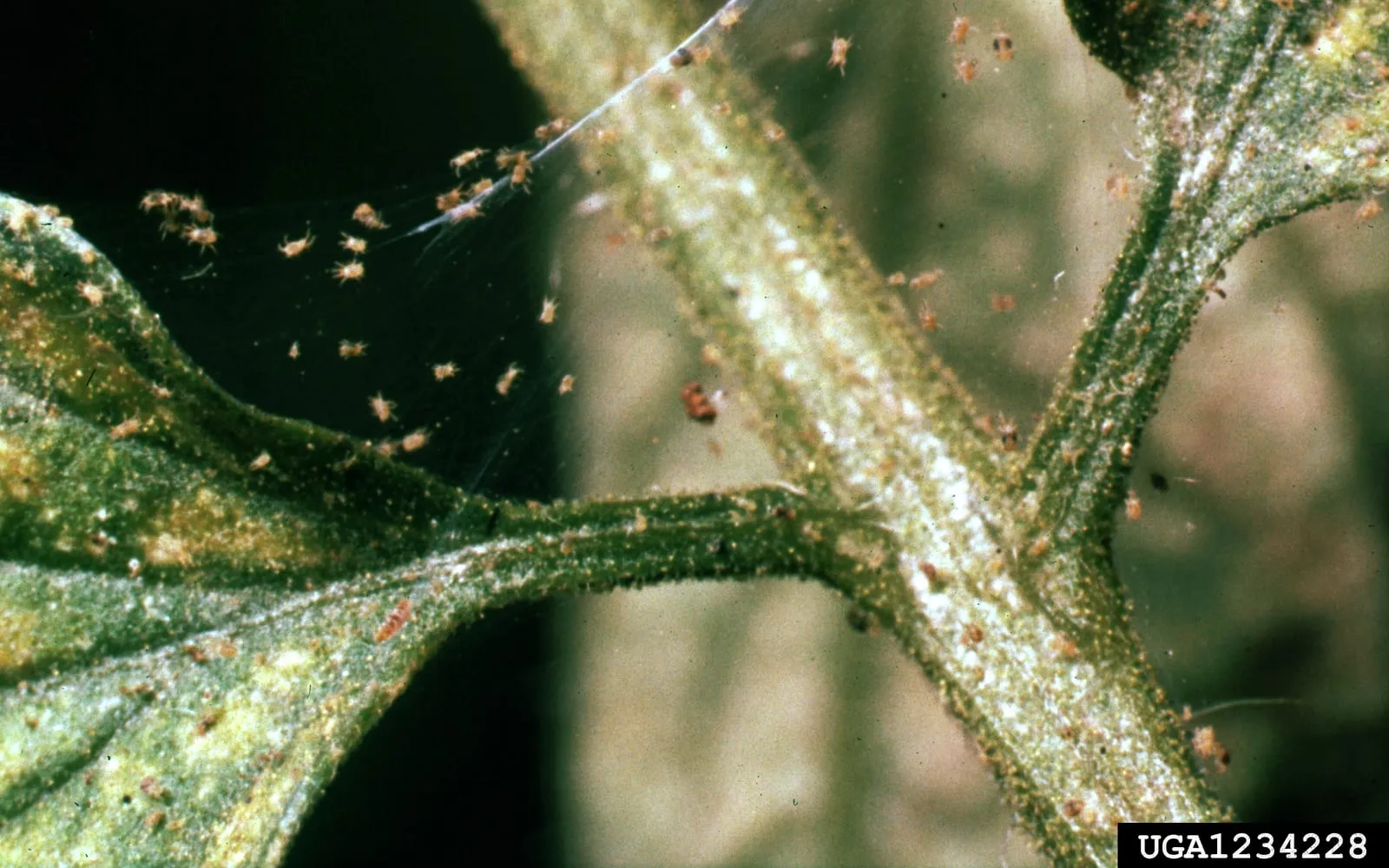
Spider mites leave fine pale speckling on the upper leaf and webbing at shoot tips. Tap leaves over white paper to confirm them, then raise humidity and wash plants before colonies build.
At a glance
- Type
- Pest
- Cause
- Mite
- Severity
- Destroys the crop or display
- Affects
- Houseplants, Garden plants, Herbs and edibles
- Active
- All year
- Established in
- Worldwide
What you are seeing
- Fine pale speckling across the upper surface of the leaf, like dust that will not wipe off
- The whole leaf turning dull, then bronze or greyish, then dropping
- Fine silk webbing between the shoot tip and the leaf stalks, most visible against the light
- Minute pale specks on the underside that move when watched for a few seconds
- Damage starting on the side of the plant nearest a radiator or a sunny pane
- Whole plant declining from the bottom up over three or four weeks
Before you treat anything
Nothing recommended here is harmful to a child, a pet or a pond. Sprays sold for spider mite are mostly fatty acids or plant oils, which kill by contact and will kill introduced predatory mites just as readily, so using one after releasing Phytoseiulus wastes both.
What you are looking at
The first sign is a change in the surface of the leaf rather than anything you can point at. A monstera or a fig that was glossy goes dull, and close up the upper side carries a fine pale speckling, as though someone has dusted it. The dust does not wipe off, because each speck is a group of leaf cells that has been emptied from below.
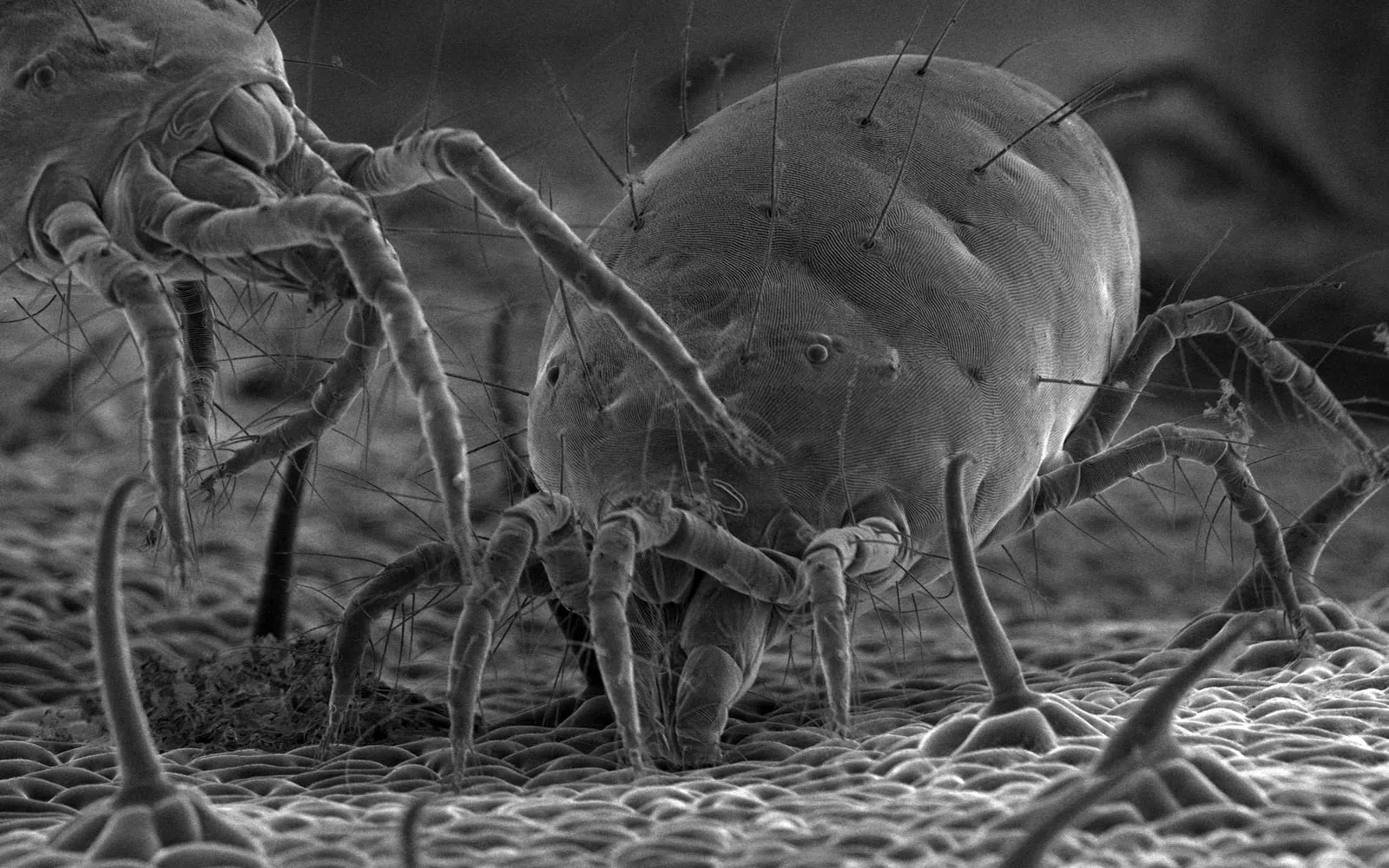
Turn the leaf over. An adult is about half a millimetre long, oval, pale yellowish-green with a dark blotch on each side of the body. Those two blotches are gut contents showing through a translucent animal, and they are what gives it the name two-spotted spider mite. At that size the naked eye reports specks of grit.
The test that settles it costs nothing. Hold a sheet of white paper under a shoot and tap the stem hard. Wait five seconds. Grit stays where it lands and mites start walking. Drag a finger through them and the smear is green.
Webbing comes later and means the population is already large. Fine silk runs between the leaf stalks and the growing point, easiest to see against a window, and in a bad case the whole shoot tip is wrapped and the mites are moving over the outside of it.
Why the name misleads
A spider mite is an arachnid, closer to a tick than to anything with six legs. It also spins silk, so the webbing part of the name is useful. The colour is less helpful. Adults are yellowish-green through spring and summer, and the fertilised females turn orange-red in autumn as they leave the plant to overwinter. Someone looking for red mites in July may miss the pest entirely.
Eight legs rather than six puts it with the spiders, ticks and scorpions rather than the insects. That is a practical point rather than a taxonomic one, since products developed against insects are frequently poor against mites, and resistance in this species is among the worst documented in any plant pest.
Why it explodes in a heated room in winter
Temperature runs the whole thing. At 30 degrees C a mite goes from egg to egg-laying adult in about a week; at 21 degrees it takes a fortnight; below about 12 degrees it stops. A female lays somewhere around a hundred eggs.
A centrally heated sitting room in January sits at 21 degrees with humidity down near 30 per cent, which is closer to the conditions this mite evolved in than a British garden ever gets. That is why the houseplant most likely to be ruined by red spider mite is ruined in February, while everything else on this site is dormant, and why the plant nearest the radiator goes first.
Dry air is half of it. The mite loses water quickly at high humidity and its eggs do badly there, so raising the moisture around a plant is a control measure rather than a comfort measure.
What the damage adds up to
Each mite empties individual cells with a pair of needle-like mouthparts, and one puncture is nothing. The speckling merges as the count rises, the leaf loses the ability to photosynthesise across whole regions, and it goes bronze and falls. A plant can drop most of its foliage in a month.
Outdoors this rarely ends a plant, because predators find the colony and rain knocks it about. On a fig or a calathea in a warm room, with no predators and no rain, the same population runs unchecked until the plant has nothing left. Take an indoor infestation more seriously than an outdoor one.
What to do about them
Change the air before you change anything else. Move the plant off the radiator shelf, stand it on damp gravel, group it with others, and run a humidifier through the heating season if you keep a large collection. A colony that was doubling every week slows to something the plant can carry.
Then shower it. Tepid water over the leaf undersides, weekly for a month, removes most of the adults each time. The eggs stay, which is why one wash achieves nothing and four in a row achieve a great deal. Take off the bronzed lower leaves at the same time and bag them.
Under glass, buy predators. Phytoseiulus persimilis eats nothing else, breeds faster than its prey above 21 degrees C, and will clear a greenhouse. Order it when you find the first stippling rather than when the leaves start dropping, because it needs a living population to work through and a plant that has already collapsed gives it nothing to eat.
Why no spray is listed here
This mite has developed resistance to more classes of pesticide than almost any other plant pest, and a treatment that kills 95 per cent of a colony leaves the 5 per cent that shrug it off to rebuild in a fortnight. Repeated spraying selects for exactly that.
The fatty acid and plant oil products sold for it work by contact and by smothering, so they need to reach the underside of every leaf, and they kill introduced predatory mites as efficiently as they kill the pest. Releasing Phytoseiulus and then spraying is money spent twice to no effect.
What it gets mistaken for
Thrips also silver the leaf, but they leave small black dots of excrement among the damage and the injured tissue often has a metallic sheen. No webbing.
Underwatering and leaf scorch both dull a leaf, and both affect it evenly rather than as a scatter of tiny pale points. Look at the leaf against a light: mite damage is stippled at a scale of tenths of a millimetre, and stress damage is not.
Fine webbing with no stippling and no mites is a spider that has taken up residence, which is a different animal and does no harm at all. The webbing to worry about is dense, dusty and stretched between the leaf stalks and the growing tip rather than spanning a gap.
What to do, in order
Start here
Prevention, and the changes that stop the problem returning. Most of these pages should end at this tier.
- Raise the humidity around the plant
- This mite breeds fastest in hot dry air and struggles above about 60 per cent relative humidity. A tray of damp gravel under the pot, a group of plants standing together, or a room humidifier through the winter does more than anything you can spray on the leaves.
- Move it away from the heat source
- The plant that gets hit first is the one on a shelf above a radiator or against a south-facing pane. A metre of distance changes the microclimate enough to slow the population noticeably.
- Keep the plant watered
- A plant under drought stress carries more soluble nitrogen in its sap and supports a faster-breeding colony. The two problems arrive together in a heated room in February, and half of what looks like mite damage on a dried-out plant is the drought.
- Quarantine anything new for three weeks
- Almost every houseplant infestation walks in on a new plant. Keep new arrivals in a different room, look at the leaf undersides weekly, and the plant that would have infested a whole collection infests nothing.
- Clear the greenhouse down in autumn
- Fertilised females leave the plants in autumn, turn orange-red and overwinter in cracks in the staging, the frame and under pots. Washing the structure down and clearing plant debris removes the population that would otherwise appear from nowhere in April.
Then reach for a barrier
Netting, hand removal and water. Nothing here harms anything except the target.
- Confirm it with a sheet of white paper
- Hold paper under a shoot and tap it sharply. Mites drop, and after a few seconds they start walking, which is the point at which the specks stop being dust. Draw a finger across them and it smears green.
- Shower the plant
- A firm spray of tepid water over the leaf undersides in the shower or with a hose knocks off most of a colony and raises the humidity while it dries. Repeat weekly for a month, because the eggs are not removed and keep hatching.
- Take off the worst leaves and bag them
- Leaves that have gone bronze will not recover and are carrying eggs. Removing the bottom third of an infested plant sets the population back further than any treatment, provided the leaves go straight into a bag rather than onto the compost next to the plant.
- Isolate the plant while you deal with it
- They spread by walking along touching leaves and by drifting on silk threads in moving air. Standing an infested plant apart from the rest of the collection stops the slow spread along a windowsill.
Then bring in the predators
Encourage what already lives in the garden, and buy predators in where the problem is under glass and nothing will arrive on its own.
- Introduce Phytoseiulus persimilis under glass
- A predatory mite that eats nothing but spider mites and clears a greenhouse infestation faster than any spray. It needs about 21 degrees C and reasonable humidity, so introduce it from late spring and put it out while the colony is small rather than after the leaves have bronzed.Sold by licensed biocontrol suppliers across Europe, North America, Australia and New Zealand, where it is already approved for release. Buy from a supplier in your own country: importing a live agent yourself is an offence in most of them.
- Use Amblyseius andersoni when it is cooler
- This one works at lower temperatures and tolerates a wider range of conditions, which suits a conservatory in spring or a room that runs cool at night. It also eats other mites, so it establishes before the spider mites arrive.Sold by licensed biocontrol suppliers across Europe, North America, Australia and New Zealand, where it is already approved for release. Buy from a supplier in your own country: importing a live agent yourself is an offence in most of them.
- Accept that nothing arrives indoors on its own
- In a garden, predatory mites, ladybirds of the genus Stethorus and anthocorid bugs all take spider mites, which is why outdoor infestations so often resolve themselves. A sitting room has none of them, so an indoor plant either gets predators bought in or gets the cultural changes above.
Biological controls are live organisms and their sale and release are regulated country by country. An agent sold freely in one place may be unapproved in another, so buy from a licensed supplier where you live and never import or move one yourself.
In pictures
Plants affected
Guides that name it among the problems to watch for. The list is the plants it is characteristic of rather than everything it will feed on.
Common on UK allotments
This is one of the pests and diseases allotment growers meet most often. See it alongside the other common problems on the allotment guide.
Common allotment pests and diseasesA common houseplant pest
This is one of the pests and problems that houseplant owners meet most often. See it alongside the others, with a quick table for telling them apart, on the houseplant pests guide.
Common houseplant pestsA common tomato problem
This is one of the problems tomato growers meet most often. See it alongside the other pests, diseases and disorders on the tomato guide.
Common tomato problemsA common rose problem
This is one of the pests, diseases and disorders that rose growers meet most often. See it alongside the others on the common rose problems guide.
Common rose problemsA common vegetable pest
This is one of the pests that vegetable growers meet most often. See it alongside the others on the vegetable pests guide, grouped by how they feed and with prevention that works against most of them.
Common vegetable pests