
Houseplant
Snake Plant
Dracaena trifasciata
Also known as Mother-in-law's tongue, Sansevieria trifasciata, Saint George's sword
How to grow a snake plant, Dracaena trifasciata. Watering, light, why variegated cuttings turn green, and what the air-purifying claims are worth.
At a glance
- Difficulty
- Easy
- Water
- Every 2-3 weeks in summer, monthly or less in winter
- Light
- Anything from low light to bright indirect. Tolerates some direct sun
- Temperature
- 10-35 deg C. Never below 10 deg C
- Humidity
- Ordinary room humidity is fine
- Hardiness
- USDA 10-12, RHS H1b, hardy to 10 C
- Type
- Evergreen perennial succulent
- Height
- 30-120 cm depending on variety
- Native to
- Tropical West Africa
- Best month
- January in the Northern Hemisphere, July in the Southern Hemisphere
Dry west Africa. It uses crassulacean acid metabolism, opening its stomata at night, which is the basis of the claim about air cleaning and also why it needs so little water. Outdoors year round in USDA 10 and warmer, where it spreads by rhizome and has naturalised across the tropics.
Hardiness zones describe winter cold alone. Summer heat, humidity, rainfall and the length of the growing season decide as much, so treat the range as the outer limit rather than as a recommendation.
Every month named in this guide is for the temperate Northern Hemisphere. If you garden in the Southern Hemisphere, shift each one by six months, so January becomes July. Closer to the equator the wet and dry seasons matter more than the calendar, and the shift stops being a useful guide.
Harmful if eaten
- Do not eat
- The leaves
- Harm from
- Eating it
- Affects
- People, cats and dogs
The leaves contain saponins, the same class of soapy compound that makes holly berries unpleasant. The ASPCA lists snake plant as toxic to cats and dogs, with nausea, vomiting and diarrhoea as the signs, and files it under the older name Sansevieria trifasciata. Chewing a leaf gives people a burning mouth and an upset stomach, though the taste is bitter enough that almost nobody persists. It does not appear on the RHS list of potentially harmful garden plants. Serious poisoning is not a realistic worry; a cat that shreds one and eats the pieces being sick on your carpet is. Keep it off the floor if you have a chewer.
Source: ASPCA
About
The snake plant is the one you cannot kill, and that is nearly true. You can kill it with kindness, and watering is how.
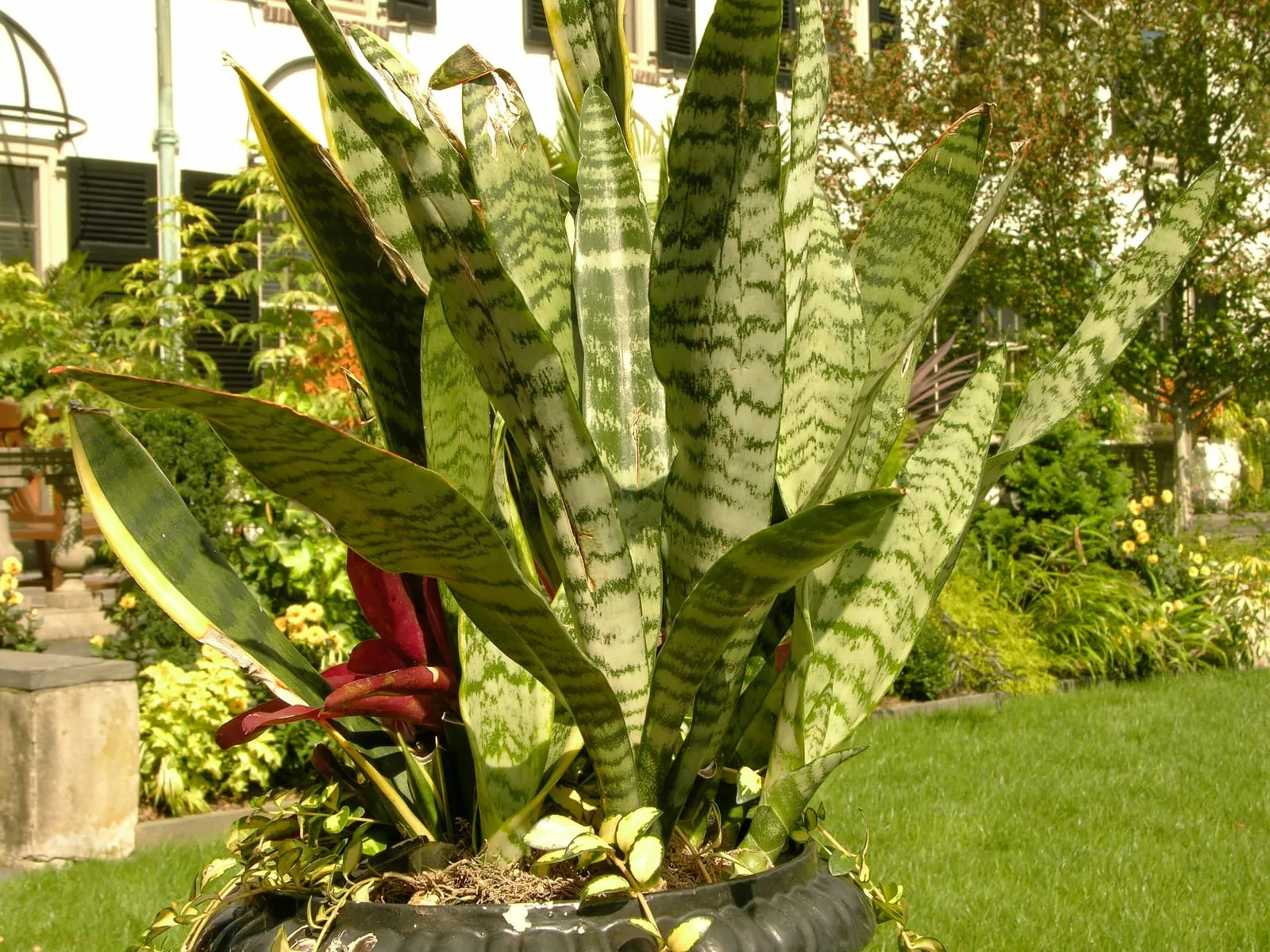
It is a West African succulent with stiff upright leaves banded in dark and pale green, often edged in yellow. It grows in offices under fluorescent light, in dim hallways, in the corner of a bathroom, and in a bright window. That range puts it among the houseplants that take a low-light spot. It goes a month without water in winter and does not notice.
The name on the label may be out of date. Botanists moved the whole genus Sansevieria into Dracaena in 2017 after DNA work showed the two could not be separated, so the plant sold as Sansevieria trifasciata for a century is now Dracaena trifasciata. Nurseries and the ASPCA still mostly use the old name. It is the same plant.
Appearance and character
Stiff, upright, sword-shaped leaves growing straight from a creeping underground rhizome, banded horizontally in two shades of green. Most named varieties add a yellow margin, as in ‘Laurentii’, and some are short rosettes rather than tall spears, as in ‘Hahnii’.
Mature plants sometimes flower, which surprises people who have had one for years. A tall spike carries small greenish-white flowers that are strongly scented at night and drip nectar. It is not a sign of anything wrong.
The leaves are tough because they are full of fibre. The plant was grown across West Africa for bowstrings and rope, which is where the alternative name bowstring hemp comes from.
Where it is from
Tropical West Africa, from Nigeria east to the Congo, in dry rocky ground and open woodland shade.
It expects long dry spells, so it stores water in its leaves and rots if the soil stays wet. It also grew up in dappled shade rather than open desert, which is why it copes with a dark corner better than most succulents.
How it grows
An evergreen perennial that spreads sideways by a thick underground rhizome, sending up new leaves at the edge of the clump until it fills the pot and eventually cracks it.
It uses a form of photosynthesis called CAM, shared with most succulents, in which the leaf pores stay shut through the heat of the day and open at night to take in carbon dioxide. That is the grain of truth behind the claim that snake plants release oxygen at night. It is real, and it is a rounding error in a room full of air.
The related claim, that a few of these will purify the air in your house, comes from a NASA experiment in the 1980s that measured plants in sealed chambers the size of a bin. Scaled up to a ventilated room, you would need something like a plant per square metre to compete with opening a window. Grow it because it is handsome and unkillable.
Through the seasons
Spring is when growth restarts. Repot now if the pot is bulging, and give it its one feed of the year.
Summer is the growing season. Water every two to three weeks, and only when the compost has gone dry all the way through.
Autumn growth slows. Start stretching the intervals between waterings.
Winter is the dangerous season, and the reason this plant is a January pick. In a cool room it needs water once a month at most, and some plants in cold rooms want none at all until March. Watering a cold, dormant snake plant on a schedule is how most of them die.
Care difficulty
Easy, and the label is deserved. It tolerates low light, dry air, irregular attention and being ignored for a month.
The single failure mode is overwatering, and it is made worse by cold. Wet compost at 12 deg C rots roots far faster than wet compost at 22 deg C, which is why winter kills more snake plants than summer.
Watering
Soak it thoroughly, let the water run out of the bottom, then leave it alone until the compost is dry all the way through. In practice that is every two to three weeks in summer and monthly or less in winter.
Push a finger right down into the pot rather than judging by the surface. The top can look dry while the bottom, where the roots are, is still wet.
Water onto the compost, not into the crown where the leaves meet. Water sitting in that funnel rots the base of the leaves.
A snake plant dies from too much water far more often than too little, the overwatering trap that catches most houseplants.
If you are unsure, do not water. This plant recovers from drought and rarely recovers from rot.
Warning signs, diseases and pests
Root rot is the disease that matters, and the first sign is leaves going soft and yellow at the very base, then falling over from the bottom while the tips still look fine. There is often a sour smell. Tip the plant out, cut away everything mushy, let the healthy rhizome dry for a day, and repot in dry cactus compost.
Wrinkled leaves with edges curling inward mean the opposite problem, and a thorough soak fixes it, though a slow-growing plant takes weeks to plump up.
Mealybugs tuck into the crevices between leaves. Spider mites show as fine speckling in dry heat. Fungus gnats are a symptom of overwatering rather than a problem in themselves.
Brown crispy tips usually come from physical damage or erratic watering. Trim them off with scissors, following the leaf’s natural point, and accept that the cut edge stays brown.
Growing environment
It grows in almost any light. Bright indirect is where it grows fastest, a dim corner is where it grows slowest, and both are fine. Variegated forms need better light to keep their yellow margins. Move it into direct sun gradually if at all, because a plant that has been in shade for a year will scorch.
Keep it above 10 deg C. It tolerates 10 to 35 deg C without complaint but cold draughts and cold wet compost together will finish it.
Ordinary household humidity is right. This is a dry-country plant and the tropical humidity figures often quoted for it are wrong.
Use a free-draining cactus or succulent compost, and a heavy pot. A tall specimen in a light plastic pot topples.
Feeding
Once or twice a year, in spring and perhaps midsummer, with a balanced liquid feed at half strength. That is all it wants.
Over-feeding shows as brown tips and, in bad cases, splitting leaves. If you have been feeding it monthly, stop, and flush the pot through with plain water to wash the salts out.
Troubleshooting
Soft, yellow, collapsing leaves at the base. Root rot from overwatering, usually in winter. Unpot it and cut back to firm tissue.
Wrinkled leaves, edges curling in. Underwatered for a long time. Soak it and be patient.
Leaves falling outward, the clump opening up in the middle. Too little light, or a pot that is too small to support the height. Move it brighter and repot.
Brown tips. Erratic watering, over-feeding, or damage. Trim to shape.
My variegated cutting came up plain green. Expected, and it is not your fault. The yellow margin is a chimera, a layer of tissue only present at the edge of the leaf, and a leaf cutting regrows from tissue underneath it. To keep the variegation, divide the rhizome instead of taking leaf cuttings.
It has flowered. Nothing is wrong. Mature plants do this, often after a period of being slightly stressed or pot-bound. The spike drips sticky nectar, so move it off good furniture.
Snake Plant problem guides
Not sure what is wrong? See the common houseplant pests guide.