
Houseplant
Maidenhair Fern
Adiantum raddianum
Also known as Delta maidenhair fern, Adiantum, Black maidenhair
How to care for Adiantum raddianum. Why it crisps in an ordinary room, the one thing that revives a fern you think you have killed, and how it differs from its near-hardy wild relative.
At a glance
- Difficulty
- Difficult
- Water
- Whenever the surface starts to dry, often every 2-3 days
- Light
- Indirect light or light shade. Direct sun destroys the fronds
- Temperature
- 16-24 deg C. Below 13 deg C checks it badly
- Humidity
- 60% or higher, and it will not thrive below 50%
- Hardiness
- USDA 10-11, RHS H1c, hardy to 10 C
- Type
- Evergreen perennial fern
- Height
- 30-45 cm
- Native to
- Damp shaded rock and streamside in tropical South America
- Best month
- December in the Northern Hemisphere, June in the Southern Hemisphere
Tropical America, on damp shaded rock and stream banks. It wants humidity above all and will crisp within hours of drying out, which no amount of later watering reverses. Cut a collapsed plant to the base and it reshoots.
Hardiness zones describe winter cold alone. Summer heat, humidity, rainfall and the length of the growing season decide as much, so treat the range as the outer limit rather than as a recommendation.
Every month named in this guide is for the temperate Northern Hemisphere. If you garden in the Southern Hemisphere, shift each one by six months, so December becomes June. Closer to the equator the wet and dry seasons matter more than the calendar, and the shift stops being a useful guide.
Not known to be toxic
Non-toxic. The ASPCA lists maidenhair fern among plants that are not toxic to cats, dogs or horses, and Adiantum does not appear on the RHS list of potentially harmful garden plants. NC State Extension records no toxicity for the genus. Ferns in general are worth a word of caution here, because the name covers unrelated plants and some of them are a different matter. Asparagus fern is not a fern at all and its berries are toxic, and bracken is carcinogenic to livestock. True maidenhairs in the genus Adiantum carry neither problem, and this is a safe plant to grow within reach of a cat.
Sources: ASPCA (Maidenhair Fern, Adiantum species), NC State Extension, Adiantum raddianum
About
Maidenhair ferns kill more houseplant confidence than any other plant on sale. They look delicate and they are delicate, and the specific weakness is that the fronds have almost no waxy cuticle. Water leaves them as fast as the air will take it.
The wiry black stalks give the plant its name, and they repel water so thoroughly that droplets bead and roll off like mercury. That property named the genus, from the Greek adiantos, meaning unwetted.
A maidenhair which has crisped to a brown skeleton is usually alive. Cut every frond off at compost level, keep the pot damp and warm, and new growth appears within weeks. Most people throw the plant away a fortnight too early.
Appearance and character
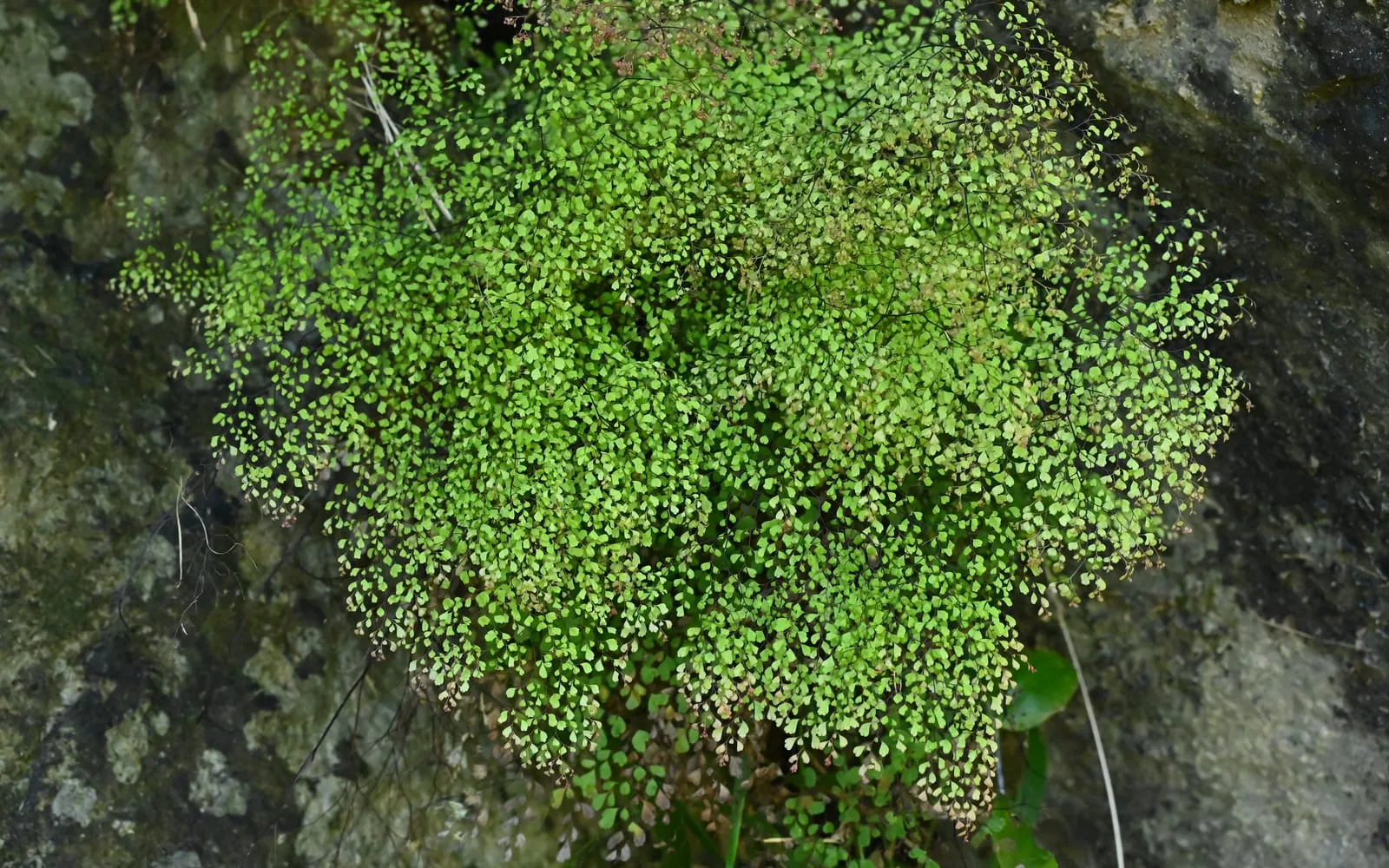
Fronds arch outward from a low crown, 30 to 45 cm long, divided and divided again into hundreds of small fan-shaped leaflets no bigger than a fingernail.
Each leaflet is thin enough to see light through, mid to pale green, with a scalloped outer edge. The overall texture reads as a green mist rather than as individual leaves.
The stalks are the distinctive feature, glossy black or very dark brown, thin as wire and surprisingly strong.
New fronds uncurl from tight croziers at the centre of the crown, pale and soft, and darken as they harden over a week or two.
Spores form in small pockets along the underside of the leaflet margins, where the edge folds over to cover them. A fern with brown crusty edges to the leaflets may be fruiting rather than dying, so look before you panic.
Where it is from
Tropical South America, on damp shaded rock, in gorges and along streamsides where spray keeps the air permanently wet.
Growing beside falling water is the whole story. The plant never experiences dry air, so it never evolved to resist it. Its leaflets lack the thick cuticle that lets a rubber plant sit in a heated room.
Light in those gorges is indirect and often dim. Direct sun scorches the fronds within hours.
Roots run in a thin layer of leaf litter and moss over rock, so they want constant moisture with free drainage and plenty of air. A dense waterlogged compost rots them.
Adiantum capillus-veneris is the closely related species found wild from Britain to the tropics, scarce and legally protected, clinging to damp limestone and sea cliffs in the west. It is the one referred to in old herbals. The plant sold as a houseplant is almost always the tropical A. raddianum, which is easier under glass and no easier in a dry room.
How it grows
An evergreen perennial fern spreading slowly by a short creeping rhizome at the compost surface.
New fronds appear in flushes through spring and summer, unrolling from croziers. Older fronds yellow and die back from the base, and cutting them out at the crown keeps the plant looking fresh and improves airflow.
There is no flowering. Ferns reproduce by spores, and a mature plant will occasionally seed itself into the compost of a neighbouring pot in a humid room.
Propagation at home is by division. Turn the plant out in spring, pull the crown apart into two or three pieces each with roots and several fronds, and pot them separately. Growing from spores is possible and slow enough to be a project rather than a method.
Growth stops below about 13 deg C and the plant sits still through winter.
Through the seasons
Spring brings the main flush of new fronds. Divide or repot now, cut out any frond that browned over winter, and start feeding weakly once growth appears.
Summer demands the most attention. Check the compost every couple of days, keep the plant out of any direct sun, and keep humidity high in warm dry weather.
Autumn slows growth. Stop feeding at the end of September.
Winter is the season that kills maidenhairs, and central heating is the reason. Humidity in a heated room falls below 30%, which this plant cannot survive for long. Move it to the coolest bright room you have, keep it off windowsills, and away from every radiator.
Care difficulty
Difficult, and honestly so. This is not a beginner’s plant, and putting one in an ordinary centrally heated living room means watching it crisp.
Humidity is the whole problem. Below 50% the leaflets brown at the edges and then shrivel, and no watering regime compensates because the loss is through the leaf surface rather than the roots.
The plants that succeed are in bathrooms with windows, in kitchens, in terrariums, or grouped closely with other plants under a humidifier. A maidenhair on a mantelpiece above a radiator will die, and nothing you do to the compost will change that.
Drying out is the second killer, and it acts fast. A few hours of dry compost in a warm room takes out a whole flush of fronds.
Watering
Keep the compost damp at all times. Check every two or three days in summer and water as soon as the surface starts to dry.
Water little and often rather than in occasional deep soaks. The aim is compost that is never dry and never sodden.
Use rainwater or filtered water. Maidenhairs are among the most sensitive houseplants to the fluoride and chlorine in tap water, both of which brown the leaflet margins.
Water at room temperature and pour onto the compost rather than over the crown, where water sitting in the centre encourages rot.
Standing the pot in a shallow tray of water for twenty minutes and then draining it works well, and it keeps water off the fronds.
Reduce the frequency in winter while never letting the compost dry out.
Warning signs, diseases and pests
Crisp brown leaflets, spreading from the frond tips inward, mean dry air. This is the diagnosis for the great majority of unhappy maidenhairs.
Whole fronds browning at once, with dry light compost, mean the plant dried out. Cut them off and keep watering.
Brown leaflet edges with damp compost and reasonable humidity point to tap water. Switch to rainwater.
Yellowing fronds with wet cold compost mean root rot. Turn the plant out, cut away soft roots, and repot into fresh open compost.
Pale bleached patches come from direct sun.
Neat brown lines along the underside of the leaflet margins are spore cases and are a sign of maturity.
Scale insects appear as tiny brown bumps on the black stalks and are easy to miss against the dark colour. Wipe them off with a damp cloth.
Mealybugs settle in the crown as white fluff and come off with a cotton bud dipped in surgical spirit. Avoid drenching the plant in any spray, since the thin fronds mark easily.
Growing environment
Indirect light or light shade. A north-facing window is close to ideal. An east window works if the plant sits back from the glass. Keep it out of direct sun entirely.
Aim for humidity of 60% or above. A bathroom or kitchen with a window is the easiest answer in a heated house. Failing that, group it with other plants on a wide tray of wet gravel, or run a humidifier nearby.
A closed glass container or terrarium suits this fern better than any other common houseplant, and solves the humidity question outright.
Keep it between 16 and 24 deg C, cooler rather than warmer. Heat with dry air is the worst combination. Below 13 deg C growth stops.
Use peat-free compost lightened with leaf mould or fine bark so it holds moisture while staying open. A shallow pot suits the creeping rhizome.
Keep it away from radiators, heating vents and draughts from external doors.
Feeding
A balanced liquid feed at a quarter of the recommended strength, once a month from April to September.
Ferns are easily scorched by fertiliser, and weak and infrequent beats strong and regular. A maidenhair fed at full strength browns at the leaflet edges within a fortnight.
Feed nothing from October to March.
Repot every couple of years in spring into fresh compost. Refreshing the compost does more than feeding for a plant that has stalled.
Troubleshooting
Every frond has gone brown and crispy. Almost certainly dry air, possibly combined with a missed watering. The plant is probably alive. Cut all the fronds off at compost level, keep the compost damp and the pot somewhere humid and warm, and wait. New croziers usually appear within three to six weeks.
Brown edges on the leaflets while the plant looks otherwise well. Tap water. Switch to rainwater or filtered water.
Brown lines under the leaflet edges. Spore cases. The fern is mature and healthy.
It crisps again every winter. Central heating. Move it out of the heated living room to a cooler, brighter, damper spot for the winter, or grow it in a terrarium.
Fronds are pale and washed out. Too much light. Move it out of direct sun.
The plant collapsed after I went away for a weekend. It dried out. Cut the dead fronds away, water, and it will usually reshoot.
Should I mist it? Misting raises humidity for a few minutes and leaves the fronds wet, which does little good. A gravel tray, a group of plants or a humidifier all work better.
Is it safe with cats? Yes. True maidenhairs are listed non-toxic by the ASPCA. Take care not to confuse it with asparagus fern, which is not a fern and does carry toxic berries.
Maidenhair Fern problem guides
Not sure what is wrong? See the common houseplant pests guide.