
Houseplant
Swiss Cheese Plant
Monstera deliciosa
Also known as Monstera, Split-leaf philodendron, Fruit salad plant
How to grow and care for Monstera deliciosa, the Swiss cheese plant. Watering, light, feeding, common problems, and whether it is safe around pets.
At a glance
- Difficulty
- Easy
- Water
- Every 5-7 days
- Light
- Bright indirect light, 4-6 hours
- Temperature
- 18-30 deg C
- Humidity
- Undemanding. Fine from 40%, better above 60%
- Hardiness
- USDA 10-12, RHS H1b, hardy to 12 C
- Type
- Evergreen perennial climber
- Height
- Up to 20 m in the wild, 2-3 m indoors
- Native to
- Southern Mexico, Central America
- Best month
- April in the Northern Hemisphere, October in the Southern Hemisphere
Rainforest from southern Mexico to Panama, climbing trunks towards the light. The splits and holes develop only on mature growth with something to climb, so a plant given a moss pole leafs out quite differently from one left to trail. Outdoors year round in USDA 10 and warmer, where it is grown for the fruit as well as the leaves.
Hardiness zones describe winter cold alone. Summer heat, humidity, rainfall and the length of the growing season decide as much, so treat the range as the outer limit rather than as a recommendation.
Every month named in this guide is for the temperate Northern Hemisphere. If you garden in the Southern Hemisphere, shift each one by six months, so April becomes October. Closer to the equator the wet and dry seasons matter more than the calendar, and the shift stops being a useful guide.
Harmful if eaten
- Do not eat
- Every part except the ripe fruit
- Harm from
- Eating it
- Affects
- People, cats and dogs
Every part of the plant except the ripe fruit contains insoluble calcium oxalate crystals. Chewing a leaf causes immediate burning of the mouth and lips, drooling, and sometimes swelling that makes swallowing difficult. Cats and dogs react the same way. It is painful rather than dangerous, and the sensation stops most animals at one bite, but keep it away from pets that chew houseplants and from small children. If someone does chew a leaf, rinse the mouth and offer something cold, and speak to a doctor or vet if breathing or swallowing is affected.
Sources: ASPCA, RHS potentially harmful garden plants
About
The Swiss cheese plant is the one most people recognise, with glossy architectural leaves full of holes. It earned its name from leaves that split and perforate as the plant matures, and it has become the default statement houseplant because it grows fast, forgives neglect and looks expensive.
What most people do not realise is that they are growing a climber. In the wild it hauls itself up rainforest trees on thick aerial roots and can reach 20 metres. Indoors it will do the same to anything you give it, and a plant with something to climb produces far bigger, more dramatic leaves than one left to sprawl.
Garden centres sometimes label it split-leaf philodendron, which is worth knowing about because it sends people looking for the wrong care advice. Monstera is not a philodendron. The plant that name properly belongs to is Thaumatophyllum bipinnatifidum, a self-supporting shrub that never climbs and never makes holes. If a label says philodendron and the leaves have oval holes punched through them, trust the holes.
Appearance and character
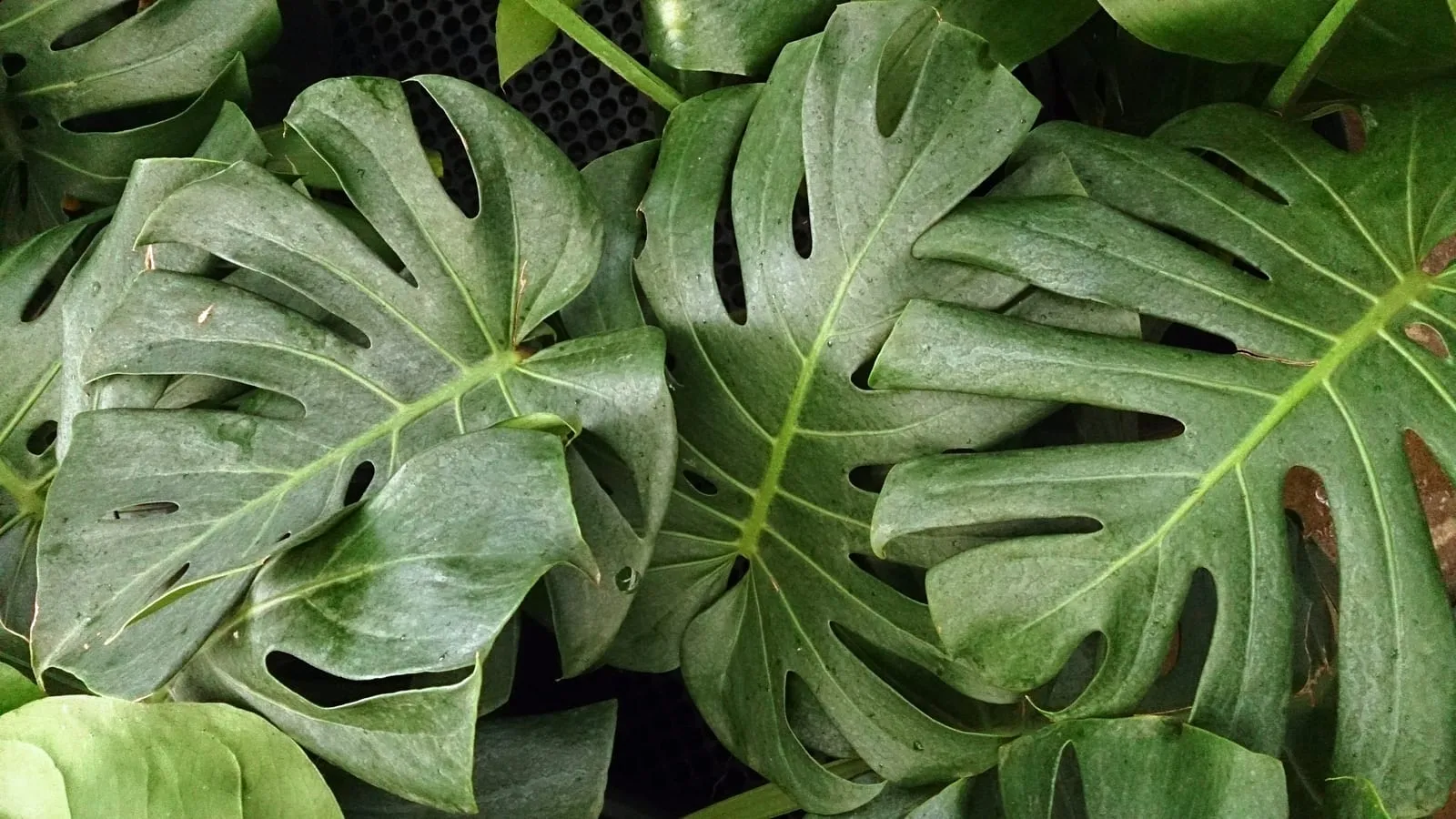
Young plants have plain heart-shaped leaves with no holes at all, which leads a lot of people to think they have bought the wrong thing. The splits arrive with maturity and with light. Given enough of both, leaves reach 40-90 cm across.
The holes are called fenestrations. The best-supported explanation is about light rather than wind. On a rainforest floor, most of the light arrives as sunflecks that move across the ground as the canopy shifts, so a leaf’s problem is covering ground rather than filling in every square centimetre of it. A perforated leaf spreads the same amount of tissue over a wider area, which catches more of those flecks for the same building cost.
Indoors it almost never flowers. In the wild it produces a cream spadix wrapped in a pale hood, which ripens over the best part of a year into the fruit that gives the plant its species name. Ripe deliciosa fruit tastes like a cross between pineapple and banana, which is where “fruit salad plant” comes from. Unripe, it is loaded with oxalic acid and will burn your mouth badly. The foliage has no scent.
Where it is from
Southern Mexico and Central America, in humid lowland rainforest. It wants to be kept warm and consistently damp, bright but shaded from direct sun, and never left sitting in cold water.
How it grows
An evergreen perennial climber. It does not have a dormant season in the way a garden plant does, but growth slows markedly in winter when light drops, and that slowdown should change how you water and feed it.
Left on a windowsill it sprawls sideways and stays small-leaved. Given a moss pole or a slab of bark, the aerial roots grab on, the plant climbs, and leaf size increases with every new node.
Through the seasons
Spring is when it wakes up. This is the moment to repot if it is rootbound, start feeding again, and put up a support before the new growth needs it.
Summer is peak growth. Expect a new leaf every four to six weeks in good conditions. Water more often and watch for spider mites in dry heat.
Autumn growth slows. Stop feeding altogether once new leaves stop appearing.
Winter is the risky season, and almost all monstera deaths happen here. The plant needs much less water, but centrally heated rooms are dry, so humidity needs to go up while watering goes down. Getting those two the wrong way round is the single most common mistake.
Care difficulty
Easy. It tolerates a wide range of light, recovers well from being forgotten, and tells you clearly what is wrong before anything becomes fatal. Most losses come from too much attention, specifically watering to a schedule rather than to the soil.
Watering
Every 5-7 days in growing season, but treat that as a reminder to check rather than an instruction to water. Push a finger into the compost: if the top 5 cm is still damp, leave it.
When you do water, water thoroughly until it runs out of the drainage holes, then empty the saucer after fifteen minutes. Monstera roots want moisture but will rot in standing water.
In winter, stretch the interval considerably. Once a fortnight is often enough.
Warning signs, diseases and pests
The usual pests are spider mites, scale insects, and mealybugs. Spider mites are the most likely and the easiest to miss: look for fine webbing where the leaf meets the stem, and faint pale speckling across the leaf surface. Dry indoor air in winter is what invites them.
Wipe the leaves regularly. It removes the dust that slows photosynthesis and it is also how you spot an infestation early, while it is still a cloth-and-water problem rather than a treatment problem.
Root rot is the disease that kills these plants, and it comes from overwatering and poor drainage rather than from an infection you could have prevented. Soft blackened stems at soil level and a sour smell from the compost mean you should get the plant out of its pot immediately and cut away anything mushy.
Growing environment
Bright indirect light for four to six hours is ideal. It survives low light but grows slowly and keeps its leaves solid, without the splits people want it for. Direct afternoon sun scorches, though morning sun is fine.
Keep it between 18 and 30 deg C, and never below 10 deg C. Draughts and sudden swings do more damage than a steady temperature at the cool end of the range, so keep it away from doors that open to the outside and from radiators.
Humidity is where monstera gets over-specified. The 60-80% figure you see quoted describes the rainforest it came from, not what it needs from you. A monstera grows perfectly well at the 40 to 50 per cent a heated home sits at through winter, and it will not die at 35%. Higher humidity gives you slightly larger leaves and fewer brown tips, so treat it as an upgrade rather than a requirement, and do not buy a humidifier on this plant’s account.
If you want to raise it anyway, a pebble tray or grouping plants together does more than misting, which lifts humidity for a few minutes and then stops.
Feeding
A balanced liquid fertiliser at half strength, fortnightly, from spring through to the end of summer. Stop completely in autumn and winter: feeding a plant that is not growing pushes salts into the compost that it never takes up.
Water first, then feed. Fertiliser onto dry roots burns them. Every couple of months, flush the pot through with plain water to wash out accumulated salts. Brown, crisp leaf tips are usually the first sign that this has been missed.
Troubleshooting
Yellow leaves. Almost always overwatering. Let the compost dry out properly before the next water and check the pot drains.
Brown, crisp leaf tips. Low humidity, or salt build-up from over-feeding. Flush the pot and raise humidity.
New leaves have no holes. Not enough light, or the plant is still young. Move it brighter and give it something to climb.
Leggy growth with long gaps between leaves. Reaching for light. Move it gradually to a brighter spot.
No new growth at all in summer. Light or nutrients. If it has been in the same pot for years, it is probably rootbound.
Swiss Cheese Plant problem guides
Not sure what is wrong? See the common houseplant pests guide.