
Houseplant
Rex begonia
Begonia rex
Also known as Painted-leaf begonia, King begonia, Fancy-leaf begonia
How to care for Begonia rex. The begonia grown entirely for its leaf, why humidity matters more than light, and how to raise a new plant from a single leaf.
At a glance
- Difficulty
- Moderate
- Water
- When the top third of the compost has dried
- Light
- Medium indirect light or light shade. Direct sun scorches the leaves
- Temperature
- 18-24 deg C, and never below 13 deg C
- Humidity
- High, and it is the requirement most owners underestimate
- Hardiness
- USDA 10-12, RHS H1b, hardy to 13 C
- Type
- Evergreen perennial, rhizomatous and clump-forming
- Height
- 20-40 cm
- Native to
- Northeastern India, Southern China
Humid subtropical forest in the eastern Himalayan foothills and southern China, growing in shade on damp rocky slopes and mossy banks with high rainfall and cool nights. It has no frost tolerance and is damaged below about 13 deg C, so outdoors it needs a warm humid frost-free climate in deep shade. High humidity with good airflow is the condition it needs indoors, and stagnant damp air produces mildew as readily as dry air produces crisp edges.
Hardiness zones describe winter cold alone. Summer heat, humidity, rainfall and the length of the growing season decide as much, so treat the range as the outer limit rather than as a recommendation.
Harmful if eaten
- Do not eat
- Every part, and the underground parts most of all
- Harm from
- Eating it
- Affects
- People, cats and dogs
Begonias contain soluble calcium oxalates, and the ASPCA lists the genus as toxic to cats, dogs and horses. Chewing the leaves causes burning and irritation of the mouth, drooling and vomiting, and the concentration is highest in the tubers and rhizomes rather than in the foliage, which matters because this species grows from a rhizome sitting on the compost surface within easy reach. Effects are mild to moderate and settle without treatment in most cases. There is no significant risk from handling the plant. Some begonia species are eaten as a sour vegetable in parts of Asia after cooking, but this one is grown for ornament and there is nothing to gain from eating it.
Sources: ASPCA (Begonia), RHS potentially harmful garden plants
About
The rex begonia is grown for the leaf and nothing else, which is exactly what a shade plant should be. Flowers are small, pale and sparse, and most growers remove them so the plant puts its energy into foliage instead.
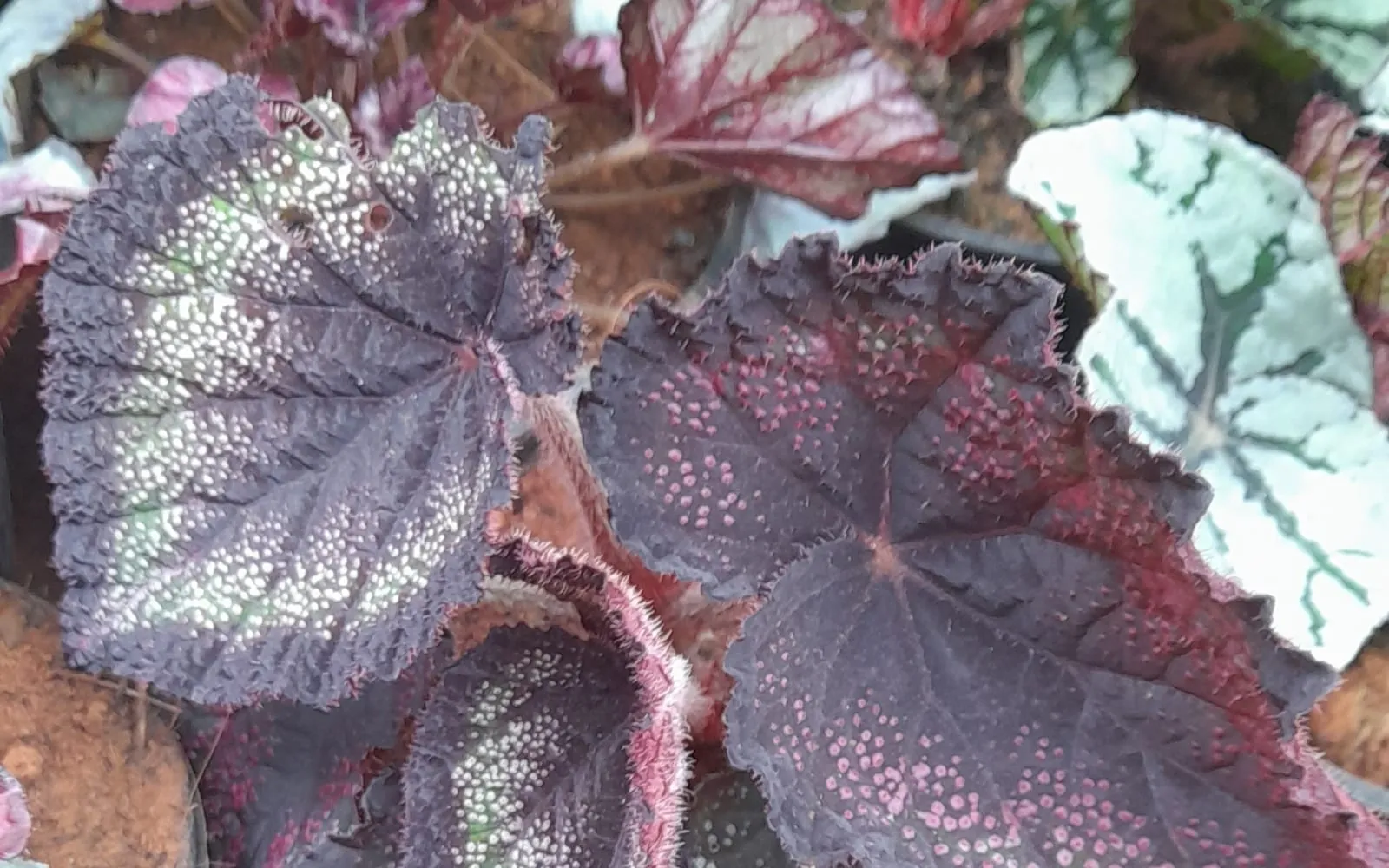
That foliage is the most extravagantly patterned of any common houseplant. Depending on cultivar it carries spirals, silver bands, metallic sheens, deep purples, pinks and reds, often with several of those on one leaf, and the surface can be smooth, puckered or covered in fine red hairs.
It has a reputation for being difficult, and the reputation is half deserved. The plant is undemanding about light, taking a medium or dim position happily. What it wants is humid air with movement through it, and the failure mode is a household that provides neither. In dry heated air the leaf edges crisp brown, and in still humid air powdery mildew arrives instead.
Appearance and character
A low spreading perennial growing from a thick rhizome that creeps along the surface of the compost rather than rooting deep.
Leaves rise individually from that rhizome on hairy stalks. Each is markedly asymmetric, with one side of the base much larger than the other, giving the lopsided outline typical of the whole genus. Blades are 10 to 20 cm long, often puckered or textured, and carry the pattern the plant is grown for.
Colour and marking vary enormously between cultivars, and thousands have been named since the species reached Europe. ‘Escargot’ spirals its leaf into a snail shell. ‘Fireworks’ is silver with deep purple centres and margins. Others are almost black, or pink, or banded in metallic silver.
Growth is moderate, forming a clump 20 to 40 cm across.
Flowers are small, pale pink or white, held on thin stalks above the leaves in sparse clusters, and they are usually removed.
Many cultivars go semi-dormant in winter, dropping most of their leaves and looking dead, which alarms owners into throwing away plants that would have resprouted in spring.
Where it is from
The eastern Himalayan foothills of northeastern India and adjacent southern China, growing in shade on damp rocky slopes and mossy banks in humid subtropical forest.
That habitat sets every requirement. Shade explains the tolerance of dim rooms and the intolerance of direct sun. Constant high humidity from monsoon rainfall explains the crisp brown edges in a dry room. Growing on rock and moss rather than in soil explains the shallow creeping rhizome and the need for an open, free-draining compost in a shallow pot.
The species reached Europe in 1856 in a shipment of orchids from Assam, where a single plant was noticed among the packing material. Almost every rex cultivar sold since descends from crosses involving it, and the modern plants are hybrids rather than the pure species.
The genus Begonia is one of the largest in the plant kingdom, with over two thousand species.
How it grows
Give it medium indirect light or light shade. Bright light bleaches the pattern and direct sun scorches the leaves outright.
Keep the humidity high and the air moving. Those two together are the whole difficulty, since still damp air brings mildew and dry air crisps the edges. A gravel tray plus an open door beats a sealed propagator.
Water when the top third of the compost has dried, at the edge of the pot rather than over the leaves.
Keep water off the foliage. Wet leaves in still air are how powdery mildew starts, and the hairy textured surfaces of this plant hold water for a long time.
Keep it above 13 deg C and ideally between 18 and 24 deg C.
Use a shallow wide pot with an open compost. The rhizome runs across the surface and rots if buried or kept wet.
Feed monthly at quarter to half strength through the growing season.
Propagate from a leaf. This genus roots more readily from leaf tissue than almost anything else, and a single leaf produces several plantlets.
Repot every year or two in spring into a wider pot rather than a deeper one.
Through the seasons
Spring restarts growth after the winter rest. Resume feeding, repot or divide, and take leaf cuttings.
Summer is the growing season. Water when the top third dries, feed monthly, keep the humidity up and the air moving.
Autumn slows it. Reduce watering and stop feeding from October.
Winter is when many cultivars go semi-dormant, shedding most of their leaves. Water very sparingly, keep the plant above 13 deg C, and do not throw it away. It will resprout from the rhizome in spring.
Care difficulty
Moderate, and the difficulties are specific.
Humidity with airflow is the requirement people fail to provide. Dry air produces crisp brown edges, still damp air produces powdery mildew, and the plant needs the space between those two.
Powdery mildew is the disease that ruins rex begonias, appearing as white dusty patches on leaves and stems. Removing affected leaves, improving airflow and keeping water off the foliage are the practical responses.
Overwatering rots the surface rhizome, and burying the rhizome when potting does the same.
Winter dormancy costs plants their lives every year through misdiagnosis. A rex begonia that drops its leaves in December is resting, and it resprouts in spring from a rhizome that looks finished.
Watering
Water when the top third of the compost has dried, roughly weekly in summer and every two to three weeks in winter.
Water at the edge of the pot and never over the leaves.
Bottom watering suits it well, standing the pot in a few centimetres of water for twenty minutes and then draining it fully.
Reduce watering sharply through winter dormancy, giving just enough to stop the rhizome shrivelling.
Underwatering shows as drooping leaves and crisp edges.
Overwatering shows as yellowing leaves, a soft mushy rhizome and collapse, and it is the commonest cause of death.
Warning signs, diseases and pests
White dusty patches on leaves and stems are powdery mildew. Remove affected leaves, improve the airflow, stop wetting the foliage and space the plant away from its neighbours.
Brown crisp leaf edges are dry air. They are permanent on affected leaves, so raise the humidity and judge by the new growth.
Leaves dropping in autumn and winter with no other symptom is normal dormancy in many cultivars. Keep the plant barely moist and wait for spring.
A soft mushy rhizome is rot from overwatering or from being buried. Cut away the soft tissue, dust the cuts and repot shallowly in fresh open compost.
Fine pale stippling with webbing is red spider mite in dry heated air.
White cottony fluff among the leaf stalks and along the rhizome is mealybug.
Faded washed-out pattern is too much light. Move it out of bright positions.
Scorched brown patches are direct sun damage and are permanent.
Growing environment
Medium indirect light or light shade.
Never direct sun.
Warm, 18 to 24 deg C, with 13 deg C as the floor.
High humidity with air movement through it, which is the combination that decides success.
Free-draining peat-free compost in a shallow wide pot with drainage holes, with the rhizome sitting on the surface rather than buried.
A terrarium suits some cultivars, though the still air raises the mildew risk, so ventilate it.
Outdoors only in a warm humid frost-free climate in deep shade.
Avoid direct sun, dry heated rooms, wet foliage, still stagnant air and deep pots.
Feeding
Feed monthly from spring to early autumn with a balanced liquid houseplant fertiliser at quarter to half strength.
Stop feeding entirely through autumn and winter, particularly if the plant goes dormant.
Feed lightly. Rich feeding produces soft growth that mildews more readily.
Repot every year or two in spring into a wider rather than deeper pot, keeping the rhizome at the surface.
Flush the compost occasionally with plain water to clear salts.
Troubleshooting
It has dropped all its leaves and looks dead. Many rex cultivars go semi-dormant in winter. Keep the compost barely moist, keep the plant above 13 deg C, and wait. It will resprout from the rhizome in spring.
White dusty patches on the leaves. Powdery mildew, the classic begonia disease. Remove the affected leaves, improve airflow, stop watering over the foliage and give the plant more space.
The leaf edges are brown and crisp. Dry air. Raise the humidity, and judge by the new leaves since the damage is permanent on the old ones.
How do I grow a new plant from a leaf? Cut a healthy leaf, slice through the main veins on the underside in several places, lay it face up on damp compost and weigh it down so the cuts touch the surface. Plantlets appear at the cuts within a couple of months.
Is it safe with a cat? No. Begonias contain soluble calcium oxalates and the ASPCA lists the genus as toxic to cats, dogs and horses, with the rhizome the most concentrated part.
The pattern has faded. Too much light. Move it somewhere dimmer, since bright light bleaches the markings and direct sun scorches outright.
The rhizome has gone soft. Rot, from overwatering or from being buried when potted. Cut away the soft tissue and repot shallowly, with the rhizome sitting on the surface.
Should I remove the flowers? Most growers do. They are small and sparse, and removing them puts the plant’s energy into the foliage it is grown for.
Rex begonia problem guides
Not sure what is wrong? See the common houseplant pests guide.