
Houseplant
Watermelon peperomia
Peperomia argyreia
Also known as Watermelon begonia, Peperomia sandersii, Peperomia argyreia
How to care for Peperomia argyreia. The silver-striped peperomia whose markings are structural rather than pigment, why the stalks snap, and how to propagate one from half a leaf.
At a glance
- Difficulty
- Easy
- Water
- When the top half of the compost has dried
- Light
- Medium to bright indirect light. Deep shade dulls the silver
- Temperature
- 18-26 deg C, and never below 12 deg C
- Humidity
- Moderate. It tolerates ordinary room air
- Hardiness
- USDA 10-12, RHS H1b, hardy to 12 C
- Type
- Evergreen perennial, semi-succulent and compact
- Height
- 20-30 cm
- Native to
- South America
Rainforest floor and lower slopes in northern South America, in deep shade with constant warmth and humidity and no cold season. It grows in shallow leaf litter and mossy pockets rather than deep soil, which is why the root system is small and why compost that stays wet kills it. Damaged below about 12 deg C, it needs a warm frost-free climate outdoors and is grown almost entirely as a houseplant.
Hardiness zones describe winter cold alone. Summer heat, humidity, rainfall and the length of the growing season decide as much, so treat the range as the outer limit rather than as a recommendation.
Not known to be toxic
Non-toxic. The ASPCA lists Peperomia argyreia among plants that are not harmful to cats, dogs or horses, and the genus does not appear on RHS lists of potentially harmful garden plants. There is no irritant sap and no risk from handling the plant or from an animal chewing a leaf. This is a small plant that lives on desks, windowsills and low shelves within easy reach of a curious cat, so the safety is more useful here than it would be on a specimen at head height. The name watermelon refers only to the leaf markings, and nothing about the plant is edible or related to a melon; it sits in the pepper family alongside black pepper.
Sources: ASPCA (Watermelon Peperomia, Peperomia argyreia), RHS potentially harmful garden plants
About
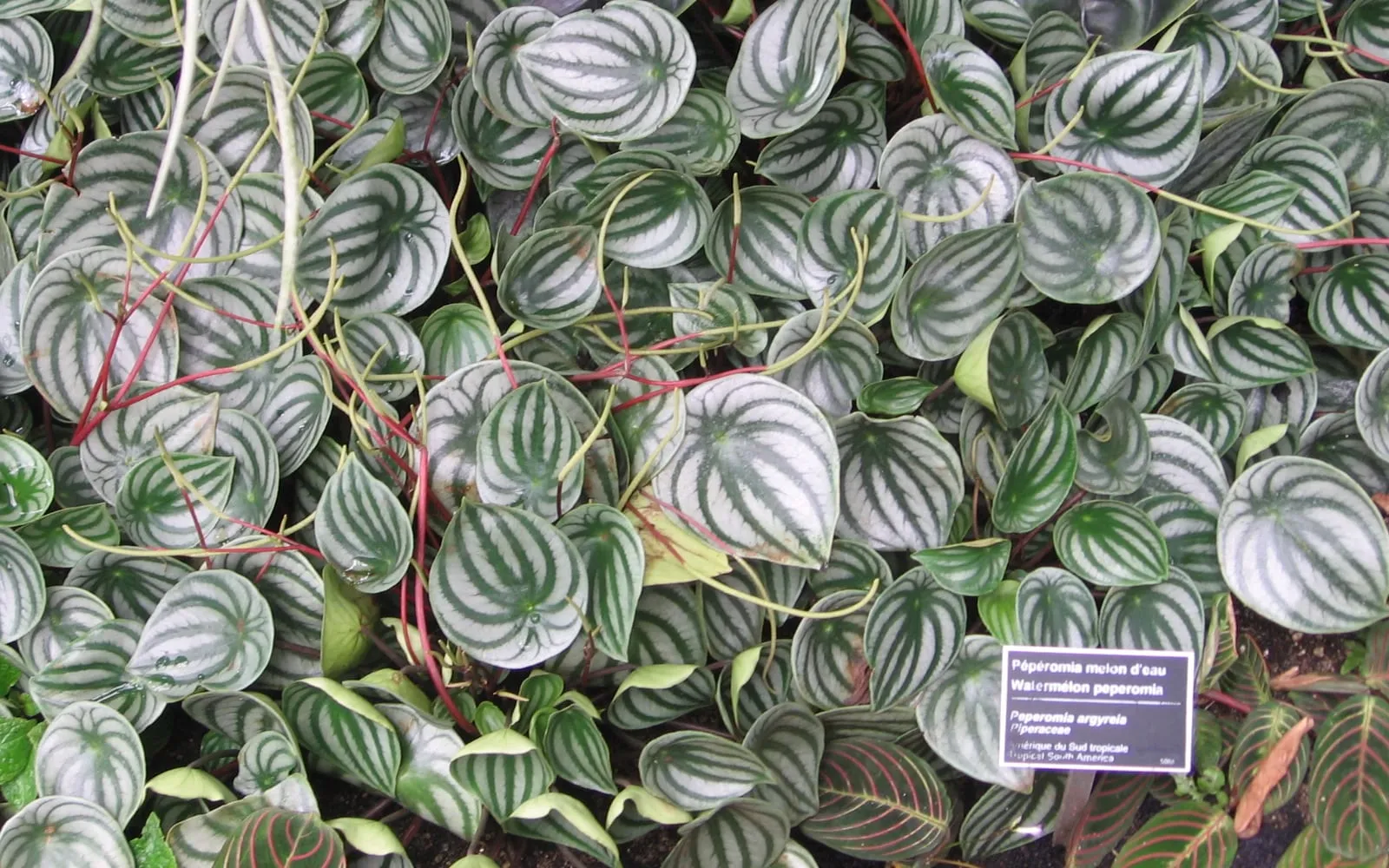
The watermelon peperomia is grown for one thing, which is the leaf. Round, fleshy, and marked with broad curved bands of silver radiating from the point where the stalk joins, it looks close enough to the rind of a watermelon that the name has stuck across several languages.
The silver changes how the plant behaves in a dim room. It is not variegation and not pigment. The leaf tissue between the veins is lifted slightly away from the layer of chlorophyll beneath it, leaving an air gap that reflects light and reads as silver. The chlorophyll is still there, underneath, working normally.
That means the plant loses nothing by keeping its markings in shade, which is why it holds a dimmer position than a variegated plant of the same size. What it does lose in deep shade is the contrast, since the stalks stretch and the whole plant goes floppy reaching for light.
Appearance and character
The leaf attachment is the structural feature that defines this species. The stalk joins the blade on its underside, set in from the margin rather than at the edge, so each leaf is held out like a small shield on a pole. Botanists call that arrangement peltate, and among the peperomias grown indoors it is unusual.
Everything else follows from it. The silver bands radiate outward from that attachment point in a rough circle, which is why the pattern reads as a melon rind rather than as stripes along a midrib, and why the leaf looks symmetrical from every angle.
Blades are almost circular, 8 to 12 cm across, thick and fleshy, with pale green undersides washed in red. Stalks are a strong wine red, upright, and long in proportion to the plant, holding the leaves clear of one another.
A clump reaches 20 to 30 cm and thickens slowly.
Flower spikes are slender, greenish and carried on thin stalks well above the foliage. Removing them changes very little either way.
Those long red stalks snap cleanly when knocked, and a broken one cannot be mended.
Where it is from
Northern South America, principally Brazil, Bolivia, Ecuador and Venezuela, on the rainforest floor among shallow litter and mossy pockets.
Litter is only a few centimetres deep and dries between downpours, which selects for a root system that stays near the surface and for tissue that carries its own reserve. That is why the stalks and blades are fleshy, and why a pot of dense compost held permanently damp is the wrong environment for roots evolved to sit in a thin, airy, intermittently dry layer.
The silvering is a structural colour rather than a pigment, produced by an air space beneath the upper leaf surface. The same trick has evolved independently in several unrelated forest floor groups, Begonia and Scindapsus among them. Whether it returns light through the chlorophyll for a second pass or breaks up the leaf outline against dappled shade has not been settled.
Argyreia means silvery. The species was described twice, and the older name Peperomia sandersii is still printed on plenty of labels.
How it grows
Position it where the light is moderate and never direct. The markings survive shade, so the thing to judge is the stalks rather than the colour, and stalks that lengthen and lean are telling you the corner is too dark.
Site it out of the way. Long brittle stalks and a busy shelf make a poor combination, and most damage to this plant is mechanical rather than cultural.
Let the top half of the compost dry before watering, then water at the rim and let it drain. Bottom watering works well and keeps the crowded stalk bases dry.
Pot it into something gritty and shallow. A third perlite through houseplant compost, or an orchid mix, gives the surface roots the air they evolved with.
Undersize the pot rather than oversize it, since wet compost the roots never reach is what rots them.
Hold the room above 12 deg C, ideally 18 to 26 deg C.
Feed at quarter to half strength every six to eight weeks in the growing season and not at all through winter.
Two propagation methods work, and the second surprises people. A whole leaf with 2 cm of stalk roots readily, and so does half a leaf, cut straight across the veins and pushed cut-edge-down into damp compost, which produces plantlets along the severed vein ends.
Through the seasons
Spring restarts growth. Resume light feeding, repot if the plant has filled its pot, and take leaf cuttings.
Summer is the growing season. Water when the top half dries, feed every six to eight weeks, and keep it out of direct sun.
Autumn slows it. Reduce watering and stop feeding from October.
Winter is when most plants are lost. Water very sparingly, keep it above 12 deg C and away from cold glass, and leave it alone.
Care difficulty
Easy, with the usual peperomia rule about water and one about handling.
Overwatering is the way it dies. The short central stem softens and the leaves drop while still firm and plump, which reads as anything except thirst.
Cold plus wet compost makes winter the risk period.
Brittleness is a practical nuisance. Stalks snap when brushed past, so a position out of the traffic of a room suits it better than a busy shelf.
Stretching in deep shade is cosmetic and reversible, though the stretched stalks stay long.
Watering
Water when the top half of the compost has dried, roughly every ten to fourteen days in summer and every three to four weeks in winter.
Water at the edge of the pot rather than into the middle of the rosette, since water sitting among the crowded stalk bases encourages rot.
Bottom watering suits it well. Stand the pot in a few centimetres of water for twenty minutes, then drain it fully.
Lift the pot to judge. The weight difference between wet and dry compost is more reliable than the look of the surface.
Underwatering shows as drooping stalks and slightly soft leaves, and recovery is complete within a day.
Overwatering shows as firm leaves dropping off, a soft brown stem base and a sour compost smell.
Warning signs, diseases and pests
Leaves dropping while still firm and plump is overwatering. Check the short central stem, which will be soft. Take leaf cuttings at once if it has gone.
Drooping stalks with slightly soft leaves is underwatering, which corrects itself.
Long floppy stalks that cannot hold the leaves up means the position is too dark. Move it brighter, out of direct sun.
Brown concentric rings on the leaves are ring spot virus. There is no cure and the plant should be destroyed rather than propagated.
White cottony fluff where the stalks meet the crown is mealybug, which hides in the crowded centre.
Small flies rising from the compost are fungus gnats, indicating compost kept too wet.
Bleached silver and scorched patches are sun damage.
A snapped stalk cannot be mended. Use the leaf as a cutting.
Growing environment
Medium to bright indirect light, and the markings hold in shade even though the habit suffers.
Never direct sun.
Warm, 18 to 26 deg C, with 12 deg C as the floor.
Moderate humidity, and it copes with ordinary room air.
Very free-draining compost with a third perlite or bark, in a small pot with drainage holes.
A sheltered position out of the traffic of a room, since the stalks are brittle.
Outdoors only in a warm frost-free climate in shade.
Avoid deep pots, water-retentive compost, saucers left full and watering into the crown.
Feeding
Feed every six to eight weeks from spring to early autumn with a balanced liquid houseplant fertiliser at quarter to half strength.
Stop feeding entirely from mid-autumn to early spring.
Feed lightly, since a fine root system burns easily and shows it as brown leaf margins.
Repot every two or three years in spring into a pot one size up at most.
Flush the compost occasionally with plain water to clear salts.
Troubleshooting
Leaves are falling off but they still look healthy. Overwatering. The short stem beneath the rosette has rotted. Take leaf cuttings from good leaves immediately and start again in a smaller pot with a more open compost.
Will it lose its silver in a dim room? No. The silver is an air layer under the leaf surface rather than a lack of chlorophyll, so shade costs the plant nothing to keep it. What suffers in deep shade is the habit, since the stalks stretch and flop.
A stalk has snapped. They are brittle and it cannot be repaired. Use the leaf as a cutting rather than throwing it away.
How do I propagate it? Take a leaf with 2 cm of stalk and push the stalk into damp compost, or cut a leaf in half across the veins and push the cut edge in. Both produce plantlets within a couple of months.
Is it safe with a cat? Yes. The ASPCA lists it as non-toxic to cats, dogs and horses.
Is it related to a watermelon or a begonia? Neither. It is a peperomia in the pepper family, and both names refer only to the look of the leaf.
The stalks have grown very long and floppy. Too little light. Move it to a brighter position out of direct sun. The stretched stalks will stay long, but new growth will be compact.
Brown rings on the leaves. Ring spot virus, which cannot be treated. Destroy the plant rather than propagating from it.
Watermelon peperomia problem guides
Not sure what is wrong? See the common houseplant pests guide.