
Houseplant
Emerald ripple peperomia
Peperomia caperata
Also known as Ripple peperomia, Peperomia caperata, Emerald ripple
How to care for Peperomia caperata. The deeply corrugated rosette peperomia, why water sitting in the crown rots it, and how to propagate one from a single leaf.
At a glance
- Difficulty
- Easy
- Water
- When the top half of the compost has dried
- Light
- Medium indirect light, and it holds lower levels well
- Temperature
- 18-26 deg C, and never below 12 deg C
- Humidity
- Moderate. It tolerates ordinary room air without trouble
- Hardiness
- USDA 10-12, RHS H1b, hardy to 12 C
- Type
- Evergreen perennial, semi-succulent and compact
- Height
- 15-20 cm
- Native to
- Brazil
Rainforest floor in southeastern Brazil, growing in leaf litter and on mossy rocks and logs in deep shade with constant warmth and humidity. Unlike the branch-dwelling peperomias it is a ground-layer plant, which is why it tolerates a little more moisture than its relatives and still wants sharp drainage. It is damaged below about 12 deg C and needs a warm frost-free climate outdoors, though it is grown almost exclusively indoors.
Hardiness zones describe winter cold alone. Summer heat, humidity, rainfall and the length of the growing season decide as much, so treat the range as the outer limit rather than as a recommendation.
Not known to be toxic
Non-toxic. The ASPCA lists Peperomia caperata among plants that are not harmful to cats, dogs or horses, and the genus does not appear on RHS lists of potentially harmful garden plants. That matters more for this plant than for a large specimen, because a rosette peperomia lives on a low shelf, a windowsill or a desk, which is exactly where a cat investigates. There is no irritant sap and no risk from handling it. The plant sits in the pepper family with black pepper and kava, and while some peperomias are eaten as leaf vegetables in parts of South America, this species is grown for its foliage and there is nothing to gain from eating it.
Sources: ASPCA (Emerald Ripple Peperomia, Peperomia caperata), RHS potentially harmful garden plants
About
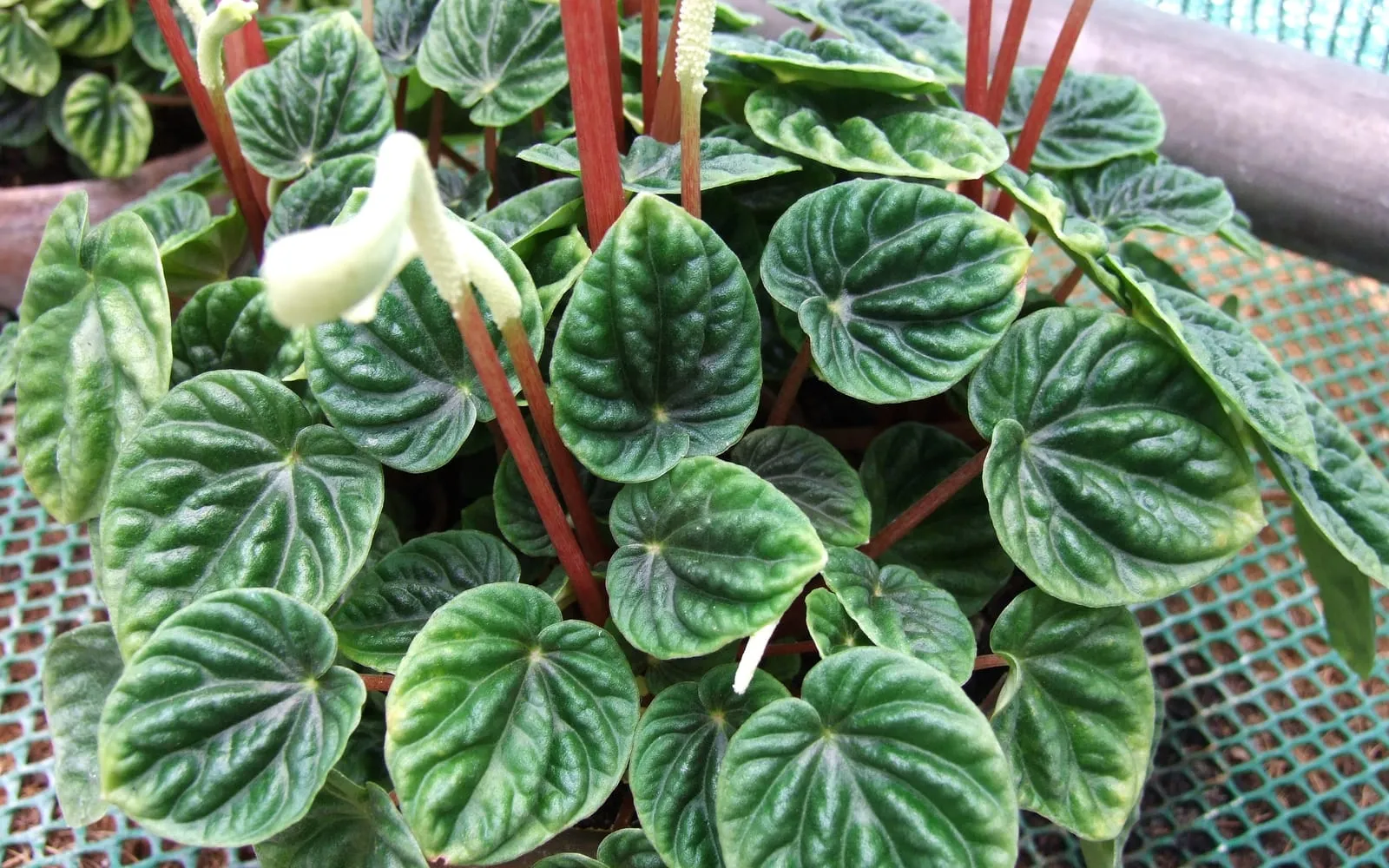
The emerald ripple is the peperomia grown for texture rather than for size. Its leaves are so deeply corrugated that the surface looks quilted, with the veins sunk into deep channels and the tissue between them raised into ridges, and in the dark red cultivars the effect catches light like crushed velvet.
It grows as a tight rosette of long-stalked leaves rather than as a bushy stem plant, which changes one important thing about its care. Water poured into the middle of a rosette sits among the crowded leaf stalks and does not drain away, and crown rot follows within days. Watering at the edge of the pot is the single habit that keeps this plant alive.
It is otherwise as tolerant as the rest of the genus, holding a medium or dim position, coping with ordinary room air, and asking to be left alone between waterings.
Appearance and character
A compact perennial forming a dense rosette of leaves on long, slender, often red-flushed stalks rising from a very short central stem.
Each leaf is heart-shaped, 3 to 5 cm across, thick and semi-succulent, and deeply corrugated so that the surface is a pattern of sunken veins and raised ridges. The texture is the reason to grow it.
Colour varies by cultivar from deep glossy green through to almost black-red. ‘Rosso’ has dark leaves with rich red undersides, ‘Luna Red’ is deep burgundy, ‘Emerald Ripple’ is the plain green original, and ‘Frost’ is silvery grey-green.
Growth is slow and the plant stays small, at 15 to 20 cm tall and about as wide.
Flowers are the family signature, appearing as slender white or greenish spikes on thin stalks held well above the leaves. They are produced freely, look like narrow rat tails, and are the reason the plant is sometimes described as odd rather than attractive in flower.
The red colouring in dark cultivars is anthocyanin and fades towards green in deep shade.
Where it is from
The Atlantic forest of southeastern Brazil, growing on the forest floor in leaf litter and on mossy rocks and rotting logs in deep shade.
That ground-layer habitat separates it from the branch-dwelling peperomias like the baby rubber plant. A plant growing in leaf litter and moss experiences steadier moisture than one perched on a branch, so this species tolerates slightly more water at the root, though the crown is more vulnerable to sitting wet because of its rosette shape.
Constant warmth and humidity with no dry season is what it evolved in, and deep shade under a closed canopy is the ordinary condition rather than a special tolerance.
The genus is one of the largest in the plant kingdom, with well over a thousand species, and sits in the Piperaceae alongside black pepper.
Breeding since the 1990s has produced most of the dark red and silver cultivars now sold, largely from Dutch and Danish nurseries.
How it grows
Give it medium indirect light. It holds a dimmer position well, though the dark red cultivars lose their colour in deep shade.
Keep it out of direct sun, which scorches and bleaches the leaves.
Water at the edge of the pot rather than into the middle of the rosette, and only when the top half of the compost has dried.
Use a very open compost. Houseplant compost with a third perlite, or an orchid or cactus mix, matches the drainage the roots want.
Choose a small shallow pot. This plant has a small root system and sits unhappily in a deep pot full of wet compost.
Keep it above 12 deg C and ideally between 18 and 26 deg C.
Feed every six to eight weeks at quarter to half strength through the growing season.
Remove flower spikes if you dislike them, though leaving them costs the plant very little.
Propagate from a single leaf. Cut a leaf with 2 cm of its stalk, push the stalk into damp compost, and a new plantlet forms at the base within a couple of months.
Through the seasons
Spring restarts growth. Resume light feeding, repot if needed, and take leaf cuttings.
Summer is the growing season. Water when the top half dries, feed every six to eight weeks, and keep it out of direct sun.
Autumn slows it. Reduce watering and stop feeding from October.
Winter is the dangerous season. Water very sparingly, keep it above 12 deg C and away from cold glass, and resist the urge to water on a schedule.
Care difficulty
Easy, with one specific vulnerability.
Crown rot is that vulnerability and it is peculiar to the rosette shape. Water sitting among the crowded leaf stalks in the centre softens the very short stem, and the whole plant collapses at once with the leaves still looking healthy.
Overwatering at the root does the same thing more slowly.
Cold combined with wet compost makes winter the season when most are lost.
Colour loss in dark cultivars is cosmetic and reverses when the plant is moved brighter.
Ring spot virus appears occasionally as brown concentric rings and cannot be treated.
Watering
Water when the top half of the compost has dried, which usually means every ten to fourteen days in summer and every three to four weeks in winter.
Water at the edge of the pot and never into the crown. This is the most important single instruction for the species.
Water thoroughly until it drains, then empty the saucer.
Bottom watering suits this plant well, standing the pot in a few centimetres of water for twenty minutes and then draining it, since it keeps the crown dry entirely.
Underwatering shows as limp, slightly wrinkled leaves that recover within a day.
Overwatering shows as a sudden collapse of the whole rosette, sometimes with no warning at all, because thick leaves stay firm while the stem rots beneath them.
Warning signs, diseases and pests
The whole plant collapsing at once, with leaves still looking healthy, is crown rot. Check the very short central stem, which will be brown and soft. Take leaf cuttings from undamaged leaves immediately, since the parent will not recover.
Yellowing leaves falling while firm is overwatering at the root.
Limp wrinkled leaves are underwatering and correct themselves.
Brown concentric rings on the leaves are ring spot virus. There is no cure and the plant should be destroyed rather than propagated.
White cottony fluff deep among the leaf stalks is mealybug, which the crowded rosette hides very well. Part the leaves to look.
Small flies rising from the compost are fungus gnats, which mean the compost is staying too wet.
Dark cultivars turning green is insufficient light. Move it brighter, out of direct sun.
Scorched pale patches are sun damage.
Growing environment
Medium indirect light, and it holds lower levels at the cost of colour in the dark cultivars.
Never direct sun.
Warm, 18 to 26 deg C, with 12 deg C as the floor.
Moderate humidity, and it copes with ordinary room air without special provision.
Very free-draining compost with a third perlite or bark, in a small shallow pot with drainage holes.
A shallow pot rather than a deep one, since a small root system in a deep pot sits in wet compost.
Outdoors only in a warm frost-free climate in shade, and it is grown almost entirely indoors.
Avoid deep pots, water-retentive compost, saucers left full and watering into the middle of the plant.
Feeding
Feed every six to eight weeks from spring to early autumn with a balanced liquid houseplant fertiliser at quarter to half strength.
Stop feeding entirely from mid-autumn to early spring.
Feed lightly. A small plant with a fine root system burns easily, showing as brown leaf margins and a crust on the compost surface.
Repot every two or three years in spring, into a pot one size up at most.
Flush the compost occasionally with plain water to clear accumulated salts.
Troubleshooting
The whole plant collapsed overnight. Crown rot, from water sitting in the middle of the rosette. The leaves stay firm while the short central stem turns to mush. Take leaf cuttings from healthy leaves at once and start again, watering at the pot edge in future.
How do I water it without wetting the crown? Pour at the edge of the pot, or stand the pot in a few centimetres of water for twenty minutes and then let it drain.
Can I grow a new plant from one leaf? Yes. Cut a leaf with about 2 cm of stalk attached and push the stalk into damp compost. A plantlet appears at the base within a couple of months.
The red has faded to green. Not enough light. The red is anthocyanin pigment and it fades in deep shade. Move the plant brighter, out of direct sun.
Is it safe around pets? Yes. The ASPCA lists it as non-toxic to cats, dogs and horses.
What are the white spikes? Flowers. Peperomia flower spikes look like narrow rat tails and appear readily. They cost the plant little, so leave or remove them as you prefer.
Brown rings have appeared on the leaves. Ring spot virus, which has no treatment. Destroy the plant rather than taking cuttings from it.
The leaves have gone limp and wrinkled. Underwatering, which is the easy problem. Water it and they will recover within a day.
Emerald ripple peperomia problem guides
Not sure what is wrong? See the common houseplant pests guide.