
Houseplant
Lucky bamboo
Dracaena sanderiana
Also known as Ribbon plant, Curly bamboo, Friendship bamboo
How to grow lucky bamboo, Dracaena sanderiana. It is not bamboo, why tap water yellows the tips, and moving it from water into compost.
At a glance
- Difficulty
- Easy
- Water
- Change the water weekly if grown in water, or keep compost damp
- Light
- Bright indirect light, and direct sun scorches it
- Temperature
- 18 to 26 deg C, and never below 12 deg C
- Hardiness
- USDA 10-12, RHS H1b, hardy to 15 C
- Type
- Evergreen perennial, long lived and slow growing
- Height
- 30 cm to 1.5 m depending on how it is grown
- Native to
- Central Africa, from Cameroon and the Congo basin
- Best month
- June in the Northern Hemisphere, December in the Southern Hemisphere
West and central African forest, and no relation to bamboo. The vase of water it is sold in suits it for a while and starves it eventually, so a plant kept that way needs feeding or moving to compost. It is fluoride-sensitive, so stand tap water overnight.
Hardiness zones describe winter cold alone. Summer heat, humidity, rainfall and the length of the growing season decide as much, so treat the range as the outer limit rather than as a recommendation.
Every month named in this guide is for the temperate Northern Hemisphere. If you garden in the Southern Hemisphere, shift each one by six months, so June becomes December. Closer to the equator the wet and dry seasons matter more than the calendar, and the shift stops being a useful guide.
Toxic to cats and dogs if eaten
- Do not eat
- All parts
- Harm from
- Eating it
- Affects
- Cats and dogs
Lucky bamboo is a Dracaena, and the ASPCA lists Dracaena species as toxic to cats and dogs. The plant contains saponins, and eating it causes vomiting, sometimes with blood, drooling, loss of appetite, depression and in cats dilated pupils. This matters more than it might for other houseplants because lucky bamboo is sold as a novelty gift, usually in a small vase at table height, in households that have no idea it is a Dracaena at all. Cats in particular chew the strap leaves. The effects are unpleasant rather than usually life-threatening, and a cat or dog that has eaten a quantity needs a vet. True bamboo, which is a grass, is non-toxic and is listed as such by the ASPCA, so anybody reassured by the common name has been misled by it. For people the plant is not a significant hazard and the usual outcome of chewing a leaf is stomach upset. The RHS does not list Dracaena among harmful garden plants.
Sources: RHS potentially harmful garden plants, ASPCA toxic and non-toxic plants
About
Lucky bamboo is not bamboo, and the confusion causes real problems.
It is a Dracaena, an African plant in the asparagus family, and its resemblance to bamboo is superficial. Real bamboo is a grass, it is non-toxic, and it will not grow in a vase of water on a desk. Lucky bamboo will, which is why it is sold that way.
The practical consequence is that people give it bamboo care, or assume it is harmless because bamboo is. The ASPCA lists Dracaena as toxic to cats and dogs, and a cat that chews the leaves vomits.
The other consequence of the vase is water quality. Lucky bamboo is markedly sensitive to fluoride and chlorine, both of which are in most mains water, and the brown or yellow leaf tips that almost every plant develops are caused by them. Using rainwater, filtered water or tap water left to stand for a day removes the problem.
The spirals are worth explaining. They are not natural. Growers rotate a young stem in front of a one-sided light source over many months so it curves as it grows, then cut and sell the curled sections.
Given decent light, clean water and almost no fertiliser it lives for years, and moving it into compost makes it grow far better than it ever will in a vase.
Appearance and character
An evergreen perennial reaching 30 cm to 1.5 m depending on how it is grown and cut.
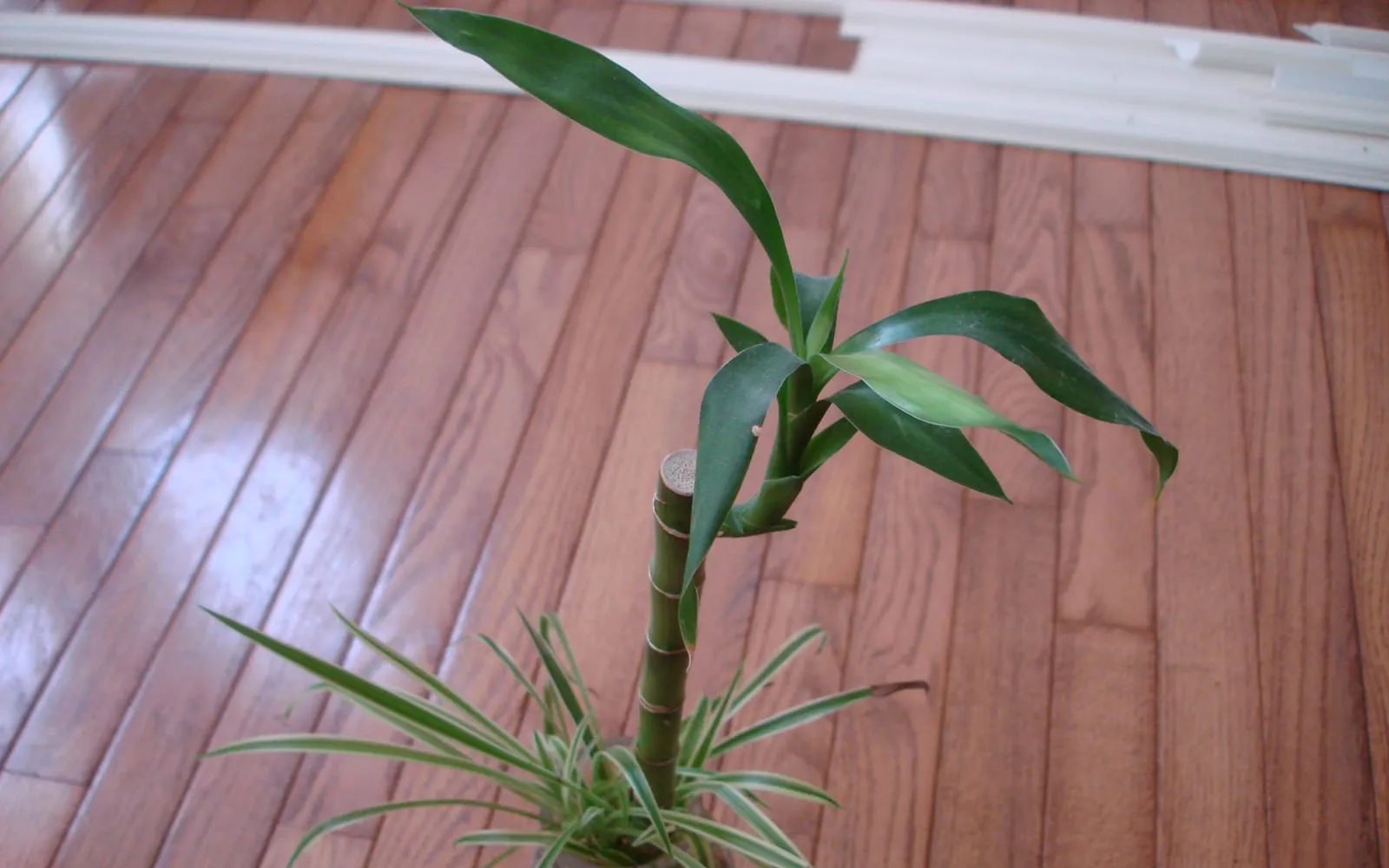
Stems are the feature. Upright, green, jointed, hollow-looking and superficially like a bamboo cane, and they thicken very slowly.
The green colour distinguishes it from true bamboo, whose canes go woody and buff.
Leaves are strap-shaped, 10 to 25 cm long, glossy mid-green, sometimes with a cream or grey margin, emerging from the joints in loose tufts.
Spirals, curls, lattices, towers and trellised arrangements are all produced by growers by manipulating light and by binding, rather than being natural growth forms.
Cut stems root readily and produce new shoots from the joints, which is why the plant is sold as cut canes rather than as whole plants.
Flowers are almost never produced in cultivation.
Growth is slow, particularly in water, where it may add only a few centimetres a year.
The species is Dracaena sanderiana, and Dracaena braunii appears on some labels as a synonym.
Where it is from
Central Africa, from Cameroon and the Congo basin, growing in shaded rainforest understorey.
It is in Asparagaceae, the same family as asparagus, agave, yucca, sansevieria and the ponytail palm, and it is not remotely related to bamboo, which is in the grass family.
The lucky bamboo trade is largely a modern invention. The plant was introduced to European horticulture in the nineteenth century and named for Henry Sander, a St Albans orchid nurseryman, and its association with feng shui and with gifts of luck was developed commercially in Taiwan and China from the 1980s.
The number of stems in an arrangement carries meanings in that commercial tradition. Three for happiness, five for health, eight for wealth and so on, and four is avoided because the word for four resembles the word for death in several east Asian languages.
Most lucky bamboo sold in the west is grown in China and Taiwan on a very large scale.
The spiral form is produced by rotating young stems in front of a directional light over several months, which is labour intensive and is why curled canes cost more.
Fluoride sensitivity is a known characteristic of the genus and is the reason for the leaf tip damage that almost every plant develops.
How it grows
Grow it in water if you want the classic arrangement. Stand the canes in a vase or bowl with pebbles to hold them upright, and add enough water to cover the roots by 3 to 5 cm.
Change the water weekly. Stagnant water goes cloudy, smells, and rots the roots.
Use rainwater, filtered water or bottled water, or tap water left standing uncovered for 24 hours. Fluoride and chlorine in fresh tap water cause the brown and yellow leaf tips that almost every lucky bamboo develops, and standing the water off removes the chlorine but not the fluoride, so filtered or rainwater is better.
Rinse the pebbles and the vase every few weeks.
Grow it in compost for much better results. Pot the canes into a free-draining peat-free houseplant compost, keep it damp but not wet, and the plant grows far more strongly than it ever does in water. Roots that formed in water adapt over a few weeks.
Place it in bright indirect light. Direct sun scorches the leaves and deep shade gives weak pale growth.
Keep it above 12 deg C, away from draughts, cold glass and radiators.
Feed very sparingly. A single drop of balanced liquid feed in the water every two months is plenty, or use a proprietary lucky bamboo feed at the stated rate. Overfeeding is a common cause of algae and yellowing.
Wipe the leaves occasionally to remove dust.
Prune to control it. Cut an over-tall stem across cleanly just above a joint, and new shoots emerge from the joints below the cut. Seal the cut end of the parent stem with wax if you want to stop it shooting there.
Propagate from the offcuts. Cut a section with at least one joint, remove the lowest leaves, and stand it in fresh water. Roots appear within a few weeks.
Remove any stem that turns yellow. Yellowing in lucky bamboo usually spreads and the stem rarely recovers, so cutting it out protects the rest.
Do not attempt to make your own spirals. It takes months of daily rotation in front of a directional light and is not worth the effort.
Through the seasons
Winter growth is slow. Keep it above 12 deg C, change the water weekly regardless, and stop feeding.
Spring starts into growth, which is the time to pot up into compost, prune and propagate.
Summer is the main growth period, needing bright indirect light and clean water.
Autumn slows down, and this is the point to stop feeding.
Care difficulty
Easy, and among the most tolerant houseplants sold.
It survives low light, irregular attention, small containers and a good deal of neglect, and it lives for years in a vase of water with nothing but weekly changes.
The two things that go wrong are water quality and overfeeding, and both are simple to correct.
Yellowing stems are the one problem with no fix, and removing an affected stem before it spreads is all you can do.
Moving it into compost is the single change that most improves it, and most people never consider it because of how it is sold.
Watering
Change the water completely every week if growing it in water, and rinse the vase and pebbles every few weeks.
Keep the water level 3 to 5 cm above the roots and no higher, since submerging the stems rots them.
Use rainwater, filtered water or bottled water. Fresh mains water in most places contains enough fluoride and chlorine to brown the leaf tips.
Keep compost-grown plants damp without waterlogging, letting the top 2 cm dry between waterings.
Never let a compost-grown plant stand in a saucer of water.
Use tepid water rather than cold.
Warning signs, diseases and pests
Brown or yellow leaf tips is fluoride and chlorine in tap water, which is the standard lucky bamboo problem. Switch to rainwater, filtered or bottled water. Trim the damaged tips with scissors following the natural taper.
A stem turning yellow from the bottom upwards is usually terminal. Remove that stem entirely before it affects the others, and check the water quality and feeding.
Yellow leaves with green stems is often overfeeding or too much light. Reduce the feed and move it out of direct sun.
Cloudy smelly water with slimy roots is stagnation and rot. Change the water, rinse everything, cut away any brown mushy roots, and change the water weekly thereafter.
Green algae on the pebbles and vase walls is light plus nutrients in the water. Rinse everything, feed less, and use an opaque container if it persists.
Pale weak stretched growth is insufficient light.
Scorched pale patches on the leaves is direct sun.
Brown limpet-like bumps on the stems or white cottony masses in the leaf bases are scale insect and mealybug. Wipe them off with a cotton bud dipped in alcohol.
Growing environment
Bright indirect light. An east or north-facing windowsill, or a well-lit spot away from direct sun. Deep shade gives weak pale growth.
Water with pebbles, or a free-draining peat-free houseplant compost. Compost gives much better growth.
18 to 26 deg C, and never below 12 deg C. Keep it away from cold glass, draughts and radiators.
Allow the height you want and cut it back when it exceeds it.
It suits a desk, a shelf, a bathroom, a kitchen windowsill or an office, and it is one of the better plants for a low-light indoor position.
Keep it out of reach of cats and dogs. The ASPCA lists Dracaena as toxic to both, and the common name misleads people into thinking it is harmless bamboo. Cats chew the strap leaves readily.
Grow it with other undemanding indoor plants that want similar light. Sansevieria, pothos, zamioculcas and spider plant all tolerate the same conditions.
Feeding
Feed very sparingly, which is the opposite of most houseplant advice.
A single drop of balanced liquid feed in the water every two months is enough for a water-grown plant, or use a proprietary lucky bamboo feed at the stated rate.
Feed compost-grown plants monthly from April to September at half strength.
Do not feed from October to March.
Overfeeding causes yellowing leaves and algae in the water, and it is a commoner problem than underfeeding.
Change the water weekly regardless of feeding, since nutrients accumulate.
Troubleshooting
Is it bamboo? No. It is Dracaena sanderiana, an African plant in the asparagus family. True bamboo is a grass, will not grow in a vase of water, and is non-toxic, which lucky bamboo is not.
The leaf tips have gone brown. Fluoride and chlorine in tap water, which is the standard problem. Use rainwater, filtered or bottled water, and trim the damaged tips following the natural taper.
A whole stem has turned yellow. Usually terminal in lucky bamboo. Remove that stem entirely before it affects the others, and review the water quality and the feeding.
The water has gone cloudy and smells. Stagnation. Change it, rinse the vase and pebbles, cut away any brown mushy roots, and change the water every week from now on.
Can I plant it in compost? Yes, and it grows far better. Pot it into free-draining houseplant compost and keep it damp but not wet. Roots formed in water adapt within a few weeks.
How do I make it shorter? Cut the stem cleanly just above a joint, and new shoots emerge from the joints below the cut. Root the offcut in water to make a new plant.
How are the spirals made? Growers rotate a young stem in front of a one-sided light over many months so it curves as it grows. The curve is a manufacturing process rather than a growth habit, and it is not worth trying at home.
Is it safe for cats? No. The ASPCA lists Dracaena as toxic to cats and dogs, causing vomiting and drooling. The common name misleads people, since real bamboo is safe and this is not.
Should I feed it? Barely. A drop of feed every two months is plenty in water. Overfeeding causes yellowing and algae.
Lucky bamboo problem guides
Not sure what is wrong? See the common houseplant pests guide.