
Houseplant
Satin pothos
Scindapsus pictus
Also known as Silver vine, Silver philodendron, Scindapsus
How to care for Scindapsus pictus. The silver-spotted trailer that keeps its markings in far less light than a variegated pothos, why it is not a pothos at all, and how to stop the leaves shrinking.
At a glance
- Difficulty
- Easy
- Water
- When the top half of the compost has dried
- Light
- Low to medium indirect light. It holds its silver in shade better than a variegated pothos
- Temperature
- 18-27 deg C, and never below 12 deg C
- Humidity
- Moderate. Larger leaves develop above 60 per cent
- Hardiness
- USDA 11-12, RHS H1b, hardy to 12 C
- Type
- Evergreen perennial climber, long-lived
- Height
- 2-3 m trailing indoors
- Native to
- Southeast Asia
Lowland rainforest climber from Southeast Asia, growing up trunks in warm, humid, deeply shaded conditions with no cold season at all. It has no frost tolerance and suffers below about 12 deg C, so outdoors it needs a consistently warm, humid, frost-free climate. Indoors the limiting condition is almost never light and almost always warmth, which is why plants decline in winter rooms rather than in dark ones.
Hardiness zones describe winter cold alone. Summer heat, humidity, rainfall and the length of the growing season decide as much, so treat the range as the outer limit rather than as a recommendation.
Toxic if eaten
- Do not eat
- Every part, and the sap most of all
- Harm from
- Eating it and handling it
- Affects
- People, cats and dogs
Like most of the arum family, Scindapsus pictus carries needle-shaped crystals of calcium oxalate called raphides throughout its tissues. Chewing any part of it drives those crystals into the soft tissue of the mouth and throat, causing immediate burning, swelling of the lips and tongue, drooling and difficulty swallowing. The ASPCA lists Scindapsus pictus as toxic to cats and dogs for exactly this reason, and the same mechanism applies to people. Serious harm is uncommon because the pain starts on the first bite and stops most animals and children continuing, but a swollen airway is a genuine emergency in a small pet. The sap also irritates skin on contact, so wear gloves when taking cuttings and wash your hands afterwards. Keep it off the floor and out of reach where a cat chews plants.
Sources: ASPCA (Satin Pothos, Scindapsus pictus), RHS potentially harmful garden plants
About
Satin pothos is neither a pothos nor a philodendron, though it is sold as both. It is Scindapsus, a separate genus in the same family, and the distinction matters more than a naming quibble usually does, because the plant behaves differently from the Epipremnum it gets confused with.
The difference that counts is what happens in a dim room. A golden pothos loses its variegation in poor light, because the yellow tissue carries no chlorophyll and the plant cannot afford it. Satin pothos keeps its markings, because the silver is not variegation at all. It is an air pocket between the leaf surface and the pigmented layer beneath, reflecting light rather than replacing chlorophyll, and a plant in shade has no reason to give it up.
That makes it the better trailer for a dark corner, and it is slower and thicker-leaved into the bargain, so it drops fewer leaves and looks after itself for longer between waterings.
Appearance and character
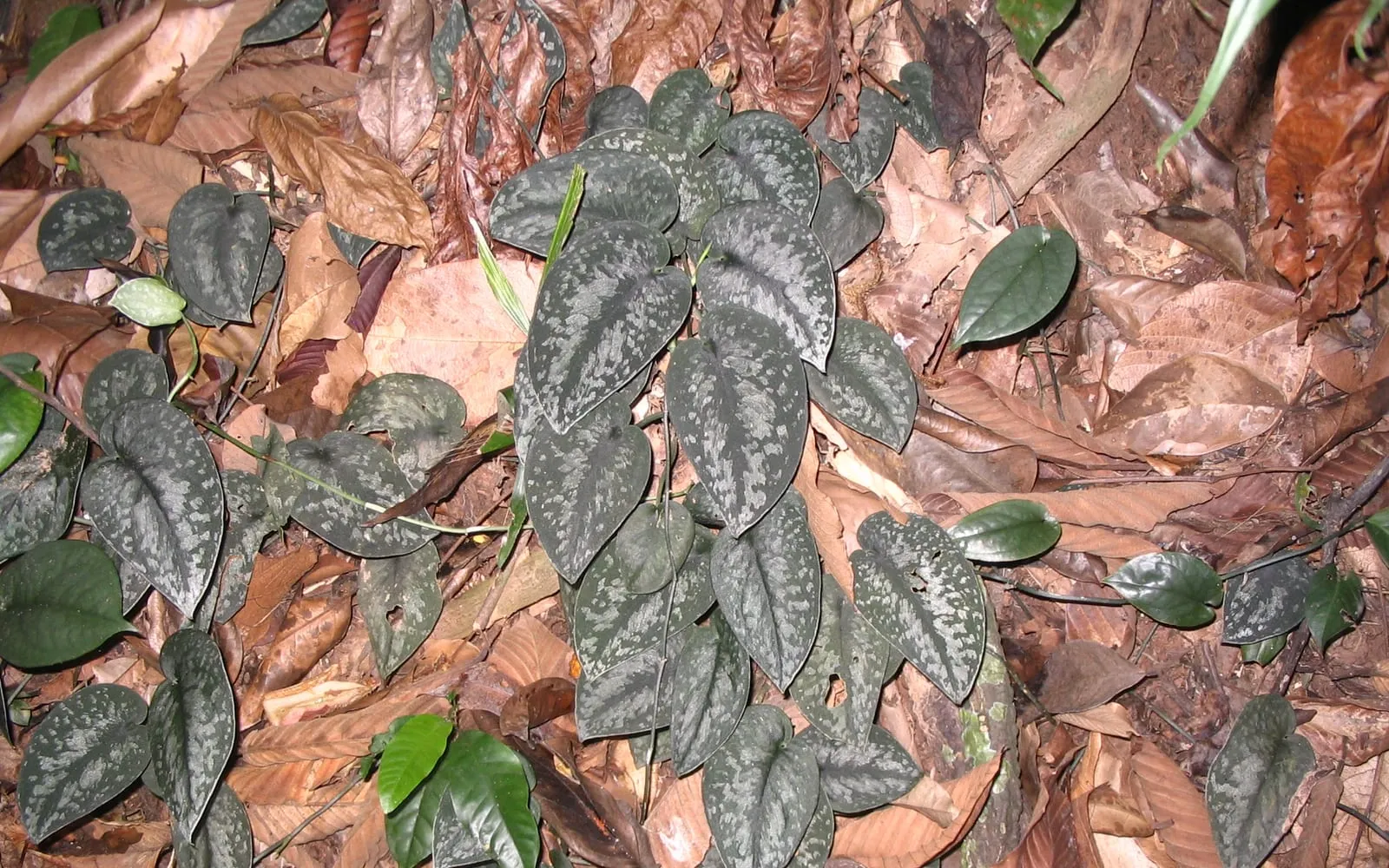
A climbing vine with thick, slightly stiff, heart-shaped leaves held alternately along a trailing stem. The leaf is matt dark green, dusted and blotched with metallic silver in a pattern that varies from scattered flecks to broad bands depending on the cultivar.
The texture is the tell against a pothos. A satin pothos leaf feels substantial and faintly velvety, and it is slightly asymmetric at the base, where an Epipremnum leaf is thinner, glossier and more evenly heart-shaped.
Growth is moderate and slower than a pothos, producing a trailing stem that reaches two to three metres given years. Leaves are small on a young plant and enlarge as the vine climbs, which is the aroid habit of putting out bigger leaves the higher it gets.
‘Exotica’ has the largest leaves and boldest silver bands. ‘Argyraeus’ is smaller and neatly flecked with even silver spots. ‘Silvery Ann’ carries broad silver patches over much of the leaf and wants more light than the others.
Flowering indoors effectively never happens, and the plant is grown for foliage alone.
Where it is from
The lowland rainforests of Southeast Asia, from India through Thailand and Malaysia to Indonesia and the Philippines, where it grows as a hemiepiphyte.
That word explains the plant. It germinates on the forest floor in deep shade, finds a tree trunk, and climbs it with clinging aerial roots, producing larger leaves as it rises into better light. The plant sold in a pot is the juvenile, forest-floor phase of that life cycle, which is precisely the phase built for gloom.
Growing flat against a trunk rather than out in the open is also why the leaves are asymmetric and why the silver is arranged the way it is. The markings are thought to break up the leaf outline in dappled shade, though the shade tolerance itself is the older and simpler adaptation.
The genus is small, at around three dozen species, and almost none of the others reach cultivation. Scindapsus treubii, with plain dark or silvered leaves and no spotting, is the one occasionally sold alongside it.
How it grows
Give it low to medium indirect light. It holds a dim corner well, and it grows faster and makes larger leaves in brighter indirect light without losing the silver either way.
Keep it out of direct sun, which bleaches the leaves and burns the silver areas first.
Water when the top half of the compost has dried. The thick leaves store water, so this plant tolerates being forgotten far better than being kept damp.
Keep it above 12 deg C at all times and ideally between 18 and 27 deg C. Cold is the thing that damages it indoors, not shade.
Give it something to climb if you want the leaves to enlarge. A moss pole, a plank or a wall of cork lets the aerial roots grip, and a climbing stem produces noticeably bigger leaves than a trailing one.
Feed monthly at half strength through spring and summer, and stop entirely in winter.
Repot every two or three years in spring, moving up one pot size, into a compost with bark or perlite through it so that it drains freely.
Prune the vine back to a node whenever it goes leggy. Cutting a long bare stem back by half forces branching from the nodes below, and the cuttings root in water or damp compost within a few weeks.
Through the seasons
Spring starts the growth. Resume feeding, repot if the roots have filled the pot, and take cuttings now if you want to thicken the plant.
Summer is the main growing season. Water when the top half dries, feed monthly, and pinch out growing tips to encourage branching.
Autumn slows it. Reduce watering, stop feeding from October, and move the plant nearer the light as the days shorten.
Winter is when it is most at risk. Water sparingly, keep it well away from cold glass and from draughty doorways, and expect no growth at all.
Care difficulty
Easy, and more forgiving than most of the trailing aroids.
Overwatering is the main risk and the usual cause of death. A thick-leaved plant carrying its own water reserve in a dim corner needs very little, and compost that stays wet rots the stems at the base.
Cold is the second. Below 12 deg C the leaves blacken at the edges and drop, and a plant left against a freezing window overnight can be ruined.
Legginess is the aesthetic problem rather than a health one. A vine left to trail unpruned goes bare along its length and carries leaves only at the tips, and the bare stretches do not refill on their own.
Small leaves along a whole vine mean the plant is short of light, not short of food. Feeding a plant in a dark corner produces salts rather than growth.
Watering
Water when the top half of the compost has dried, which in a shaded room often means every ten to fourteen days in summer and every three weeks in winter.
Water thoroughly until it drains from the bottom, then empty the saucer.
Lift the pot to judge it. The weight difference between wet and dry compost is the most reliable guide with a plant whose leaves hide thirst well.
The leaves curl slightly inwards along the midrib when the plant is dry, which is a useful early signal, and they plump out again within hours of watering.
Underwatering causes limp, curled leaves and occasional crisping at the tips, and the plant recovers fully.
Overwatering causes yellowing leaves, blackening stem bases and a sour smell. Take cuttings from healthy growth immediately if you find that, because the parent may not recover.
Warning signs, diseases and pests
Yellow leaves low down the vine, appearing several at once, are overwatering. Check the drainage and let the compost dry further between waterings.
Leaves getting smaller as the vine extends means insufficient light. Move the plant nearer a window or give it a pole to climb, since a climbing stem makes larger leaves than a trailing one.
Long bare stems with leaves only at the tips are the result of low light and no pruning. Cut back hard in spring and use the cuttings to fill the pot.
Brown crisp edges and tips are dry air or accumulated salts. Raise the humidity and flush the compost through.
White cottony fluff in the leaf axils is mealybug, which favours the tight joints on this plant. Wipe it off with a damp cloth and check weekly.
Fine pale speckling with faint webbing is red spider mite, which follows warm dry air.
Blackened leaf edges after a cold night are cold damage. Move the plant somewhere warmer and remove the worst leaves.
Loss of silver on new leaves is unusual and generally means very deep shade combined with a highly variegated cultivar such as ‘Silvery Ann’. Move it brighter, out of direct sun.
Growing environment
Low to medium indirect light, and it will hold a dimmer corner than most trailing plants.
Never direct sun.
Warm, between 18 and 27 deg C, with 12 deg C as a hard floor.
Moderate humidity, and larger leaves above 60 per cent. It copes with ordinary room air better than a calathea or a fern.
Free-draining peat-free houseplant compost with bark or perlite mixed through it, in a pot with drainage holes.
A moss pole, plank or cork slab if you want the plant to climb and the leaves to enlarge.
Outdoors it needs a warm humid frost-free climate in shade, which is USDA 11 and warmer. Everywhere else it is an indoor plant.
Avoid cold glass, draughty hallways in winter and pots without drainage.
Feeding
Feed monthly from spring to early autumn with a balanced liquid houseplant fertiliser at half the strength on the label.
Stop feeding entirely from mid-autumn to early spring.
Feed less rather than more in a dim position. A plant making little growth cannot use the fertiliser, and the surplus accumulates as salts that burn the root tips and brown the leaf edges.
Repot every two or three years in spring, moving up one pot size into a free-draining mix.
Flush the compost with plain water two or three times a year to clear salts.
Troubleshooting
Is this the same as a pothos? No. It is Scindapsus pictus, a different genus in the same family. It is slower, thicker-leaved and better in low light than an Epipremnum.
The new leaves are much smaller than the old ones. Not enough light. Move it closer to a window or give it a pole to climb, since climbing stems produce larger leaves.
Will it lose its silver in a dark room? No, and this is the plant’s main advantage over a variegated pothos. The silver is an air layer under the leaf surface rather than a lack of chlorophyll, so shade does not cost the plant anything to keep it.
The stems are bare with leaves only at the ends. Low light and no pruning. Cut the vine back to a node in spring and root the cuttings into the same pot.
Several leaves have yellowed at once. Overwatering. Let the top half of the compost dry between waterings and check that the pot drains.
Is it safe with a cat? No. It carries calcium oxalate raphides and the ASPCA lists it as toxic to cats and dogs. Chewing causes burning and swelling in the mouth. Hang it well out of reach.
Can I grow it in water? Cuttings root readily in water and will live there for months, though they grow poorly in the long run and do better moved into compost once the roots are a few centimetres long.
White fluff where the leaves meet the stem. Mealybug. Wipe it off with a damp cloth and check the plant weekly for a month, since the tight leaf joints hide them well.
Satin pothos problem guides
Not sure what is wrong? See the common houseplant pests guide.