
Houseplant
Chinese evergreen
Aglaonema commutatum
Also known as Aglaonema, Silver queen
How to care for Aglaonema commutatum. Why cold does more damage than low light, watering it correctly, and why the pink varieties need brighter conditions than the green ones.
At a glance
- Difficulty
- Easy
- Water
- When the top 2-3 cm of compost has dried
- Light
- Low to medium indirect light. Variegated forms need more
- Temperature
- 18-24 deg C. Never below 12 deg C
- Humidity
- Moderate to high, and it dislikes dry winter air
- Hardiness
- USDA 10-12, RHS H1b, hardy to 15 C
- Type
- Evergreen perennial, slow-growing and long-lived
- Height
- 45-90 cm indoors
- Native to
- The Philippines and north-eastern Sulawesi
- Best month
- February in the Northern Hemisphere, August in the Southern Hemisphere
Tropical Asian forest floor. It is the most shade-tolerant plant on this shelf and the least cold-tolerant, taking damage at temperatures other foliage plants shrug off. Keep it above 15 deg C and away from cold glass.
Hardiness zones describe winter cold alone. Summer heat, humidity, rainfall and the length of the growing season decide as much, so treat the range as the outer limit rather than as a recommendation.
Every month named in this guide is for the temperate Northern Hemisphere. If you garden in the Southern Hemisphere, shift each one by six months, so February becomes August. Closer to the equator the wet and dry seasons matter more than the calendar, and the shift stops being a useful guide.
Toxic if eaten
- Do not eat
- Every part, and the sap in particular
- Harm from
- Eating it, handling it and sap in the eyes
- Affects
- People, cats and dogs
Chinese evergreen belongs to the arum family, and like most of its relatives it is armed with calcium oxalate raphides. These are microscopic needle-shaped crystals held under pressure in specialised cells, and chewing any part of the plant fires them into the soft tissue of the mouth. The ASPCA lists Aglaonema as toxic to cats and dogs. The result is immediate intense burning of the lips, tongue and throat, drooling, difficulty swallowing and vomiting, and in rare cases enough swelling to affect breathing. The pain is severe and immediate, which is what usually stops an animal or a child from eating more than a mouthful. Sap on the skin causes irritation and a rash, and sap in the eye is genuinely painful and should be flushed with water for fifteen minutes before seeking medical advice. Wear gloves when taking cuttings or dividing a plant, and wash your hands afterwards. The bright red berries that follow the flowers carry the same compounds and are more attractive to a child than the leaves, so remove them from a plant in a household with small children. Keep the plant out of reach of cats that chew foliage, since a determined cat will return to it.
Sources: ASPCA (Chinese Evergreen, Aglaonema commutatum), RHS potentially harmful garden plants
About
Chinese evergreen is the plant to reach for when a room has no good light. It tolerates conditions that kill most other foliage plants, it grows slowly enough to stay in proportion for years, and it asks for very little.
The mistake people make is assuming that a plant this tolerant of shade is tolerant of everything. It is not tolerant of cold. Below about 12 deg C the leaves develop greyish or dark sunken patches within days, and a plant left near a draughty window or a front door in January can be ruined in a week.
Check the variety before buying, because the light requirement varies with the variety. The old silver-and-green forms cope with real shade. The modern pink and red ones need considerably more light or they fade to green.
Appearance and character
An evergreen perennial forming a clump of upright stems, reaching 45 to 90 cm indoors over many years.
Leaves are broad and elliptical, 15 to 30 cm long, thick and slightly leathery, carried on short sheathing stalks.
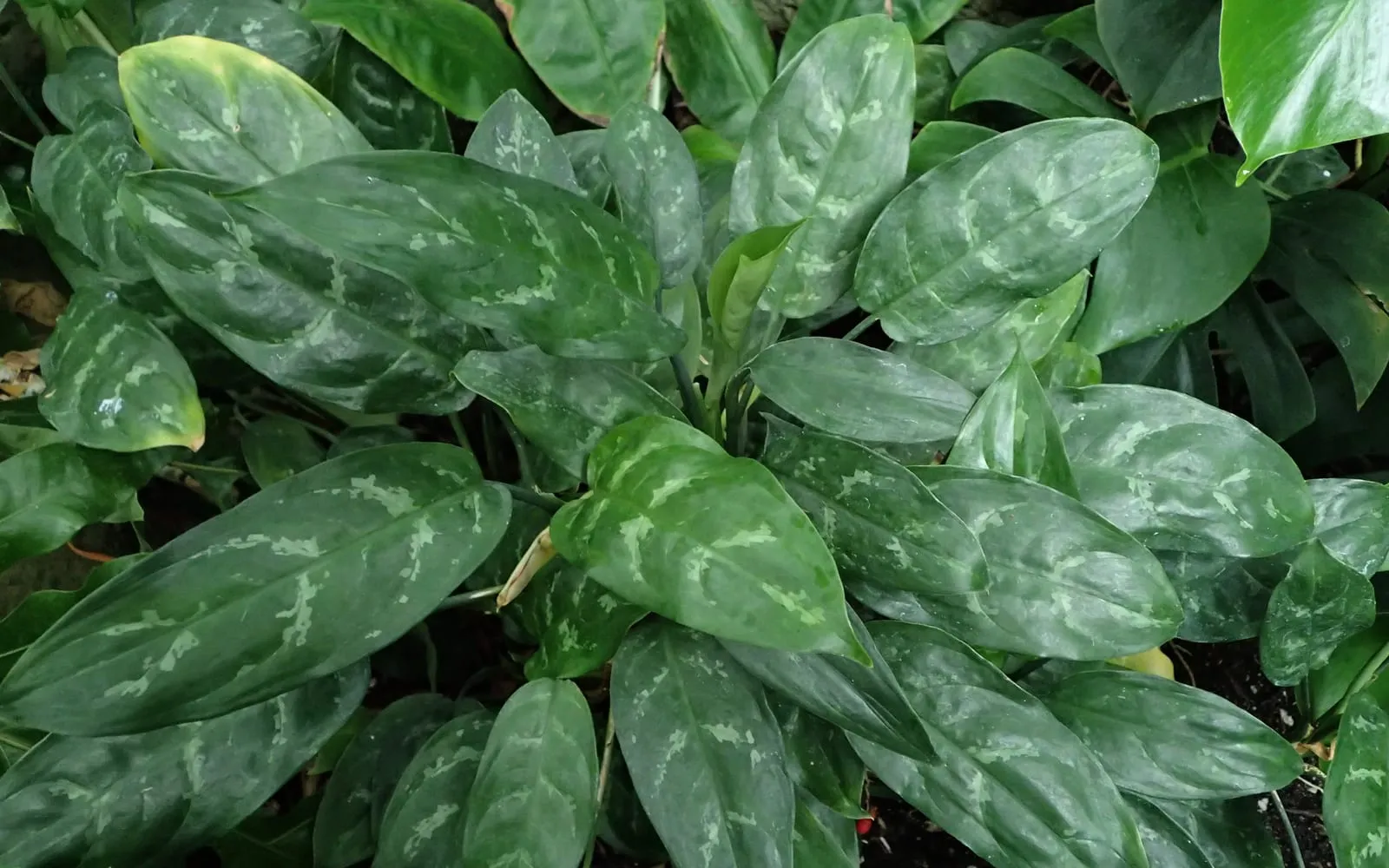
The markings are the reason to grow it. Depending on variety, the leaf is splashed, speckled, streaked or edged in silver-grey, cream, pink or red over a dark green ground, and the pattern follows the lateral veins.
Stems thicken and become cane-like with age, and the plant gradually loses its lower leaves to leave bare stems, which is normal rather than a fault.
Flowers appear occasionally on mature plants as a small pale green spathe around a narrow spadix, in the manner of a peace lily but far less showy.
Berries follow, ripening to bright red, and they are attractive and toxic.
Varieties differ widely. ‘Silver Queen’ is the classic pale silvery form, ‘Maria’ is dark green and the most shade-tolerant, ‘Siam Aurora’ and ‘Red Valentine’ carry strong pink and red, and ‘Cutlass’ has narrow strap leaves.
Where it is from
The Philippines and north-eastern Sulawesi, where it grows on the floor of humid tropical rainforest under a dense canopy.
That habitat explains almost everything about its care. Deep shade under a closed canopy gives the tolerance of low light, constant warmth gives the intolerance of cold, and the humid forest floor gives the dislike of dry centrally heated air.
The genus contains around twenty-five species across tropical Asia and New Guinea, and modern varieties are hybrids selected for colour rather than pure species.
Aglaonema has been grown in Chinese homes for centuries as a plant associated with good fortune, which is where the common name comes from.
Breeding in Thailand from the 1980s onward produced the pink and red varieties that dominate the market now, and those carry considerably less chlorophyll, which is why they need brighter conditions.
How it grows
Position it in low to medium indirect light. Green and silver varieties tolerate a north-facing room or a spot well back from a window, and pink and red ones want bright indirect light to hold their colour.
Keep it warm and away from cold. Aim for 18 to 24 deg C, never let it drop below 12 deg C, and keep it away from draughty windows, external doors and unheated rooms in winter.
Water when the top 2 to 3 cm of compost has dried, watering thoroughly and letting the pot drain completely. Empty the saucer.
Reduce watering considerably in winter, when growth stops and cold wet compost rots the roots.
Feed monthly through spring and summer with a balanced houseplant fertiliser at half strength, and stop from October to March.
Wipe the leaves with a damp cloth every few weeks. Dust reduces the light reaching a plant that is already growing in shade.
Repot every two or three years in spring, moving up one pot size. Aglaonema is happy slightly pot-bound.
Divide a congested clump when repotting, separating the stems with roots attached, and wear gloves.
Cut back a leggy plant hard in spring. It reshoots from the base, and the cut stems root in water or compost.
Through the seasons
Winter is the risky season. Keep it well away from cold glass and draughts, water sparingly, stop feeding, and expect no growth.
Spring is when it wakes up. Repot or divide, resume feeding, and increase watering as growth restarts.
Summer is the growing season. Water when the surface dries, feed monthly, and watch for red spider mite in hot dry rooms.
Autumn is the wind-down. Reduce watering and feeding from October, and move the plant away from any window that gets cold at night.
Care difficulty
Easy, and among the most forgiving houseplants available, with one condition attached.
Cold is the failure that catches people out. This plant tolerates poor light and irregular watering far better than it tolerates a cold windowsill.
Overwatering is the second cause of loss, particularly in winter.
Low humidity browns the leaf tips and encourages red spider mite without killing the plant.
Beyond those, it grows slowly, needs little feeding, and lives for many years.
Watering
Water when the top 2 to 3 cm of compost has dried out, which in a warm room in summer usually means every week to ten days.
Water thoroughly until it runs from the drainage holes, then let it drain completely and empty the saucer.
Cut back sharply in winter, watering perhaps every two or three weeks. Cold wet compost is what kills these plants.
Use tepid water rather than cold from the tap, since cold water on the roots shocks a tropical plant.
Rainwater or filtered water reduces the brown leaf tips that hard tap water causes, and the plant survives tap water perfectly well.
Yellow lower leaves usually mean overwatering. Drooping with dry compost means underwatering, and the plant recovers quickly from that.
Warning signs, diseases and pests
Greyish or dark sunken patches on the leaves are cold damage, and they are the most common problem with this plant. They appear within days of exposure below about 12 deg C and do not recover. Move the plant somewhere warmer, away from glass and draughts, and remove the worst leaves.
Red spider mite is the pest to watch for in centrally heated rooms. Look for fine pale stippling on the upper leaf surface, a dull dusty appearance and, in a bad infestation, fine webbing between the leaves and stems. It thrives in hot dry air. Raise the humidity, wipe the leaves, and isolate the plant while treating it.
Mealybug appears as white cottony masses in the leaf axils and on the undersides. Wipe them off with a cotton bud dipped in alcohol.
Brown crispy leaf tips point to dry air or to a build-up of minerals from hard tap water. Raise the humidity and flush the compost through occasionally.
Yellowing lower leaves in quantity mean overwatering or compost that stays wet. Check the drainage.
Faded washed-out markings on a pink or red variety mean not enough light.
Bare stems with leaves only at the top are natural ageing. Cut the plant back hard in spring to restart it.
Growing environment
Low to medium indirect light for green and silver varieties, which makes them useful in north-facing rooms, hallways and offices.
Bright indirect light for pink and red varieties, which lose their colour in shade.
Avoid direct summer sun, which scorches the leaves.
Warmth is the real requirement. Keep it between 18 and 24 deg C and never below 12 deg C.
Away from draughts, external doors, cold windowsills and radiators.
Moderate to high humidity. A bathroom or kitchen suits it, and grouping plants together or standing the pot on a tray of damp pebbles helps elsewhere.
A free-draining peat-free houseplant compost with added perlite, in a pot with drainage holes.
Feeding
Feed monthly from April to September with a balanced liquid houseplant fertiliser at half the stated strength.
Stop feeding entirely from October to March. A plant that is not growing cannot use it, and the salts build up in the compost.
Repot every two or three years in fresh compost, which does more than feeding.
Flush the compost through with plain water occasionally to clear accumulated fertiliser salts, which contribute to brown leaf tips.
Avoid high-nitrogen feeds, which produce soft growth prone to pests.
Troubleshooting
Grey or dark sunken patches on the leaves. Cold damage. Move it away from the window or door, keep it above 12 deg C, and remove the worst affected leaves.
Brown crispy leaf tips. Dry air or hard tap water. Raise the humidity, use filtered water or rainwater, and flush the compost occasionally.
The pink variety has faded to green. Not enough light. Coloured varieties need bright indirect light, unlike the green and silver ones.
Yellow lower leaves. Usually overwatering, especially in winter. Let the top few centimetres dry between waterings and empty the saucer.
Fine pale speckling and webbing. Red spider mite, brought on by hot dry air. Raise the humidity, wipe the leaves, and treat promptly.
It has gone leggy with bare stems. Natural ageing. Cut it back hard in spring and it will reshoot from the base. Root the cut stems as new plants.
Will it survive in a room with no window? Not indefinitely. It copes with low light better than almost any other houseplant and still needs some daylight.
Is it safe with cats? No. It contains calcium oxalate crystals that cause severe mouth pain and swelling. Keep it out of reach, and remove the red berries.
Chinese evergreen problem guides
Not sure what is wrong? See the common houseplant pests guide.