
Houseplant
Corn plant
Dracaena fragrans
Also known as Dracaena, Happy plant, Massangeana
How to grow corn plant, Dracaena fragrans. Brown leaf tips, cane pruning, watering, light and toxicity to cats and dogs.
At a glance
- Difficulty
- Easy
- Water
- When the top third of the compost has dried
- Light
- Bright indirect light, and it tolerates moderate shade
- Temperature
- 18 to 26 deg C, and never below 12 deg C
- Hardiness
- USDA 10-12, RHS H1b, hardy to 13 C
- Type
- Evergreen perennial, long lived and slow growing
- Height
- 1.5-2 m indoors
- Native to
- Tropical Africa, from Sudan and Ethiopia south to Mozambique and Angola
- Best month
- July in the Northern Hemisphere, January in the Southern Hemisphere
A 15 m forest tree where it grows wild and a stem cutting in a pot everywhere else. Outdoors year round in USDA 10 and warmer. Brown leaf tips indoors are usually fluoride and salts in tap water rather than dry air, since this genus is unusually sensitive to both.
Hardiness zones describe winter cold alone. Summer heat, humidity, rainfall and the length of the growing season decide as much, so treat the range as the outer limit rather than as a recommendation.
Every month named in this guide is for the temperate Northern Hemisphere. If you garden in the Southern Hemisphere, shift each one by six months, so July becomes January. Closer to the equator the wet and dry seasons matter more than the calendar, and the shift stops being a useful guide.
Toxic to cats and dogs if eaten
- Do not eat
- All parts, and the leaves most accessibly
- Harm from
- Eating it
- Affects
- Cats and dogs
The ASPCA lists Dracaena fragrans as toxic to cats and dogs. The plant contains saponins, and eating the leaves causes vomiting, often with blood, drooling, loss of appetite, depression and weakness, with dilated pupils additionally in cats. Corn plant is one of the most widely sold houseplants anywhere and its toxicity is not widely known. Cats chew the arching strap leaves readily, since they hang at cat height and move. The effects are unpleasant rather than usually life-threatening, but a cat or dog that has eaten a quantity needs a vet. The RHS does not list Dracaena among harmful garden plants, and no significant hazard to people is recorded, so a child who has chewed a leaf needs watching rather than an emergency. Where a household has a cat that chews plants, one of the genuinely non-toxic large houseplants such as ponytail palm, parlour palm or a true fern is the better choice.
Sources: RHS potentially harmful garden plants, ASPCA toxic and non-toxic plants
About
Almost every corn plant grown indoors has brown leaf tips, and the cause is the tap water.
Dracaena is unusually sensitive to fluoride, which is added to mains water across much of North America, Australia and Ireland, and to a lesser extent to chlorine and to the boron in some fertilisers. The damage shows as a dry brown tip with a narrow yellow band behind it, and once a leaf tip is browned it stays that way.
Switching to rainwater or filtered water stops new damage, and trimming the existing tips with scissors following the natural taper of the leaf tidies the plant. Neither restores what is already brown.
The plant itself is one of the easiest large houseplants. It tolerates moderate shade, dry air, irregular watering and years in the same pot, and a good specimen reaches two metres and lasts for decades.
Lower leaves yellow and drop over the years, leaving a bare woody cane with a rosette of leaves at the top. That is normal rather than a fault, and cutting the cane back forces new shoots from below the cut and gives you a bushy plant again.
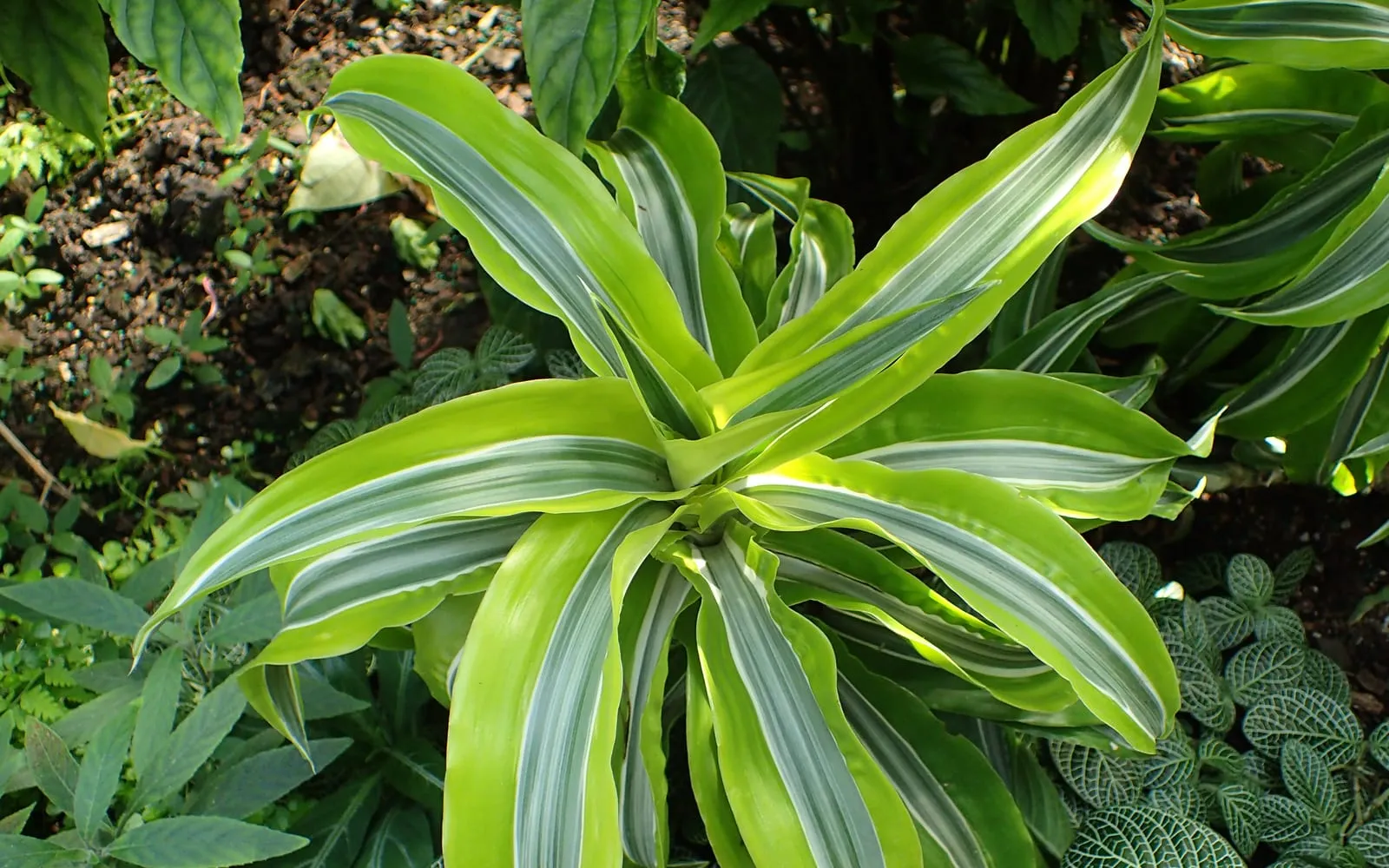
The ‘Massangeana’ cultivar, with a broad yellow-green stripe down each leaf, is the one most often sold and is what most people mean by corn plant.
Appearance and character
An evergreen perennial reaching 1.5 to 2 m indoors, growing on one or more thick woody canes.
Canes are stout, woody and grey-brown, usually sold as several of different heights potted together to give a tiered effect.
Leaves are long, arching and strap-shaped, 30 to 90 cm long and 5 to 10 cm wide, glossy and mid-green, held in a rosette at the top of each cane.
‘Massangeana’ has a broad yellow-green stripe down the centre of each leaf and is the commonest cultivar. ‘Lemon Lime’ has bright chartreuse margins, and ‘Janet Craig’ is plain dark green.
The leaf arrangement, arching out from a central point, is what gives the resemblance to a maize plant and the common name.
Flowers are occasionally produced on mature plants indoors, in dense creamy panicles, and they are extremely strongly scented at night, which is where fragrans comes from. Many people find the scent overwhelming in a room.
Growth is slow, adding perhaps 15 cm a year indoors.
Lower leaves yellow and drop with age, leaving a bare cane, which is normal.
Where it is from
Tropical Africa, from Sudan and Ethiopia south through Uganda, Kenya and Tanzania to Mozambique, Zambia and Angola, growing in upland forest understorey.
It is in Asparagaceae alongside asparagus, agave, yucca, sansevieria, the ponytail palm and lucky bamboo, and it is not a palm despite occasionally being sold as one.
The plant reached European cultivation in the nineteenth century and became a mass-market houseplant in the twentieth, particularly in offices, where its tolerance of low light and neglect made it a standard.
Canes are produced commercially by cutting mature stems in tropical nurseries, shipping them as bare logs, and rooting them at the destination, which is why the plants are sold as several canes of different heights in one pot.
Dracaena means female dragon in Greek, and the genus takes its name from the dragon tree, Dracaena draco, whose red resin was the dragon’s blood of medieval trade.
Fluoride sensitivity is a recognised characteristic across the genus and is why brown leaf tips are so nearly universal on plants watered with fluoridated tap water.
It was among the plants tested in the NASA clean air study of the 1980s, and the air purification claims that followed have not held up at the scale of a room.
How it grows
Grow it in bright indirect light. It tolerates moderate shade at the cost of slower growth and duller variegation, and direct midday sun scorches the leaves.
Variegated cultivars need more light than the plain green ones to hold their colour.
Use a free-draining peat-free houseplant compost in a pot with drainage holes.
Pot it into a container only slightly larger than the root ball, since a large pot holds too much wet compost around the roots.
Water when the top third of the compost has dried, giving enough to run through the pot, then draining fully. Never leave it standing in a saucer of water.
Reduce watering considerably from October to March.
Use rainwater or filtered water where you can, since fluoride in tap water is what causes the brown leaf tips.
Keep it above 12 deg C, away from draughts, cold glass and radiators.
Feed monthly from April to September with a balanced liquid houseplant feed at half strength. Avoid feeds high in boron and superphosphate, which add to the leaf tip damage.
Wipe the leaves occasionally with a damp cloth, since dust builds up on the broad straps.
Trim brown leaf tips with scissors, cutting to follow the natural taper of the leaf rather than straight across, which is far less obvious.
Remove whole yellowed lower leaves by pulling them cleanly away from the cane.
Cut a bare leggy cane back in spring to force new shoots. Cut the cane cleanly across at the height you want with a saw or sharp secateurs, and two or three new shoots emerge from just below the cut within a couple of months.
Root the cut-off top as a cutting. Remove the lower leaves, let the cut end dry for a day, and pot it into damp compost or stand it in water.
Repot every two or three years in spring, or top-dress annually.
Stand it outside in a sheltered shaded spot through July and August in a warm summer, and bring it in before the nights turn cold.
Through the seasons
Winter growth is slow. Water sparingly, stop feeding, and keep it away from cold windows and radiators.
Spring starts into growth, and this is repotting, cutting back and propagating season.
Summer is the main growth period, needing regular water and monthly feeding.
Autumn slows down, and this is the point to stop feeding and reduce watering.
Care difficulty
Easy. Corn plant is one of the most tolerant large houseplants available and survives conditions that kill most things.
It handles moderate shade, dry air, irregular watering, being left in the same pot for years and a wide temperature range.
The two problems are brown leaf tips, which are cosmetic and largely solved by the water you use, and overwatering, which rots the cane from the base and is the one thing that kills it.
Legginess with age is normal rather than a failure, and cutting the cane back deals with it.
Watering
Water when the top third of the compost has dried, checking with a finger rather than by a schedule.
Water thoroughly so it runs through the pot, let it drain fully, and empty the saucer.
Reduce watering considerably from October to March.
Overwatering is the commonest way a corn plant dies. The cane goes soft at the base and the plant collapses, and by then it is too late.
Use rainwater or filtered water where you can, which prevents the brown leaf tips.
Use tepid water rather than cold.
Mist occasionally or stand the pot on damp pebbles in very dry air, which helps the leaf tips as well.
Warning signs, diseases and pests
Brown dry leaf tips with a narrow yellow band behind them is fluoride in tap water, which is nearly universal. Switch to rainwater or filtered water, avoid feeds containing boron and superphosphate, and trim the tips following the natural taper.
Yellowing lower leaves that drop is normal ageing, at a rate of a few a year.
Many leaves yellowing at once with a soft cane base is overwatering and root rot. Reduce watering, check the drainage, and repot into fresh compost cutting away any brown mushy roots. A soft cane is usually past saving.
Brown patches in the middle of the leaves rather than at the tips is usually sunburn or cold damage.
A bare woody cane with leaves only at the top is normal ageing. Cut the cane back in spring and new shoots emerge below the cut.
Variegation fading to plain green is insufficient light.
Fine mottling with faint webbing between the leaves is red spider mite, which thrives in dry air. Wipe the leaves, raise the humidity, and use a biological control.
White cottony masses in the leaf bases is mealybug. Wipe them off with a cotton bud dipped in alcohol.
Brown limpet-like bumps along the leaves is scale insect.
An overpowering sweet scent at night is the plant flowering, which is uncommon indoors and is a sign it is well established. Cut the flower spike off if the scent is too much.
Growing environment
Bright indirect light. It tolerates moderate shade, and variegated cultivars need more light to hold their colour. Keep it out of direct midday sun.
A free-draining peat-free houseplant compost in a pot only slightly larger than the root ball.
18 to 26 deg C, and never below 12 deg C. Keep it away from draughts, cold glass and radiators.
Average indoor humidity is acceptable, and misting or a pebble tray helps the leaf tips in very dry air.
Allow 1 m of spread for a mature multi-cane plant.
It suits a living room corner, a hallway, an office, a landing or any large indoor space with reasonable light, and it is one of the standard plants for a low-light position.
Keep it out of reach of cats and dogs. The ASPCA lists it as toxic to both, and the arching leaves hang at cat height. Ponytail palm, parlour palm and the true ferns are non-toxic alternatives at a similar scale.
Grow it with other tolerant large houseplants. Sansevieria, zamioculcas, monstera and schefflera all want similar light and watering.
Feeding
Feed monthly from April to September with a balanced liquid houseplant feed at half strength.
Do not feed from October to March.
Avoid feeds high in boron and superphosphate, both of which add to the leaf tip browning that fluoride causes.
Repot every two or three years in spring into fresh compost, or top-dress annually.
Do not overfeed. Salt build-up in the compost contributes to leaf tip damage, and flushing the pot through with plenty of water every few months helps.
Troubleshooting
Why are the leaf tips brown? Fluoride in tap water, which Dracaena is unusually sensitive to. Switch to rainwater or filtered water, avoid feeds containing boron and superphosphate, and trim the damaged tips following the natural taper of the leaf.
Will the brown tips grow out? No. Once a leaf tip is browned it stays that way. Changing the water stops new damage on new growth.
It has a bare cane with a tuft of leaves on top. Normal ageing. Cut the cane cleanly across in spring at the height you want, and two or three new shoots emerge below the cut within a couple of months. Root the cut-off top as a new plant.
Lots of leaves have gone yellow at once. Overwatering, which is the one thing that kills a corn plant. Check the drainage, let the top third of the compost dry between waterings, and repot cutting away any mushy roots. A soft cane base is usually past saving.
Is it safe for cats? No. The ASPCA lists Dracaena fragrans as toxic to cats and dogs, causing vomiting and drooling, and the arching leaves hang at cat height. It is one of the most widely sold houseplants and the toxicity is not well known.
It has flowered and the smell is overwhelming. That is fragrans doing what it is named for, and the scent is strongest at night. It is a sign of a well-established plant. Cut the spike off if the scent is too much.
The variegation has faded. Not enough light. Move it into brighter indirect light.
How often should I repot it? Every two or three years in spring, or top-dress annually. It grows slowly and does not need a large pot.
Can it go outside in summer? Yes, in a sheltered shaded spot through July and August in a warm summer. Bring it in before the nights turn cold.
Corn plant problem guides
Not sure what is wrong? See the common houseplant pests guide.