
Houseplant
Nerve plant
Fittonia albivenis
Also known as Fittonia, Mosaic plant, Painted net leaf
How to care for Fittonia albivenis. The plant that faints when it dries out, keeping the humidity it demands, growing it in a terrarium, and pinching to keep it bushy.
At a glance
- Difficulty
- Moderate
- Water
- Whenever the surface begins to dry, which is often
- Light
- Low to medium indirect light, and never direct sun
- Temperature
- 18-26 deg C. Never below 15 deg C
- Humidity
- Very high. This is the plant's one non-negotiable demand
- Hardiness
- USDA 11-12, RHS H1b, hardy to 15 C
- Type
- Evergreen creeping perennial, short-lived without renewal
- Height
- 10-20 cm, spreading to 30 cm
- Native to
- The rainforests of Peru, Colombia and Brazil
- Best month
- December in the Northern Hemisphere, June in the Southern Hemisphere
Peruvian rainforest floor, growing as ground cover in permanent damp shade. It collapses dramatically when dry and recovers within hours of watering, which is a habit rather than an emergency. A terrarium suits it better than a room.
Hardiness zones describe winter cold alone. Summer heat, humidity, rainfall and the length of the growing season decide as much, so treat the range as the outer limit rather than as a recommendation.
Every month named in this guide is for the temperate Northern Hemisphere. If you garden in the Southern Hemisphere, shift each one by six months, so December becomes June. Closer to the equator the wet and dry seasons matter more than the calendar, and the shift stops being a useful guide.
Not known to be toxic
Non-toxic. The ASPCA lists Fittonia albivenis among plants that are not harmful to cats, dogs or horses, and the RHS does not include it in its list of potentially harmful garden plants. This makes the nerve plant one of the safest houseplants to keep in a home with animals or small children, and it is a common choice for a child's bedroom or a classroom for that reason. A cat that chews the soft leaves will take no harm beyond the stomach upset any plant material can cause. The plant has a traditional use among indigenous peoples of the Amazon, where a preparation of the leaves has been used as a headache remedy, which is a further indication of how benign it is. It also makes an excellent terrarium plant precisely because it is small, harmless and demands the humidity a closed case provides. The only practical caution has nothing to do with toxicity. The stems are soft and brittle and a cat batting at a hanging one will destroy it, so a nerve plant is better on a shelf out of the way or sealed in a terrarium than in a spot where it will be played with.
Sources: ASPCA (Nerve Plant, Fittonia albivenis), RHS potentially harmful garden plants
About
The nerve plant faints. Let the compost dry out and the whole thing collapses flat within hours, looking so thoroughly dead that most owners throw it away. Water it and it stands back up, usually within two or three hours and almost always by the next morning.
Once you know that, the plant becomes far less alarming. It is not a delicate species so much as an unusually honest one, telling you exactly when it wants water in a way no other houseplant does.
What it will not tolerate is dry air. This is a rainforest floor plant that expects near-saturated humidity, and a centrally heated room in December is the opposite. That is why so many are bought in autumn and dead by February, and why a terrarium suits it better than a windowsill.
Appearance and character
A low creeping evergreen perennial, 10 to 20 cm high and spreading to about 30 cm, with stems that root as they run across the surface.
Leaves are the whole point. Oval, 5 to 10 cm long, thin, soft and slightly hairy, carried in opposite pairs.
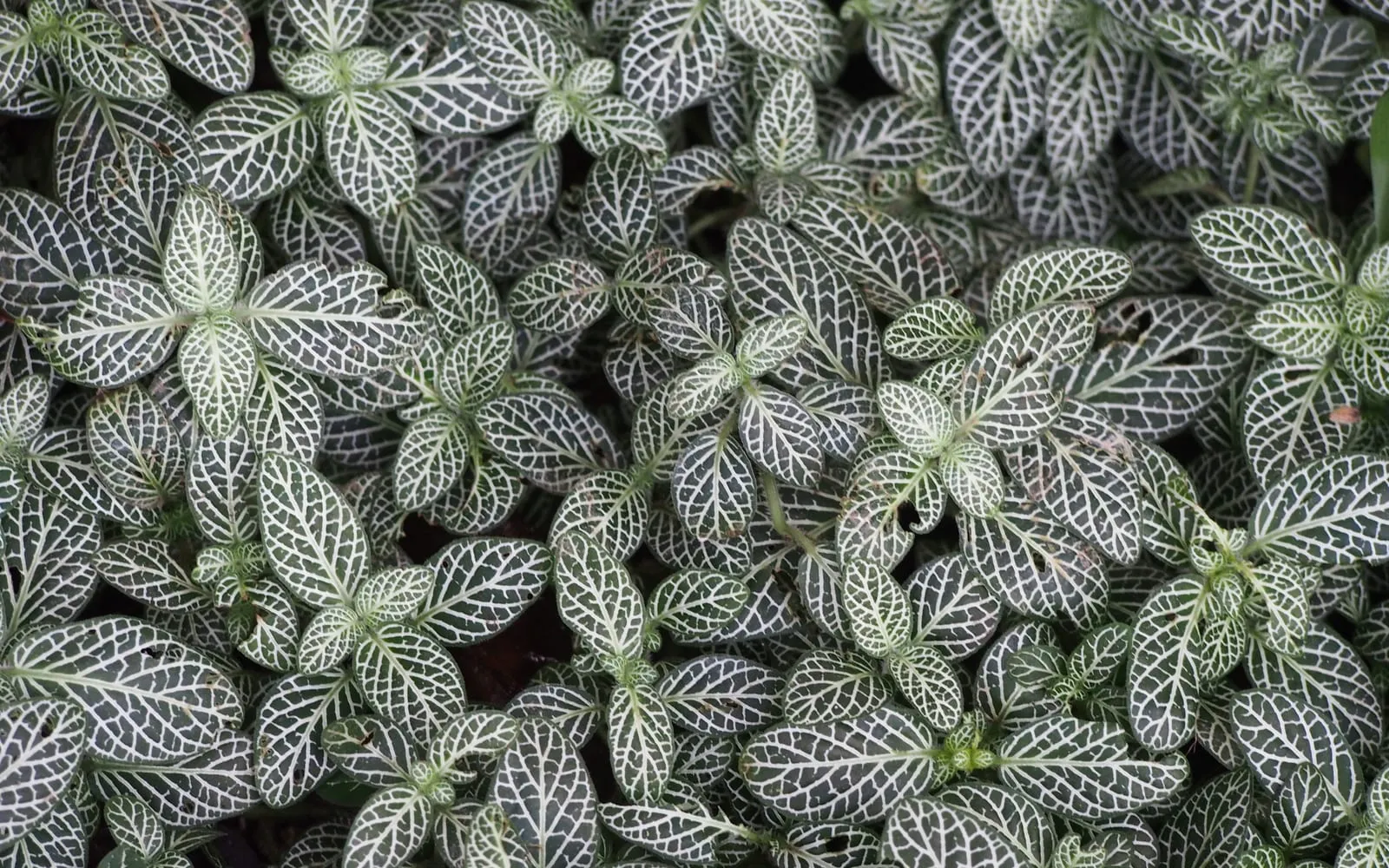
The veining is what gives the plant its names. A fine network of contrasting veins covers the entire leaf surface in a dense mosaic, in white, cream, pink or deep red over an olive to dark green ground.
Stems are soft, green and brittle, and they break easily.
Flowers appear occasionally on a mature plant, small and creamy-white in a spike of green bracts. They are unremarkable and worth removing, since flowering takes energy from the foliage.
The plant grows quickly in the right conditions and goes bare in the middle within a year or two, which is why it is treated as something to renew from cuttings rather than to keep indefinitely.
Named forms differ in the vein colour. ‘Nana’ is small-leaved and best for terrariums, and the red and pink-veined forms are sold under a range of trade names.
Where it is from
The rainforests of Peru, Colombia, Brazil and neighbouring countries, where it grows as ground cover on the forest floor.
That habitat sets every requirement at once. Deep shade under a closed canopy, constant warmth without seasonal variation, and humidity that rarely drops below saturation.
The forest floor is also where the low creeping habit comes from, and the rooting stems are how the plant spreads across leaf litter.
The genus is named after Elizabeth and Sarah Mary Fitton, Irish sisters who wrote Conversations on Botany in 1817, an early and influential popular botany book for young readers.
Older books and some labels use Fittonia verschaffeltii and Fittonia argyroneura for what is now all treated as Fittonia albivenis.
The dense vein network is thought to help distribute the scattered light that reaches the forest floor across the leaf surface.
How it grows
Position it in low to medium indirect light. An east or north-facing room suits it, and direct sun scorches the thin leaves within a day.
Keep it warm, 18 to 26 deg C, and never below 15 deg C.
Raise the humidity, or use a terrarium. This is the requirement that decides whether the plant lives. A closed glass container, a bell jar, a cloche or a bathroom with good light all work. On an open shelf in a heated room it needs a humidifier, and a pebble tray alone is rarely enough.
Water whenever the surface of the compost begins to dry, keeping it lightly and evenly moist. This is far more often than most houseplants.
Never let it sit in water. Moist and sodden are different things and the roots rot in the latter.
Use a moisture-retentive peat-free compost with added perlite, in a shallow pot, since the roots are fine and shallow.
Feed monthly at quarter strength from April to September. The plant is small and burns easily.
Pinch the growing tips regularly through the growing season. This is what keeps it bushy rather than a mat of bare runners.
Remove flower spikes as they appear.
Take cuttings every year or two. Stem tips with two or three pairs of leaves root readily in damp compost or water, and this is how to keep a good plant going rather than nursing an old one.
Repot annually in spring into fresh compost and a shallow pot.
Through the seasons
Winter is the dangerous season. Heating strips the humidity and the plant browns and collapses. Move it into a terrarium or beside a humidifier, keep it warm and away from radiators, and water a little less than in summer.
Spring is renewal. Repot, take cuttings, resume feeding, and pinch the tips as growth restarts.
Summer is fast growth. Water frequently, feed monthly at low strength, pinch the tips, and keep it out of direct sun.
Autumn is preparation. Get the humidity arrangement in place before the heating goes on rather than after.
Care difficulty
Moderate, and the whole of the difficulty is humidity.
A nerve plant in a terrarium is close to unkillable. The same plant on an open shelf in a heated room is a struggle from October to March.
The dramatic collapse is alarming and reversible, and it is the plant’s most useful feature once understood.
Going leggy within a year is normal, and taking cuttings is the answer rather than a rescue.
Root rot from standing water is the other real risk, and the plant wants moist rather than wet.
Watering
Water whenever the surface begins to dry, which in a warm room may be every two or three days.
Keep the compost lightly and evenly moist at all times. This is one of the few houseplants that should never dry out.
Never leave the pot standing in water. The roots are fine and rot quickly.
Water from above onto the compost, or from below by standing the pot in water for ten minutes and then draining it thoroughly.
Use tepid water, and rainwater or filtered water where the tap water is hard.
A collapsed plant needs watering immediately and will usually recover within hours. Repeated collapses weaken it, so treat the first as a warning rather than a routine.
Warning signs, diseases and pests
Sudden dramatic collapse, with the whole plant lying flat, means the compost has dried out. Water it thoroughly and it stands back up within a few hours. It is not dying. Letting it happen repeatedly does weaken the plant, so treat it as a signal that the watering routine is wrong.
Brown crispy leaf edges and tips mean the air is too dry. This is the commonest chronic problem and the one that kills plants over a winter. Move it into a terrarium or beside a humidifier.
Yellowing lower leaves that go soft mean overwatering or standing water. Check the drainage.
Bare leggy stems with leaves only at the tips mean the plant needs pinching and is probably a year or two old. Take cuttings and start again.
Faded or bleached leaves with scorched patches mean direct sun.
Leaves dropping in quantity usually means cold, a draught or a sudden change in conditions.
Mealybug and aphids both attack the soft growth. Check regularly and wipe them off.
Growing environment
Low to medium indirect light. It grows in less light than most houseplants and scorches in direct sun.
Warmth of 18 to 26 deg C, and never below 15 deg C.
Very high humidity, which is the requirement that governs everything. A terrarium, a closed glass case, a bell jar or a well-lit bathroom are all better than an open shelf.
Moisture-retentive compost with perlite, in a shallow pot with drainage holes.
Away from radiators, draughts and cold glass.
It is an excellent terrarium plant, being small, harmless, humidity-loving and happy in low light, and it combines well with mosses and small ferns.
Out of reach of a cat, less for safety than because the brittle stems are easily destroyed.
Feeding
Feed monthly from April to September with a balanced liquid houseplant fertiliser at quarter strength. The plant is small and burns easily.
Stop feeding from October to March.
Repot annually in spring into fresh compost, which does more than feeding.
Avoid feeding a plant that has just collapsed and recovered. Let it settle first.
Terrarium plants need very little feeding, since the closed system recycles nutrients and excess growth is a nuisance.
Troubleshooting
It has collapsed completely. Is it dead? Almost certainly not. Nerve plants faint when the compost dries out and recover within a few hours of watering. Water it thoroughly and check again in the morning.
Brown crispy edges on the leaves. The air is too dry, which is the main reason these plants die over a heated winter. Move it into a terrarium or beside a humidifier.
How often should I water it? Whenever the surface begins to dry, which is more often than most houseplants. Keep it lightly moist and never sodden.
It has gone bare and stringy in the middle. Normal after a year or so. Pinch the tips regularly to keep it bushy, and take cuttings to replace the plant.
Can I grow it in a terrarium? It is one of the best terrarium plants there is, being small, low-light tolerant, non-toxic and dependent on exactly the humidity a closed case provides.
Why is it called a nerve plant? The fine network of white or pink veins covering the whole leaf surface resembles a nervous system.
Will misting be enough? No. Misting raises the humidity for a few minutes. A terrarium or a humidifier changes the conditions the plant lives in.
Is it safe for children and pets? Yes. Fittonia is listed as non-toxic to cats, dogs and horses and is a common choice for a child’s room.
Nerve plant problem guides
Not sure what is wrong? See the common houseplant pests guide.