
Houseplant
Peace Lily
Spathiphyllum wallisii
Also known as Spathiphyllum, White sails, Spath
How to care for Spathiphyllum wallisii. Why it wilts on purpose, what brown tips are telling you, why a shop-bought plant often refuses to flower again, and how it behaves around cats.
At a glance
- Difficulty
- Easy
- Water
- When the top 2-3 cm of compost dries, roughly weekly in summer
- Light
- Bright indirect light for flowers. It survives in shade but stops blooming
- Temperature
- 18-27 deg C. Below 12 deg C causes damage
- Humidity
- Fine from 40%, happier above 60%
- Hardiness
- USDA 11-12, RHS H1b, hardy to 12 C
- Type
- Evergreen perennial
- Height
- 40-65 cm
- Native to
- The rainforest floor of Colombia and Venezuela
- Best month
- March in the Northern Hemisphere, September in the Southern Hemisphere
Rainforest floor in Central and South America, which is why it flowers in light no other flowering houseplant tolerates. The dramatic collapse when dry is a bluff it recovers from, and repeating it costs the plant roots. Outdoors year round only in USDA 11 and 12, in shade.
Hardiness zones describe winter cold alone. Summer heat, humidity, rainfall and the length of the growing season decide as much, so treat the range as the outer limit rather than as a recommendation.
Every month named in this guide is for the temperate Northern Hemisphere. If you garden in the Southern Hemisphere, shift each one by six months, so March becomes September. Closer to the equator the wet and dry seasons matter more than the calendar, and the shift stops being a useful guide.
Harmful if eaten
- Do not eat
- Every part, the leaves and stems most of all
- Harm from
- Eating it
- Affects
- People, cats and dogs
The whole plant carries insoluble calcium oxalate crystals, packed into needle-shaped bundles called raphides that fire into soft tissue when the tissue is chewed. The ASPCA lists Spathiphyllum as toxic to cats and dogs, with oral irritation, intense burning of the mouth and tongue, drooling, vomiting and difficulty swallowing. People react the same way. The pain arrives at the first bite and stops most animals from taking a second, so serious poisonings are rare and the usual outcome is a distressed pet and a chewed leaf. Rinse the mouth, offer something cold to drink, and call a vet or doctor if swallowing or breathing is affected. The name misleads on the danger. This is not a true lily, and it carries none of the kidney toxicity that makes Lilium and Hemerocallis a genuine emergency for cats. If your cat has eaten something called a lily, identifying which one matters more than anything else you do.
Sources: ASPCA (Peace Lily, Spathiphyllum spp), RHS potentially harmful garden plants
About
The peace lily wilts theatrically and then recovers within an hour of watering. No other common houseplant gives you such a clear signal, and it is the main reason this plant survives in offices and rented flats where nothing else does.
The signal has a cost. Each collapse means the fine root hairs have run dry and some of them have died. A plant watered only when it flops will limp along for years with a diminished root system, flowering less each season. Treat the droop as a fault report rather than a schedule.
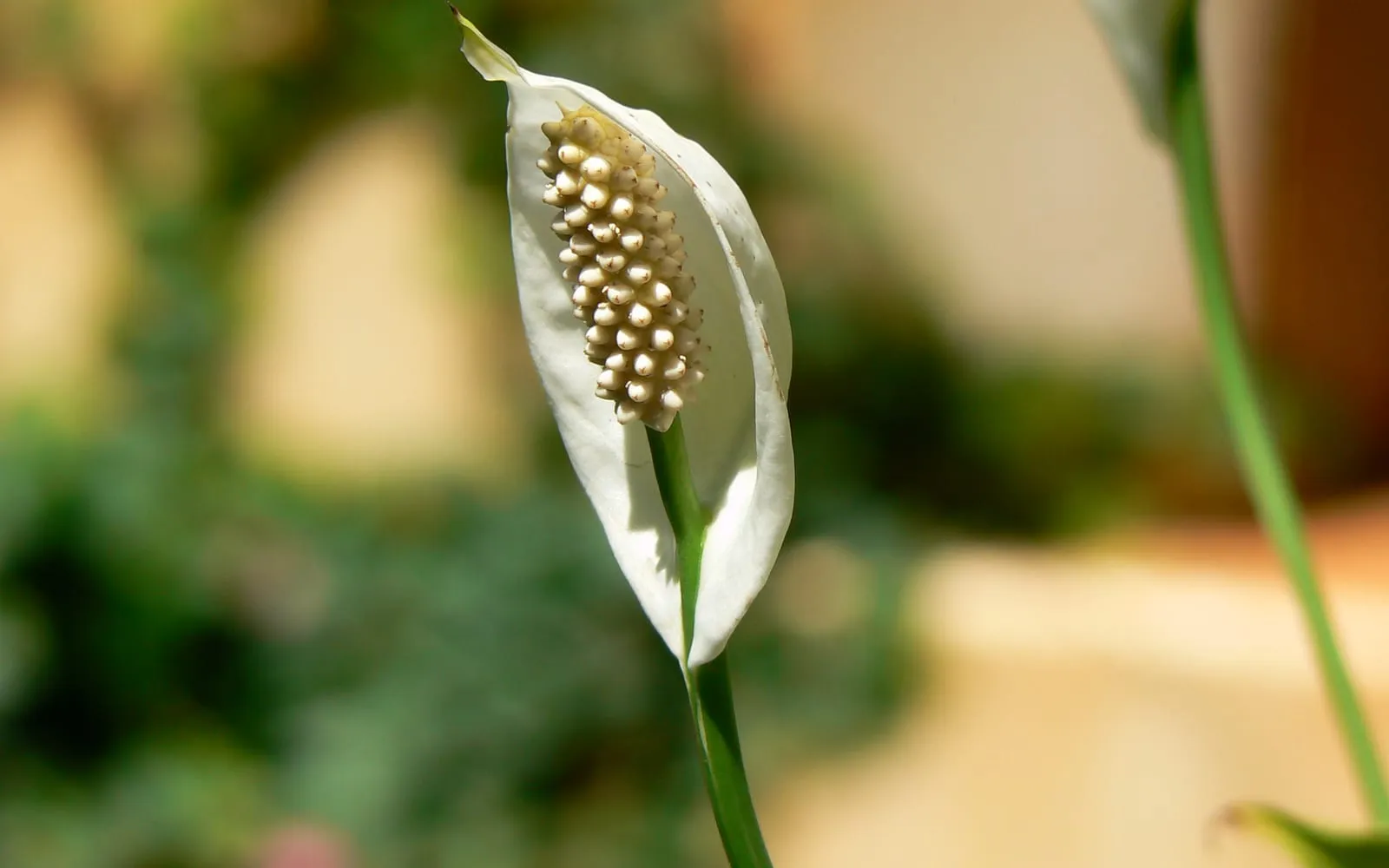
Two things about the plant are commonly misread. The white sail is a spathe, a modified leaf, and the actual flowers are the tiny knobbles studding the pale spike in front of it. And despite the name it belongs to the arum family alongside monstera and pothos, with no connection to true lilies.
Appearance and character
Glossy dark green leaves, lance-shaped and deeply ribbed, rise straight out of the compost on their own stalks. There is no stem. Every leaf comes from the crown, which is why the plant forms a fountain rather than a bush.
Spathiphyllum wallisii reaches 40 to 65 cm. Much of what is sold as a peace lily is the larger hybrid ‘Mauna Loa’, which passes a metre and carries spathes twice the size.
The spathe opens white and clean, holds that colour for a week or two, then fades through cream to a leafy green as it ages. Growers often cut the stalk at that point, though the greening does no harm.
Leaves catch dust readily and lose their shine, and a wipe with a damp cloth every few weeks does more for the plant’s looks than anything you can pour into the pot.
Where it is from
The rainforest floor of Colombia and Venezuela, in permanent shade under a closed canopy, in leaf litter that stays damp without ever flooding.
Understorey conditions explain almost all of its behaviour. Light arrives filtered and indirect, which is why a bright windowsill scorches the leaves and a north-facing room suits it. Air sits humid and still. The soil is loose, fibrous and free-draining, holding water without holding air out.
Temperatures on that forest floor barely move through the year, which is why the plant has no dormancy worth speaking of and why a cold draught from a January window does more damage than a fortnight of neglect.
How it grows
An evergreen perennial growing from a fleshy rhizome just under the compost surface. It has no bulb, no tuber and no woody parts.
New leaves emerge tightly rolled from the centre of the crown and unfurl over several days. The plant thickens by producing offsets from the rhizome, so a pot that started with one crown becomes a congested clump of five or six.
That congestion is what you divide. Tip the plant out in spring, tease the rhizome apart so each piece keeps its own roots and at least three leaves, and pot the pieces separately. Division is the only reliable way to propagate a peace lily at home, and cuttings do not work because there is no stem to cut.
Flowering runs mainly in spring, often with a second flush in autumn, and each spathe lasts around a month.
Through the seasons
Spring is when growth restarts and the main flowering happens. Divide or repot now if the plant needs it, and start feeding once you see new leaves.
Summer brings the fastest growth and the highest water demand. Check the compost twice a week in hot weather. Keep the plant out of direct sun through the middle of the day.
Autumn often produces a second, smaller flush of spathes. Reduce feeding from late September.
Winter is the risk period, and the risks are cold and wet rather than dark. Move the plant back from single-glazed windows at night, stop feeding, and cut watering to roughly every two weeks. Central heating dries the air and brings on spider mites, so keep the plant away from radiators.
Care difficulty
Easy, with one habit that separates a thriving plant from a surviving one.
Watering little and often, before the surface has dried, keeps the rhizome permanently wet and rots it. Waiting for the leaves to collapse costs root hairs. Water when the top few centimetres feel dry to a finger and you avoid both.
The second common failure is expecting flowers from a dark corner. The plant tolerates low light and refuses to bloom in it, which reads as a mysterious problem and is a straightforward one.
Brown leaf tips are the third, and the cause is often the tap. Peace lilies are sensitive to fluoride and to chlorine, both of which accumulate in the leaf margins. Rainwater or water left standing overnight fixes it.
Watering
Water when the top 2 to 3 cm of compost feels dry, which in a warm room in summer means roughly weekly and in winter closer to fortnightly. Push a finger in rather than judging by the surface, which dries first and misleads.
Water thoroughly until it runs from the drainage holes, then tip away whatever collects in the saucer. A pot standing in water for more than an hour is a pot heading for root rot. It also flops the moment it runs dry and lifts within the hour, so it shows both ends of the watering problem more plainly than most.
Use rainwater, filtered water or tap water left out overnight. Fluoride and chlorine both cause the brown, papery leaf tips that get blamed on humidity.
Room temperature water only. Cold water straight from the tap shocks the roots and can cause a droop that looks like thirst.
If the plant has collapsed, water it and leave it alone. It will stand up within a couple of hours. Repeat collapses are the thing to prevent.
Warning signs, diseases and pests
Brown, crisp leaf tips point to tap water chemicals first, dry air second and over-feeding third. Flush the pot with rainwater and cut the feed.
Yellowing lower leaves in numbers mean the roots are too wet. A single yellow leaf at the base is ordinary ageing.
Black patches spreading from leaf tips, combined with compost that stays sodden, means root rot. Turn the plant out, cut away the soft brown roots, and repot into fresh compost in a pot no larger than it needs.
Mealybugs hide in the crown where the leaf stalks meet, showing as white fluff in the crevices. Dab them with a cotton bud dipped in surgical spirit.
Scale insects appear as small brown discs on the undersides along the midrib and scrape off with a fingernail.
Spider mites arrive in dry heated rooms and leave fine webbing between the leaf stalks with a stippled, dusty look to the leaf surface. Raise the humidity and rinse the foliage.
Green spathes are normal ageing. Spathes that open green and stay small usually mean too much fertiliser.
Growing environment
Bright indirect light is the target. An east-facing windowsill, or a metre back from a south-facing window, gives enough for flowering without scorch. Direct midday sun bleaches the leaves to pale yellow-green and burns brown patches into them.
Deep shade keeps the foliage handsome and stops the flowers. If you want a plant for a dark hallway and do not mind the lack of spathes, this is a good choice.
Keep the room between 18 and 27 deg C. Below 12 deg C the leaves blacken at the edges, and a plant left against a cold window through a frost can lose its whole crown.
Humidity above 60% suits it, though it copes from 40%. Grouping plants together or standing the pot on a tray of damp gravel both help. Misting achieves very little beyond a few minutes of damp leaves.
Draughts do more harm than dry air. Keep it away from external doors and from the airflow of heating vents.
Feeding
A balanced liquid houseplant feed at half the recommended strength, once a month from April to September, is enough.
Stop entirely from October to March. A plant that is not growing cannot use the nutrients, and the salts build up in the compost and burn the root tips.
Over-feeding shows as brown leaf margins and as small, green-tinged spathes. If you suspect it, flush the pot through with several times its volume of clean water and skip the next two feeds.
Repot every two or three years into fresh compost, which does more for a tired plant than any amount of fertiliser. Choose a pot one size up, since a peace lily flowers better slightly snug than swimming in compost.
Troubleshooting
It flowered when I bought it and never again. Common, and usually not your fault. Commercial growers spray peace lilies with gibberellic acid to force uniform flowering for sale, and a treated plant often takes a year or more to resume its own rhythm. Give it good light and wait through a full spring.
It wilts every few days. The pot is too small or the compost has broken down and stopped holding water. Repot into fresh compost one size up.
It wilted and did not recover after watering. The roots have rotted, so water cannot reach the leaves. Turn it out and check. Firm white roots mean wait a little longer, and soft brown ones mean cut them off and repot.
Brown tips on almost every leaf. Tap water. Switch to rainwater or leave tap water standing overnight before use.
Leaves are dark green and glossy but there are no flowers. Not enough light. Move it closer to a window without putting it in direct sun.
The white sail has turned green. Normal ageing. Cut the stalk at the base whenever you dislike the look of it.
My cat chewed a leaf. Expect drooling and pawing at the mouth from the burning. Rinse the mouth and offer water, and ring a vet if swallowing or breathing seems affected. This plant is not a true lily and does not carry the kidney toxicity that makes real lilies a same-day emergency for cats.
Is it an air purifier? The claim traces to a 1989 NASA experiment in sealed chambers. Replicating that effect in a ventilated room would take something on the order of a plant per square metre. Grow it because it looks good.
Peace Lily problem guides
Not sure what is wrong? See the common houseplant pests guide.