
Houseplant
ZZ Plant
Zamioculcas zamiifolia
Also known as Zanzibar gem, Zuzu plant, Emerald palm
How to care for Zamioculcas zamiifolia. Low light, dry compost, rhizomes, leaflet propagation and the false cancer claim.
At a glance
- Difficulty
- Easy
- Water
- Every 2-3 weeks in summer, every 6-8 weeks in winter
- Light
- Anything from bright indirect to genuine shade. Avoid direct sun
- Temperature
- 15-26 deg C. Below 10 deg C damages it
- Humidity
- Undemanding. Ordinary room air is fine
- Hardiness
- USDA 10-12, RHS H1b, hardy to 10 C
- Type
- Evergreen perennial from a rhizome
- Height
- 60-90 cm indoors
- Native to
- Dry grassland and forest floor from Kenya south to KwaZulu-Natal
- Best month
- January in the Northern Hemisphere, July in the Southern Hemisphere
Tropical eastern Africa, from a climate with a pronounced dry season. It can live outdoors year round in USDA 10 and warmer, in shade rather than sun, and it is a houseplant everywhere else. The rhizome stores water to carry the plant through months without rain, which is what makes it so tolerant of neglect indoors and so intolerant of compost kept wet.
Hardiness zones describe winter cold alone. Summer heat, humidity, rainfall and the length of the growing season decide as much, so treat the range as the outer limit rather than as a recommendation.
Every month named in this guide is for the temperate Northern Hemisphere. If you garden in the Southern Hemisphere, shift each one by six months, so January becomes July. Closer to the equator the wet and dry seasons matter more than the calendar, and the shift stops being a useful guide.
Harmful if eaten
- Do not eat
- Every part, including the rhizome and the sap
- Harm from
- Eating it and handling it
- Affects
- People, cats and dogs
Every part contains insoluble calcium oxalate crystals. The ASPCA lists Zamioculcas as toxic to cats and dogs, and the effect is local irritation rather than systemic poisoning, with burning of the mouth, drooling and sometimes vomiting after a bite. The sap irritates skin and stings badly if it reaches the eyes, so wear gloves when dividing the rhizome or taking cuttings and wash your hands afterwards. Keep it out of reach of pets that chew foliage. The widely circulated claim that this plant causes cancer is false. It appears to have started as a garbled retelling of the calcium oxalate content, and no toxicological source supports it. The plant is an irritant, and it is not carcinogenic.
Sources: ASPCA (ZZ Plant, Zamioculcas zamiifolia), NC State Extension, Zamioculcas zamiifolia
About
Under the compost sits a cluster of pale rhizomes that look like small potatoes. They hold water, and they are the whole explanation for this plant’s reputation. A ZZ plant forgotten behind a filing cabinet for two months is a ZZ plant in good health.
Above ground the same strategy repeats. Each leaflet carries a thick waxy cuticle that reflects light and slows evaporation, which is why the foliage looks polished without ever being cleaned.
The result is a plant that tolerates a level of neglect no other common houseplant survives, and one that dies quickly from kindness. Water it on the schedule you would give a fern and the rhizomes rot within a season. Low light it takes in its stride, which is why it turns up in windowless offices and rooms too dark for most houseplants.
Appearance and character
What looks like a stem is a single enormous leaf. Each of those upright arching fronds is one compound leaf, with a fleshy stalk swollen at the base and six to eight pairs of glossy leaflets ranged along it.
Fronds emerge from the rhizome already at full length, rolled tight and pale, then darken and stiffen over a few weeks. A mature plant reaches 60 to 90 cm indoors.
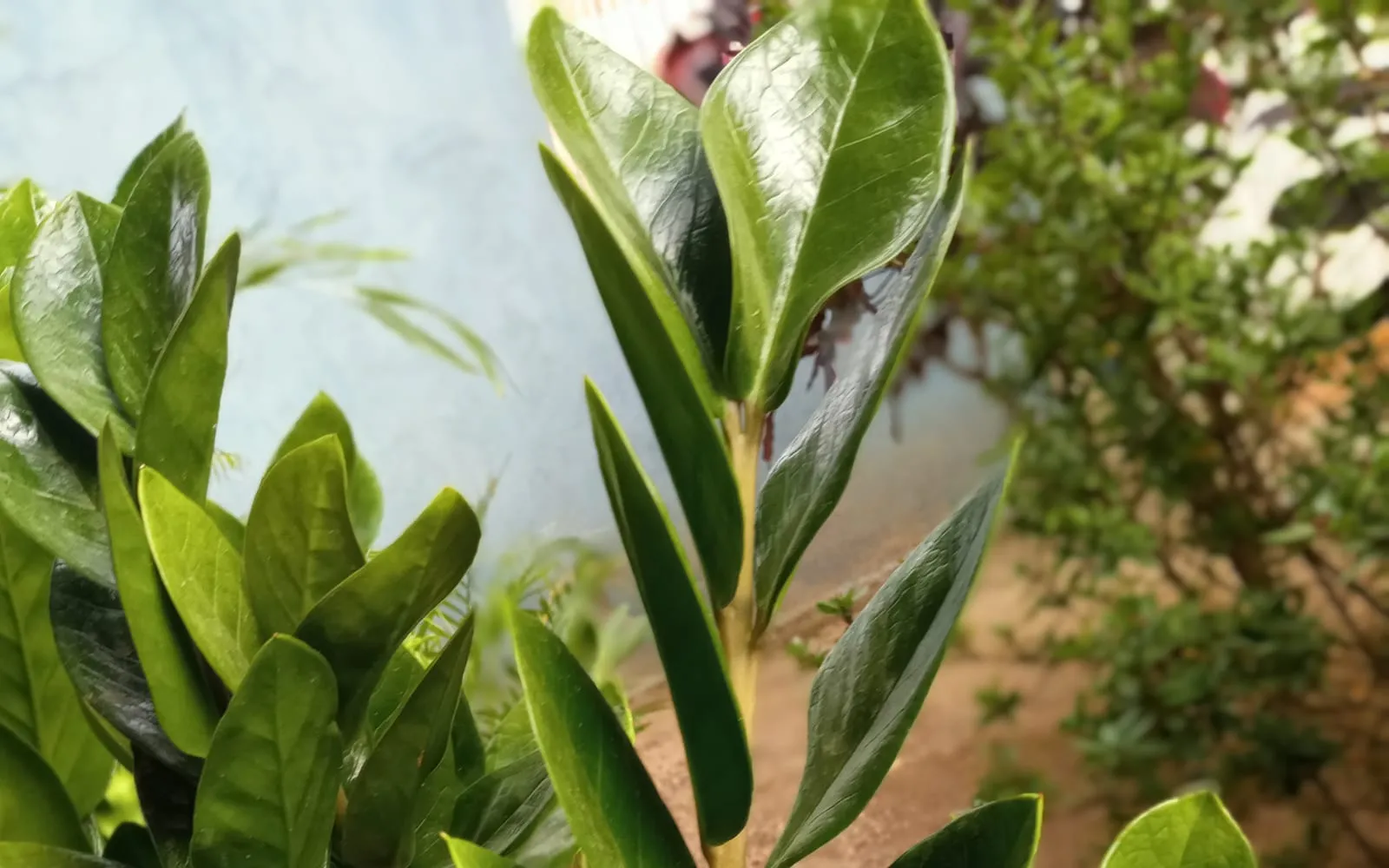
The leaflets are dark green, thick and oval, with a shine that reads almost as artificial. People routinely touch a ZZ plant in an office to check whether it is plastic.
‘Raven’ is the main cultivar. New growth emerges bright lime green and darkens over several weeks to something close to black.
Flowers appear rarely indoors, and when they do they hide at the base of the plant as a short cream spadix in a green sheath, easily missed.
Where it is from
Eastern Africa, from Kenya down through Tanzania and Malawi to KwaZulu-Natal, in dry grassland and on forest floors where the year splits into a wet season and a long dry one.
That split is the design brief. During the rains the plant grows hard and recharges the rhizomes. Through the dry months it shuts down, drops leaflets if pushed, and lives off stored water.
A heated room in winter reproduces that dry season almost exactly, which is why the plant suits centrally heated homes so well. What it never reproduces is the drainage of a Tanzanian hillside, which is why the compost matters more than anything else you do.
Shade is also part of the habitat. These plants grow under canopy, so the tolerance of a dim corner is genuine rather than a marketing claim.
How it grows
An evergreen perennial growing from thick underground rhizomes that swell as they store water and starch.
Growth comes in flushes rather than steadily. The plant sits unchanged for three or four months, then throws up two or three new fronds within a fortnight. A ZZ that has done nothing since spring is behaving normally.
New fronds arrive pale and soft and take a month or more to harden. Resist staking them; they stiffen on their own.
Propagation works two ways. Dividing the rhizome in spring gives an instant second plant, and it is the fast method. The slow method is a single leaflet pushed a centimetre into damp compost, which forms its own small tuber over three to nine months before producing a shoot. Both work, and both reward patience over attention.
Through the seasons
Spring brings the first flush of new fronds. Repot or divide now if the rhizomes are pressing against the pot wall. Start watering a little more often once you see growth.
Summer is the main growing season. Water every two to three weeks, feeding once in June and once in August.
Autumn slows everything down. Stop feeding by the end of September and begin stretching the gaps between waterings.
Winter is when most ZZ plants are killed. The plant needs almost nothing, perhaps a drink every six to eight weeks, and it will look identical either way. Keep it above 10 deg C and away from cold glass.
Care difficulty
Easy, and unusual in that the difficulty runs in one direction only.
Overwatering is the single cause of nearly every dead ZZ plant. The rhizome is already a water store, so adding water to soil that has not dried leaves it sitting in the wet, and it turns to mush from the inside. The damage is invisible until fronds start yellowing and toppling, by which point much of the rhizome has gone.
Underwatering, by contrast, is almost impossible to achieve on a domestic timescale. A plant left for three months sheds a few leaflets and recovers fully.
If you are unsure whether to water, do not. That single habit is most of the care regime.
Watering
Water every two to three weeks in summer and every six to eight in winter, adjusting for how warm and bright the room is.
Let the compost dry out almost completely between waterings. Push a finger in to the second knuckle, and if there is any dampness at all, wait.
When you do water, soak the pot through until it runs from the base, then empty the saucer. Alternating a thorough soak with a long dry spell mirrors the wet and dry seasons the plant evolved for. Kept constantly damp it rots at the rhizome, which is overwatering rather than any fault of the plant.
Cut watering hard in winter. Cold compost holds moisture far longer, and the plant is not growing.
Drooping, splaying fronds that fall outwards from the centre usually mean too much water rather than too little. Check the rhizome before you reach for the watering can.
Warning signs, diseases and pests
Yellowing fronds, several at once, starting from the base, mean root rot. Turn the plant out and look at the rhizomes. Firm and pale is healthy; soft, brown and foul-smelling has to be cut away with a clean knife before repotting into dry, gritty compost.
Fronds splaying outwards and lying flat point the same way, and a plant that has been repotted into something too large will do it too.
Brown crispy leaflet tips come from direct sun or, occasionally, from a build-up of fertiliser salts. Move it out of the sun and flush the pot.
Mealybugs settle in the joints where leaflets meet the stalk, showing as white fluff. A cotton bud dipped in surgical spirit deals with them.
Scale insects look like small brown limpets stuck to the stalks and scrape off with a fingernail.
Fungus gnats mean the compost is being kept too wet. Let it dry out properly and they disappear.
Leaflets dropping from the lowest part of a frond, a few at a time, is ordinary ageing on a mature plant.
Growing environment
Bright indirect light gives the fastest growth, and this plant tolerates real shade. An interior corner, a north-facing room or a windowless office with fluorescent lighting all work, and the plant grows more slowly in each.
Keep it out of direct sun. Midday sun through glass scorches the leaflets pale and then brown.
Room temperatures between 15 and 26 deg C suit it. Below 10 deg C the foliage blackens, so move it away from windows on frosty nights.
Humidity is irrelevant here. Dry centrally heated air causes it no trouble at all, which sets it apart from most glossy-leaved houseplants.
Put the effort into drainage. Use a pot with holes, and cut ordinary houseplant compost with a third of its volume in perlite or coarse grit. Never plant it in a container without drainage.
Feeding
Two feeds across the whole summer is plenty. Use a balanced liquid houseplant feed at half the recommended strength, once in June and once in August.
Feed nothing between October and April. A dormant plant cannot use it, and the salts accumulate and burn the roots.
Slow growth is normal for the species and is rarely a nutrient problem. Adding more fertiliser to a plant that seems static usually harms it.
Repot every three or four years, or when rhizomes push the pot out of shape. Choose a pot one size up. A ZZ plant in an oversized pot sits in wet compost it cannot use, which brings you back to root rot.
Troubleshooting
Fronds turning yellow and falling over. Overwatering. Turn the plant out, cut away any soft brown rhizome, and repot into gritty compost. Water far less often afterwards.
Nothing has grown for four months. Normal. This plant grows in flushes, and low light slows it further without harming it.
New fronds are thin, pale and floppy. Not enough light. Move it somewhere brighter, out of direct sun.
Brown tips on the leaflets. Direct sun, or fertiliser build-up. Move it, and flush the pot with clean water.
Leaflets are dropping from the bottom of older stalks. Ordinary ageing. Cut the whole frond off at the base once it looks tired.
Can I grow one from a leaflet? Yes. Push a leaflet a centimetre into damp compost, keep it barely moist and warm, and wait. A small tuber forms in three to nine months, and a shoot follows. Take several, since not all take.
Does this plant cause cancer? No. The rumour circulates widely online and has no basis. The plant contains calcium oxalate, which irritates skin and mouths, and no toxicological source links it to cancer.
ZZ Plant problem guides
Not sure what is wrong? See the common houseplant pests guide.