
Houseplant
Arrowhead plant
Syngonium auritum
Also known as Syngonium, Goosefoot plant, Arrowhead vine
How to grow syngonium, Syngonium auritum. The arrowhead plant, why the leaf shape changes as it matures, and keeping it bushy rather than climbing.
At a glance
- Difficulty
- Easy
- Water
- When the top 2 to 3 cm of compost has dried
- Light
- Bright indirect light, and it tolerates moderate shade
- Temperature
- 18 to 26 deg C, and never below 12 deg C
- Hardiness
- USDA 10-12, RHS H1b, hardy to 12 C
- Type
- Evergreen perennial climber, long lived and fast growing
- Height
- 30-60 cm as a bush, and 2 m or more climbing
- Native to
- Central America and the Caribbean, from Mexico south to Panama
- Best month
- January in the Northern Hemisphere, July in the Southern Hemisphere
Tropical Central and South America. Juvenile leaves are arrow-shaped and adult ones lobed, so a mature plant looks like a different species. It naturalises readily in wet tropical regions and is weedy in parts of Florida, Queensland and the Pacific islands.
Hardiness zones describe winter cold alone. Summer heat, humidity, rainfall and the length of the growing season decide as much, so treat the range as the outer limit rather than as a recommendation.
Every month named in this guide is for the temperate Northern Hemisphere. If you garden in the Southern Hemisphere, shift each one by six months, so January becomes July. Closer to the equator the wet and dry seasons matter more than the calendar, and the shift stops being a useful guide.
Toxic if eaten
- Do not eat
- All parts, and the sap
- Harm from
- Eating it and handling it
- Affects
- People, cats and dogs
Syngonium is an aroid, in the same family as dieffenbachia, philodendron, monstera and peace lily, and every member of it contains needle-shaped calcium oxalate crystals called raphides in its tissues. Chewing any part drives those crystals into the soft tissue of the mouth and throat, causing immediate intense burning, swelling of the lips and tongue, drooling, difficulty swallowing and vomiting. The ASPCA lists Syngonium podophyllum as toxic to cats and dogs, and the RHS lists Syngonium as harmful if eaten and as a skin irritant. The pain is immediate, which usually stops an animal or a child eating much, and severe swelling of the airway is rare and has been recorded. Rinse the mouth with cold water or milk and contact a doctor or vet where swelling develops or where a lot has been eaten. The sap also irritates skin and is worse in the eyes, so wear gloves when cutting or repotting and wash your hands afterwards. Keep it out of reach of cats, which are the most likely to chew a trailing stem.
Sources: RHS potentially harmful garden plants, ASPCA toxic and non-toxic plants
About
Syngonium changes shape as it grows up, and the plant you bought is not the plant you will have in three years.
A young syngonium is a compact bushy thing with neat arrow-shaped leaves, sold as a small table plant. As it matures the stems elongate, the plant starts to climb or trail, and the leaves change form entirely, becoming larger and dividing into three, five or more lobes. People often assume the plant has been mislabelled.
Both stages are attractive and you can choose which one you keep. Pinch the growing tips regularly and cut the long stems back and it stays bushy and juvenile. Give it a moss pole and let it run and it climbs to two metres and develops the mature divided foliage.
It is one of the more forgiving houseplants. It tolerates moderate shade, it recovers from neglect, it roots from cuttings in a glass of water within a fortnight, and it grows fast enough to be satisfying.
The one serious caution is the sap. Syngonium is an aroid, and every aroid contains calcium oxalate crystals that cause immediate burning if chewed. It is a poor choice in a household with a cat that chews plants.
Appearance and character
An evergreen climber reaching 30 to 60 cm as a bush and 2 m or more given a support.
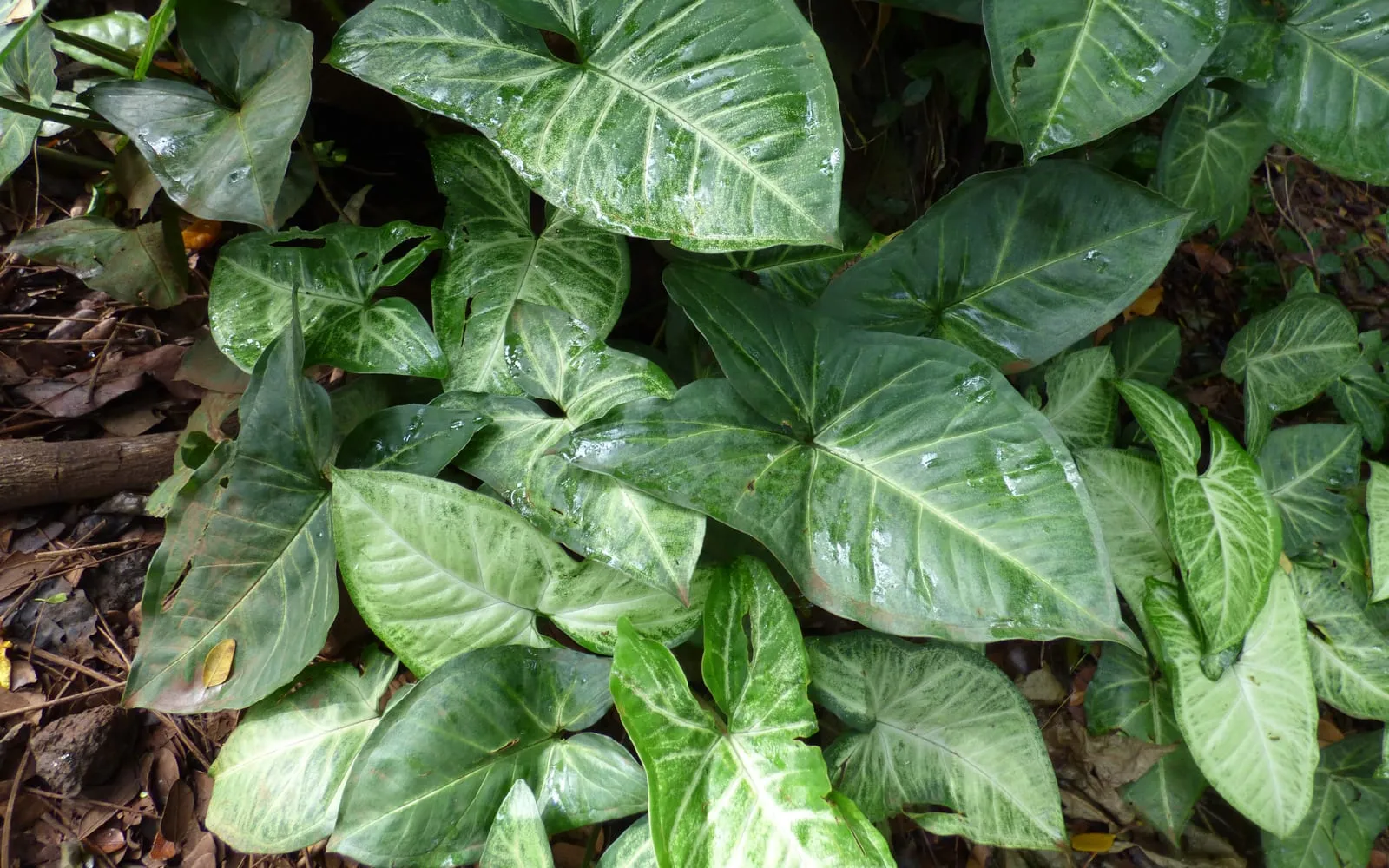
Juvenile leaves are simple and arrow-shaped or shield-shaped, 8 to 15 cm long, on long stalks, and this is the form most plants are sold in.
Mature leaves are larger and divided into three, five, seven or more separate lobes radiating from the leaf stalk, and they appear once the plant starts climbing.
Colour varies enormously by cultivar. The plain species is mid-green, and cultivars run through cream and green variegation, silver-white centres, pink, and near-white.
‘White Butterfly’ has pale cream-white leaf centres with green margins, and ‘Pink Allusion’ and ‘Neon Robusta’ are pink-flushed.
Stems are green, fleshy, and produce aerial roots at the nodes, which is how it climbs.
Flowers are rarely produced indoors and are the typical aroid spathe and spadix.
All parts bleed a clear sap that irritates skin and mouth.
Where it is from
Central America and the Caribbean, from Mexico south through Guatemala and Costa Rica to Panama, and naturalised in the Caribbean and parts of Florida.
It grows in tropical rainforest as a climber, starting on the forest floor and ascending tree trunks by aerial roots, which is where the leaf change comes from. Juvenile forest-floor foliage and mature canopy foliage are different, and the transition is triggered by climbing.
Syngonium podophyllum is the species most often sold and Syngonium auritum is the larger-leaved relative, and the trade uses the names loosely.
It is in Araceae alongside monstera, philodendron, dieffenbachia, anthurium and peace lily, and it shares the aerial roots, the spathe-and-spadix flower and the calcium oxalate content with all of them.
Syngonium is invasive in parts of Florida, Hawaii, Singapore and Australia, where discarded plants have naturalised and smother native vegetation, so cuttings should not be discarded outdoors in a warm climate.
The name comes from Greek for joined womb, describing the fused ovaries in the flower.
It became a mass-market houseplant in the twentieth century and the range of cultivars expanded rapidly from the 1990s.
How it grows
Grow it in bright indirect light. It tolerates moderate shade at the cost of slower growth and duller variegation, and direct midday sun scorches the leaves.
Variegated and pale cultivars need more light than the plain green ones to hold their colour.
Use a free-draining peat-free houseplant compost with added perlite or bark, in a pot with drainage holes.
Pot it into a container only slightly larger than the root ball, since syngonium dislikes sitting in a large volume of wet compost.
Water when the top 2 to 3 cm of compost has dried, giving enough to run through the pot, then draining fully. Never leave it standing in a saucer of water.
Reduce watering considerably from October to March.
Keep it above 12 deg C and out of draughts, and away from a radiator.
Raise the humidity. Brown crisp leaf tips are the standard syngonium complaint and they are caused by dry central heating air. Stand the pot on a tray of damp pebbles, group it with other plants, or keep it in a bathroom or kitchen.
Feed monthly from April to September with a balanced liquid houseplant feed.
To keep it bushy, pinch out the growing tips regularly and cut any stem that starts to trail back to a node. Do this from the start rather than after it has gone leggy.
To let it climb, give it a moss pole or a support, tie the stems in and keep the pole damp so the aerial roots grip. The leaves will change to the mature divided form.
Repot every two years in spring, or top-dress annually.
Propagate from stem cuttings. Cut a section with two or three nodes below a leaf, remove the lowest leaf, and stand it in water or push it into damp compost. Roots appear within two to three weeks and it is one of the easiest houseplants to propagate.
Wear gloves when cutting or repotting and wash your hands afterwards.
Through the seasons
Winter is a rest period with slower growth. Water sparingly, stop feeding, and keep it away from cold windows and radiators.
Spring starts into growth from March, and this is repotting, pruning and propagating season.
Summer is the main growth period, needing regular water, monthly feeding and humidity.
Autumn slows down, and this is the point to stop feeding and reduce watering.
Care difficulty
Easy. Syngonium is among the more tolerant houseplants and forgives a good deal of neglect.
It grows in moderate light, recovers from drying out, roots from cuttings almost without effort, and grows fast enough to reward attention.
The two things that go wrong are overwatering, which rots the roots, and dry air, which browns the leaf tips.
Deciding early whether you want a bush or a climber saves work, since a plant left to go leggy has to be cut hard back to recover a compact shape.
Watering
Water when the top 2 to 3 cm of compost has dried, checking with a finger rather than by a schedule.
Water thoroughly so it runs through the pot, then let it drain fully and empty the saucer.
Reduce watering considerably from October to March, when growth slows and the plant needs far less.
Overwatering is the commonest way syngonium is killed. Yellowing lower leaves and a soft stem base are the signs.
Use tepid water rather than cold, and rainwater in a very hard-water area.
Mist the foliage or stand the pot on damp pebbles, which addresses humidity rather than watering.
Warning signs, diseases and pests
Brown crisp leaf tips and edges is dry air, which is the standard syngonium problem in a centrally heated house. Raise the humidity with a pebble tray, group plants together, or move it to a bathroom.
Yellowing lower leaves with a soft mushy stem base is overwatering and root rot. Reduce watering, check the drainage, and repot into fresh compost cutting away any brown mushy roots.
Long bare stems with leaves only at the tips is legginess from low light or from not pinching out. Move it into brighter indirect light and cut the stems back to a node, using the cuttings to propagate.
Variegation fading to plain green is insufficient light. Move it somewhere brighter.
Scorched pale patches on the leaves is direct sun. Move it out of the midday sun.
Fine mottling with faint webbing between the leaves is red spider mite, which thrives in dry air. Raise the humidity and use a biological control.
White cottony masses in the leaf axils is mealybug. Wipe them off with a cotton bud dipped in alcohol.
Leaves changing from simple arrowheads to divided lobed shapes is the plant maturing rather than a problem. It happens as it starts to climb.
Sudden leaf drop is usually cold or a draught.
Growing environment
Bright indirect light. It tolerates moderate shade, and pale and variegated cultivars need more light to hold their colour. Keep it out of direct midday sun.
A free-draining peat-free houseplant compost with added perlite or bark, in a pot only slightly larger than the root ball.
18 to 26 deg C, and never below 12 deg C. Keep it away from draughts, cold glass and radiators.
Humidity matters. A bathroom, a kitchen or a pebble tray all help.
It suits a shelf, a table, a hanging pot, a moss pole in a corner, or a bathroom windowsill.
Grow it with other aroids that want the same conditions. Monstera, philodendron, pothos and peace lily all share the light, water and humidity requirements, and grouping them raises the local humidity.
Keep it out of reach of cats and dogs, since the sap causes immediate burning if chewed. It is a poor choice for a household with a cat that chews plants, and a hanging pot out of reach is a reasonable compromise.
Feeding
Feed monthly from April to September with a balanced liquid houseplant feed at half the recommended strength.
Do not feed from October to March, when growth has slowed.
Repot every two years in spring into fresh compost, or top-dress annually.
Avoid heavy feeding, which produces soft growth and does not improve the plant.
Pale leaves with poor colour in summer are more often a light problem than a nutrient one.
Troubleshooting
The leaves have changed shape completely. The plant is maturing. Syngonium has simple arrow-shaped juvenile leaves and divided lobed mature ones, and the change happens as it starts to climb. Keep pinching the tips out if you want the juvenile form.
How do I keep it bushy? Pinch out the growing tips regularly from the start, and cut any trailing stem back to a node. Use the cuttings to propagate.
The leaf tips have gone brown and crisp. Dry central heating air, which is the standard complaint. Stand the pot on a tray of damp pebbles, group it with other plants, or move it to a bathroom.
The lower leaves are yellowing and the stem base is soft. Overwatering and root rot. Let the top 2 to 3 cm dry between waterings, check the drainage, and repot into fresh compost cutting away any mushy roots.
It has gone leggy with bare stems. Too little light, or no pinching. Move it somewhere brighter and cut the stems back to a node.
The variegation has faded to green. Not enough light. Move it into brighter indirect light, and pale cultivars need more than plain green ones.
How do I propagate it? Cut a stem section with two or three nodes below a leaf, remove the lowest leaf, and stand it in water or push it into damp compost. Roots appear in two to three weeks.
Is it safe around cats? No. The ASPCA lists Syngonium as toxic to cats and dogs, and the calcium oxalate crystals cause immediate burning of the mouth if chewed. Keep it out of reach or choose a different plant.
Does it need a moss pole? Only if you want it to climb and to develop the mature divided leaves. Kept pinched and cut back it stays as a compact bush without one.
Arrowhead plant problem guides
Not sure what is wrong? See the common houseplant pests guide.