
Houseplant
Spikemoss
Selaginella kraussiana
Also known as Krauss' clubmoss, Trailing spikemoss, Golden clubmoss
How to care for Selaginella kraussiana. Humidity, low light, constant moisture and growing it in a closed jar or terrarium.
At a glance
- Difficulty
- Difficult
- Water
- Constantly. The compost must never dry out at the surface
- Light
- Low to medium indirect light. Never direct sun
- Temperature
- 15-24 deg C, and never below 5 deg C
- Humidity
- Very high. Low humidity is the usual failure
- Hardiness
- USDA 9-11, RHS H3, hardy to -5 C
- Type
- Evergreen perennial, creeping and mat-forming
- Height
- 2-5 cm
- Native to
- Southern and tropical Africa
Damp forest floor, stream banks and shaded rock in southern and tropical Africa, in constantly humid shade where the surface never dries. Humidity rather than temperature is the governing condition, and the plant collapses within hours of drying out at any temperature. Established plants outdoors take around -5 deg C in a sheltered damp position. It is invasive in New Zealand, where it smothers native forest floor vegetation, and it is a listed pest plant there.
Hardiness zones describe winter cold alone. Summer heat, humidity, rainfall and the length of the growing season decide as much, so treat the range as the outer limit rather than as a recommendation.
Not known to be toxic
Non-toxic. Selaginella kraussiana appears on no list of plants harmful to cats, dogs or horses, and it is absent from RHS lists of potentially harmful garden plants. There is no irritant sap and no hazard from handling it. The spikemosses are an ancient lineage separate from both the true mosses and the ferns, and none of the species grown ornamentally carries any known toxin. The plant is usually grown in a terrarium or bottle garden, which places it out of reach in any case. Its relative the resurrection plant, Selaginella lepidophylla, is sold as a curiosity for its ability to revive after drying completely, which this species emphatically cannot do.
Sources: RHS potentially harmful garden plants, NC State Extension, Selaginella
About
Spikemoss is neither a moss nor a fern. It belongs to the lycophytes, a lineage that separated from every other vascular plant more than 400 million years ago and whose extinct relatives formed the great coal forests. What survives is a small group of low creeping plants that look like moss and reproduce like ferns.
As a houseplant it has one requirement and it is absolute. The surface must never dry out. Not for a day, not for an afternoon in a warm room. A spikemoss that dries browns in patches within hours, and those patches do not recover, so a single lapse leaves a permanent scar in what is meant to be an even green carpet.
That makes it a poor plant for a shelf and an excellent one for a closed container. In a terrarium or a bottle garden, where the humidity is permanent and the compost cannot dry, it is easy and spreads into exactly the soft green mat it is grown for.
Appearance and character
A low creeping perennial forming a dense mat of branching shoots that root as they run.
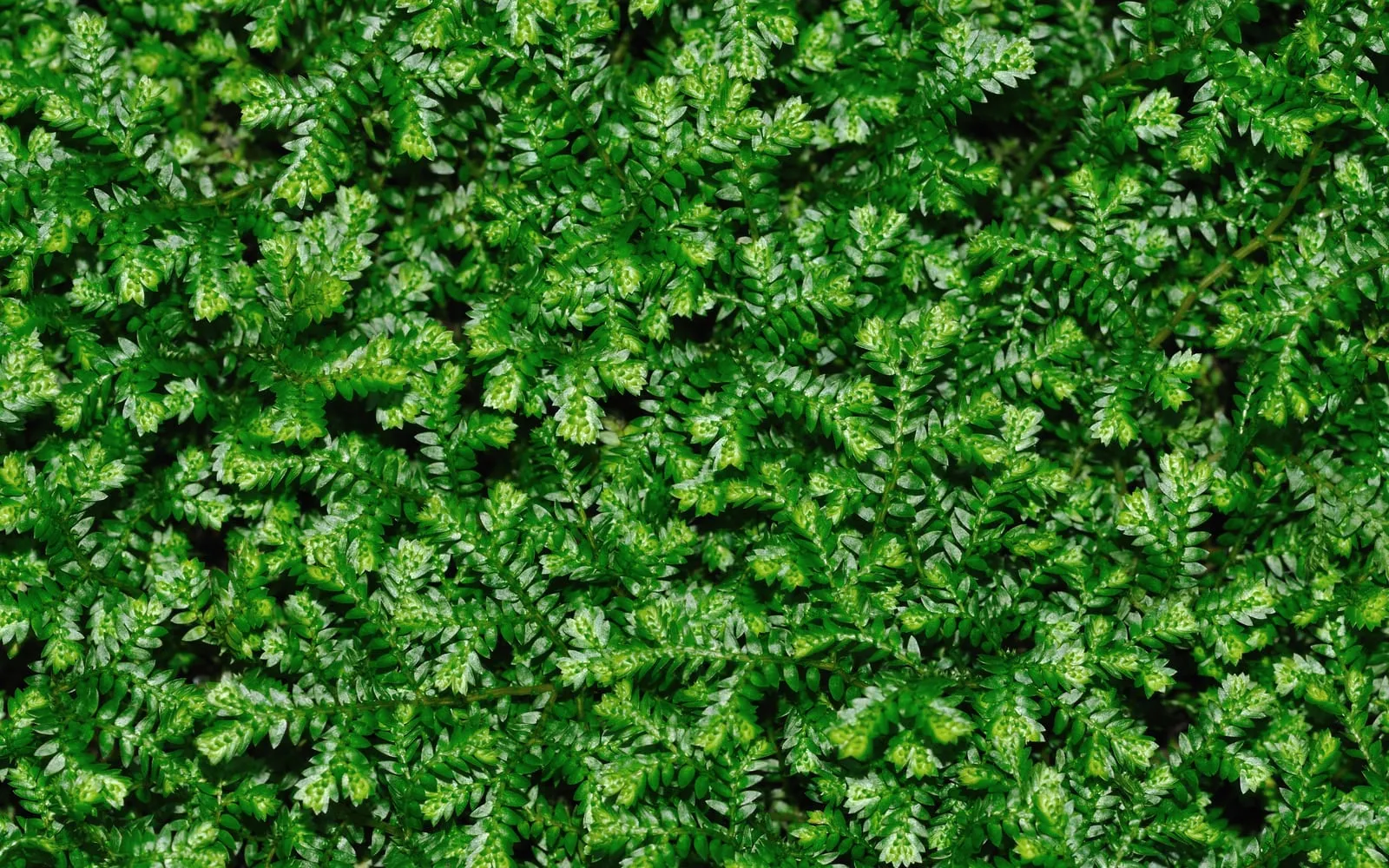
The shoots are flattened and frond-like, 5 to 15 cm long, covered in tiny scale leaves 1 to 2 mm long arranged in four ranks along the stem. The overall texture is fine, soft and lacy at a small scale.
Colour is a bright fresh green in the species. ‘Aurea’ is a golden yellow-green form and ‘Brownii’ is a compact cushion-forming selection that stays in a tight dome rather than running.
Height is only 2 to 5 cm, and the plant spreads sideways indefinitely wherever the surface stays damp.
Reproduction is by spores carried in small cone-like structures at the shoot tips, though indoors the plant spreads almost entirely by rooting stems.
A distinguishing feature from true mosses is that this plant has proper vascular tissue, roots and stems, which mosses do not, and it can therefore be divided and transplanted as a normal plant.
Where it is from
Southern and tropical Africa, growing on damp forest floors, stream banks and shaded rocks where the surface stays permanently moist.
That habitat is the whole explanation. A plant from ground that never dries has no drought adaptation whatever, no water storage and no way to shut down and wait. When the surface dries, the tissue dies.
The shade requirement follows from the same place. Forest floor light is low and diffuse, and direct sun scorches this plant within a very short exposure.
It has escaped cultivation and become a serious weed in New Zealand, where it forms dense mats on the forest floor and prevents native seedlings and ferns establishing. It is listed as a pest plant there and its sale and distribution are restricted.
The genus contains around seven hundred species worldwide, including the desert resurrection plants that curl into a dry ball and revive when wetted. This species has none of that ability.
How it grows
Give it low to medium indirect light. It holds a dim position well.
Keep it out of direct sun entirely, which scorches it faster than almost any other houseplant.
Keep the compost constantly moist at the surface. This is not the same as waterlogged, and it is the single condition that decides whether the plant survives.
Grow it in a closed or partly closed container if you can. A terrarium, a bottle garden, a covered propagator or a glass cloche all provide the permanent humidity this plant needs and remove the risk of a dry afternoon.
Ventilate a closed container occasionally. Completely still saturated air encourages grey mould, so a lid lifted for an hour a week is worth doing.
Keep it above 5 deg C and ideally between 15 and 24 deg C. It tolerates cool conditions better than warm dry ones.
Feed every eight weeks at quarter strength through the growing season, and sparingly, since this is a small plant that burns readily.
Propagate by division at any time. Any piece of stem with roots attached will establish on damp compost within a few weeks.
Trim the mat back with scissors where it outgrows its container.
Through the seasons
Spring brings the strongest growth. Resume light feeding, divide and replant where the mat has gone bare in the middle.
Summer is the risk period, since warmth dries the surface faster. Check daily in an open pot, and keep the plant out of any sun.
Autumn slows growth. Reduce feeding from October.
Winter is easier for humidity if the room is unheated and harder if it is not. Keep the plant away from radiators, and maintain moisture.
Care difficulty
Difficult in an open pot and easy in a closed one, which is the honest summary.
Drying out is the only common cause of death and it is unforgiving. There is no wilting stage that gives you warning, and no recovery from the browned sections.
Direct sun scorches it within a very short exposure.
Grey mould is the specific risk of the closed containers that otherwise suit it, and a little ventilation prevents it.
Bare patches in the middle of an old mat are normal ageing, and the remedy is to lift, divide and replant fresh sections.
Watering
Keep the compost constantly moist at the surface, checking daily in an open pot in warm weather.
Water little and often rather than heavily and rarely. The aim is a surface that never dries rather than a saturated root ball.
Grow it in a closed container to remove the risk entirely, which is what most successful growers do.
Use rainwater or filtered water where the supply is hard, since this plant is small and salts accumulate quickly.
Underwatering shows as browning of whole sections within hours, and those sections do not recover.
Overwatering, meaning standing water rather than damp compost, causes blackening and rot at the base of the shoots.
Warning signs, diseases and pests
Brown crisp patches within the green mat are drought, from as little as one warm afternoon. Cut them out, keep the surface constantly moist, and let the plant grow back over the gap.
Bleached scorched areas are sun damage.
Grey fuzzy mould on shoots in a closed container is botrytis, from still saturated air. Remove affected growth and ventilate the case.
Blackening at the base of the shoots with standing water is rot.
Small flies rising from the compost are fungus gnats, which are common in the permanently damp compost this plant requires and are usually tolerated rather than treated.
A bare centre with growth only at the edges is normal ageing of the mat. Divide and replant.
Yellowing overall growth usually means too much light rather than a feeding problem.
Growth escaping a terrarium into a damp mild garden should be removed and disposed of rather than composted.
Growing environment
Low to medium indirect light.
Never direct sun, not even briefly.
Cool to average, 15 to 24 deg C, with 5 deg C as the floor.
Very high humidity, which is the governing condition. A terrarium, bottle garden or covered case is the reliable way to provide it.
Peat-free compost kept constantly moist, in a shallow container.
Occasional ventilation in a closed case to prevent mould.
Outdoors in a permanently damp shaded position in USDA 9 and warmer, where it takes around -5 deg C. Do not plant it out in New Zealand, where it is a listed pest plant, or anywhere with a similar mild damp climate.
Feeding
Feed every eight weeks from spring to early autumn with a balanced liquid houseplant fertiliser at quarter strength.
Stop feeding from mid-autumn to early spring.
Feed very sparingly. This is a small plant with fine roots and it scorches easily, showing as browning that looks identical to drought.
Divide and replant into fresh compost every two or three years rather than repotting, since an old mat goes bare in the centre.
Flush the compost occasionally with plain water to clear salts.
Troubleshooting
Brown patches have appeared overnight. It dried out. A single warm afternoon with a dry surface is enough, and the browned sections will not recover. Cut them out and keep the surface constantly moist.
Is it a moss? No. It is a lycophyte, from a lineage older than the ferns, with proper roots, stems and vascular tissue that true mosses lack. It reproduces by spores rather than seed.
How do I keep it alive in a normal room? Grow it in a closed container. A terrarium, bottle garden or covered case provides the permanent humidity it needs and removes the possibility of drying out.
There is grey fuzz on the shoots. Grey mould, from still saturated air in a closed case. Remove the affected growth and lift the lid for an hour a week to ventilate.
Is it safe with pets? Yes. It appears on no list of plants harmful to cats, dogs or horses, and it is usually grown enclosed in any case.
Can I let it dry out and revive it? No. The resurrection plants that do that are other species in the same genus. This one dies where it dries.
The middle has gone bare. Normal ageing of the mat. Lift it, divide the healthy edges and replant into fresh compost.
Can I plant it outdoors? Only in a permanently damp shaded spot, and not in New Zealand, where it is a listed pest plant that smothers native forest floor vegetation.
Spikemoss problem guides
Not sure what is wrong? See the common houseplant pests guide.