
Hardiness zones explained: what your zone does not show
A hardiness zone records winter cold. It does not record summer heat, rain, humidity, day length or winter chill, so gardens in the same zone can need very different plants.
Hardy to zone 8 means a plant should survive winter lows of about minus 12 to minus 7 deg C. It says nothing about summer heat, rainfall, humidity, day length or how long the warm season lasts. Those things decide whether a plant grows well after it has survived the winter.
Phoenix and New Orleans show the problem. Both are near USDA zone 9. A plant list sorted by winter cold alone would group them together. Phoenix is a low desert with less than 250 mm of rain a year and weeks of extreme summer heat. New Orleans is wet subtropical, with about 1,600 mm of rain and humid ocean air through summer. A date palm can ripen fruit in Phoenix. In New Orleans the same plant has the winter warmth, but not the dry heat it needs.
How to find your hardiness zone
Look yours up before you plan around it. In the United States, the USDA plant hardiness map turns a postal code into a zone. In the United Kingdom, the RHS uses its own H1a to H7 ratings rather than USDA numbers. Where no national map exists, take your average annual winter low from a local weather service and read it against the USDA bands in the next section.
What a hardiness zone measures
The USDA map uses the average annual extreme minimum temperature. That means the coldest reading in a typical winter, averaged over thirty years. The map divides that number into bands ten Fahrenheit degrees wide, from zone 1 in the coldest places to zone 13 in frost-free tropical places. Each zone is split into an “a” and a “b” band of five degrees. Zone 8 means about minus 12 to minus 7 deg C. Zone 5 reaches about minus 29 deg C.
The 2023 USDA map moved much of the United States half a zone warmer than the previous map. That does not make a zone a full climate description. It still records winter lows, and nothing else. It also shows those lows warming over the decades, so the zones move. A companion piece, gardening in a changing climate, takes up what that means for a garden.
The Royal Horticultural Society uses a separate H1a to H7 scale. It is more useful at the tender end. The USDA scale groups all places warmer than about 4 deg C into its top zones. The RHS scale separates heated greenhouse plants, cool greenhouse plants and plants that only need frost-free conditions. At the hardy end the two systems are close. An H5 plant is usually safe to about minus 15 deg C, close to USDA zone 7. H7 covers plants that tolerate colder winters than that.
Winter lows matter. For many plants in temperate gardens, the coldest night is what kills them. The problem starts when a gardener treats that one winter number as if it describes the whole year.
What the number leaves out
Summer heat needs a separate check. The American Horticultural Society heat-zone map counts the number of days each year above 30 deg C. The coolest heat zones have fewer than one such day a year. The hottest have more than 210. A cool-season plant may survive a zone 8 winter and still fail in a hot zone 8 summer.
Rainfall matters even more. A dry summer and a wet summer produce very different gardens, even when the winter low is the same. A Mediterranean hillside dries out for months. A mild oceanic garden may stay wet all year. One suits rosemary and lavender. The other suits rhubarb and camellias.
Season length also matters. A plant needs enough warm days to flower, set seed or ripen fruit. Two places can have the same winter low and very different growing seasons.
Some plants also need winter chill. Many temperate fruit trees flower poorly unless they spend enough time below about 7 deg C. An apple or a peach can fail in a mild subtropical winter because the winter is too warm, not too cold. Humidity and wind add more local pressure: dry air can scorch leaves, and long periods of wet leaf surface can encourage rot.
Koppen, the map of the whole climate
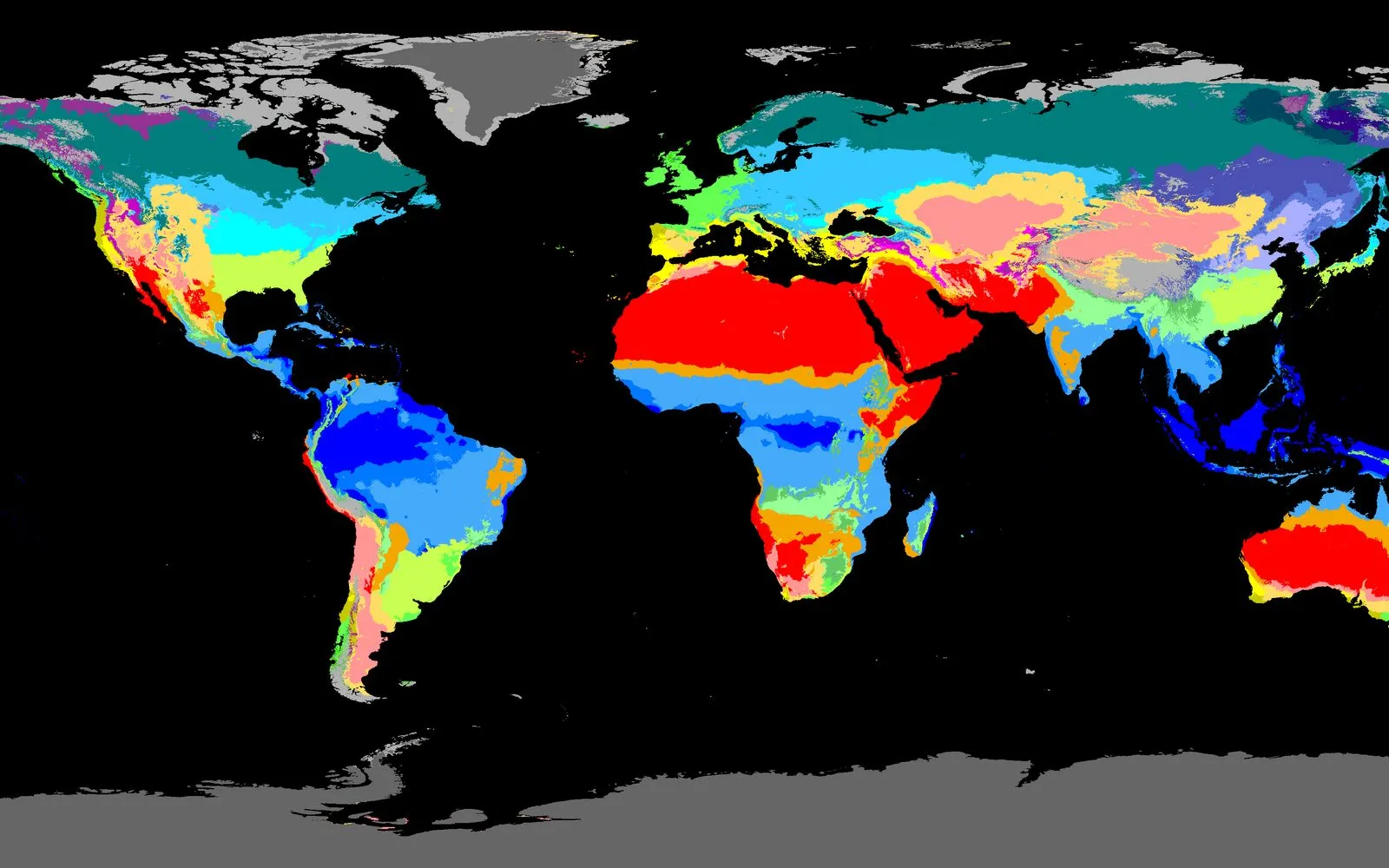
The Koppen-Geiger system groups places by temperature and rainfall through the year. It is useful for gardeners because it separates places that a hardiness zone can merge together.
Group A covers the tropics. Every month is warm, and rainfall patterns shape the year. Group B covers dry climates, including deserts and steppes, where evaporation is greater than rainfall. Group C covers temperate climates with mild winters. Group D covers continental climates with cold winters and warm or hot summers. Group E covers polar and alpine climates where the warmest month is too cold for trees.
The second and third letters add detail. They can mark a dry summer, a monsoon, a hot summer or a severe winter. Use the hardiness zone for winter survival. Use the Koppen type for heat, rainfall and the shape of the growing season.
The wet tropics
In the wet tropics every month is warm. Frost is absent, and rain falls through most or all of the year. This is USDA zone 11 and warmer, RHS H1, and the climate of lowland Malaysia, the Congo basin and the Amazon.
Coconut, breadfruit and black pepper need those conditions. They are damaged or killed near freezing, and they slow down well before frost arrives.
Banana, Musa acuminata, shows the margin clearly. Growth slows below 15 deg C. Frost kills the leaves. Hardier bananas can survive as underground corms, but outside the tropics they are usually foliage plants. Most cool climates do not give them enough uninterrupted warmth to ripen fruit.
The seasonal tropics
Away from the equator, many tropical places have a wet season and a dry season. The rain arrives in the warm months, then stops for several months. Koppen marks these savanna and monsoon climates as Aw and Am.
Cold still limits the plants. Most of them will not tolerate frost. The larger difference is the dry season. Mango flowers better after a dry spell, which is one reason it can disappoint in a wet equatorial climate. Papaya also suits warm seasonal tropics. Ginger uses a different rhythm. It dies back to a rhizome during the dry months and sends up new shoots when rain returns.
Deserts and dry country
Koppen group B is defined by water shortage, not by heat. A dry climate loses more water to evaporation than it receives as rain. That includes hot deserts, but it also includes cold steppes.
For gardeners, dry climates often mean strong sun, dry air, large differences between day and night temperatures, and soil that stays dry at the root. That last part matters in winter. Many dry-country plants tolerate more cold in dry soil than in wet soil.
Agave, prickly pear and aloe vera store water in leaves or pads. They can take a few degrees of frost if the soil is dry. In cold wet soil they rot.
Date palm needs a different combination again. The roots can tolerate light frost, but the fruit needs long periods above 30 deg C to ripen well. A desert oasis can provide that. A mild damp climate usually cannot. Pomegranate is more forgiving and can be dormant-hardy to about minus 12 deg C, but it still ripens best after a long hot dry summer.
The dry-summer Mediterranean climate
Mediterranean climates have wet winters and dry summers. Koppen marks them as Cs. They occur around the Mediterranean basin, coastal California, central Chile, the western Cape and parts of southern Australia.
The plants are adapted to summer drought. Many have small, tough, grey or aromatic leaves that reduce water loss. Rosemary, thyme, lavender and bay laurel all suit dry stony soil and sharp drainage. They often struggle more with wet winter soil than with moderate cold.
Olive, fig and grape vine belong to the same pattern. Their roots can reach water during a dry summer, and their mature wood can tolerate around minus 10 to minus 15 deg C. Late frost can still damage the new growth. In cool wet maritime gardens, these plants may survive winter but fail to get the summer heat they need.
Lemon is more tender. It is damaged below about -2 deg C and needs a frost-free winter, so gardeners in colder climates often grow it in a pot and move it under cover for winter.
Humid subtropical
Humid subtropical climates have hot humid summers, regular rain and mild winters. Koppen marks the main type as Cfa. The American Southeast, southern China, southern Japan and much of eastern Australia fit this pattern.
This climate suits broad-leaved evergreens that need warmth and moisture together. Camellia and the tea plant, Camellia sinensis, come from this belt in East Asia. They are hardy to about minus 10 deg C and grow best where summer is long, warm and reliably moist. Star jasmine suits similar conditions as an evergreen climber.
The contrast with Mediterranean planting is useful. An olive wants a dry summer. A camellia wants moisture through the growing season. The same winter low does not make those plants interchangeable.
The maritime temperate belt
Maritime temperate climates have mild winters, cool summers and rain spread through the year. Koppen marks the common type as Cfb. Britain shares this climate with the Pacific Northwest, coastal Chile, Tasmania and both islands of New Zealand.
The ocean reduces the extremes. Winter is mild for the latitude, and summer is not very hot. Plants that need a long cool growing season do well here.
Rhubarb suits this pattern. It needs winter cold to break dormancy and a cool moist summer to build strong leaves and stems. Apple also crops reliably where it gets enough winter chill without severe summer heat.
Many familiar wild and garden plants fit the same conditions: bluebell, foxglove, heather and lupin all suit cool damp country. The main problem is wet winter soil. Grit, raised beds and sloping planting sites help because they move water away from the roots.
The continental interiors
Continental interiors have colder winters and hotter summers than maritime coasts at similar latitudes. The interiors of North America and Eurasia, from the Canadian prairies through Ukraine to northern China, fit this pattern. Koppen places many of them in group D. Their USDA zones often run from 3 to 6.
Lilac, tulip and snowdrop all use winter cold as part of their growth cycle. Tulip and snowdrop bulbs need cold before spring flowering. Lilac sets buds better after a cold winter. In a mild winter, all three can flower poorly.
The same climate gives gardeners a hot reliable summer, which can ripen wood and fruit well. The cost is winter severity. A plant that dies at minus 10 deg C cannot survive where minus 30 deg C is a normal winter low.
The far north and the high mountains
Far north and high mountain climates have very short growing seasons. Koppen’s Dfc type covers much of the taiga. The plants that survive there need extreme cold tolerance and enough speed to grow during a brief summer.
Silver birch, scots pine and rowan grow further north and higher up than many other trees. Scots pine can tolerate about minus 40 deg C. Silver birch grows close to the edge of where broad-leaved trees can survive. Norway spruce is another important tree of cold forests.
Above the tree line, plants stay low. Common houseleek and yellow gentian come from alpine screes and pastures. Snow protects them in winter, and they grow during a short bright summer. In a lowland garden, wet mild winters often cause more damage than cold dry ones.
Day length, which no climate map shows
Latitude controls day length. Temperature and rainfall do not. Near the equator, days stay close to twelve hours all year. Farther from the equator, summer days get longer and winter days get shorter. At fifty degrees of latitude, a midsummer day reaches about sixteen hours and a midwinter day falls below eight.
Plants that respond to day length can behave differently in two places with similar temperature and rainfall. Onion is the common example. An onion starts forming a bulb only after the day reaches the length that variety needs.
Long-day onions need about fourteen to sixteen hours of daylight, so they suit high-latitude summers. Short-day onions start bulbing at about ten to twelve hours, so they suit lower latitudes and mild winter growing. Near the equator, a long-day onion keeps making leaves because the day never gets long enough. In a high-latitude summer, a short-day onion can bulb too early, before it has made enough leaves.
Garlic depends on cold instead. A clove usually needs a cold spell before it divides into a new head. In a warm winter it can grow into one undivided round. Hardneck garlic, variety ophioscorodon, needs a colder winter and produces a curling flower stalk called a scape. Softneck garlic, variety sativum, needs less chill, suits mild maritime or subtropical winters, plaits well and stores for longer.
Spinach and many lettuces also respond to day length. They bolt as days lengthen in early summer, so they usually crop better from spring or autumn sowings than from midsummer sowings. Chrysanthemums and poinsettias respond to long nights instead, which is why nurseries use blackout screens when they need flowers for a fixed sale date.
The cultivar settles the rest
A species gives you the broad climate range. The cultivar narrows it to a region and a use. Two cultivars of the same species can need different day lengths, different amounts of winter chill or different season lengths.
Low-chill peach and apple cultivars were bred for warm-winter regions. A low-chill peach may fruit after only a hundred to two hundred hours below about 7 deg C. Older northern cultivars may need eight hundred hours or more. That difference decides whether a tree flowers in a subtropical garden.
Seed catalogues carry this information in shorthand. Onion seed may be listed as long-day, short-day or intermediate. Short-season sweetcorn, tomato and maize cultivars may ripen in sixty to seventy days, which helps in short summers at high latitudes or high altitudes. Other cultivars are bred for heat tolerance, slow bolting, disease resistance or fruit set during warm nights.
Read those notes as carefully as the hardiness rating. The right species can still fail if the cultivar was bred for a different region.
Reading your own site
Start with your USDA zone or RHS rating. That tells you whether the plant is likely to survive your coldest winter nights. A plant rated for a warmer zone is a winter risk.
Then check your Koppen type. It shows whether your summer is hot or mild, whether your wet season is long or short, and whether your growing season gives the plant enough time. A plant is a better match when it fits both the winter low and the climate type.
After that, check the details the maps cannot show. Look at day length, winter chill, humidity, wind and soil drainage. Check the cultivar notes for chill hours, days to maturity, day-length class and heat tolerance.
Your garden can differ from the map. A south-facing wall in the northern hemisphere, or a north-facing wall in the southern, stores heat and can protect a tender plant. A frost pocket at the bottom of a slope can run colder than the surrounding garden. A city garden is often warmer than nearby countryside. A raised bed can keep roots drier in winter. A hedge can turn a sunny border into shade over a few years.
Use the hardiness zone for winter survival. Use the climate type for the year as a whole. Use your own garden conditions and the cultivar notes for the final decision.
Common questions
- Why do two gardens in the same hardiness zone grow different plants?
- Because a hardiness zone measures only the coldest night of an average winter. Two places can share that winter low and still have different summer heat, rainfall, humidity, day length and growing seasons. Phoenix and New Orleans are both near USDA zone 9, but one is dry desert and the other is wet subtropical, so their planting lists barely overlap.
- What is the difference between a hardiness zone and a climate zone?
- A hardiness zone, whether USDA or RHS, rates winter cold alone, so it predicts what will survive the coldest night. A climate zone such as a Koppen-Geiger type classifies the whole climate by temperature and rainfall through the year. Use the hardiness zone for winter survival, then use the climate type for summer heat, rainfall and season length.
- Does my hardiness zone tell me about summer heat?
- No. The USDA and RHS scales measure winter minimums and say nothing about how hot the summer runs. The American Horticultural Society heat-zone map counts the number of days a year above 30 deg C. A plant can survive your winter and still fail in your summer.
- USDA hardiness zone or Koppen climate classification, which should I use?
- Both, side by side. The USDA zone is a single number for winter cold and helps you judge winter survival. The Koppen-Geiger classification groups places by temperature and rainfall together, so it covers drought, summer heat and the shape of the growing season.
- Can long-day onions grow in the tropics?
- No. Long-day onions form bulbs only after the day reaches about fourteen to sixteen hours. That happens in a high-latitude summer, but not near the equator. Low latitudes need short-day onions, which start bulbing once the day reaches ten to twelve hours.
- Why does garlic need a cold winter to form cloves?
- A garlic clove needs cold before it divides into a new head of cloves. In a warm winter it often grows into a single undivided round. Hardneck types need more cold than softneck types, so softneck garlic suits mild maritime and subtropical regions better.
Sources and further reading
- USDA Plant Hardiness Zone MapUnited States Department of Agriculture, Agricultural Research Service, 2023The average annual extreme minimum temperature, mapped in bands ten Fahrenheit degrees wide.
- RHS hardiness ratingsRoyal Horticultural SocietyThe H1a to H7 scale, which separates the tender bands the USDA map runs together.
- Heat Zones, Plant Health, and the AHS Heat Zone MapUnited States Botanic GardenA live explanation of the AHS heat-zone map, including its twelve zones and the days a year above 30 deg C.
- Updated world map of the Koppen-Geiger climate classificationM. C. Peel, B. L. Finlayson and T. A. McMahon. Hydrology and Earth System Sciences, 2007The standard modern account of the five-group classification used throughout this piece.
- Present and future Koppen-Geiger climate classification maps at 1-km resolutionHylke E. Beck and others. Scientific Data, 2018High-resolution maps for finding which climate type a given place falls in.
- Climate change impacts on winter chill for temperate fruit and nut productionEike Luedeling. Scientia Horticulturae, 2012Why an apple or a peach needs a cold winter, and what happens where the winter is too warm to supply it.