
Edible
Pomegranate
Punica granatum
Also known as Grenadine, Anar, Punica
How to grow pomegranate, Punica granatum. Brilliant orange-red flowers, a long hot summer needed for fruit, and a plant most cool temperate gardens grow for looks.
At a glance
- Difficulty
- Difficult
- Water
- Weekly through summer, tapering as fruit ripens
- Light
- Full sun, against the hottest wall available
- Temperature
- Hardy to about -12 deg C when dormant
- Hardiness
- USDA 8-11, RHS H4, hardy to -12 C
- Type
- Deciduous shrub or small tree, very long-lived
- Height
- 2-5 m, kept smaller in a container
- Native to
- Iran, Northern India, Central Asia
- Best month
- October and November in the Northern Hemisphere, April and May in the Southern Hemisphere
Iran and northern India, on a continental Mediterranean pattern. The plant is hardy to about -12 deg C, and the fruit needs a long hot dry late summer to ripen and splits if rain arrives as it matures. Cool damp autumns are what defeat it rather than winter cold.
Hardiness zones describe winter cold alone. Summer heat, humidity, rainfall and the length of the growing season decide as much, so treat the range as the outer limit rather than as a recommendation.
Every month named in this guide is for the temperate Northern Hemisphere. If you garden in the Southern Hemisphere, shift each one by six months, so October becomes April. Closer to the equator the wet and dry seasons matter more than the calendar, and the shift stops being a useful guide.
Toxic if eaten
- Safe to eat
- The seeds and the juicy arils around them
- Do not eat
- Root bark, stem bark and the outer rind
- Harm from
- Eating it
- Affects
- People, cats and dogs
The arils are food and the juice is a staple across the Middle East. The bark is another matter. Root and stem bark contain pelletierine alkaloids, which were used medicinally as a treatment for tapeworm and abandoned because the effective dose sits uncomfortably close to a dangerous one. Symptoms of poisoning include vomiting, dizziness and visual disturbance. Nobody eats bark by accident, so this matters for anyone tempted by a home remedy rather than for ordinary growing. The ASPCA lists pomegranate as toxic to cats, dogs and horses, attributing gastrointestinal upset to the rind and the outer parts rather than to the arils.
Sources: RHS potentially harmful garden plants, ASPCA toxic and non-toxic plants
About
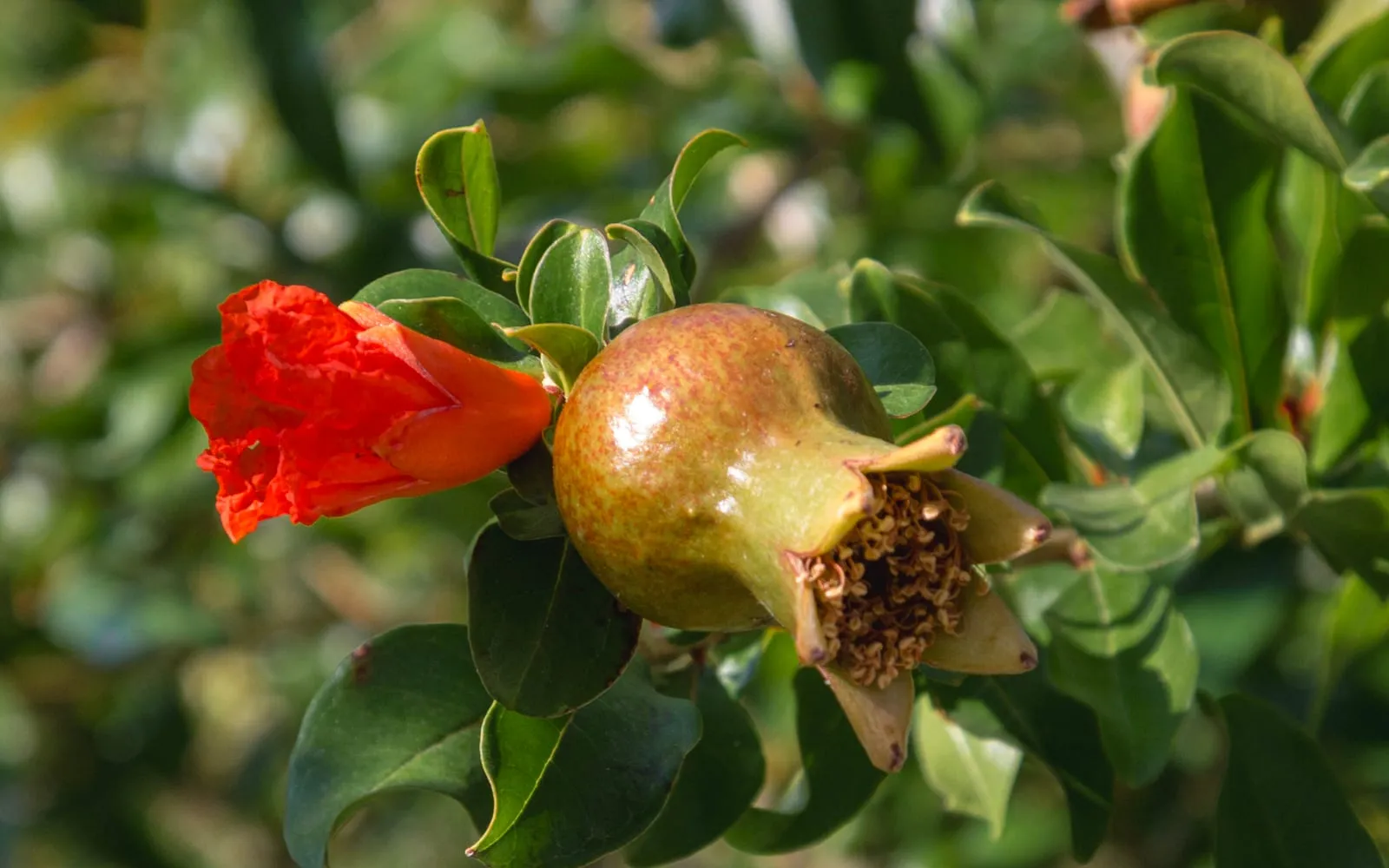
Pomegranate flowers are worth the plant on their own. They open through summer in brilliant orange-scarlet, waxy and crumpled like crepe paper, set against small glossy leaves.
Fruit is another matter in a cool summer. The plant needs a long hot dry summer and a warm autumn to ripen, which means most gardens here get flowers and no fruit, or fruit that stays hard and sour.
Where it does work is under glass, in a conservatory, or against the hottest wall in a southern garden in a good year. ‘Provence’ is the variety most often recommended for cooler climates.
The dwarf form, Punica granatum var. nana, flowers freely in a pot and makes a good conservatory plant, though its small fruit is more ornament than food.
Appearance and character
A dense twiggy deciduous shrub, often multi-stemmed, suckering from the base, with short spine-tipped side shoots on older wood.
Leaves are small, 2 to 8 cm, narrow and oblong, glossy bright green, turning clear yellow in autumn, and held in opposite pairs or whorls.
Flowers open from June to September, 3 to 4 cm across, with crumpled orange-red petals emerging from a thick waxy tubular calyx. That calyx persists and becomes the crown on the fruit.
Fruit is round, 6 to 12 cm, with a hard leathery rind ripening from green through yellow to deep red, topped by the dried calyx.
Inside, hundreds of seeds sit in chambers separated by bitter cream-coloured membrane, each seed wrapped in a translucent juicy aril.
Where it is from
Punica granatum comes from Iran, Afghanistan and northern India, and it has been cultivated for around five thousand years.
It spread west early, into Mesopotamia, Egypt and the whole Mediterranean, and it appears in Egyptian tomb paintings, Greek myth and the Hebrew Bible.
Wild plants grow on dry rocky hillsides in a climate of hot dry summers and cool wet winters, which is precisely what a cool maritime climate fails to supply.
Spain, Turkey, Iran and India are the main producers today, and Spanish and Israeli fruit fills supermarkets in autumn.
The name comes from Latin for seeded apple, and the French pomme grenade gave the grenade its name from the shape and the scattering of fragments.
How it grows
Grow it in a large container in most temperate regions, which allows the plant to be moved into a greenhouse or conservatory for winter and put outside for summer.
In the mildest southern gardens it can be planted against a hot south-facing wall, where it will flower reliably and fruit occasionally.
Choose ‘Provence’ for the best chance of fruit outdoors, or the dwarf ‘Nana’ for a conservatory display.
Plant in free-draining compost with added grit. The plant tolerates poor and alkaline soil and dislikes anything that holds water.
Prune in late winter, removing crossing wood and suckers, and shortening long shoots to build a framework. Fruit forms on short spurs on mature wood.
Feed and water through summer, then keep it much drier through winter dormancy.
Through the seasons
Growth starts in late April or May, and the plant leafs out late.
Flowering begins in June and continues through to September, which is a long season and the main reason to grow it.
Fruit sets from the earliest flowers only, since later ones have no time to develop.
Through summer the plant wants heat, sun and steady water, avoiding the swings that split the fruit.
Fruit ripens through October and November where it ripens at all. It is ready when the rind has coloured fully and the fruit feels heavy and sounds metallic when tapped.
Move containers under cover before the first hard frost, and keep the compost barely moist through winter.
Care difficulty
Difficult if you want fruit, and easy if you want flowers.
The plant itself is tough. It tolerates drought, poor soil and alkalinity, and survives to about -12 deg C when dormant.
Ripening fruit is what defeats a cool temperate climate. The species needs a long hot dry summer and a warm autumn, and gets neither in most years.
Container growing solves winter hardiness and gives control over watering, at the cost of feeding and watering all season.
Treat fruit as a bonus. Grown for the flowers and the autumn foliage it is a rewarding and undemanding plant.
Watering
Water weekly through summer, keeping moisture steady rather than alternating between dry and soaked.
Irregular watering is the direct cause of split fruit, which is the commonest disappointment on a plant that has set well.
Taper the water as fruit ripens in autumn, which concentrates the juice.
Keep the plant much drier through winter dormancy. Cold wet compost rots the roots.
A container needs checking every few days in summer heat, and free-draining compost with grit worked through it.
Warning signs, diseases and pests
Flowers every year, never any fruit. Insufficient heat. This is the normal outcome in a cool summer outdoors, and glass is the only real answer.
Fruit splitting as it ripens. Irregular watering. Water steadily through autumn and mulch to buffer the swings.
Wood dying back over winter. Cold below -12 deg C. Move containers under cover.
Clouds of small white insects under the leaves. Whitefly under glass. Use sticky traps or a biological control.
Fine pale speckling with webbing. Red spider mite in dry conservatory air. Raise humidity and ventilate.
Yellowing leaves and collapse. Root rot from waterlogging or from watering through dormancy.
Growing environment
Full sun and as much heat as possible. A south-facing wall, a greenhouse or a conservatory.
Free-draining soil or compost. The plant tolerates poor, stony and alkaline ground and dislikes rich wet soil.
A dry summer suits it, which is the opposite of what most fruit here wants.
Winter cold is survivable to about -12 deg C, though the plant is happier moved under cover in a container.
Allow 2 to 3 m against a wall, or a pot of at least 50 cm for a plant kept permanently in a container.
Feeding
Apply a balanced general fertiliser in spring as growth begins.
Follow with a high-potash liquid feed monthly from May to August, which supports the long flowering season.
Avoid heavy nitrogen, which produces leafy growth and suckers at the expense of flowers.
Stop feeding by early autumn so the wood ripens before dormancy.
A container plant needs feeding throughout the growing season, since it has no reserves to draw on.
Troubleshooting
No flowers on a young plant. Pomegranate takes three to five years to flower from a young plant, and longer from seed.
Flowers dropping without setting. Normal for many of them. Only the earliest flowers have time to make fruit, and some varieties carry sterile flowers.
Fruit hard and sour in November. Not enough heat through the season. Grow it under glass for a better chance.
Suckers around the base. Natural habit. Cut them out in late winter unless you want a multi-stemmed shrub.
Leaves dropping in autumn. Normal. The plant is deciduous despite often being sold alongside evergreens.
Plant collapsing over winter. Watered during dormancy, or left in cold wet compost. Keep it barely moist and frost-free.
Pomegranate problem guides
Not sure what is wrong? See the common vegetable pests guide.