
Edible
Rosemary
Salvia rosmarinus
Also known as Rosmarinus officinalis, Common rosemary
How to grow rosemary, Salvia rosmarinus. Drainage above all, pruning without killing it, taking cuttings, and why the botanists moved it into the sages.
At a glance
- Difficulty
- Moderate
- Water
- Rarely once established. Only in prolonged drought
- Light
- Full sun. A south-facing wall is the classic position
- Temperature
- Hardy to about -10 deg C when the soil drains freely
- Hardiness
- USDA 7-10, RHS H4, hardy to -10 C
- Type
- Evergreen shrub, long-lived
- Height
- 60-200 cm for upright forms
- Native to
- The Mediterranean coast
- Best month
- July in the Northern Hemisphere, January in the Southern Hemisphere
Cold wind and wet roots together are what kill it, and either alone is survivable, so a sheltered spot on sharp drainage buys several degrees. Upright cultivars such as 'Miss Jessopp's Upright' are hardier than the prostrate ones. Botanists moved it into Salvia in 2017, which is why older books call it Rosmarinus officinalis.
Hardiness zones describe winter cold alone. Summer heat, humidity, rainfall and the length of the growing season decide as much, so treat the range as the outer limit rather than as a recommendation.
Every month named in this guide is for the temperate Northern Hemisphere. If you garden in the Southern Hemisphere, shift each one by six months, so July becomes January. Closer to the equator the wet and dry seasons matter more than the calendar, and the shift stops being a useful guide.
Not known to be toxic
- Safe to eat
- Leaves and flowers
Non-toxic. The ASPCA lists rosemary, under the older name Rosmarinus officinalis, as non-toxic to dogs, cats and horses, and rosemary does not appear on the RHS list of potentially harmful garden plants. It is a culinary herb used freely in cooking and is one of the few plants in these guides that is safe for people and pets alike. Rosemary is sometimes included in dog food as a natural preservative. Two sensible limits apply to the concentrated oil rather than the herb. Rosemary essential oil is potent and should not be given to pets or applied undiluted to skin, and there is long-standing advice that people with epilepsy should avoid large medicinal doses of rosemary oil, since camphor in high concentration can lower the seizure threshold. Sprigs on a roast are food, and nothing here should give anyone pause.
Sources: ASPCA (Rosemary, Rosmarinus officinalis), RHS potentially harmful garden plants
About
Rosemary changed its name in 2017. DNA work showed that the genus Rosmarinus sat inside Salvia, the sages, rather than beside it, and keeping it separate made Salvia an incoherent group. The correct name is now Salvia rosmarinus, though nurseries and seed packets will carry the old one for years yet.
The plant is unchanged, and so is the growing advice. It comes from dry Mediterranean hillsides, it wants sun and sharp drainage, and it is killed far more often by wet feet than by cold.
A well-sited rosemary lives for a decade or more and gives you sprigs every month of the year.
Appearance and character
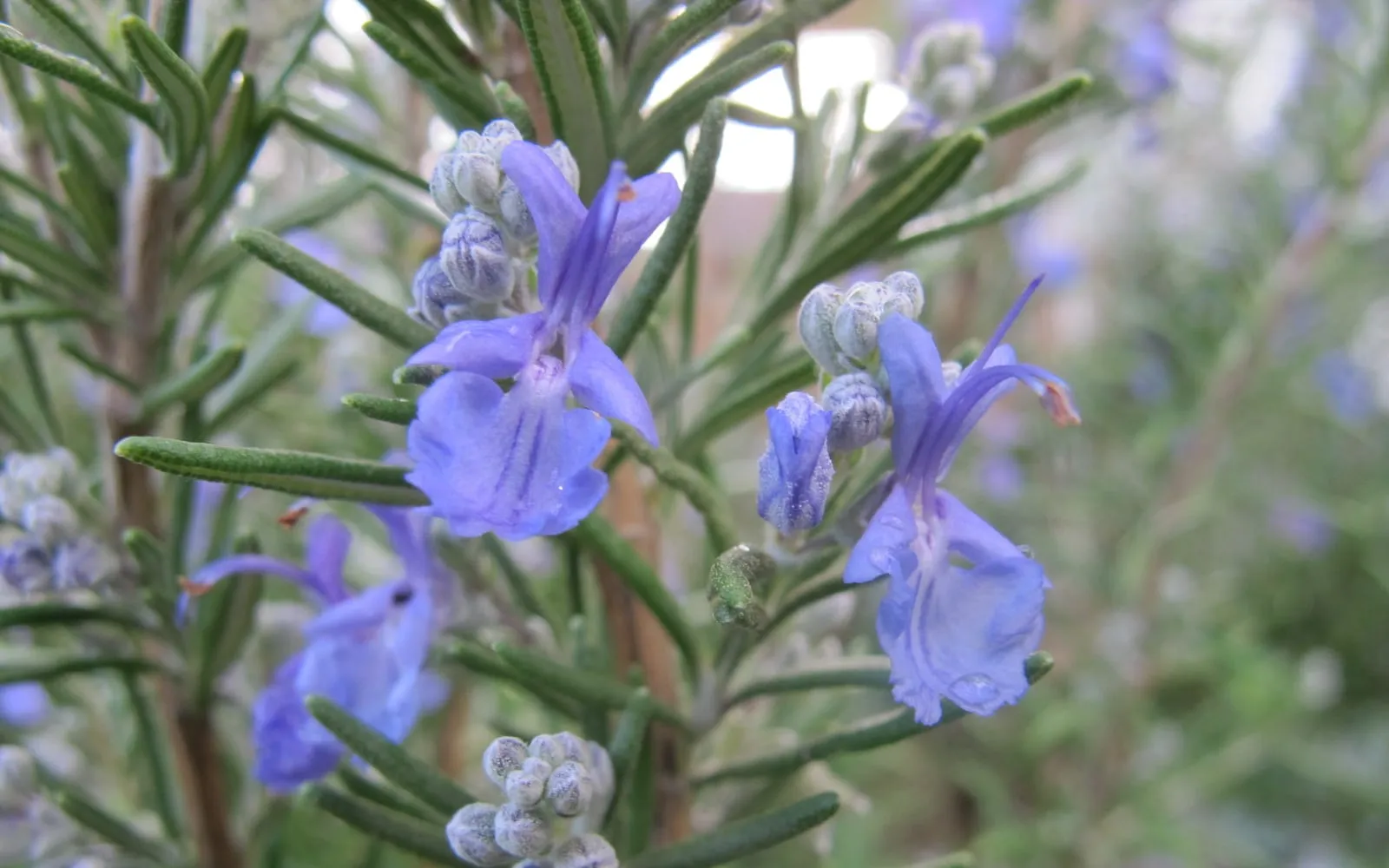
An evergreen shrub with narrow needle-like leaves, dark glossy green above and downy grey-white beneath, held densely along woody stems.
Upright cultivars such as ‘Miss Jessopp’s Upright’ grow to 1.5 m or more and make a decent informal hedge. Prostrate forms trail and are excellent over a wall or in a raised bed, and they are noticeably less hardy.
Flowers are small and two-lipped, pale blue to lavender, occasionally pink or white, appearing from March through summer and often again in autumn. Bees work them in months when little else is available, which is a good reason to leave some flowering.
The scent is resinous and pine-like, released by brushing past, and it comes from oil glands on the leaf surface. It is strongest in hot dry weather and on plants grown lean.
Where it is from
The Mediterranean coast, on limestone hillsides, sea cliffs and dry scrub in southern Europe and North Africa. The name means dew of the sea, and it grows within sight of it.
The habitat is thin stony alkaline soil, blazing sun, and winter rain that drains through rock within hours. Summer is hot and effectively rainless.
Gardeners fail rosemary by being too generous. Rich soil, regular watering, and a winter of cold wet clay around the roots are all wrong, and none of them look like mistakes at the time.
How it grows
An evergreen shrub laying down permanent woody structure and making soft new growth from it each year.
Like lavender, it rarely regenerates from old bare wood. Cut into the brown stems and that section usually dies rather than resprouting, which sets the limits on pruning.
Prune lightly after the main flowering, taking off the current season’s growth to keep the plant compact and always leaving green shoots below every cut. Doing this every year from the start keeps the bush dense. Skipping it for a few years produces a sprawling woody plant that cannot be brought back.
Lifespan is around five to ten years before the plant goes irretrievably woody. Replacing it is easy, since semi-ripe cuttings taken in late summer root readily, and a cutting struck in August is a usable plant the following summer.
Harvesting counts as pruning. Cutting sprigs regularly keeps the plant bushy, which is a pleasant coincidence of kitchen and garden needs.
Through the seasons
Spring brings the first flush of flowers, often from March. Plant new rosemary from April onward so it establishes before winter.
Summer is growth and harvest. Cut sprigs freely. Prune after the main flowering finishes, taking off no more than the current year’s growth.
Late summer is the time for cuttings. Take non-flowering shoots 8 to 10 cm long, strip the lower leaves, and push them into gritty compost.
Winter is survival, and doing nothing is the correct action. Wet at the roots is the danger rather than frost, so make sure water drains away, keep mulch off the crown, and move containers under the shelter of a wall.
Care difficulty
Moderate, and it comes down to drainage and restraint.
Rosemary in heavy wet soil dies over winter, and this accounts for most losses in Britain. Plant on a slope, a raised bed or a mound, dig grit through the planting area, or grow it in a terracotta pot of gritty compost.
Restraint covers watering, feeding and pruning alike. Established plants want no water, no feed, and only light annual pruning that never goes into old wood.
Cold is a lesser problem than reputation suggests. A dry-rooted rosemary takes about -10 deg C. The same plant in soggy soil dies at -3.
Watering
Water new plants during their first summer while the roots go down, and then essentially stop.
Established plants in the ground need nothing in an ordinary year. Water only during a prolonged drought, and then deeply rather than often.
Containers dry out completely and do need attention, but let the compost dry to depth between waterings. Terracotta is better than plastic here, since it breathes and dries.
Winter wet is the killer. Stand pots on feet so water runs straight out, and move them to the driest, most sheltered spot available.
Do not mulch with anything moisture-holding around the base. Gravel is the right mulch for rosemary, since it keeps the crown dry and reflects heat.
Warning signs, diseases and pests
Root rot from waterlogging causes most rosemary deaths. Whole branches go brown and brittle, the plant looks dusty rather than glossy, and by the time it shows above ground the roots are gone. Prevention is drainage, since there is no cure.
Rosemary beetle is a handsome metallic green and purple striped insect that arrived in Britain in the 1990s and is now widespread. Adults and larvae eat the foliage of rosemary, lavender, sage and thyme, mostly from late summer through to spring. Pick them off by hand, holding a sheet of paper under the branch and shaking.
Scale insects appear as small brown bumps along the stems with sticky honeydew.
Grey mould rots the congested centre of an unpruned plant in a damp summer. Prune annually to keep it open.
Frosted shoot tips turn brown over winter. Trim them off in spring, cutting back only into green growth.
A woody sprawling plant with a bare middle is age plus missed pruning, and it cannot be rejuvenated. Take cuttings and replace it.
Growing environment
Full sun. This is not negotiable for a plant that evolved on an open Mediterranean hillside, and shade gives soft leggy growth with weak flavour.
Hardy to about -10 deg C when dry at the root, and upright cultivars are generally hardier than prostrate ones. In a cold or exposed garden, grow it in a large pot that can be moved against a wall for winter.
Soil should be poor, gritty and sharply drained, neutral to alkaline. Do not improve it with compost or manure. Do add grit and, on acid ground, lime.
A south-facing wall is the classic position and it is classic for good reason, combining maximum sun with the shelter and the dry soil at the base of a wall.
Containers work well. Use a soil-based compost with a third added grit, in a pot with generous drainage holes.
Give it air. Crowding brings mould.
Feeding
Effectively none. Rosemary evolved on nutrient-poor limestone, and feeding it produces soft growth with diluted oils and less flavour.
A container plant may take one light, low-nitrogen feed in spring, since compost in a pot is a closed system. That is the whole programme.
Never use high-nitrogen fertiliser. The flavour comes from concentration, and lush growth dilutes it.
Repot container plants every two or three years into fresh gritty compost rather than feeding them harder.
Troubleshooting
Whole branches brown and brittle. Root rot from wet soil. Cut back to healthy wood, stop watering, and expect to lose the plant if the drainage is not fixed.
Died over winter. Waterlogging rather than cold. Replant on a mound or in a gritty pot.
Woody, sprawling and bare in the middle. Years without pruning. It will not regrow from old wood. Take cuttings and start again.
Metallic green and purple striped beetles on the foliage. Rosemary beetle. Shake them onto paper and remove them by hand.
Leggy with pale leaves and little scent. Too much shade, or too much feeding. Move it into full sun and stop feeding.
Brown shoot tips in spring. Frost damage. Trim into green growth only.
Plant labelled Rosmarinus officinalis. Same plant. It was reclassified as Salvia rosmarinus in 2017 and the trade is slow to catch up.
Flowers but hardly any new leaf growth. Often an old plant nearing the end of its useful life. Take cuttings in late summer.