
Outdoor plant
English Lavender
Lavandula angustifolia
Also known as True lavender, Common lavender, Lavender
How to grow English lavender, Lavandula angustifolia. Drainage, the pruning cut that keeps it alive, telling it apart from lavandin, and why it is toxic to cats and dogs.
At a glance
- Difficulty
- Easy
- Water
- Rarely once established. Weekly in the first summer only
- Light
- Full sun. Six hours minimum, and the more the better
- Temperature
- Hardy to about -15 deg C when dry at the root
- Hardiness
- USDA 5-9, RHS H5, hardy to -15 C
- Type
- Evergreen sub-shrub, woody at the base
- Height
- 30-60 cm
- Native to
- The western Mediterranean, chiefly the mountains of southern France and Spain
- Best month
- May in the Northern Hemisphere, November in the Southern Hemisphere
Winter wet kills far more plants than winter cold. On sharp drainage it takes -15 C, and in heavy ground that stays wet it rots at -5. Poor stony soil and drought concentrate the oil, so a fed and watered plant gives soft growth and weak scent. Humid summers bring root rot and shab, which is why it struggles through the American south-east. Lavandula angustifolia is the hardy one and the Lavandula x intermedia lavandins and French lavenders are tenderer.
Hardiness zones describe winter cold alone. Summer heat, humidity, rainfall and the length of the growing season decide as much, so treat the range as the outer limit rather than as a recommendation.
Every month named in this guide is for the temperate Northern Hemisphere. If you garden in the Southern Hemisphere, shift each one by six months, so May becomes November. Closer to the equator the wet and dry seasons matter more than the calendar, and the shift stops being a useful guide.
Harmful to pets if eaten
- Do not eat
- Leaves and flowers
- Harm from
- Eating it
- Affects
- Cats, dogs and horses
Lavender surprises people, so it is stated plainly here. The ASPCA lists Lavandula angustifolia as toxic to dogs, cats and horses through linalool and linalyl acetate, the same compounds that give the plant its scent, with nausea, vomiting and loss of appetite. A cat brushing past a bush in the garden is in no danger, and neither is a dog that chews a sprig. The real risk sits indoors and in concentrated form: lavender essential oil is considerably more dangerous than the plant, cats lack the liver enzyme needed to process the phenols in many essential oils, and diffusers, undiluted oil on skin or fur, and lavender products applied to pets have all caused serious illness. Lavender is safe for people and is used in cooking in small quantities, though the culinary variety should be Lavandula angustifolia rather than the camphorous lavandin. Keep the essential oil away from pets entirely, and do not use a diffuser in a room a cat cannot leave.
Sources: ASPCA (Lavender, Lavandula angustifolia), RHS potentially harmful garden plants
About
English lavender is not English. Lavandula angustifolia comes from the dry limestone hills of southern France and Spain, and the name records where it was distilled into lavender water rather than where it grew. It took to Britain well enough that the association stuck.
Check the distinction from its larger cousin before you buy. Lavandin, Lavandula x intermedia, is a hybrid grown for oil yield, and it is bigger, later, and sharply camphorous. Most of the lavender in commercial fields and most of the lavender in cheap oil is lavandin. For scent, for cooking and for a compact garden plant, Lavandula angustifolia is the one to grow.
It is also the hardiest lavender, which matters in a temperate winter.
Appearance and character
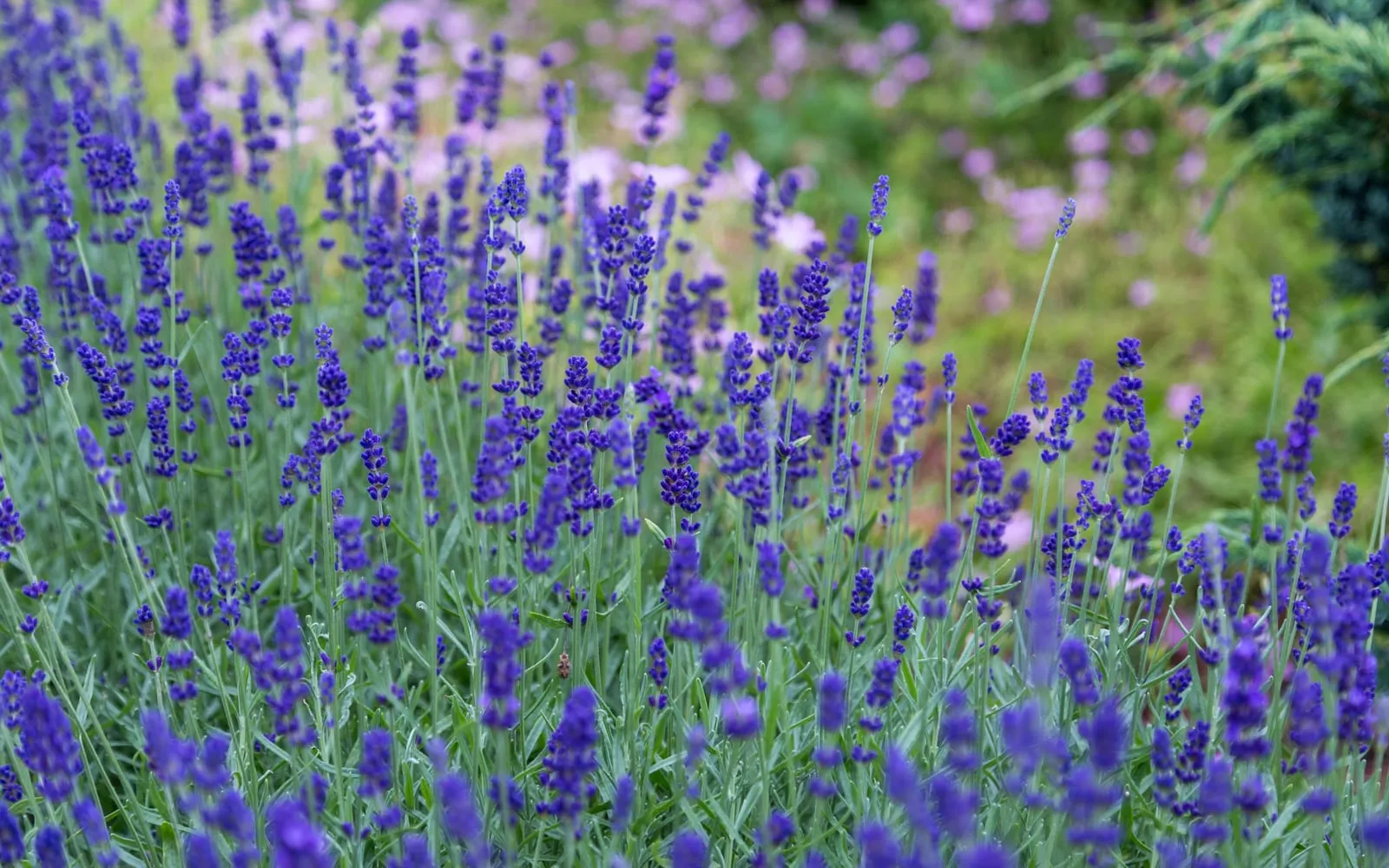
A rounded evergreen sub-shrub with narrow grey-green leaves, woody at the base and soft at the tips, forming a mound 30 to 60 cm high and rather wider.
Flowers appear in July as dense spikes of small tubular blooms in shades from pale lilac to deep violet, held on unbranched stems well clear of the foliage. Lavandin, by contrast, carries branched flower stems with side spurs, which is the quickest way to tell them apart in the garden.
The scent is in the leaves as much as the flowers, released by brushing past. It comes from oil glands on the leaf surface, and it is strongest in hot dry weather, which is why the same plant smells more powerful in a Provencal July than an English one.
Bees work it constantly through its flowering weeks.
Where it is from
The western Mediterranean, on dry rocky limestone slopes between 500 and 1500 m in the mountains of southern France, Spain and northern Italy.
The soil there is thin, stony, alkaline and almost devoid of nutrients. The sun is relentless. Rain comes in winter and drains away within hours through fissured rock.
Gardeners fail lavender by being too kind. Rich soil, generous feeding and a wet winter around the roots kill more plants than cold ever does.
How it grows
An evergreen sub-shrub that lays down permanent woody structure at the base and makes soft new growth from it each year. Flowers form on the current season’s growth.
The wood is the constraint that governs pruning. Lavender rarely produces new shoots from old bare wood, which sets it apart from most shrubs. Cut into the brown stems and that section dies back without regrowing.
Lifespan is around ten to fifteen years, shorter if it is allowed to go leggy. Plants that are pruned annually from the start stay dense and live longest.
Propagation from semi-ripe cuttings in late summer is straightforward, and it is the sensible way to replace an ageing plant, since seed-raised lavender is variable.
Through the seasons
Spring is for a light tidy in April, taking off any frost-damaged tips. Plant new lavender from April to June so it roots before winter.
Summer is flowering, through July and into August. Harvest for drying just as the first flowers on each spike open, cutting in the morning after the dew has gone.
Late summer is the important prune. Once flowering finishes, cut the whole plant back by about a third, shaping it into a dome and stopping about 2 cm above the woody base where you can still see green growth.
Winter is survival. Do nothing. Wet is the enemy rather than cold, so make sure water drains away and resist the urge to mulch over the crown.
Care difficulty
Easy, and it hangs on two decisions.
Drainage first. Lavender in heavy wet soil dies over winter, and no amount of care compensates. Plant on a raised bed or a mound, dig grit through the planting area, or grow it in a pot of gritty compost.
Pruning second. Prune every year, in late summer after flowering, and never cut into bare brown wood. An unpruned lavender goes woody, splays open in the middle and cannot be brought back, and the only remedy at that point is a replacement plant.
Watering
Water new plants weekly through their first summer while the roots establish.
After that, almost never. Established lavender is drought-tolerant and temperate rainfall is more than sufficient. Watering an established plant in the ground does harm rather than good.
Containers are the exception, since a pot dries out completely. Water when the compost is dry to a depth of several centimetres, then let it dry again.
Winter wet is the killer. Make sure pots stand up on feet so water runs out, and move them to the driest spot you have.
Warning signs, diseases and pests
Root rot from waterlogging kills more lavender than cold does. The plant goes grey and dull, then whole branches die back, and by the time it shows above ground the roots have gone. Prevention is drainage, because there is no treatment.
Rosemary beetle is a striking metallic green and purple striped insect that eats the foliage of lavender, rosemary and sage from late summer through spring. Pick them off by hand, shaking the bush over a sheet of paper to collect them.
Froghopper nymphs produce the white foam known as cuckoo spit on the stems in early summer. They do essentially no damage and need no action.
Grey mould can rot the centre of a congested plant in a humid summer. Prune annually to keep the middle open.
A woody splayed plant with a bare centre is age plus missed pruning rather than disease, and it cannot be rejuvenated.
Growing environment
Full sun, six hours minimum. Shade gives leggy growth, few flowers and little scent.
Hardy to about -15 deg C provided the roots are dry. The combination of cold and wet is what kills, so a plant that survives a hard frost on a gravel bank may die in a mild wet winter on clay.
Soil should be sharply drained, stony and poor. Neutral to alkaline suits it best, and lime helps on an acid site. Do not add compost or manure to the planting hole. Do add grit.
Spacing at 45 cm apart for a hedge lets air move through, which keeps mould down.
Containers work well. Use a soil-based compost with a third added grit, in a pot with generous drainage holes, and choose terracotta over plastic since it dries faster.
Feeding
None in open ground. Lavender evolved on nutrient-poor limestone, and feeding it produces soft leafy growth, fewer flowers and weaker scent.
A container plant may want a single low-nitrogen feed in spring, since compost in a pot is a closed system. Half strength is plenty.
Avoid manure and rich mulches around the base. A gravel mulch is far better, keeping the crown dry and reflecting heat up into the plant.
Troubleshooting
Dead, woody and splayed open in the middle. Years without pruning. It cannot be cut back into old wood and recovered. Take cuttings and replace it.
Died over winter. Waterlogging rather than cold. Replant on a mound, dig in grit, or use a pot.
Leggy with few flowers. Not enough sun, or too much feeding. Move it to a brighter spot and stop feeding.
Grey and dull with dying branches. Root rot. Check the drainage, and expect to lose the plant.
White foam on the stems. Cuckoo spit from froghoppers. Harmless. Leave it.
Metallic green and purple beetles on the foliage. Rosemary beetle. Pick them off by hand.
Bought as lavender, smells of camphor and grows waist high. It is lavandin, Lavandula x intermedia, rather than English lavender. Look for unbranched flower stems when buying.