
Edible
Black Pepper
Piper nigrum
Also known as Peppercorn, Kali mirch, Pepper vine
How to grow black pepper, Piper nigrum. Why black, white and green pepper all come from the same berry, growing the vine under glass, and what it needs to fruit.
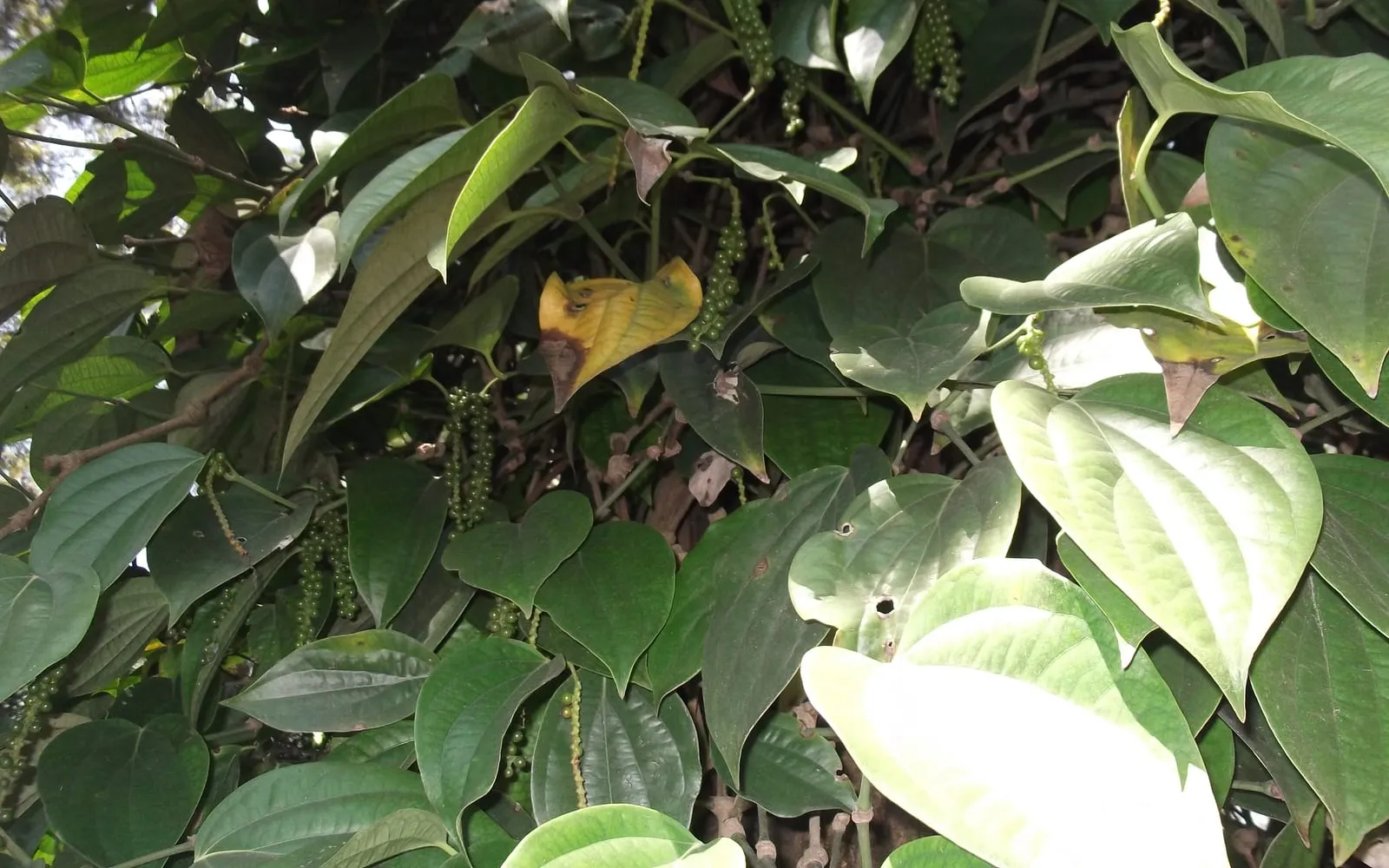
At a glance
- Difficulty
- Difficult
- Water
- Two or three times a week in summer, sparingly in winter
- Light
- Bright indirect light or dappled shade
- Temperature
- Damaged below 12 deg C and killed by frost
- Humidity
- High. It comes from monsoon forest
- Hardiness
- USDA 10-12, RHS H1b, hardy to 12 C
- Type
- Tender evergreen perennial climber
- Height
- 4-5 m in cultivation, more in the wild
- Native to
- South Asia
- Best month
- June and July in the Northern Hemisphere, December and January in the Southern Hemisphere
Wet forest of the Western Ghats, climbing trees in partial shade. It wants a support to root against, dappled light rather than full sun, and rain through the year with a short dry spell to trigger flowering.
Hardiness zones describe winter cold alone. Summer heat, humidity, rainfall and the length of the growing season decide as much, so treat the range as the outer limit rather than as a recommendation.
Every month named in this guide is for the temperate Northern Hemisphere. If you garden in the Southern Hemisphere, shift each one by six months, so June becomes December. Closer to the equator the wet and dry seasons matter more than the calendar, and the shift stops being a useful guide.
Not known to be toxic
- Safe to eat
- The fruit, at any stage of ripeness
Non-toxic. Black pepper is the most traded spice in the world and it is eaten in enormous quantity with no toxicity concern in food use. It appears on neither the RHS list of potentially harmful garden plants nor the ASPCA list. Piperine, the compound responsible for the heat, is an irritant in concentrated form, which is why ground pepper makes people sneeze and why pepper spray works, and the spice in cooking is a different proposition. A dog that eats a quantity of ground pepper will have an unpleasant time and will not be poisoned.
Sources: RHS potentially harmful garden plants, ASPCA toxic and non-toxic plants
About
Black, white and green pepper all come from this one vine, and the difference is when the berry is picked and what happens to it afterwards. Green pepper is the unripe berry preserved wet. Black pepper is the unripe berry left to ferment briefly and dried, which is what shrivels and darkens the skin. White pepper is the fully ripe berry soaked until the outer flesh rots away, leaving the pale seed inside.
Pink peppercorns are not pepper at all. They come from a South American tree, Schinus, and they are in the mix for colour.
Growing the vine outside the tropics means a warm greenhouse and patience. It is a tropical forest climber that wants heat, humidity and dappled light, and it takes three or four years to fruit even in ideal conditions. As a foliage plant it is handsome, and anyone growing it for a jar of peppercorns should expect a small one.
Appearance and character
A woody evergreen climber, reaching 4 to 5 m in cultivation, clinging by short roots produced along the stem in the manner of ivy.
Leaves are broad, oval and pointed, 10 to 20 cm long, glossy dark green, with five to seven strong veins curving from the base to the tip.
Flowers are tiny and greenish-white, packed into slender pendulous spikes 5 to 15 cm long hanging opposite the leaves.
Fruit follows on the same spikes as a string of small round berries, green at first, turning yellow and then red as they ripen.
The scent is faint on the growing plant and strong the moment a berry is crushed.
Two kinds of shoot exist on a mature vine. Climbing shoots root as they go and produce no fruit, and lateral fruiting branches carry the spikes, which matters when taking cuttings.
Where it is from
Black pepper is native to the Western Ghats of southern India, particularly Kerala, growing as a forest climber in monsoon country.
Its trade is one of the oldest in the record. Peppercorns were found in the nostrils of Ramesses II, who died in 1213 BC, and Roman Egypt ran a substantial Indian Ocean pepper trade, with Pliny complaining about the drain of silver it caused.
Medieval Europe treated it as a store of value. Rents and dowries were sometimes paid in pepper, and the phrase peppercorn rent survives from the practice of a nominal payment.
The search for a direct sea route to the pepper coast is what drove Portuguese exploration, and Vasco da Gama reached Calicut in 1498 looking for it.
Vietnam is now the largest producer by a wide margin, ahead of Brazil, Indonesia and India, and pepper remains the most traded spice in the world by volume.
How it grows
Buy a plant, or take cuttings from a fruiting lateral branch. Cuttings from climbing shoots root readily and are slow to fruit, which is a common disappointment.
Seed works if it is fresh, sown from a ripe berry at 25 deg C. Dried peppercorns from a jar will not germinate.
Pot into rich humus-rich free-draining compost, and provide a support. A moss pole suits the vine’s climbing roots.
Grow it in a heated greenhouse or conservatory at a minimum of 15 deg C, and preferably 20 deg C or more.
Keep the humidity high. This is a monsoon forest plant and dry heated air is what kills most attempts.
Give it dappled light rather than direct sun. In the wild it grows up trees.
Water regularly through the growing season and sparingly in winter.
Expect the first flowers in the third or fourth year and a small crop after that.
Pick spikes for black pepper when the first berry on the string turns red, blanch them briefly in hot water and dry them in the sun or a low oven until the skins wrinkle and blacken.
Through the seasons
Winter is survival under glass above 15 deg C. Water sparingly and keep the humidity up.
Spring brings new growth from April. Repot, prune out weak stems and start feeding.
Early summer is rapid growth, and flowering on a mature plant.
Midsummer is when the berries develop on the spikes.
Late summer and autumn is when they ripen, going green to yellow to red over several weeks.
Autumn is harvest for a productive plant, and the point at which watering should be reduced.
Care difficulty
Difficult outside the tropics, and the requirements are heat, humidity and time.
Heat is the first. It needs a minimum of 15 deg C at all times and 20 deg C or more to grow well, which means a heated greenhouse or conservatory rather than a windowsill.
Humidity is the second and the one most attempts fail on. Dry indoor air in winter browns the leaf edges and brings spider mite, and the plant declines from there.
Time is the third. A vine takes three or four years to fruit, and a cutting taken from a climbing shoot rather than a fruiting lateral takes longer still.
Overwatering in winter rots the roots of a cool plant.
Grown as a foliage climber rather than a crop, it is easier and more rewarding. The peppercorns are a bonus rather than a reasonable expectation.
Watering
Water two or three times a week through the growing season, keeping the compost evenly damp.
Water sparingly in winter, allowing the surface to dry between waterings.
Never leave it standing in water. Cold wet compost in winter is what rots the roots.
Use tepid water in winter and rainwater in a hard water area.
Keep the humidity high by misting, by standing the pot on damp gravel and by grouping plants together.
Water at the base rather than over the foliage in still air.
Warning signs, diseases and pests
Brown leaf edges and general decline usually mean dry air or cold. Both are the same underlying problem of an unsuitable winter.
Spider mite produces fine stippling and webbing and takes hold in dry heated air. Raise the humidity and use a predatory mite.
Mealybug hides in the leaf axils as white waxy fluff. Dab it out.
Scale insects sit as brown limpets on the stems with sticky honeydew below.
Root rot from cold wet compost softens the base and kills the plant.
Yellowing leaves that drop mean cold, wet roots or both.
No flowers on a plant under three years old is normal. No flowers on an older plant usually means too little light or too little warmth.
Growing environment
A heated greenhouse or conservatory. Nothing outdoors outside the tropics will do.
Minimum 15 deg C and preferably 20 deg C or above.
High humidity throughout the year.
Bright indirect light or dappled shade. Direct sun through glass scorches the leaves.
Rich, humus-rich, free-draining compost in a large pot with a moss pole or trellis.
pH from 5.5 to 7.
Ventilate on warm days without letting the humidity crash, which is the balance a greenhouse grower has to strike.
Feeding
Feed a balanced liquid feed fortnightly from May to August.
A feed with potash suits a fruiting plant better than a high-nitrogen one, which gives leaf at the expense of flower.
Stop feeding from September and give nothing through the winter.
Repot into fresh compost every second spring, or top-dress a large pot.
Organic matter in the compost matters more than fertiliser, since this is a forest floor plant used to leaf litter.
Troubleshooting
What is the difference between black, white and green pepper? All three come from this vine. Green pepper is the unripe berry preserved wet. Black pepper is the unripe berry briefly fermented and dried, which shrivels and blackens the skin. White pepper is the ripe berry soaked until the flesh rots off, leaving the pale seed.
Are pink peppercorns pepper? No. They come from a South American tree of the genus Schinus and are unrelated.
Can I grow it from peppercorns in a jar? No. They have been dried and are dead. Fresh seed from a ripe berry germinates at 25 deg C.
It has never flowered. A vine takes three or four years, and a cutting from a climbing shoot rather than a fruiting lateral takes longer. Warmth and light are the other factors.
The leaf edges went brown. Dry air or cold. Raise the humidity and the temperature.
How do I make black pepper? Pick the spike when the first berry turns red, blanch it briefly in hot water, then dry it in strong sun or a very low oven until the skins wrinkle and blacken.
Can I keep it as a houseplant? In a humid warm room, yes, as a foliage climber. Expect no fruit outside a heated greenhouse.