
Outdoor plant
Rowan
Sorbus aucuparia
Also known as Mountain ash, Quickbeam, Witch tree
How to grow rowan, Sorbus aucuparia. The best small tree for a cold exposed garden, berries for birds from late summer, and why summer heat rather than winter cold is what limits it.
At a glance
- Difficulty
- Easy
- Water
- Rarely once established
- Light
- Full sun to partial shade
- Temperature
- Extremely hardy, and it grows higher up mountains than almost any other European tree
- Hardiness
- USDA 3-7, RHS H7, hardy to -40 C
- Type
- Deciduous tree, fast growing and relatively short lived
- Height
- 8-15 m
- Native to
- Europe and western Asia, from Arctic Norway to Morocco and Siberia
- Best month
- September in the Northern Hemisphere, March in the Southern Hemisphere
Cold temperate to subarctic, and winter cold is never the constraint. Rowan grows to the Arctic treeline and gives out going the other way, where hot humid summers shorten an already short life and make fireblight far more damaging. Above USDA 7 it struggles, and in those regions a heat-tolerant Sorbus or a native alternative is the better tree.
Hardiness zones describe winter cold alone. Summer heat, humidity, rainfall and the length of the growing season decide as much, so treat the range as the outer limit rather than as a recommendation.
Every month named in this guide is for the temperate Northern Hemisphere. If you garden in the Southern Hemisphere, shift each one by six months, so September becomes March. Closer to the equator the wet and dry seasons matter more than the calendar, and the shift stops being a useful guide.
Edible, with limits
- Safe to eat
- The berries once cooked, which are made into jelly
- Do not eat
- The raw berries and the seeds
- Harm from
- Eating it
- Affects
- People
Rowan berries are a traditional food across northern Europe and they need cooking first. Raw berries contain parasorbic acid, which causes stomach upset, vomiting and diarrhoea if eaten in quantity, and the seeds contain cyanogenic glycosides in the same way as apple pips. Cooking converts the parasorbic acid to sorbic acid, which is harmless and is used as a food preservative, and this is why cooked rowan has been a standard preserve for centuries from Britain and Ireland through Scandinavia to Russia, as a jelly eaten with game in some countries and as a cordial or a flavoured spirit in others. A child who eats one or two raw berries is very unlikely to come to harm, and a handful will cause a stomach ache. Sieve the seeds out during cooking rather than crushing them, which every jelly recipe does anyway. Rowan is not listed by the ASPCA as toxic to cats or dogs and birds eat the berries in enormous quantity with no ill effect. Freezing the berries, or picking them after the first frost, also reduces the acidity and is the traditional advice.
Sources: RHS potentially harmful garden plants, ASPCA toxic and non-toxic plants, NC State Extension, Sorbus aucuparia
About
If a garden in cool temperate Europe has room for one native tree, rowan is usually the right answer.
It stays small, it has a light open crown that does not blot out a garden, it grows on almost any soil, and it stands cold and wind better than any other tree in Britain. Rowan grows higher up a Scottish mountain than anything else, which is where the name mountain ash comes from.
It also gives four distinct seasons of interest, which is a great deal from a tree that occupies a few square metres.
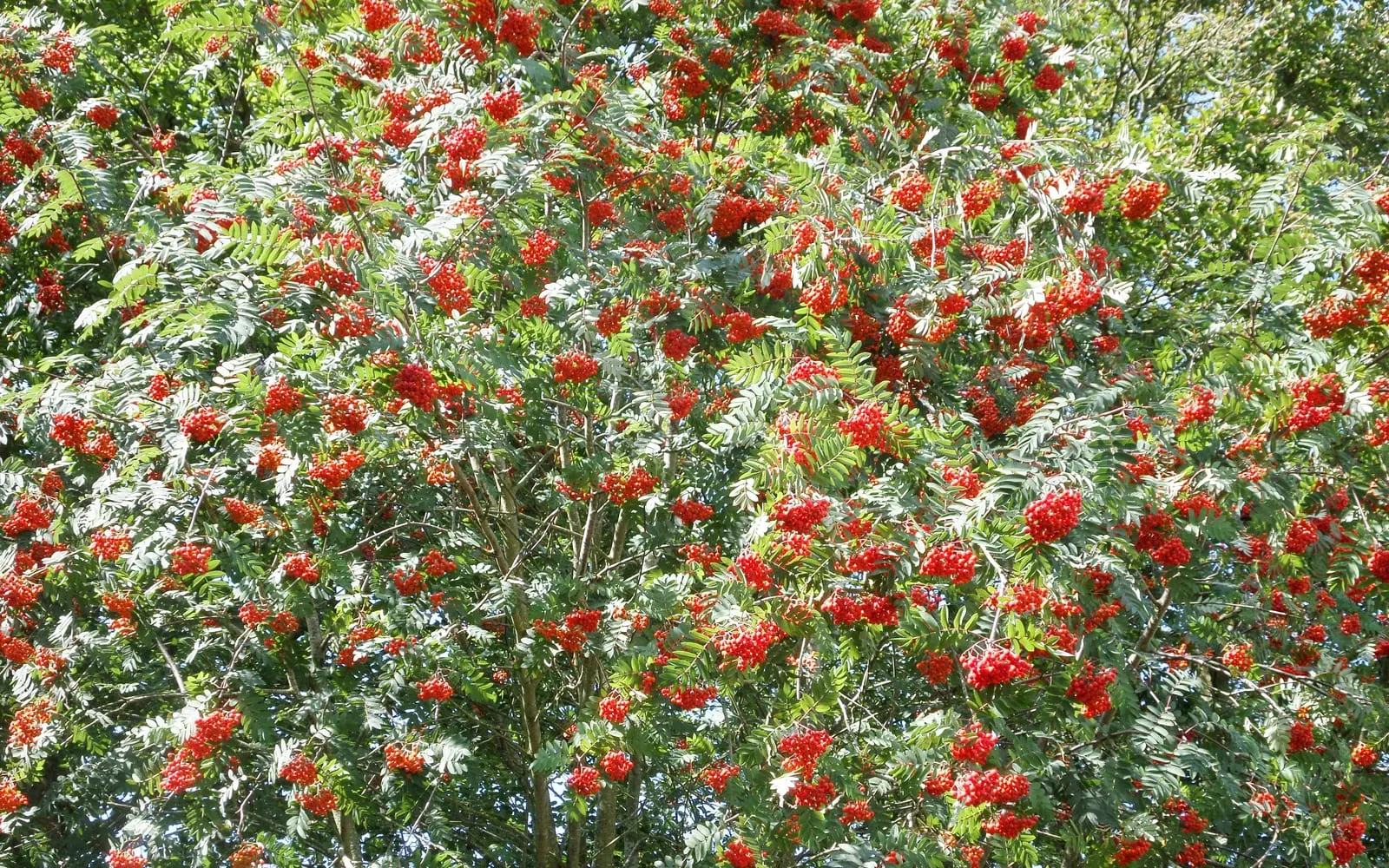
The berries are the main event. They ripen scarlet from August and birds strip them, with blackbirds, mistle thrushes, redwings and fieldfares all feeding heavily. A rowan in a garden is one of the most reliable ways to bring birds in.
It is not an ash, despite the name. The leaves look similar because both are pinnate, and the two trees are unrelated. Ash has black buds in opposite pairs and rowan has purple hairy buds arranged alternately.
Appearance and character
A small deciduous tree reaching 8 to 15 m, upright when young and spreading into a light open crown with age.
Leaves are pinnate, made of five to eight pairs of narrow toothed leaflets plus one at the tip, 10 to 25 cm long overall. They are arranged alternately along the twig rather than in opposite pairs, which separates rowan from ash.
Flowers open in May in dense flat creamy-white clusters 8 to 15 cm across. The scent is strong and not universally liked, and it draws large numbers of insects.
Berries ripen from August, scarlet to orange-red, about 8 mm across, held in heavy drooping bunches. Yellow-fruited and pink-fruited cultivars are widely sold.
Autumn colour is good, turning through yellow to orange and red, and the leaves fall early.
Bark is smooth, shiny and silvery-grey, developing shallow fissures with age.
Buds in winter are purple-brown and covered in fine grey hairs.
Where it is from
Native across Europe from Iceland and Arctic Norway to the mountains of Spain and Morocco, and eastwards through Turkey and the Caucasus into Siberia. Britain and Ireland hold it throughout, including the far north.
It grows in upland woodland, on mountainsides, on crags, in hedgerows and on rocky ground. Few trees go higher or further north. It reaches over 900 m in the Scottish Highlands, climbs past 2000 m in the Alps, and forms part of the treeline scrub in Scandinavia.
Planted widely outside that range as an ornamental, where it is usually sold as European mountain ash. It has naturalised across much of northern North America and is treated as an invasive species in Alaska and parts of the Pacific Northwest, because birds spread the seed into native forest. Check local guidance before planting one in those regions.
It seeds itself readily, often germinating in the forks of other trees and on walls where birds have left the seed, and it tolerates acid peat, thin soil and exposure.
Its folklore is extensive and follows the tree across its range. In Norse myth a rowan bends over a river to save Thor from drowning, and the tree keeps that protective role southwards. Rowans were planted beside doors and gates across Britain and Ireland to guard against witchcraft, and many old Scottish crofts still have one at the gable. Cutting one down was considered unlucky.
The species name aucuparia comes from the Latin for bird-catching, since the berries were used to bait traps.
How it grows
Plant between November and March, bare-root or container-grown, in sun or partial shade.
It grows on almost any soil and prefers acid to neutral ground. It is the one common native tree that is unhappy on thin shallow chalk, where it becomes yellow and short-lived.
Stake a young tree for two years and water through the first two summers.
Prune very little, and in late summer or autumn rather than in spring, since rowan is prone to silver leaf and to bleeding from winter cuts.
Remove dead, damaged or crossing branches and lift the crown over a path. Otherwise leave the natural shape alone.
It is naturally single-stemmed and needs no formative work beyond keeping one leader.
Rowan is short lived by tree standards, commonly 80 to 120 years, which is worth knowing when planting for the long term.
Propagate from seed collected in autumn, cleaned of pulp and sown outside over winter, or transplant a self-sown seedling.
Consider a named cultivar for a small garden. ‘Sheerwater Seedling’ is narrowly upright, ‘Joseph Rock’ has yellow berries the birds leave until last, and Sorbus vilmorinii is smaller still with pink fruit.
Through the seasons
Winter shows the smooth silvery bark and purple hairy buds. This is planting season for bare-root stock.
Spring breaks bud early and the creamy flower clusters open in May.
Summer ripens the fruit, which begins to colour from late July.
Autumn is the peak. Scarlet berries from August, taken by thrushes through September and October, with yellow and orange leaf colour behind them.
Care difficulty
Easy, and one of the most forgiving trees available for a cold or exposed garden.
It is extremely hardy, tolerates exposure, wind, cold, poor acid soil and urban conditions, and needs no routine care.
The only soil it dislikes is shallow chalk, where it is a poor choice.
Fireblight is the main disease risk and is uncommon in most gardens. Its short lifespan is a limitation rather than a difficulty.
Watering
Water through the first two summers after planting.
An established rowan needs no watering where summers are cool and rainfall is spread through the year. In a hot dry summer it will need it, and a rowan grown at the warm edge of its range is short of water more often than it is short of anything else.
It tolerates dry conditions well once its roots are down and dislikes waterlogged ground.
Warning signs, diseases and pests
Fireblight is the serious disease, caused by Erwinia amylovora. Shoots die from the tip backwards, leaving blackened leaves that hang on as though scorched, often with a shepherd’s crook bend at the tip. Cut affected branches out at least 60 cm into healthy wood, disinfect tools between cuts, and burn the prunings.
Rowan sawfly larvae strip leaves in early summer, sometimes defoliating whole branches. The tree refoliates and no treatment is needed.
Silver leaf gives the foliage a silvery sheen and stains the wood dark inside. It enters through pruning wounds, which is why rowan should be pruned in late summer rather than winter.
Honey fungus attacks rowan and is fatal, showing as white fungal sheets under the bark at the base.
Yellowing between the veins on chalky soil is lime-induced chlorosis. It is a sign the tree is in the wrong place, and sequestered iron helps only temporarily.
Berries vanishing within a fortnight is the tree doing its job.
Dieback in an old tree is often age. Rowan does not live as long as oak or lime.
Growing environment
Full sun to partial shade. It fruits and colours best in sun and tolerates light shade well.
Most soils, preferring acid to neutral, moist but well-drained ground. Avoid shallow chalk.
Exposure is where it excels. Rowan stands cold, wind, altitude and coastal conditions that defeat almost every other small tree.
Allow 4 to 6 m of space. It is one of the few trees suited to a small garden, a front garden or a narrow side plot.
It is excellent near buildings compared with most trees, since the root system is modest and the crown is light.
Its wildlife value is high. The flowers feed insects in May, the berries feed thrushes and winter migrants from August, and the tree supports a good range of moth caterpillars.
Underplant it freely. The light canopy lets bulbs, hardy geraniums and woodland plants grow beneath it.
Feeding
None needed on ordinary soil.
Mulch a young tree with compost for its first two or three springs, keeping the mulch off the trunk.
Avoid nitrogen-rich feeds, which encourage soft growth that fireblight finds easier to enter.
Yellowing leaves on chalk are a pH problem rather than a feeding one, and the real answer is to plant something else there.
Troubleshooting
Is rowan the same as ash? No. They are unrelated and the leaves look similar because both are pinnate. Ash has matt black buds in opposite pairs, rowan has purple hairy buds arranged alternately, and rowan is a much smaller tree.
Can I eat the berries? Cooked, yes. Rowan jelly is a traditional preserve for lamb and game. Raw berries contain parasorbic acid and cause stomach upset, and cooking converts it to harmless sorbic acid. Sieve out the seeds.
The birds ate all the berries in a week. That is the tree working as intended. Choose a yellow-berried cultivar such as ‘Joseph Rock’ if you want them to last longer, since birds take those last.
The leaves are yellow between the veins. Lime-induced chlorosis on chalky soil. Rowan dislikes shallow chalk, and sequestered iron is only a temporary fix.
Blackened shoots that look scorched and stay on the tree. Fireblight. Cut back at least 60 cm into healthy wood, disinfect tools between cuts, and burn the prunings.
Something stripped the leaves in June. Rowan sawfly larvae. The tree refoliates and needs no treatment.
When should I prune it? Late summer or autumn, and as little as possible. Winter pruning risks silver leaf entering the wounds.
Is it big enough to matter for wildlife? Yes. Across northern Europe it is among the best small trees for birds and insects, and it fits where an oak never would. In regions where it has naturalised, that same appeal to birds is what makes it a weed.