
Edible
Breadfruit
Artocarpus altilis
Also known as Ulu, Uru, Sukun, Fruta de pan
How to grow breadfruit, Artocarpus altilis. The starch that caused a mutiny on the Bounty, why it must be cooked, and the seedless cultivars that have to be propagated by root cutting.
At a glance
- Difficulty
- Difficult
- Water
- Twice a week in growth, less in winter
- Light
- Full sun
- Temperature
- Minimum 15 deg C. Damaged below 10 deg C
- Humidity
- High
- Hardiness
- USDA 10-12, RHS H1b, hardy to 12 C
- Type
- Tender evergreen tree
- Height
- 15-25 m in the open, 2 m in a pot
- Native to
- New Guinea, the Pacific islands
- Best month
- June and July in the Northern Hemisphere, December and January in the Southern Hemisphere
Wet lowland tropics across the Pacific. It wants steady warmth, deep soil and shelter, since the wood is brittle and the crown catches wind. No frost.
Hardiness zones describe winter cold alone. Summer heat, humidity, rainfall and the length of the growing season decide as much, so treat the range as the outer limit rather than as a recommendation.
Every month named in this guide is for the temperate Northern Hemisphere. If you garden in the Southern Hemisphere, shift each one by six months, so June becomes December. Closer to the equator the wet and dry seasons matter more than the calendar, and the shift stops being a useful guide.
Skin irritant
- Safe to eat
- The fruit cooked, and the seeds of seeded types when boiled or roasted
- Do not eat
- The white latex, and the raw fruit, which is indigestible
- Harm from
- Eating it and handling it
- Affects
- People
Breadfruit is not toxic and nothing in it is listed as harmful to cats or dogs. It is a starch rather than a fruit in use, and raw breadfruit is indigestible in the same way a raw potato is; it has to be roasted, boiled, fried or steamed. The white latex from cut fruit and from the tree is sticky and mildly irritant, and cutting a fruit under water or with an oiled knife is standard practice in the Pacific. Seeded types have edible seeds when boiled or roasted, and the seedless cultivars that dominate Pacific cultivation carry none. As with jackfruit, people sensitive to latex may react to the fruit.
Sources: ASPCA toxic and non-toxic plants, RHS potentially harmful garden plants
About
Breadfruit is a starch staple that Europe met as a cargo. The mutiny on the Bounty in 1789 happened on a voyage to carry breadfruit seedlings from Tahiti to the West Indies, where planters wanted a cheap food for enslaved people, and Bligh completed the delivery on a second attempt four years later.
The fruit is cooked rather than eaten raw. Roasted whole in a fire, boiled, or sliced and fried, it behaves like a potato or a dense bread, which is where the name comes from.
Most cultivated breadfruit is seedless, which makes propagation a matter of root cuttings and suckers rather than seed, and it is why a temperate grower will struggle to find a plant at all.
Appearance and character
An upright evergreen tree with a broad spreading crown, 15 to 25 m in the open.
All parts bleed a sticky white latex when cut.
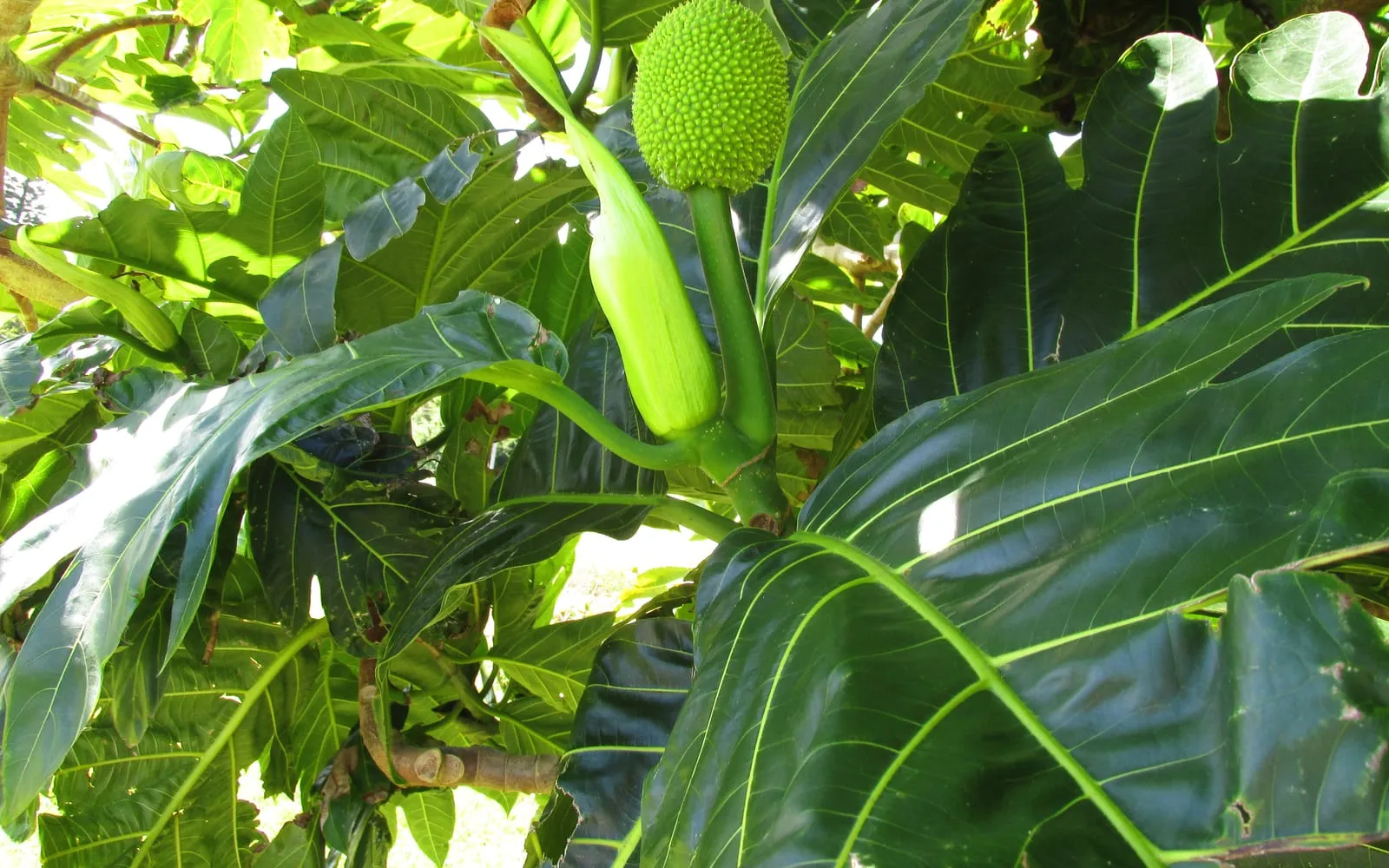
Leaves are the tree’s signature. Very large, 30 to 90 cm, deeply cut into seven to eleven pointed lobes, thick, glossy dark green above and rough beneath, and they are among the most striking leaves of any cultivated tree.
Flowers come in dense heads. Male heads are long, drooping and club-shaped; female heads are rounded and become the fruit.
Fruit is round to oval, 10 to 30 cm, 1 to 4 kg, with a green to yellow-brown rind patterned in fine polygonal segments and a texture between pebbled and warty.
Flesh is creamy white to pale yellow, firm and starchy when mature, becoming sweeter and softer if allowed to over-ripen.
Seedless cultivars have no seeds at all. Seeded types, called breadnut in some places, carry large chestnut-like seeds that are boiled or roasted.
Where it is from
Breadfruit was domesticated in New Guinea and the Melanesian islands from the wild breadnut, and Austronesian voyagers carried it east across the Pacific over thousands of years.
Selection during those voyages produced the seedless cultivars, since a plant propagated from root cuttings needs no seed, and hundreds of named varieties exist across Polynesia and Micronesia.
Hawaii knows it as ulu, Tahiti as uru, and it is central to Pacific food culture and to the traditions attached to it.
Europe met it through Cook’s voyages, and Joseph Banks promoted the idea of moving it to the Caribbean as cheap food for enslaved plantation workers. That project produced the Bounty voyage, the mutiny of 1789, and Bligh’s successful second attempt in 1793.
The tree took hold in the Caribbean, though the enslaved people it was intended for largely refused to eat it at first, and it became a staple only later.
It is grown across the humid tropics now, and it is promoted as a climate- resilient staple crop by several Pacific and Caribbean agencies.
How it grows
Obtain a plant rather than seed if you want a proper cultivar, since the good ones are seedless and cannot be raised from seed.
Propagate from root cuttings or suckers, which is how it is done throughout the Pacific. A section of surface root laid in damp compost under warmth will shoot.
Sow seed only for seeded types. It germinates quickly at 25 to 30 deg C and dies within days of drying.
Grow in deep free-draining compost. Breadfruit tolerates sand and coral soils and will not tolerate waterlogging.
Give full sun when mature and light shade when young, because the huge soft leaves scorch under glass.
Keep the temperature above 15 deg C and the humidity high.
Water twice a week in growth and less in winter.
Feed monthly from April to September with a feed containing magnesium and potassium.
Expect fruit in three to six years in the tropics, and expect a temperate plant to be a foliage subject.
Through the seasons
Winter is the difficult season. Hold above 15 deg C with high humidity, water lightly and feed nothing.
Spring brings a growth flush as light returns. Start feeding.
Early summer is the main growing period.
Midsummer is peak growth, and the huge leaves expand fast.
Late summer is a second flush in a warm house.
Autumn is when to stop feeding and hold the plant warm as light falls.
Care difficulty
Difficult, and harder than jackfruit in two ways.
Propagation is the first. The good cultivars are seedless and have to be raised from root cuttings, so obtaining a plant outside the tropics is the first obstacle.
Cold sensitivity is the second. Minimum 15 deg C with damage below 10 deg C, which is warmer than jackfruit needs.
High humidity is required, and dry heated air scorches the enormous leaves.
Size is a practical problem. Leaves up to 90 cm across need room and are easily damaged by draughts and handling.
Waterlogging kills it.
As a foliage plant in a large heated house it is one of the most dramatic things that can be grown, and that is the realistic ambition.
Watering
Water twice a week through the growing season, keeping the compost evenly damp.
Drain fully. Breadfruit will not tolerate waterlogging.
Reduce in winter without letting the compost dry out.
Keep humidity high with misting, damp gravel and grouping.
Use rainwater where the supply is very hard.
Use a deep pot.
Water more in hot weather, since the leaf area transpires heavily.
Warning signs, diseases and pests
Scorched brown patches on young leaves mean direct glass sun on a plant that wants shade.
Brown leaf edges mean dry air.
Leaf drop after a cold night is chill damage below 10 deg C.
Wilting in damp compost is root rot from waterlogging.
Brown limpets on the stems are scale.
White fluff in the leaf axils is mealybug.
Fine webbing on the leaves is spider mite.
Yellowing between the veins is magnesium or potassium shortage, which this species shows readily in a pot.
Sticky white latex from any cut is normal.
Growing environment
A large heated greenhouse. There is no outdoor option outside the tropics.
Minimum 15 deg C, with 25 to 32 deg C for growth.
Full sun when mature, light shade when young.
High humidity year round.
Deep free-draining compost, tolerant of sand.
pH from 6.0 to 7.5.
Room for very large leaves and shelter from draughts, which tear them.
A deep pot with excellent drainage.
Feeding
Feed monthly from April to September with a balanced liquid feed.
Choose one containing magnesium and potassium, which breadfruit runs short of in a pot.
Stop feeding at the end of September.
Give nothing through winter.
Top-dress or repot each spring, taking care with the roots.
Correct yellowing between the veins promptly.
Keep feeding generous, since the leaf area is enormous.
Troubleshooting
What was the Bounty carrying? Breadfruit seedlings from Tahiti, bound for the West Indies as a cheap food for enslaved plantation workers. The mutiny in 1789 ended that voyage, and Bligh completed the delivery on a second attempt in 1793.
Can I eat it raw? No. Raw breadfruit is indigestible, much like a raw potato. Roast it whole, boil it, steam it or slice and fry it.
Where do I get a plant? With difficulty. The good cultivars are seedless and have to be propagated from root cuttings or suckers, so seed is not an option for them.
How do I propagate one? Lay a section of surface root in damp compost under warmth and it will shoot. This is how it is done throughout the Pacific.
What is breadnut? The seeded form, closer to the wild ancestor, whose large chestnut-like seeds are boiled or roasted and eaten.
The young leaves scorched under glass. Breadfruit leaves are large and soft and burn in direct sun through glass. Shade young plants.
Why is it colder-sensitive than jackfruit? Different origins. Jackfruit comes from the Indian Western Ghats and breadfruit from equatorial Oceania, so breadfruit needs 15 deg C where jackfruit manages at 10.
Will it fruit outside the tropics? Not realistically. Fruiting takes three to six years and a tropical climate, and the leaf size alone makes a fruiting specimen impractical here.
Breadfruit problem guides
Not sure what is wrong? See the common vegetable pests guide.