
Edible
Banana
Musa acuminata
Also known as Dessert banana, Cavendish, Pisang
How to grow banana, Musa acuminata. The giant herb that is not a tree, why every Cavendish is the same plant, Panama disease, and which bananas survive a cool winter.
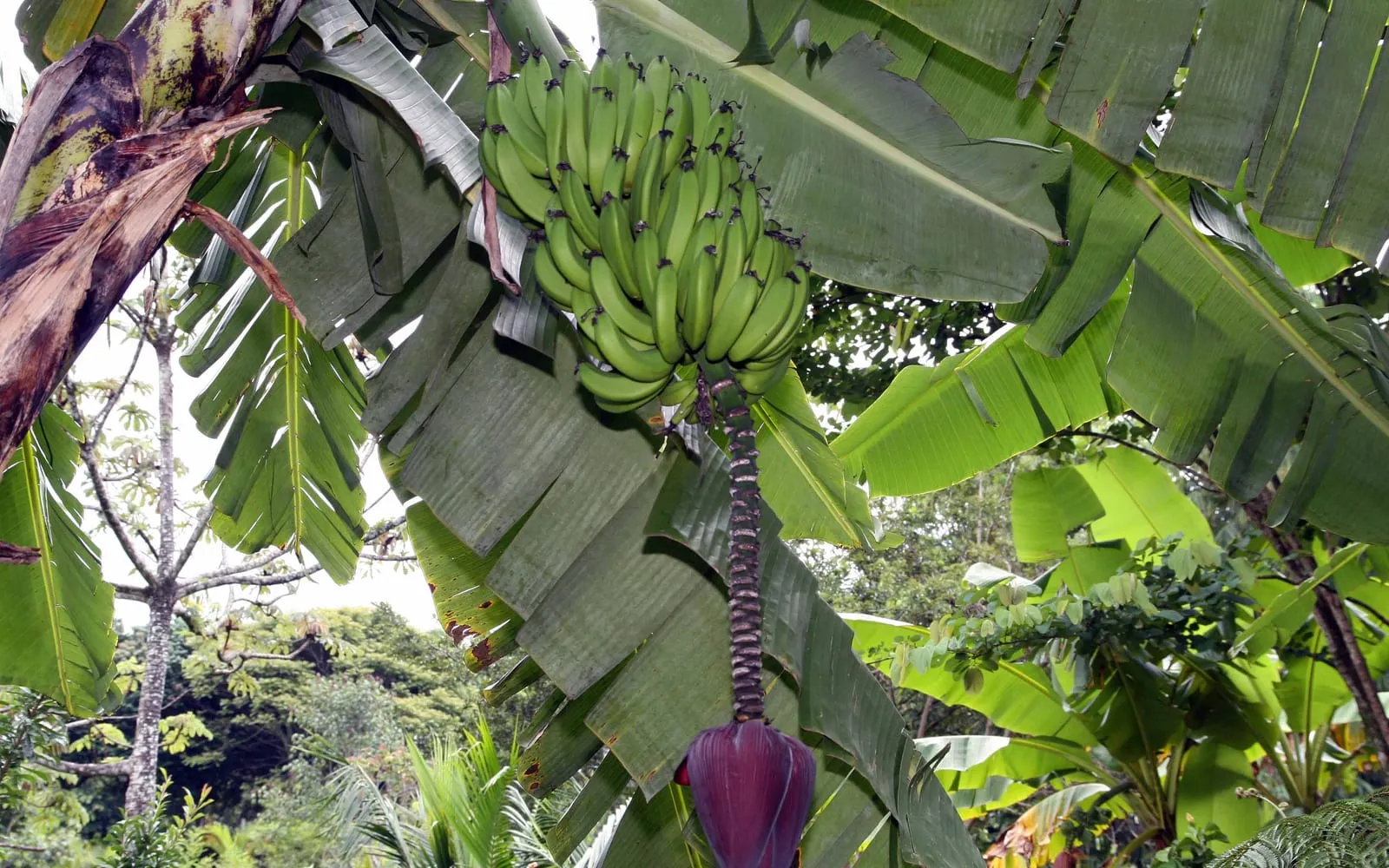
At a glance
- Difficulty
- Moderate
- Water
- Every day or two in summer, which is more than almost anything else here
- Light
- Full sun, with shelter
- Temperature
- Growth stops below 15 deg C. Leaves are killed by frost, corms of hardy types survive
- Humidity
- High
- Hardiness
- USDA 9-11, RHS H1c, hardy to 0 C
- Type
- Tender evergreen perennial, each pseudostem monocarpic
- Height
- 2-8 m depending on cultivar, 2-3 m for the dwarf types
- Native to
- South East Asia, New Guinea
- Best month
- May, June and July in the Northern Hemisphere, November, December and January in the Southern Hemisphere
Wet tropics, and the limit is the season length rather than the winter. Leaves burn at 0 deg C and the pseudostem dies at about -2, but the plant reshoots from the corm, which is why it survives USDA 9 and fruits only where 10 to 15 frost-free months run end to end. A cut-back plant restarts its count.
Hardiness zones describe winter cold alone. Summer heat, humidity, rainfall and the length of the growing season decide as much, so treat the range as the outer limit rather than as a recommendation.
Every month named in this guide is for the temperate Northern Hemisphere. If you garden in the Southern Hemisphere, shift each one by six months, so May becomes November. Closer to the equator the wet and dry seasons matter more than the calendar, and the shift stops being a useful guide.
Not known to be toxic
- Safe to eat
- The ripe fruit, and the male flower bud and inner pseudostem as vegetables
Banana is not toxic. The ASPCA lists Musa as non-toxic to cats, dogs and horses, and every part a person is likely to encounter is either edible or harmless. The fruit, the male flower bud and the tender core of the pseudostem are all eaten across South and South East Asia, and the leaves are used as plates and wrappers. Two practical cautions rather than toxicological ones. Unripe banana is heavily starchy and hard to digest in quantity, and the sap from cut stems and green fruit stains cloth a rusty brown that does not wash out.
Sources: ASPCA toxic and non-toxic plants, RHS potentially harmful garden plants
About
A banana plant is a herb, and the tallest one on earth. What looks like a trunk is a pseudostem, a tight roll of leaf bases with no wood in it at all, rising from an underground corm. Push one over and it collapses like wet cardboard.
Each pseudostem flowers once, carries one bunch, and dies. The corm below sends up suckers to replace it, so a clump goes on indefinitely while no individual stem does.
The banana in a supermarket has no seeds because it has no sex life. A Cavendish is a sterile triploid propagated only by division, which makes every Cavendish on the planet a cutting from the same plant. That is convenient for shippers and dangerous for growers, since a disease that beats one beats all of them.
Appearance and character
A pseudostem, green to purple-flushed, 2 to 8 m tall, made of the overlapping sheathing bases of the leaves.
Leaves are enormous, up to 2.7 m long and 60 cm across, spirally arranged, and they emerge rolled like a cigar and unfurl over a few days.
Wind tears them into strips along the veins, which is normal and does no real harm. Leaves are built to shred rather than to snap the stem.
The flower spike pushes out of the top of the pseudostem and bends downwards under its own weight. Female flowers come first in tiers, each tier becoming a hand of bananas, and the purple bud at the end goes on producing male flowers.
Fruit fingers curve upwards towards the light, which is why a bunch of bananas has the shape it does.
Ripening is a colour sequence. Green to yellow to freckled brown, with the starch converting to sugar as it goes, and it happens off the plant readily because bananas produce a great deal of ethylene.
The corm below ground is the perennial part, and suckers rise from it around the parent.
Where it is from
The eating banana descends from Musa acuminata, native to the Malay peninsula and the islands of South East Asia, with a contribution from Musa balbisiana across much of the range.
Domestication began in New Guinea, where archaeological work at Kuk Swamp puts banana cultivation at around 7,000 years ago, making it one of the oldest crops in the world.
Wild bananas are full of hard black seeds and barely worth eating. The edible kinds arose as sterile triploids that set fruit without pollination, and every one has been carried by hand ever since.
Austronesian voyagers took them across the Indian Ocean to Africa, and the Portuguese and Spanish carried them to the Atlantic islands and then the Americas.
The trade cultivar was Gros Michel until the mid twentieth century, when Fusarium wilt, called Panama disease, wiped it out commercially. Cavendish replaced it because it resisted that strain. A new strain, Tropical Race 4, now attacks Cavendish and is spreading, and the industry is looking for a third banana.
India and China grow the most, mostly for themselves. Ecuador, the Philippines and Central America dominate the export trade.
How it grows
Buy a plant or a sucker rather than starting from seed. Edible bananas have no viable seed, and seed-grown ornamental species give a different plant.
Plant into a large pot of rich, moisture-retentive but free-draining compost. Bananas are gross feeders and gross drinkers.
Give it the warmest brightest place available, at a minimum of 15 deg C for growth.
Water heavily through summer. A banana in full growth in warm weather uses more water than anything else in this collection.
Feed weekly with a high-potash feed from May to September.
Shelter it from wind, which will not kill it but reduces it to ribbons.
Remove suckers to one or two if you want a big pseudostem, or let a clump form if you want a mass of foliage.
Overwinter under glass at 10 deg C or more, kept much drier. Growth stops and that is expected.
Choose Musa basjoo if you want one outdoors. The Japanese fibre banana is root hardy through USDA 7 with a thick mulch over the crown, and though the top growth dies at the first frost it comes again. It does not give edible fruit.
Expect no fruit indoors from a full-sized cultivar. Dwarf Cavendish in a heated conservatory will crop given eighteen months of warmth and a great deal of feed.
Through the seasons
Winter is dormancy under glass. Hold it above 10 deg C, water lightly, and feed nothing. Outdoor basjoo is cut down by frost and mulched deeply over the crown.
Spring is when growth restarts. Repot, remove excess suckers, and begin feeding as the first new leaf unrolls.
Early summer is fast growth. A leaf every seven to ten days is normal in warm weather.
Midsummer is peak growth, peak water and weekly feed.
Late summer brings the flower spike on a plant that has made enough leaves, usually thirty or more.
Autumn is when to cut feeding, reduce water, and bring an outdoor pot under cover before the first frost.
Care difficulty
Moderate, and the demands are heat, water and food rather than finesse.
Water is the first. A banana in growth needs watering every day or two and will wilt dramatically if it misses.
Feeding is the second. Weekly high-potash feed through the season is the minimum, and an underfed banana makes small pale leaves and never flowers.
Heat is the third. Growth stops below 15 deg C, and fruit needs a long warm run that a cool climate gives only under glass.
Space defeats most people. Even a dwarf Cavendish needs a metre and a half of head room and a pot to match.
Musa basjoo outdoors is easy, hardy to about minus 10 deg C at the root with a deep mulch, and gives the tropical look without the fruit.
Fruit indoors is possible with a dwarf cultivar, a heated conservatory and eighteen months of patience.
Watering
Water every day or two in summer, keeping the compost consistently damp.
Give plenty each time. In warm weather it is difficult to overwater a growing banana in a free-draining pot.
Mist or group plants to keep humidity up, which reduces spider mite and brown leaf edges.
Cut back sharply in winter. Cold wet compost rots the corm, and that is the usual way an overwintered banana dies.
Water outdoor plants heavily through summer, including in a wet spell, because the leaf area transpires enormously.
Use rainwater if the tap water is very hard.
Never let a pot stand in water through the cold months.
Warning signs, diseases and pests
Shredded leaves are wind and are normal. Leave them.
Brown crisp leaf edges mean dry air, dry compost, or both.
Yellowing lower leaves with the plant otherwise growing is normal ageing. Cut them off at the pseudostem.
Yellowing across the whole plant with stunted new growth is hunger. Feed weekly.
Fine stippling and webbing under the leaves is spider mite in dry heated air.
Blackened water-soaked leaves after a cold night are frost damage. Outdoor basjoo recovers from the corm.
A soft collapsing pseudostem in winter, smelling sour, is corm rot from cold wet compost.
Yellowing of the older leaves progressing up the plant, with the pseudostem splitting at the base, is Fusarium wilt. There is no cure, and infected soil stays infected for decades.
A pseudostem dying after fruiting is the life cycle rather than a fault.
Coconut rhinoceros beetle also attacks banana where it occurs, boring into the crown and pseudostem. Native to Africa and tropical Asia, it has spread through much of the Pacific, reaching Guam in 2007 and Hawaii in 2013, and continues gaining ground; clearing rotting plant debris nearby, where it breeds, is the main defence.
Black Sigatoka is the most damaging leaf disease the crop faces anywhere it is grown commercially, causing dark streaks that coalesce into dead patches and can destroy most of a leaf’s working surface within weeks in warm humid weather, cutting the leaf area a plant has left to fill its bunch. It is endemic across nearly all major banana-growing regions in Africa, Asia, the Pacific and Latin America, and there is no cure once a plant is infected. Remove infected leaves promptly and space plants for airflow, since commercial growers rely on frequent fungicide spraying that few smallholders can sustain.
Growing environment
A heated greenhouse or conservatory for fruiting cultivars. A sheltered garden for Musa basjoo.
Minimum 10 deg C to survive, 15 deg C to grow, and 25 to 30 deg C to fruit.
Full sun, with shelter from wind.
High humidity, which improves leaf quality under glass.
Deep rich compost with plenty of organic matter and good drainage, in the largest pot you can manage.
pH from 5.5 to 7.0.
Head room. This is the constraint most growers underestimate.
A deep dry winter mulch over the crown for anything grown outdoors.
Feeding
Feed weekly from May to September. Bananas are among the hungriest plants in cultivation.
Use a high-nitrogen feed early in the season to build leaf, then a high-potash feed such as tomato food from midsummer.
Top-dress a large pot with rich compost in spring rather than repotting a monster.
Stop feeding at the end of September.
Give nothing through winter.
Add magnesium if older leaves yellow between the veins while the plant is otherwise growing.
Mulch outdoor plants heavily with manure or garden compost each spring.
Troubleshooting
Is a banana a tree? No. The trunk is a pseudostem of rolled leaf sheaths with no wood in it. Botanically the plant is a herb, and the largest one there is.
My leaves are torn to ribbons. Wind. It looks alarming and harms the plant very little, since banana leaves are built to tear along the veins rather than snap the stem.
Which banana survives a frost? Musa basjoo, the Japanese fibre banana. The top growth dies at the first frost and the corm survives to about minus 10 deg C under a deep dry mulch. It does not give edible fruit.
Why do supermarket bananas have no seeds? Cavendish is a sterile triploid that sets fruit without pollination and is propagated only by division. Every Cavendish is a piece of the same original plant.
What is Panama disease? A soil-borne Fusarium wilt. It destroyed the Gros Michel banana trade in the mid twentieth century, Cavendish replaced Gros Michel because it resisted that strain, and a new strain called Tropical Race 4 is now attacking Cavendish.
The stem died after fruiting. Each pseudostem flowers once and dies. The corm below sends up suckers, which are the next generation.
My plant grows and never flowers. It needs heat, food and around thirty leaves before it will flower. In an unheated greenhouse it will not get there.
The bananas are tiny and full of seeds. You have an ornamental species rather than an edible cultivar. Seed-grown Musa are usually the wild kinds.
Banana problem guides
Not sure what is wrong? See the common vegetable pests guide.
- Spider mite under glass in dry air
- Root rot in cold wet compost over winter
- Panama disease, the soil fungus that destroyed the Gros Michel trade and now threatens Cavendish too
- Coconut rhinoceros beetle, an established and still-spreading Pacific invader
- Black Sigatoka, the most damaging leaf disease of the crop worldwide
- Wind shredding the leaves, which looks alarming and does little harm
- Frost killing the top growth
- Aphids on the emerging leaf spike